Previous posts have discussed Jonathan M. Clark’s enlistment in the U.S. Army’s Fifth Regiment of Infantry, Company K (part 1, part 2, part 3) and his arrival at Fort Howard (Green Bay), in the Michigan (later Wisconsin) Territory (part 1, part 2, part 3) on October 20, 1833. Let’s rejoin the regiment and see what kept Co. K busy during Pvt. Clark’s first full month on duty, November, 1833. Continue reading
Jonathan M Clark
Map of Ouisconsin Territory, 1836
UPDATED, February 11, 2024, to include a revised annotated map. But for the full update—with additional notes and corrections—please see the most recent version of this, posted on February 12, 2024.
In September, 1836, Sgt. Jonathan M. Clark was discharged from the U.S. Army at “Ft. Hamilton,” Wisconsin Territory, after serving his three-year term of service with Co. K, Fifth Regiment of Infantry. One year later, in the autumn of 1837, Jonathan’s future wife Mary Turck would make the long trip from Palmyra, New York, to Milwaukee and finally Mequon, Washington County, Wisconsin, with her parents Peter and Rachael Turck and six younger siblings. By the end of 1840 Jonathan and Mary would be married and starting their family in Mequon.
That seems simple enough, until you take a moment to wonder how much Jonathan—or especially Mary and her family—knew about this new Wisconsin Territory. Jonathan had been in the territory since October, 1833, building portions of the military road along the Fox River waterway from Ft. Howard (Green Bay) towards Ft. Winnebago (near modern Portage). As a road building soldier, Jonathan probably had seen—or helped draw—a variety of maps of the military road and its vicinity. But for a better overview of the larger territory, Jonathan or Mary might have sought out a map such as this:
Continue readingHistory Mystery! No. 1 (of many)
Jonathan & Mary & ? on the 1840 Census
Introducing a new feature on the blog: History Mystery! In which you, the reader, are invited to Help the Historian solve one of the many persistent mysteries surrounding Jonathan M. Clark, his family, and related bits of local history. History Mystery! No. 1 seeks to answer the question: Who was that older guy living with newlyweds Jonathan and Mary Clark in June, 1840? Here are the clues: Continue reading
1840 Election Updates
The previous post on the first election in old Washington County relied heavily on the 1881 History of Washington and Ozaukee Counties. It’s a useful book, and it’s possible that the author(s) or editor(s) that prepared it for publication spent some time with the historical documents that still existed at that time, or at least talked to some of the older settlers who had personal memories of the events. Still, I like to have primary or more contemporary secondary sources whenever available, so I went looking and found a few. In the process, I’ve cleared up some dates and details surrounding the first election and the early organization of the county. Continue reading
Early Election Returns!
Really early returns, from Mequon’s first election in 1840.
In an earlier post, I outlined some of the key moments in the settlement and changing political boundaries of early Washington/Ozaukee county. Originally attached to Milwaukee County for all civil and judicial matters, old Washington County got it’s civil independence by act of the Territorial Legislature on February 19, 1840. And sometime later that year the first election to chose county officers was held at the Mequon home of Taylor Heavilon. Continue reading
Fort Howard, October 1833 (part 2)
If you’re just joining us, I recommend reading the two previous posts in this thread, Pvt. Clark, reporting for duty and Fort Howard, October 1833 (part 1). In this post we’ll take a look at the reverse side of Fort Howard’s “Return of the Fifth Regiment of Infantry” for the month of October, 1833:
Fort Howard, October 1833 (part 1)
Jonathan M. Clark arrived and reported for duty at Fort Howard, the headquarters of the U.S. Army’s Fifth Regiment of Infantry on Sunday, October 20, 1833. He served there until his discharge at the end of service in 1836. What did he do for those three years?
After the national excitement over the brief Blackhawk War in 1832, the northwest frontier was generally calm. The federal government continued to negotiate treaties with the Native Americans, urging them ever westward. Most Indians and white settlers observed the treaty boundaries and there was only the occasional “scare” from the original inhabitants. So what were the soldiers to do?
Let’s take a further look at Ft. Howard’s “Return of the Fifth Regiment of Infantry” for the month of October, 1833 and see what we can find. Here’s the front side: Continue reading
Pvt. Clark, reporting for duty
One of the most useful facts we discovered in looking at Jonathan M. Clark’s entry in the U.S. Army’s Register of Enlistments was that Jonathan was assigned to the Fifth Infantry, Company K. In the 1830s, the Fifth Infantry’s mission was to protect the expanding northwestern frontier.
The regiment’s companies were stationed at Ft. Dearborn (present day Chicago), Ft. Howard (Green Bay) and Ft. Winnebago (at the portage between the Fox and Wisconsin rivers, near the city of Portage). It was the regiment’s job to protect the settlers from the Native Americans (and vice versa), keeping the peace along the boundaries between the two peoples, as established in a series of treaties that, for the most part, continuously pushed the Indians farther and farther westward, toward the Mississippi River and beyond. Continue reading
JMC in the U.S. Army Register
Every effective fighting force must be organized, and the United States Army is no exception. In war or peace, the army has to manage a complex array of soldiers, supplies and facilities. This requires bureaucrats and their paperwork. Once Jonathan M. Clark joined the Army in September, 1833, his federal paper trail began.
To find Jonathan among all the other recruits and their paperwork, and to follow him through his army years, we need some kind of guide or index and thankfully, since 1798 the army has maintained just what we need, its Register of Enlistments. Here’s JMC’s entry in the volume covering enlistments from January 1828 through 1835, organized alphabetically by surname. He’s near the bottom—look for enlistee number 189:
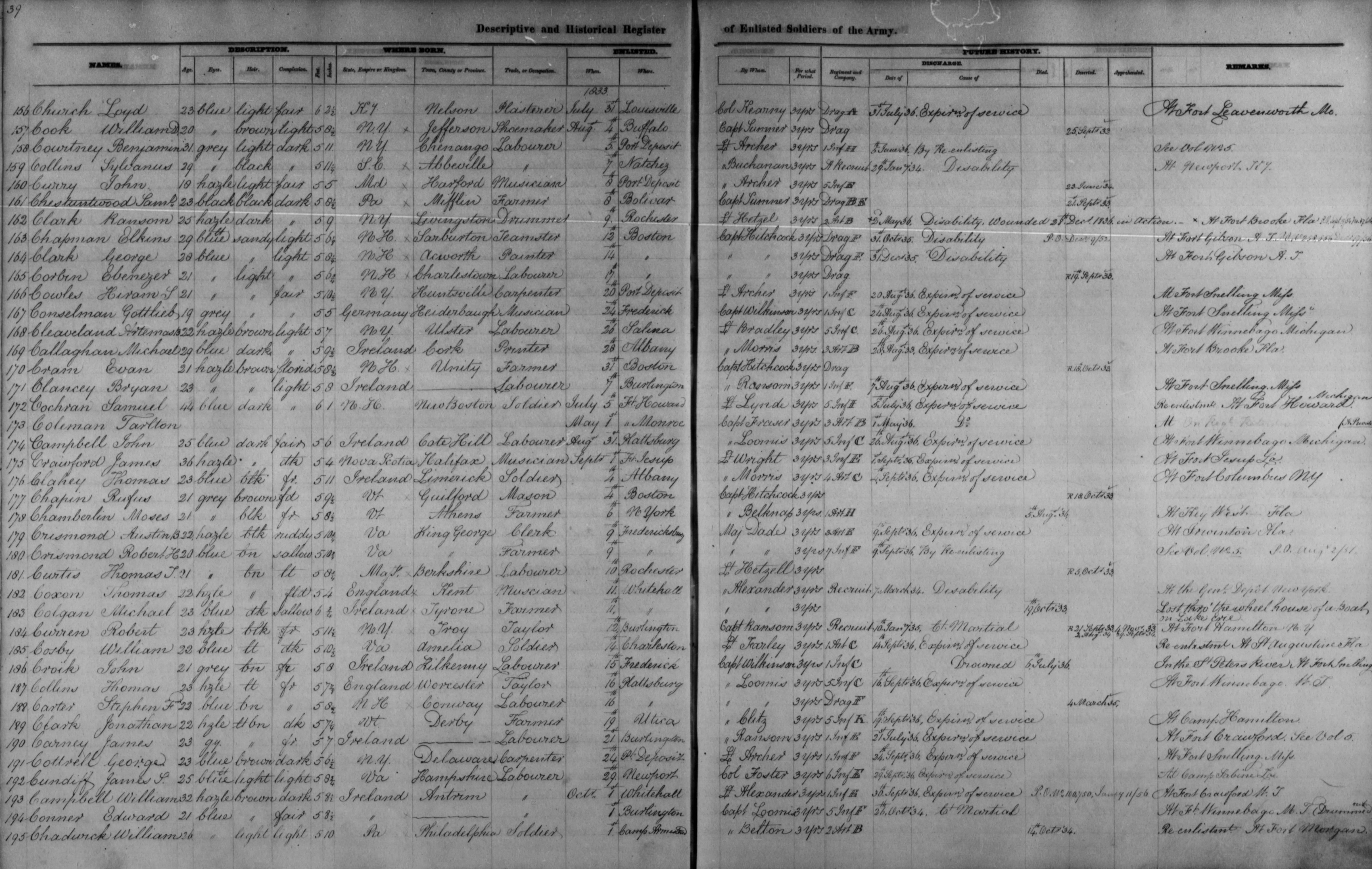
Jonathan M. Clark in NARA M233. Registers of Enlistments in the United States Army, 1798-1914. Roll: MIUSA1798_102878. Accessed online via Fold3.com
Click image to open at full size in a new window.
JMC Joins the Army: A Closer Look
I love primary sources. Not only can you learn interesting information—that may include actual, accurate, facts (with allowances for misspellings and such)—but primary sources often convey a flavor or sense of the moment and suggest additional lines of inquiry. With that in mind, let’s take a closer look at Jonathan M. Clark’s 1833 U. S. Army enlistment paper as featured in our earlier post “Jonathan Joins the Army” and see what we can infer from the information there.
First of all, how do we know this Utica, New York, enlistment belongs to “our” Jonathan M. Clark? Census and other records show that there are plenty of Clarks from New England, born about the same time as our JMC, some of whom served in the army, and some of whom came to the Michigan/Wisconsin Territory in the early 1830s. My research shows there may even have been a second, unrelated, “Jonathan M. Clark” in the Territory at about the same time. So how do we connect our JMC with this 1833 army recruit?
 Clark House Historian