This blog, Clark House Historian, published its first post 10 years ago today! (And just to be clear, the Clark House Historian blog is ten years old today. Reed Perkins, the Jonathan M. Clark House historian and author of the blog is, alas, a good deal older…)
Time to celebrate!
Our first post was a modest, two-paragraph “welcome” post, reproduced—in its entirety—below:
In our previous post I made use of a paragraph from a recently rediscovered 1891 profile of Jonathan and Mary (Turck) Clark’s eldest child, Caroline M. Clark, later Mrs. C. M. Woodward. Caroline was the most publicly active, visible, and well-documented of all of the Clark siblings, and we have published a number of blog posts on her life and career, including this comprehensive piece: Caroline M. (Clark) Woodward: a closer look at that 1893 biography. I recommend reading that post and clicking all the links; they lead you to other, detailed CHH posts about specific moments and events in Caroline’s life.
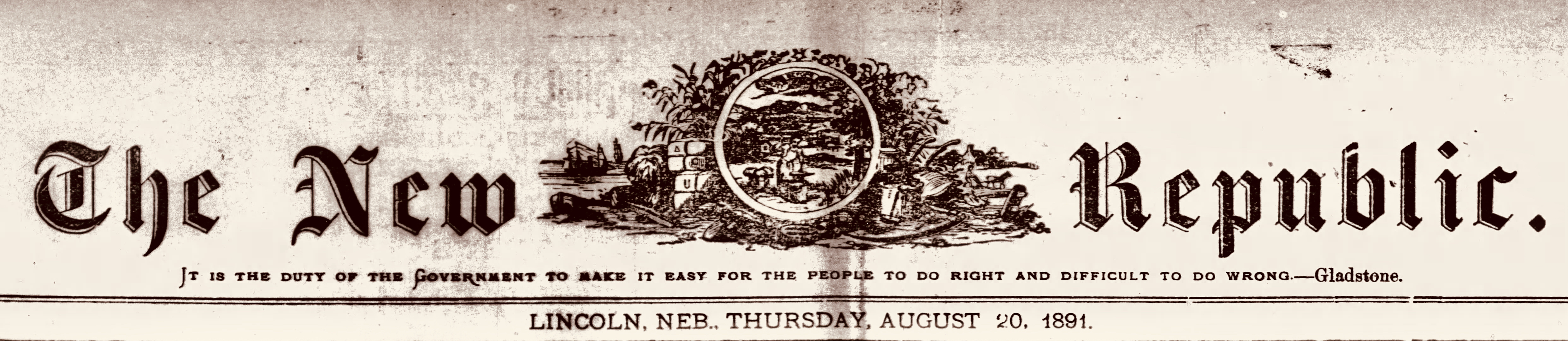
Today I’d like to share with you the complete 1891 profile that I quoted in our March 26, 2026, post. It originally appeared as one long column of text on page 1 of the Lincoln, Nebraska, “New Republic” newspaper, on August 20, 1891. Caroline (1840-1924) was fifty years old when this article appeared, and had another thirty years of active work in the temperance and women’s rights fields ahead of her.
Given the amount of accurate detail in the article, I suspect that the information came directly from Caroline herself. In fact, given how well-written and how accurate the whole profile is, I would not be surprised if Caroline wrote most, or all of it herself. For ease of reading, I have divided the article into several sections, created paragraph headers, and added a few notes on some of the facts mentioned in each section.
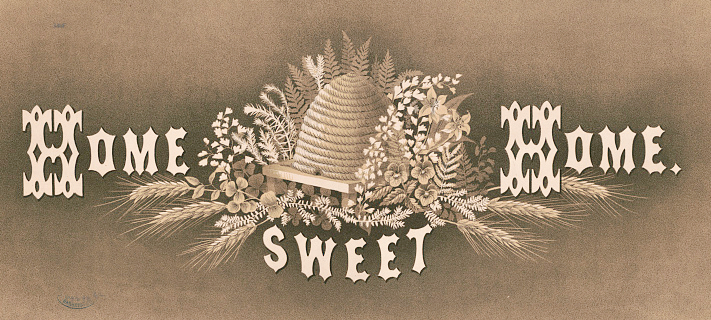
Home Sweet Home., ca. 1876. [New York: publisher not transcribed]. Library of Congress.
One of the first and most important tasks for any settlers arriving in the recently “opened-for-settlement” Wisconsin Territory was to create some sort of dwelling to shelter themselves as they carved out new farmsteads amid the dense hardwood forests. But what sort of quickly-built structures did our immigrants first construct and take shelter in?
Obviously, the big, stone, full-basement, two-story, Greek Revival style Jonathan Clark House, with its “1848” inscription carved over the front door, and its many double-hung sash windows, was not a hastily-made “first shelter” for newlyweds Jonathan and Mary (Turck) Clark. They must have had another, smaller, first home. What was that first home like? Until now we have assumed that the Clarks’ first home was probably a log cabin, and not some kind of “shanty,” but we didn’t really know. In today’s post, we share with you a recently discovered document that—I believe—solves this mystery once and for all…
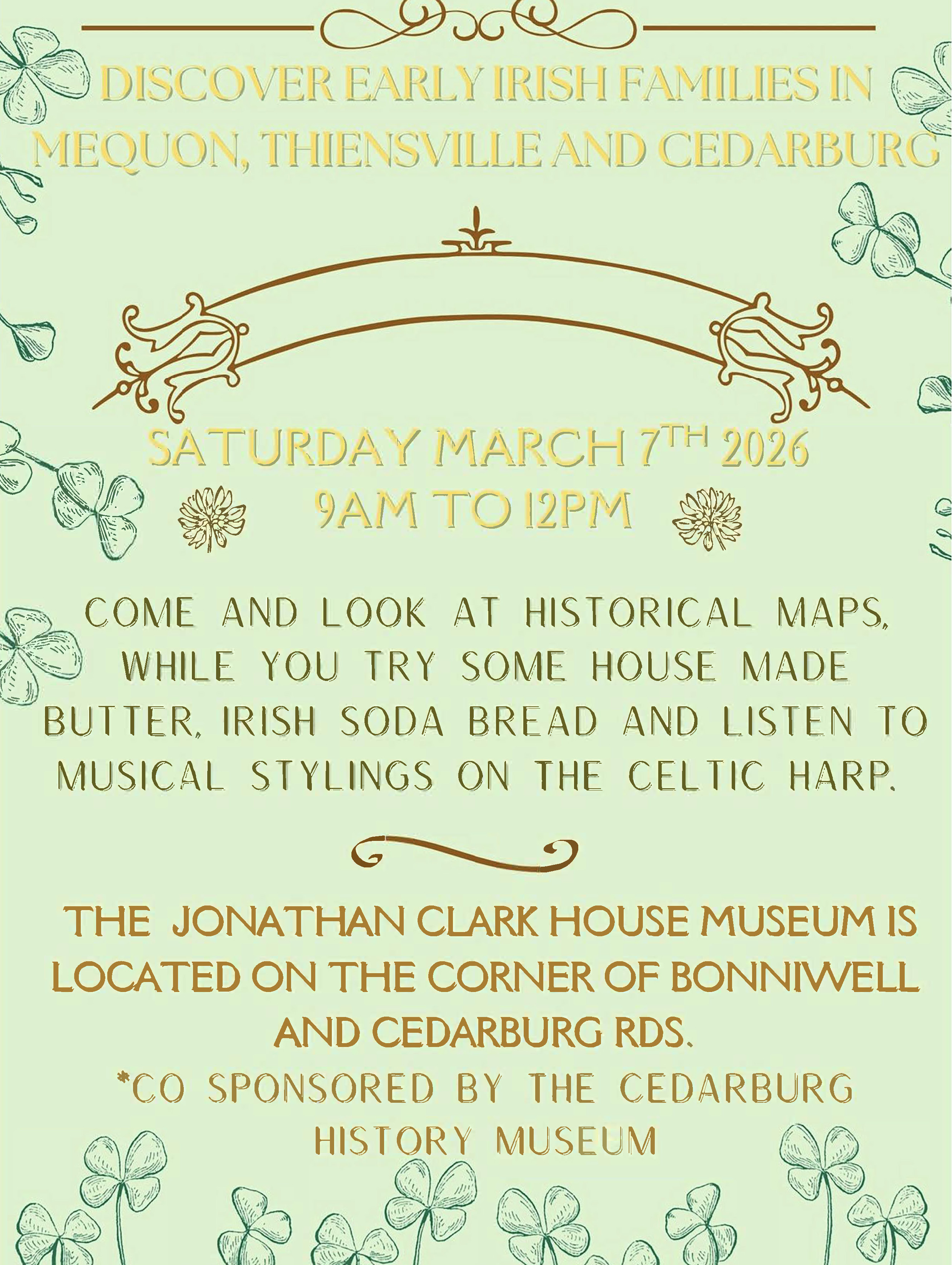
Did you know that in the early days of settlement, much of Cedarburg—and a surprising portion of Mequon—was home to Irish immigrants? Come by the Jonathan Clark House Museum on Saturday and find out if your home had Irish neighbors! Come look at historical maps while you nibble on house made butter and Irish soda bread and enjoy festive music on the Celtic Harp. Event co-sponsored by the Cedarburg History Museum.
The museum is located at the corner of Bonniwell and Cedarburg roads in Mequon, Wisconsin. We look forward to seeing you on Saturday! And as St. Patrick’s Day approaches, you might be interested in catching up on some previous, Irish-themed Clark House Historian posts. Just read on, click all the links, and Erin go Bragh!
We’re coming up on the tenth (!) anniversary of Clark House Historian, and I realize that in those ten years I have not yet written about all of Mary (Turck) Clark’s immediate family. Regular readers will recall that the Vermont and/or Canadian ancestry of Mary’s husband Jonathan M. Clark remains, in spite of our best efforts, mysterious and—so far—mostly unknown. But we actually know a lot about Mary Clark’s people, the Peter Turck family, including her seven siblings. Over the years I’ve blogged a bit about Mary’s oldest sibling, Joseph R. Turck, and her youngest, brother Benjamin Turck. I think it’s about time I started to write about Mary Clark’s other brothers and sisters, beginning with younger sister Elizabeth Turck, later Mrs. Densmore Maxon.
Elizabeth Turck Maxon’s memoir
A memoir from the Turck family, even a short one, would be a substantial addition to what we know about the family and the events of their pioneer lives. In 1907, near the end of her long and productive life, Elizabeth Turck Maxon wrote down some of her recollections of early days in the area, in the form of a letter to the Old Settler’s Club of Washington County, Wisconsin.
When that 1907 letter was new, some—but not all—of its contents were published in various Wisconsin newspapers. In 1912, editor Carl Quickert included his selection of “the most interesting passages” from Elizabeth’s letter on pages 64-65 of his book Washington County Wisconsin Past and Present, Vol 1 (Chicago, S.J. Clarke Publishing Co., 1912).
In all the various 1907 newspaper editions, and in Quickert’s 1912 history, the omitted passages were usually noted with three asterisks, like this * * * This was typical editorial practice for the time. But, of course, those asterisks piqued my interest. What had been cut? What additional things might Elizabeth’s full text tell us about the early days in old Washington/Ozaukee county?
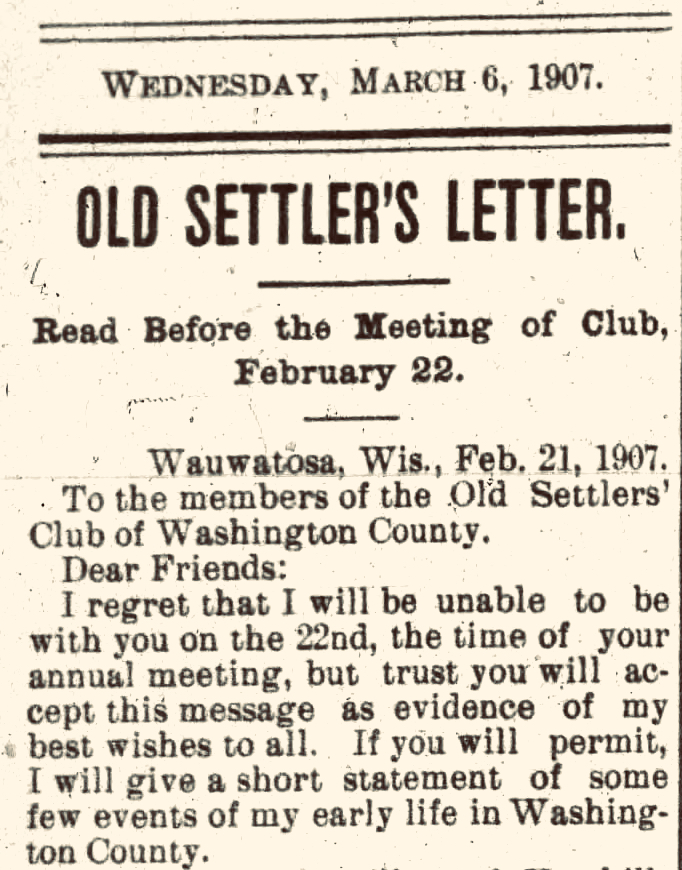
Old Settler’s Letter, 1907
I spent over a decade looking for Elizabeth’s unabridged, original, text and I think I finally found it. It was published on page 4 of the West Bend [WI] News of March 6, 1907. It’s a long letter, a full column of text, beginning with Elizabeth’s salutation to the members of the club, dated February 21, 1907.
The greetings are followed by the main text, beginning with her birth information and the story of the Peter Turck family’s migration from New York state to Wisconsin Territory in 1837. Below is the unabridged text (in the grey text boxes), interspersed with paragraph headers and my comments in plain type. FYI, I have blogged previously about a number of the events and characters in Elizabeth’s letter here on CHH, and have added links to some of those posts. Be sure to click the links for more information, and some interesting illustrations and maps.
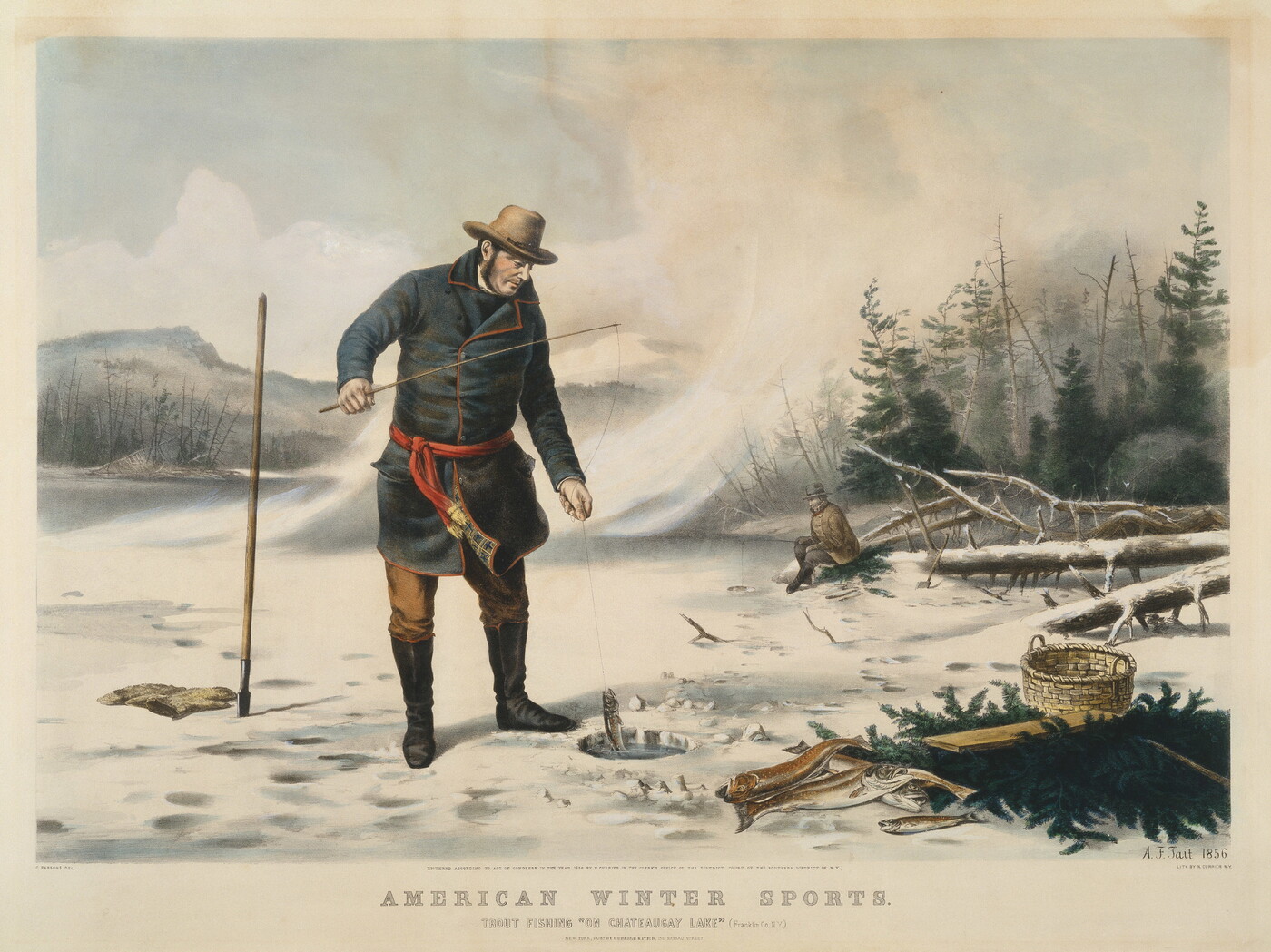
In an earlier post, “Intensely Cold Weather,” we examined the negative effects of several episodes of bitterly cold winter weather during the Clark family’s era and shortly afterwards. Today we look at some of the positive aspects of frigid winters in our part of the Old Northwest.
It’s no secret. Wisconsinites like to do stuff outdoors in the winter cold. Ice fishing. Skating. Cheering for the Packers.
But the Green Bay Packers professional football team wasn’t organized until 1919, a full eighty years after Jonathan M. Clark bought his first parcel of Mequon land in 1839. So what did our intrepid Wisconsin pioneers do back in the mid-1800s when those deep snows fell and cold north winds began to blow? Well, if you believe the newspapers of the era, there was no finer way to occupy a clear, frosty day—or moonlit evening—than to bundle up, go outside, and enjoy a…
We’re having some very cold weather this weekend, not unusual for Wisconsin in mid-winter. But it got me thinking, wondering what sort of winter weather did the Clarks and Turcks and Bonniwells experience, and what effect the did the cold have on their daily lives?
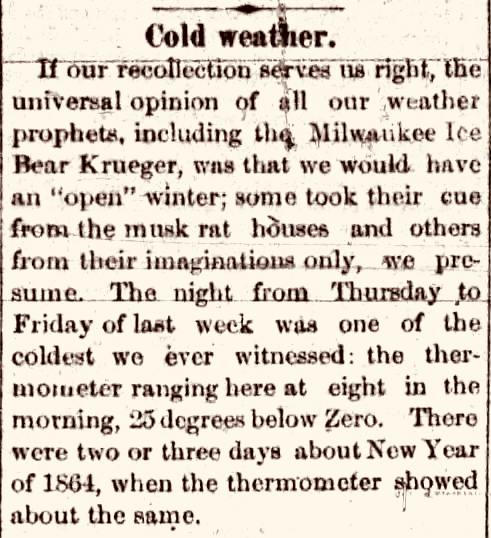
To find out, I started by searching digitized old newspapers, looking for the phrase “below zero,” in Wisconsin, between the years 1833-1899. Oh boy, did I get results! After narrowing my search to more local sources, I found this news item on page 2 of the Wednesday, January 2, 1884 issue of the Cedarburg News:
This article suggests that the winter of 1883-1884 was expected to be somewhat mild; an “open” winter was one with little or no snow cover on the ground. All the signs and predictions thought this would be the case. Apparently, the local muskrats had built their houses differently in 1883, as muskrats do when they expect a milder winter. The “universal opinion” of the “local weather prophets”—including Milwaukee’s famed “Ice Bear,” Henry Kroeger—thought so, too. But on the night of December 28-29, 1883, the thermometers in Cedarburg—just a few miles from the old Jonathan Clark farm—dropped to 25 degrees below zero (Farenheit). It was the coldest morning in decades.
But by the 1880s many of the older members of the Clark, Turck, and Bonniwell families had died, and many of the younger generation had left Ozaukee county and relocated to Milwaukee, Chicago, Minnesota, and elsewhere. Some or most of them may have missed this late-1883 cold snap. But this short article also mentions another, similar record cold spell, one that Mary Turck Clark and her children actually lived through, in Milwaukee, around the New Year of 1864.
What’s the news? I’ve gathered the expert—and stylish—editorial staff of Clark House Historian (see above) and together we proudly present the latest installment of our more-or-less annual Blog Year in Review!
Let’s begin with some blog statistics for 2025:
In some ways, 2025 was not a particularly productive year for CHH. I only managed to publish 35 posts, averaging less than one per week. Most posts were new material, but some were revised repeats of favorite seasonal and holiday topics, such as Christmas, Memorial Day, Veterans Day and such.
Meanwhile, “behind the scenes,” I was busy with some non-blog research projects, one focused on the post-Fred Beckmann history of the Wisconsin House building in Cedarburg, and another centered on the history and construction of the Jonathan Clark House.
Not surprisingly, with the number of CHH posts down, reader engagement dropped also, to a low of only 3 “likes” and 34 comments for the year. Just to be clear, I really do like to hear from y’all, so let me encourage you “like,” comment, and ask questions more often in 2026. Even if I’m working on a larger, longer, research project—which tends to slow my online blog production—I really enjoy reading and replying to your queries.
On the other hand, the number of blog subscribers increased in the past year. Clark House Historian currently has 86 subscribers. If you’d like to comment or subscribe, but don’t know how, click this link for all the “how to” details.
Monthly readership
As you can see (below), even though the number of new posts in 2025 was lower than in previous years, total blog readership was up substantially over 2024:
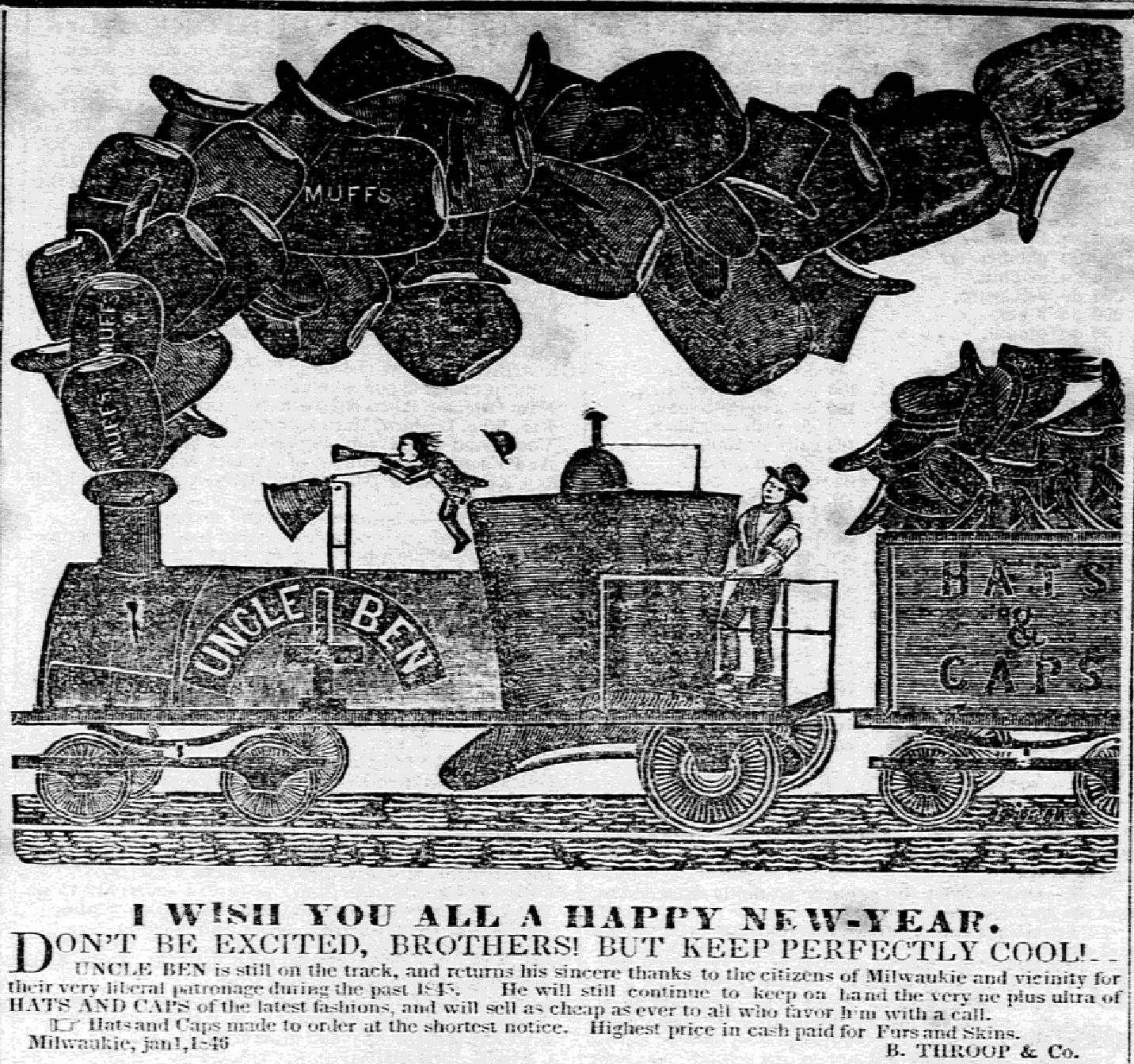
180 years ago, on New Year’s Day, 1846, this amusing woodcut appeared on page 3 of the Milwaukee Daily Sentinel, advertising the shop of pioneering Milwaukee merchant—and local character—Bazille “Uncle Ben” Throop:
That same morning, Jonathan and Mary Clark awoke to their fifth New Year’s Day together as a married couple. Living with them were their first three (of an eventual eight) children: Caroline (5 years old), Henry (almost 3) and Elizabeth “Libbie” (9 months). They were probably still living in their original log cabin home; it would be at least two more years until Jonathan M. Clark carved his name and “1848” in the keystone above the front door lintel of the two-story stone house that is now the Jonathan Clark House Museum.
Did the Clarks see “Uncle Ben’s” ad on January 1st? It’s not impossible, but I’d be at least mildly surprised if our young farm couple spent their earnings on a subscription to a Milwaukee daily newspaper. On the other hand, given their love of lifelong learning, it would not be out of character if they did. But we really don’t know.
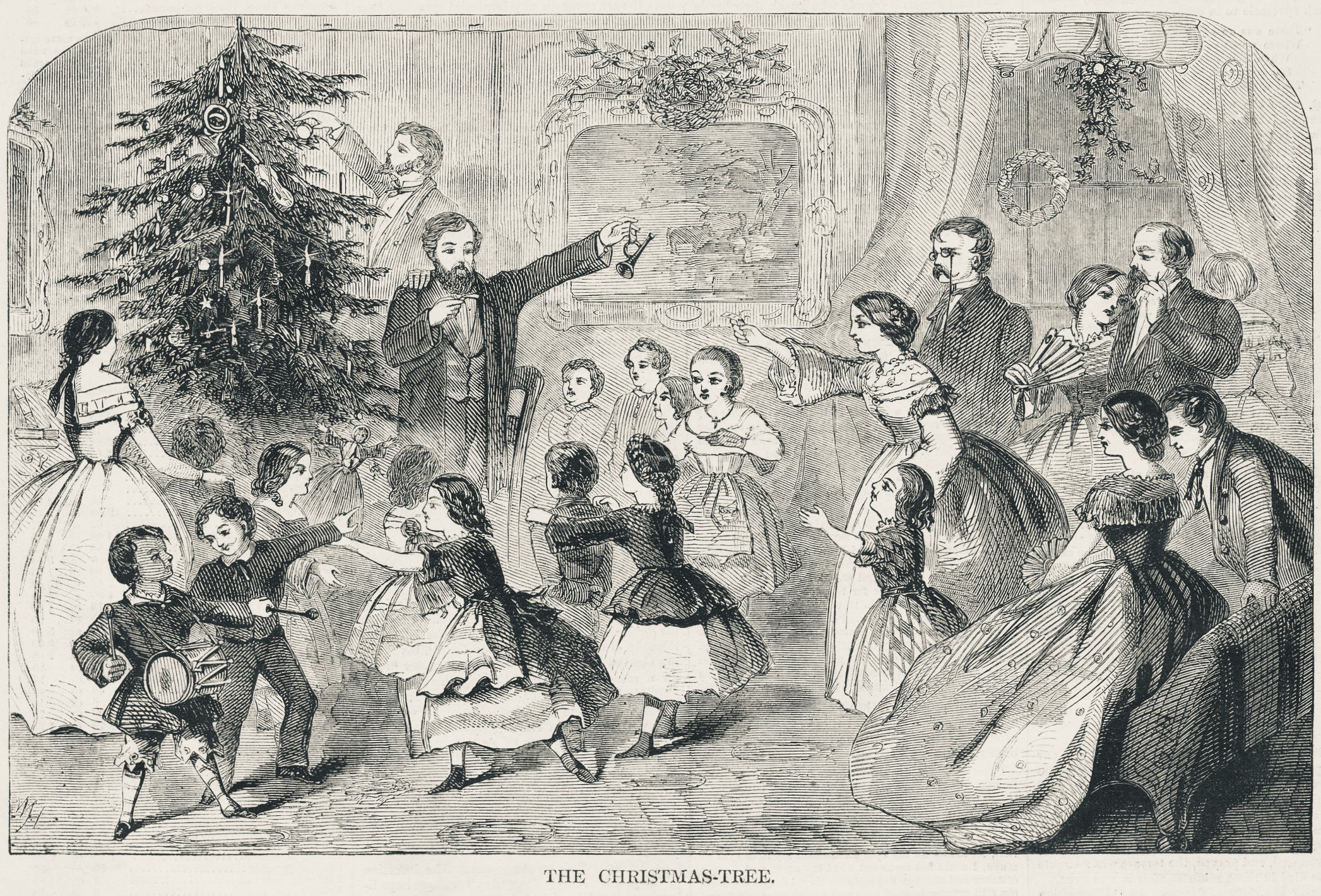
“The Christmas Tree,” after Winslow Homer, Harper’s Weekly, 25 Dec. 1858. Metropolitan Museum of Art, public domain.
Christmas is almost upon us and, frankly, I’ve been too busy—and too tired—this month to write much for the blog. It’s certainly not for lack of topics or sources. I have the beginnings of over 60 [sic!] blog posts sketched out already, and a huge pile of fascinating documents and images set aside to illustrate those posts. The amount of interesting material is daunting, and organizing each topic into one or more coherent posts takes time and energy that have been hard to come by these past few months. Now it’s late December and I’m looking forward to visits from family that will keep me happily preoccupied until early January.
I’ll be back with new material after the New Year. In the meanwhile, below are links to a few holiday-themed favorites from past years for your (re-)reading pleasure. I hope you enjoy them. And in 2026, I look forward to an exciting (and more consistently productive!) year of discoveries here at Clark House Historian.

 Clark House Historian