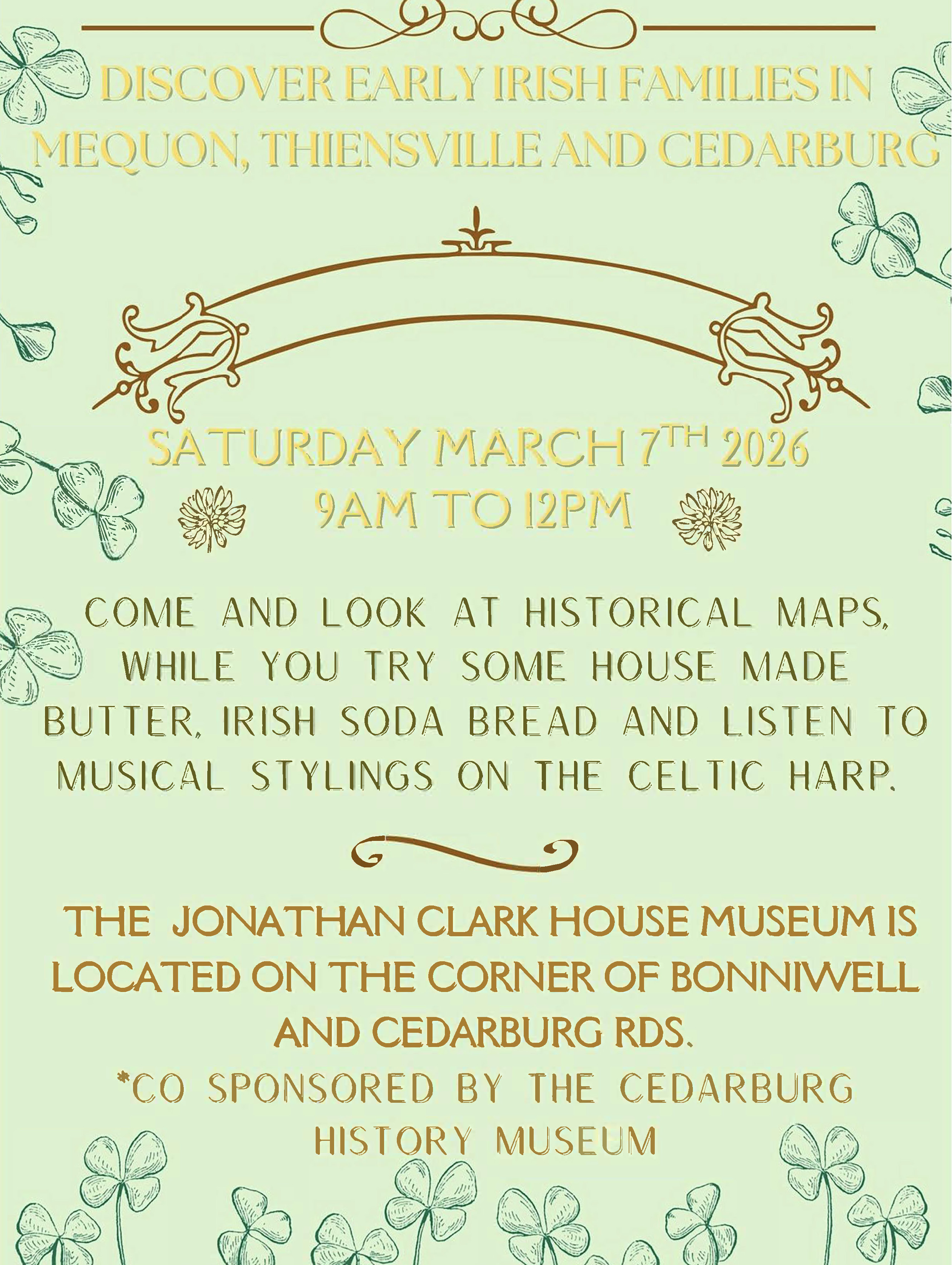
Did you know that in the early days of settlement, much of Cedarburg—and a surprising portion of Mequon—was home to Irish immigrants? Come by the Jonathan Clark House Museum on Saturday and find out if your home had Irish neighbors! Come look at historical maps while you nibble on house made butter and Irish soda bread and enjoy festive music on the Celtic Harp. Event co-sponsored by the Cedarburg History Museum.
The museum is located at the corner of Bonniwell and Cedarburg roads in Mequon, Wisconsin. We look forward to seeing you on Saturday! And as St. Patrick’s Day approaches, you might be interested in catching up on some previous, Irish-themed Clark House Historian posts. Just read on, click all the links, and Erin go Bragh!
Our previous two posts (here and here) examined the 1888 recollections of a Mequon man that migrated from Germany to Mequon-Thiensville in 1848-1849, just after completing his schooling. His recollections were published in the form of two “letters” addressed to the Cedarburg News in May, 1888. Both letters were signed with just the initial “L.” Today I’d like to see what we know about our author — “L.” — and whether we can identify him.
But—before we start solving mysteries, there are errors to correct…
Updated dates!
I goofed! I fell into a record-keeping, citation-making trap. As I started this new post, I decided to take yet another look at my sources. And much to my chagrin, I noted that the date at the head of each of our “Mequon Correspondence” letters does not agree with the date that each letter was actually printed in the Cedarburg News. That’s not so strange; I would expect that a letter would be written, dated, and sent to the paper’s editor before the newspaper’s date of publication. But in our case, the letters are dated almost a full week after the newspaper date of publication. What’s that all about?
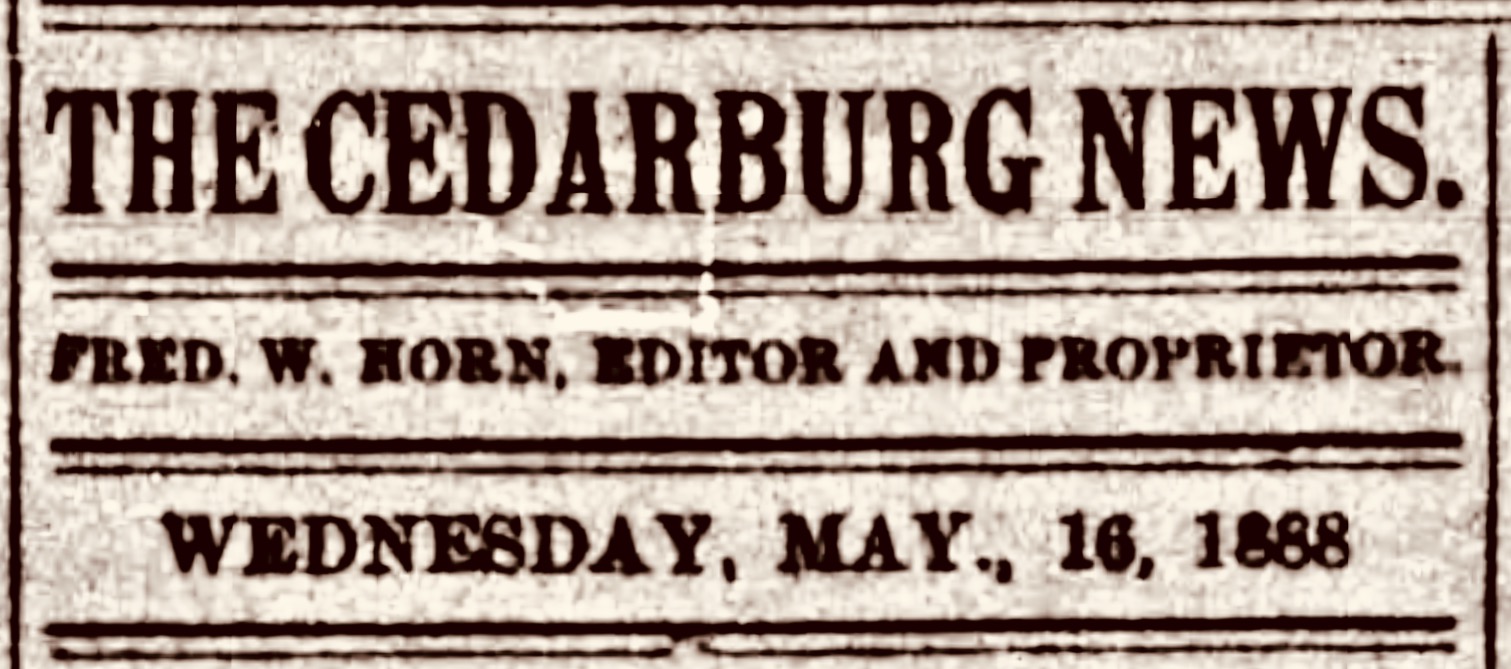
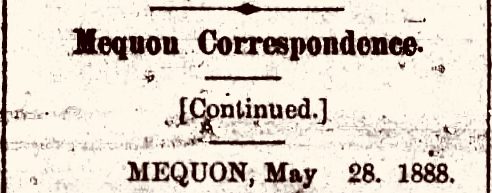
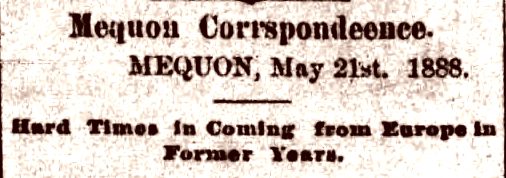
Anyway, here’s the correct info: • the first letter of two, titled “Mequon Corrspondeence” [sic], was published on page 2 of the Cedarburg News on May 16, 1888, but the “letter” was dated, in its headline, “May 21, 1888.” • the second letter, titled “Mequon Correspondence. [Continued.]” appeared the following week, May 23, 1888, also on page 2, but the “letter” was dated, in its headline, “May 28, 1888.”
For the record, earlier today (28 Feb. 2026) I added this corrected date information to thosse two previous CHH posts. And now that we’ve settled that, let’s see what we can do to solve today’s History Mystery!
UPDATED, Feb. 28, 2026, to correct erroneous dates of publication of the two Cedarburg News “letters.“
Migration memories, 1848, continued
In our previous post we presented the first part of a personal memoir of travel from Germany to New York City and, eventually, Mequon-Thiensville, circa 1848. Those recollections were published as the first of two “letters” to the Cedarburg News in May, 1888. Both letters were pseudonymous, signed only with the initial “L.”
The first letter of the pair, titled “Mequon Corrspondeence” [sic], was published on page 2 of the Cedarburg News on May 16, 1888, but note that the letter itself was dated, in its headline, “May 21, 1888.” If you missed it, I recommend you begin with that earlier post and then come back here for the conclusion. Today we complete the author’s reminiscences with excerpts from his second letter, titled “Mequon Correspondence. [Continued.]” appeared the following week, May 23, 1888, also on page 2, but the letter was dated, in its headline, “May 28, 1888.”
An 1840s “prank” in NYC
The May 28th, 1888, letter begins with two anecdotes from our immigrant’s first day in New York City. The first incident involves a schoolboy “prank” in which a bottomless peach basked is used to trap the arms of an unsuspecting “fat old bachelor, the universal fool of our ship [illegible] to the greatest merriment of the bystanders.”
UPDATED, Feb. 28, 2026, to correct erroneous dates of publication of the two Cedarburg News “letters.”
Hard Times in Coming from Europe
You may have wondered why I haven’t written much about the German immigrant history and heritage of our corner of southeast Wisconsin. After all, since the late-1830s, and especially following the “Revolutionary Year” of 1848 in Europe, waves of Europeans—including hundreds of thousands of emigrants from the German Lands— left their homes in the Old World and set out to make a fresh start in America. Many of these German-speaking emigrants would find their way to Wisconsin, where they and their descendants would leave a lasting imprint on the culture and development of the new state.
The story of the Jonathan Clark House, however, centers around the lives of the Clarks and their immediate neighbors and in-laws, especially the Bonniwell and Turck families. All were prominent players in the earliest days of white migration to and settlement of Mequon, old Washington/Ozaukee county, and the city of Milwaukee. The Clarks, Turcks and Bonniwells came to Wisconsin Territory from New York, New England, English-speaking Canada and the United Kingdom in the later 1830s. Their Wisconsin story was not so well known or documented, so I have spent much of my time over the past decade or so researching their families, lives, and the events of their day.
Having said that, we need to remember that these “Yankee-Yorkers” and other English-speaking pioneers were not the only early immigrants to our area. Irish and German families were, indeed, already present and establishing farms and businesses in old Washington/Ozaukee county by the late-1830s, including at the large German Freistadt Colony and the early Irish neighborhood centered between the Jonathan Clark House and the crossroads hamlet of Hamilton. All of these overseas immigrants were the Clarks’ neighbors, and their stories are intertwined throughout the early history of Mequon.
And one thing those 19th-century Irish and German and British immigrants all had in common was time spent on a ship, making the uncertain and difficult voyage from Europe to America. In the next few posts we will look at some first-person recollections of a school boy who came with his mother and brother from the German Lands to Mequon-Thiensville around 1848, as recollected and published in 1888.
Those of you that have been reading this blog for a while know that I really enjoy researching and writing about Clark House genealogy and history. I get excited chasing down obscure sources, finding unknown facts and images and then using them to craft a more detailed picture of Jonathan and Mary (Turck) Clark, their lives, family, neighbors, and to develop a clearer understanding of the era they lived in.
Regular readers also know that I’ve learned a few things along the way, one of which is that, in the words of—supposedly—Lawrence of Arabia, “All sources lie.” Which means, explains genealogist and bibliographer Elizabeth Shown Mills, “Sources err. Sources quibble. Sources exaggerate. Sources mis-remember. Sources are biased. Sources have egos and ideologies. Sources jostle for a toehold in the marketplace of ideas.
Here at CHH, I’ve blogged about and evaluated a number of local history sources over the years, most recently at JCH sources: a look at local history, part 1 and part 2. Now I’ve been asked by Jonathan Clark House museum director Nina J. Look to examine the detailed timeline of Clark House events that she has assembled over the past decade or more. This is painstaking and detailed work, and while don’t exactly enjoy proofreading and fact-checking, it’s an important thing to do. Thus, I’m in error-hunting mode these days, as I help my Clark House friends tell the most accurate and complete version of the Clark House story that we can.
ER-RA’ TUM, n.: pl. ERRATA.
Errata are errors or mistakes in writing or printing… on paper, the internet, or wherever, and I’m currently focused on finding and correcting some of them. This has inspired me to add another selection to the blog’s list of categories in the “Search CHH by Category” menu. This new category is called Errata, and I’m going to attach it to posts like this one, that are focused on particularly important, tedious, and/or persistent errors of fact. (For more on using Categories and navigating the blog in general, see our post Finding what you want: a few tips.)
Today, our inaugural “Errata”-filled example comes from an otherwise impeccable source, architectural historian Richard W. E. Perrin and his important, lavishly illustrated book Historic Wisconsin Buildings: A Survey in Pioneer Architecture 1835-1870, second edition (Milwaukee Public Museum, Milwaukee, 1981).
We’re having some very cold weather this weekend, not unusual for Wisconsin in mid-winter. But it got me thinking, wondering what sort of winter weather did the Clarks and Turcks and Bonniwells experience, and what effect the did the cold have on their daily lives?
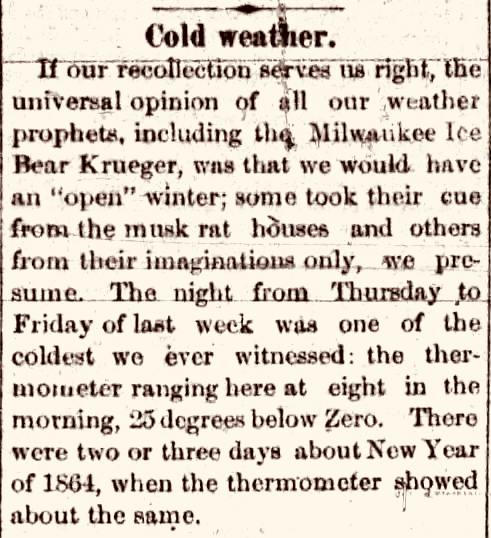
To find out, I started by searching digitized old newspapers, looking for the phrase “below zero,” in Wisconsin, between the years 1833-1899. Oh boy, did I get results! After narrowing my search to more local sources, I found this news item on page 2 of the Wednesday, January 2, 1884 issue of the Cedarburg News:
This article suggests that the winter of 1883-1884 was expected to be somewhat mild; an “open” winter was one with little or no snow cover on the ground. All the signs and predictions thought this would be the case. Apparently, the local muskrats had built their houses differently in 1883, as muskrats do when they expect a milder winter. The “universal opinion” of the “local weather prophets”—including Milwaukee’s famed “Ice Bear,” Henry Kroeger—thought so, too. But on the night of December 28-29, 1883, the thermometers in Cedarburg—just a few miles from the old Jonathan Clark farm—dropped to 25 degrees below zero (Farenheit). It was the coldest morning in decades.
But by the 1880s many of the older members of the Clark, Turck, and Bonniwell families had died, and many of the younger generation had left Ozaukee county and relocated to Milwaukee, Chicago, Minnesota, and elsewhere. Some or most of them may have missed this late-1883 cold snap. But this short article also mentions another, similar record cold spell, one that Mary Turck Clark and her children actually lived through, in Milwaukee, around the New Year of 1864.
As I write this, southeastern Wisconsin is in the midst of our first substantial snowfall of Winter, 2025-2026. In Jonathan and Mary Clark’s lifetime, the day after a storm like this meant it was time to hitch up the sleigh and have some fun “dashing through the snow.” Here’s a lightly-revised and expanded repeat of a post that celebrates Clark-era “sleighing time” and “jingle bells.” (And be sure to click the highlighted links for more vintage wintertime images and info.)
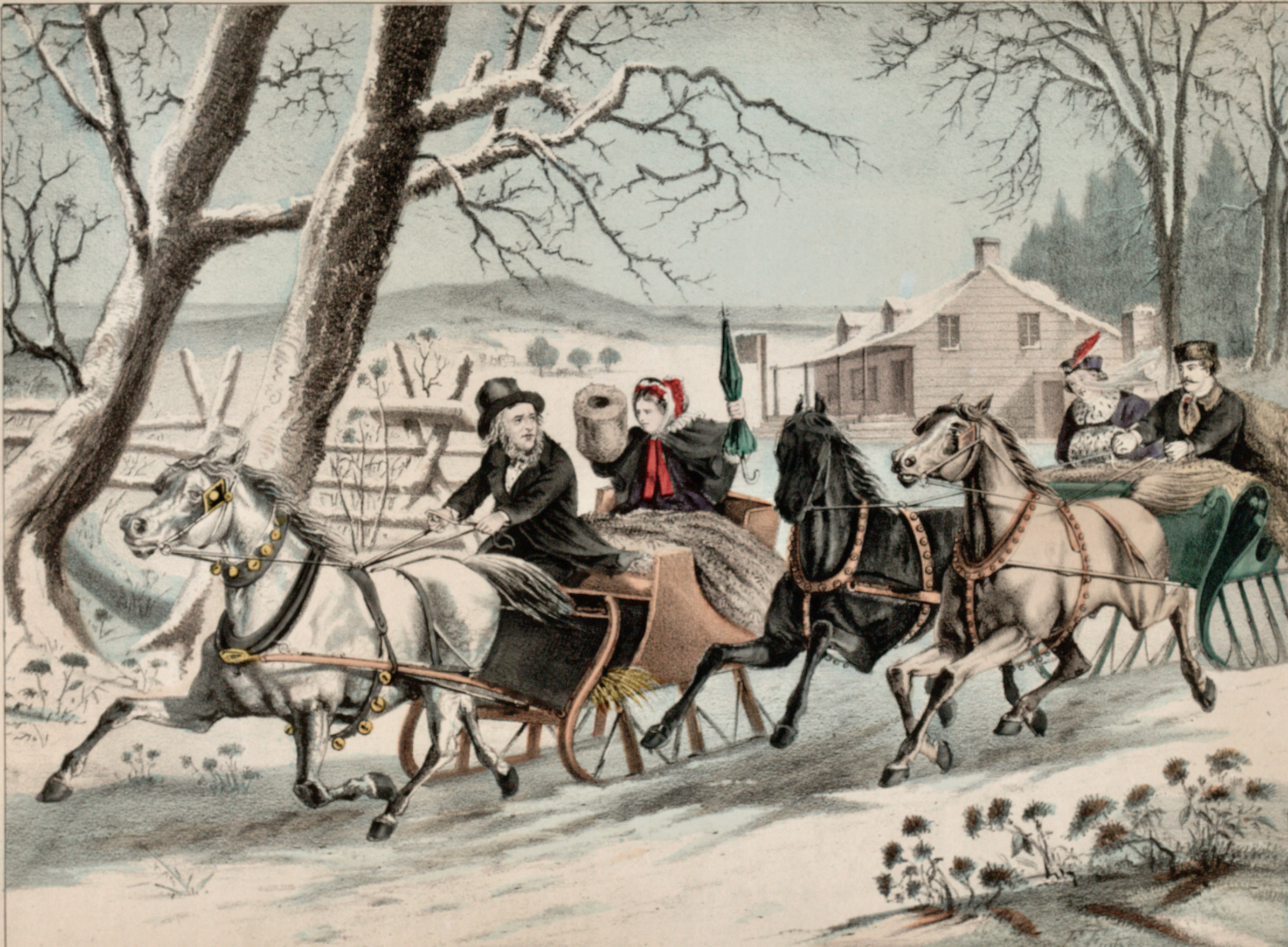
Kimmel and Forster, publishers, “Winter Pleasure in the Country,” circa 1865. National Museum of American History, Peters Prints Collection, Smithsonian Institution.1 Note the modest straps of jingle bells on the one-horse sleigh and the much more ostentatious—and louder—straps of bells on the two-horse sleigh.
Last winter, our earlier CHH posts Snow!, Shoveling out -and other winter chores and Stuff Happens – on a sleigh ride, got me wondering again about winter travel in old Washington/Ozaukee county during the Clarks’ era of the mid-1830s through the 1860s or so. Assuming most of the more successful farmers—such as the Clarks, Bonniwells and Turcks—owned a one- or two-horse sleigh, how easy was it to navigate that sleigh on the early county roads? Could you sleigh ride all the way to Milwaukee? And if you could, how long might that take?
Join us! this Saturday, May 3rd, 12:00-2:00 p.m., for a special screening of FernGully, the Last Rainforest at the historic Rivoli Theater, W62N567 Washington Avenue in downtown Cedarburg . All proceeds to benefit the Jonathan Clark House Museum.
This unique event features a pre-screening illustrated talk by Oscar-nominated director Bill Kroyer, featuring behind-the-scenes artwork and film clips. Doors open at 11:30 a.m. Come early and enjoy a specially-created, big-screen Clark House trivia quiz before the main event begins at Noon!
The Jonathan Clark House is excited to announce a special screening of FernGully, the Last Rainforest. on Saturday, May 3rd, 12:00-2:00 p.m., at the historic Rivoli Theater, W62N567 Washington Avenue in downtown Cedarburg.
This unique event features a pre-screening presentation by Oscar-nominated director Bill Kroyer, featuring behind-the-scenes artwork and film clips.
Kimmel and Forster, publishers, “Winter Pleasure in the Country,” circa 1865. National Museum of American History, Peters Prints Collection, Smithsonian Institution.1
Talk of sleighs and sleighing in our recent CHH posts on Snow! and Shoveling out -and other winter chores, plus our January, 2022, essay on Stuff Happens – on a sleigh ride, got me wondering again about winter travel in old Washington/Ozaukee county during the Clarks’ era. Assuming most of the more successful farmers—such as the Clarks, Bonniwells and Turcks—owned a one- or two-horse sleigh, how easy was it to navigate that sleigh on the early county roads? Could you ride all the way to Milwaukee? And if you could, how long might that take?



 Clark House Historian