Bonniwell background: more Chatham links & docs

I’m still thinning out my backlog of Bonniwell-related documents that currently crowd my computer desktop. Today’s post includes some multimedia links, too. I hope you enjoy them.

A long, narrow, disagreeable, ill-built town…

Unlike the glowing prose of the description of Chatham we discussed earlier in Bonniwell background: Chatham, Kent 1832, not everyone was impressed by the Bonniwell’s home town, at least not in the late-1700s. For example, Edward Hasted (1732-1812), in his monumental History and Topographical Survey of the County of Kent (second edition, vol. 4, Canterbury, 1798, pp. 191-226) had this to say:

THE TOWN OF CHATHAM, the greatest part of which has been built since the reign of queen Elizabeth, adjoins to that of Rochester, which, with Stroud [sic, Strood], makes one long street of more than two miles in length, of which Chatham is one, being commonly called the Three Towns, through which the high road leads from London to Dover, as above mentioned.

It is situated close to the bank of the Medway for about half a mile, after which the river leaving the town flows north-north east. It is like most sea ports, a long, narrow, disagreeable, ill-built town, the houses in general occupied by those trades adapted to the commerce of the shipping and seafaring persons, the Victualling-office, and the two breweries, and one or two more houses, being the only tolerable built houses in it.

The 12 volumes of the second edition of Hasted’s complete magnum opus have been digitized and made available at British History Online. The quoted bits above are a brief excerpt from Hasted’s almost 9,000 words devoted to the parish history of Chatham. Click the link for online access, or download a PDF copy here.

I discovered Hasted’s sour appraisal of 1798 Chatham while watching an interesting YouTube video devoted to the history of two major disasters that befell the town—and our Bonniwell and Hills families—in the early 1800s:

Continue reading

Bonniwell background: Chatham, Kent 1832

Time for some housekeeping. I’m trying to wrap up my “brief” survey of the documentary life of Mequon pioneer (and Clark House brother-in-law) Alfred T. Bonniwell, and I need to thin out my collection of “not-specifically-Alfred, but still interesting and Bonniwell-related” documents that currently crowd my “to do” list. Today’s gem is a view and description of the Bonniwell family’s hometown of Chatham as it was in 1832, the year they left England and sailed to North America:

Continue reading

Memorial Day, 2023

Lest We Forget

Our annual Memorial Day post, first published in 2020. Updated for 2023 with new information about Evander B. Bonniwell’s service.

Graves of Unknown Union Soldiers, Memphis National Cemetery, photo by Clayton B. Fraser, (Library of Congress), public domain. Memphis National Cemetery is the final resting place of Mequon’s Watson Peter Woodworth, and almost 14,000 of his Union Army comrades.

Today is the day our nation officially observes Memorial Day. For many Americans, Memorial Day represents “the first day of summer,” and is traditionally celebrated with trips to the lake, picnics, parades, and sales on cars, appliances, and other consumer goods.

But for many of us, Memorial Day remains rooted in its origins as Decoration Day. The first national observance was in 1868, when retired general John A. Logan, commander and chief of the Grand Army of the Republic—the Union veterans’ organization—issued his General Order Number 11, designating May 30 as a memorial day “for the purpose of strewing with flowers or otherwise decorating the graves of comrades who died in defense of their country during the late rebellion, and whose bodies now lie in almost every city, village, and hamlet churchyard in the land.”

On this Memorial Day, let’s take a moment to remember what this day truly represents.

Continue reading

Farewell to California! The Bonniwell party returns (part 4)

If you’re just joining us, you may want to read the first three parts of this series: (part 1), (part 2), and especially (part 3) before continuing with today’s Part 4.

April, 1851: Alfred T. and (George? or Charles?) Bonniwell to NYC

Based on the documents that I have been able to locate so far, the next members of the Bonniwell expeditions to return from California were Alfred T. Bonniwell and one of his older brothers.

Like Henry Bonniwell and P.M. Johnson at the end of 1850, in the spring of 1851 Alfred and his brother had a choice of routes and providers for the return home from San Francisco.

“Vessels Advertised,” for Panama and New York City, San Francisco Daily Alta California, January 10, 1851, page 1.

Like Henry Bonniwell and P.M. Johnson before them, Alfred and his brother appear to have chosen to travel on the ships of the Pacific Mail Steamship Company. They probably sailed on the steamer Sarah Sands from San Francisco to Panama (City). then crossed the isthmus of Panama (via some combination of horse, mule and/or canoe) and boarded the U.S.Mail Steamer Cherokee for the trip to New York:

Continue reading

Farewell to California! The Bonniwell party returns (part 3)

UPDATED, May 13, 2023, with a few minor text edits and additions for clarity.

If you’re just joining us, you might want to read the first two parts of this series: Farewell to California! The Bonniwell party returns (part 1) and Farewell to California! The Bonniwell party returns (part 2), before continuing with today’s Part 3.

Since its beginnings in 1848, news of the California Gold Rush was highly sought after across the nation. U. S. newspapers published all the latest doings, and raced to print the latest updates before competing papers could do so. Readers were breathlessly informed of the amounts of gold and cash (usually in the form of specie, or money as coins) that regularly arrived at eastern ports. Lists of passengers departing to and arriving from the gold fields occupied inch after inch of column space. Ships arriving from the west fed America’s appetite for the latest developments by carrying eastward the U.S. Mail and the latest California newspapers. Ship captains prided themselves on delivering the news more quickly than their competitors.

December, 1850: Henry Bonniwell and P. M. Johnson

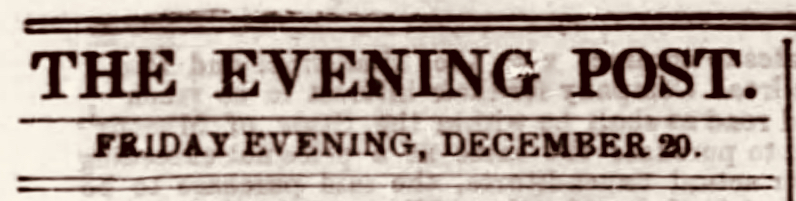
The result of this insatiable need for California news—available to 21st-century readers via digitized and searchable historic newspaper collections—is that I have been able to identify the names of several of our returning Bonniwell expedition members, along with their date of return and means of travel. From what I’ve learned so far, the first two of our Wisconsin adventurers to return were Henry V. Bonniwell and Phineas M. Johnson, who arrived in New York City harbor on the morning of Friday, December 20, 1850, as passengers on the steamer Cherokee.

Today’s Clark House Historian post uses just one of these gold rush articles as its source. The original article occupied the complete first column (and a bit of the second) of page 2 of the Friday evening, December 20, 1850, New York Evening Post. There’s a lot of news packed into the original article; to make that news easier to digest, I have divided the unbroken column of type into several smaller parts. Let’s take a closer look…

Continue reading

Farewell to California! The Bonniwell party returns (part 2)

The Bonniwell party’s prospectors had gone to the California gold fields via two very different routes. The 1849 party went west using a combination of land and water transportation to get from Milwaukee to El Dorado via steamship from New Orleans, then across the Isthmus of Panama by foot, mule and canoe, and then another steamer to San Francisco. Compared to the overland route, it was quicker, more reliable, and safer, but more expensive.

The larger Bonniwell party of 1850, led by “Captain” William T. Bonniwell, took the shorter but more strenuous—and risky—overland route. After fitting out their wagon train at Independence, Missouri, they headed west, across the vast plains and the great western desert, and then struggled up and across the Sierra Nevada. This route was much less expensive, and much less secure. They faced constant dangers, including lack of adequate food and water, unpredictable weather, equipment failure, the threat of bandits, and the possibility of Indian attack.

Both Bonniwell parties survived their journeys and made it to the gold region. They appear to have had some success, mixed with much tedium and many futile efforts. Eventually, our Wisconsin prospectors—like many, if not most, California gold seekers—decided to return home. And then the question became: how to get home safely, economically, and reasonably quickly? For most adventurers, especially those with even a modest amount of gold dust or specie in their baggage, it was clear that the overland route was too long, impractical and dangerous. So some kind of (mostly) ocean voyage seemed like the best bet, and the San Francisco newspapers were full of enticing deals for homeward travelers.

San Francisco to Panama, and beyond

San Francisco newspapers regularly featured advertisements for competing steamship lines. Here’s one from the Daily Pacific News of January 21, 1850, for the Empire City line, promoting the trip from San Francisco to Panama [City] on their newest ship, the Sarah Sands.

This 1850 lithograph, like the ad above, suggests the iron ship Sarah Sands was new, modern and cut a sleek line through the sea. Just the thing for a returning miner’s comfortable trip homeward:

Continue reading

Farewell to California! The Bonniwell party returns (part 1)

I’ve never been to California’s gold rush country, so I don’t know how accurate this unknown artist’s View of Sutter’s Mill & Culloma Valley. On the South Fork of the American Line, Alta, California might have been.1 It’s drawn in the Romantic style of the time, although it’s clear the unspoiled, natural, “sublime,” view of El Dorado county’s hills and mountains are quickly giving way to the shelters and “diggings” of the immigrant gold miners and the nearby rough-and-tumble mining town of Culoma.

I wonder, did the Bonniwell party’s miners have the time, or inclination, to savor such exalted vistas? Perhaps. During the Bonniwell’s overland trek in the summer of 1850, George Bonniwell mentioned in his diary a number of “beautiful ” views of rivers, bluffs and other natural wonders. But after a year or two of toil in the harsh conditions of gold-rush era California, I expect the day-to-day existence of our Mequon men had become much less awe-inspiring. The typical experience of gold rush miners—whether successful or not—tended to be much more…mundane:

Continue reading

1850 census: more neighbors “in Wisconsin”– while prospecting in California

Recently, we took a closer look at the 1850 census for old Washington county1 and noticed that six men from the neighboring Bonniwell families—men that we know from other records were actually half a continent away, prospecting for gold in California—were officially enumerated as members of their Wisconsin families in census schedules for Mequon and Grafton. In addition, we now know that those six Bonniwell men were not the only members of their expedition to be enumerated with the families they left behind in old Washington county.

Persons “whose usual place of abode…”

In the months since my original attempt to identify and list all the members of the Bonniwell 1849 and 1850 expeditions in Gold! – The Bonniwells go west…but when? and who?, I have been able to identify—with varying degrees of confidence—several other members of their California expeditions. I have more details to share about the lives of these men later, when time permits. For today, I’d like to briefly introduce each of them and make note of their presence on the 1850 census schedules for old Washington Co., Wisconsin, even though all were still seeking fortunes in California at the time they were enumerated.

Phineas Miller “P.M.” Johnson (1808-1876)

P. M. Johnson was, with William T. Bonniwell, one of the co-organizers of the Bonniwell 1849 and 1850 expeditions to the California gold region. We know that he was still in California in 1849-1850, but he was enumerated on lines 37-42, page 229a of the 1850 census for Grafton, Washington Co., Wisconsin with his wife, Orra Ann (Collins) Johnson and his four eldest children: Ransom W., Samuel C., William H., and George.2

The P.M Johnson family’s 1850 enumeration concludes on the reverse of this schedule, lines 1-4, page 229b, with the information for their youngest four offspring, Anna, Edwin, Julia, and four-month-old Harriet.

Continue reading

JMC & the neighbors petition Congress, 1849

Today we have a surprise addition to our survey of Alfred T. Bonniwell documents. It’s a recent discovery, a very cool 1849 petition to Congress asking for a new postal road from Grafton to Waukesha, via Mequon. It’s signed by many of old Washington county’s most civic-minded men, including Grafton postmaster P.M. Johnson, Jonathan M. Clark, Peter Turck, and almost all of the Bonniwell men. It’s of interest to us, in part as an example of the citizen petition process in the early days of Wisconsin statehood, and more specifically as a record of “who was here?” in Washington county in a non-census year.

A growing county needs a new mail route

Petition of Phineas M. Johnson and others to U.S. Congress. [1849-02-06]. /documents/D275080, page 1, detail, salutation, The Papers of Abraham Lincoln Digital Library. Public domain.1, 5

Citizen petitions have been a part of American governance since early days. Check out our 2021 RBOH: Wisconsin Citizen Petitions for more information on a newly digitized collection of early Wisconsin territorial and state petitions, including a searchable database of petition images. Citizens could also petition the federal government for assistance; our petition is addressed To the Honorable the Senate and House of Representatives in Congress Assembled, and looks like this:

Continue reading

The Bonniwells & Co. and the 1850 census–part 4: “in” Wisconsin!

In our last post, we discovered that none of our Bonniwell gold rush expedition members could be found on the surviving population schedules for the 1850 federal census in California.1 Does that mean they were not to be found anywhere on the national 1850 enumeration? Well, no. It turns out that while the Bonniwell men and their companions were physically present in California, they managed to be enumerated in…Wisconsin?

Currier & Ives. Home Sweet Home, c. 1874. New York: Published by Currier & Ives. Library of Congress.

There’s no place like home

You might think that once every ten years, when the census enumerator came to call, he or she would simply speak to a responsible adult at each address and write down the information for all of the “inhabitants” of each household. And that is pretty much how it was done.2

Naturally, there could be complications. What if some members of the household were away, perhaps working the fields, or at the mill? Maybe someone had to go to town, or farther away, on business. What about a child that is out of town at school or college? Or… what if the head of household had gone prospecting in the wilds of California’s gold district?

Continue reading