Finding what you want: a few tips for readers

Sometimes a blog is like a labyrinth…
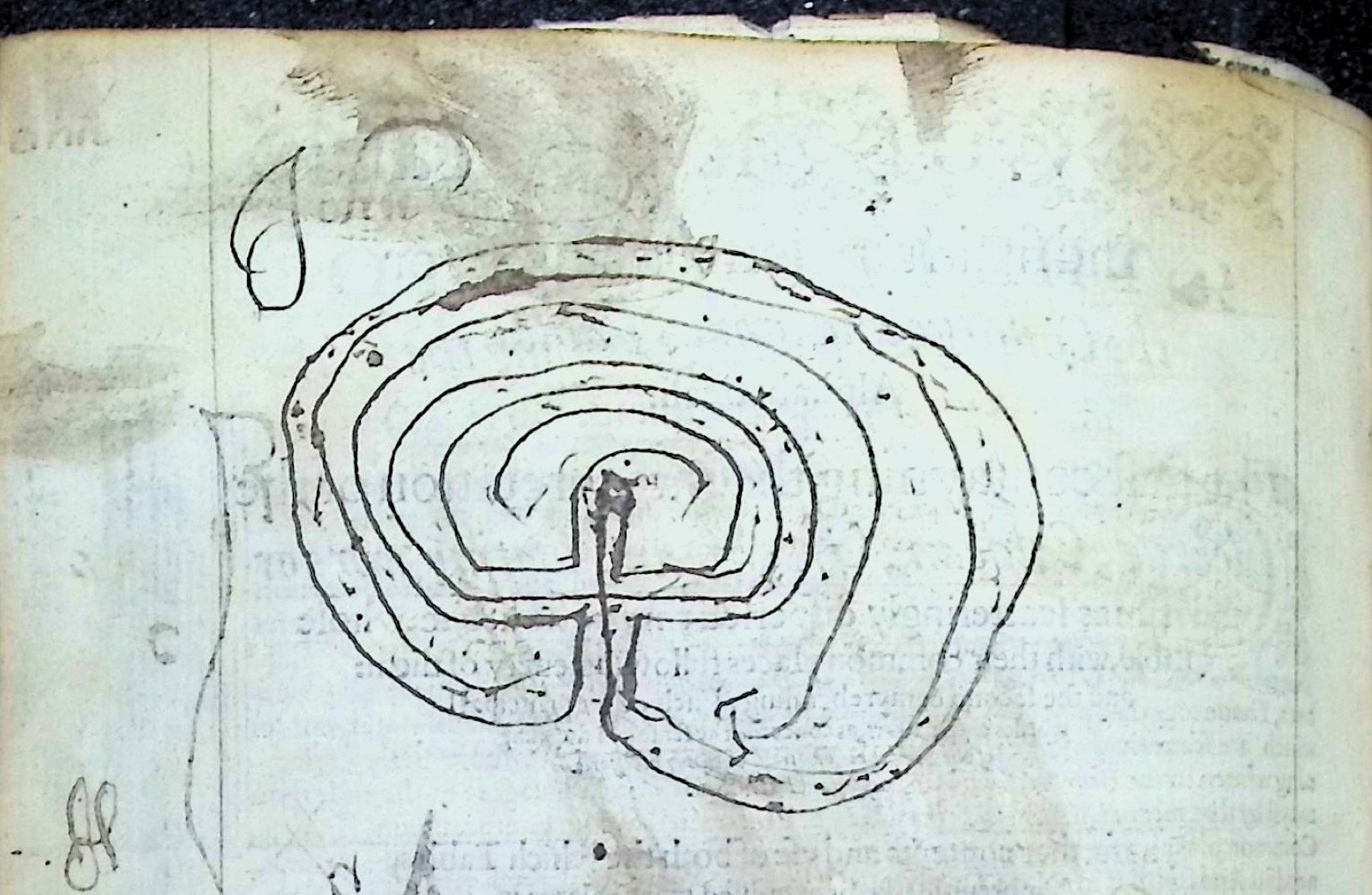
JCH Bonniwell family Bible, MS inscription “John” and drawing of a Labyrinth, First […] Concordance, sig. A1 verso (detail)

I’m looking forward to blogging more regularly, and I hope you enjoy the upcoming posts. But I’ve been publishing Clark House Historian for almost ten years (!), and I know it can be hard to navigate the blog and find the particular historical information, photos, maps and other images that you might be looking for. Today’s post has a few tips to help you make your way through the twists and turns of the Clark House Historian information labyrinth.

Tip No. 1: Click the links!

If you’d like to view a larger, clearer version of almost any image on the blog: click the image (or, sometimes, the link in the caption), and a new full-size image will open in a new window. Other links (highlighted in the blog’s signature minty-green color) will connect you with related blog posts and online sources for further information.

And by the way, you can read the blog on your phone and open and zoom in on the photos, drawings, maps and other images. But I create the CHH posts on a device with a good-sized screen, and I recommend viewing on the largest screen that you can.

Finally, and most importantly, be sure to click the Continue reading—> link, typically found after the first image and paragraph or two. There is a lot more to be found “below the fold.”

Continue reading
JCH News & Events – Spring, 2025

Howdy! Sorry for the long blog silence. It’s not that I’m lacking for topics or material to share with you all, but I’ve been busy “behind the scenes” at the Clark House for the last month or so.

In particular, I’ve been working on two big projects. JCH executive director Nina Look and I have just published the Spring | May 2025 issue of the JCH Newsletter, and Nina and I have been collaborating with JCH intern Nicole Buerosse on a major, archival-quality upgrade for the preservation and display of the museum’s irreplaceable Bonniwell Family Bible.

Scaffolding at the Clark House? What’s up with that? Read on for more info…

Continue reading

Help the Historian: Mysterious (Bible?) Fragment – a clue!

Among the real pleasures of writing a blog like this are the comments I receive from CHH readers. Recently, I heard from reader James Cornelius of nearby Grafton, Wisconsin,1 who had some thoughts about our January 24, 2025, post “Help the Historian: Mysterious (Bible?) Fragment.” 2

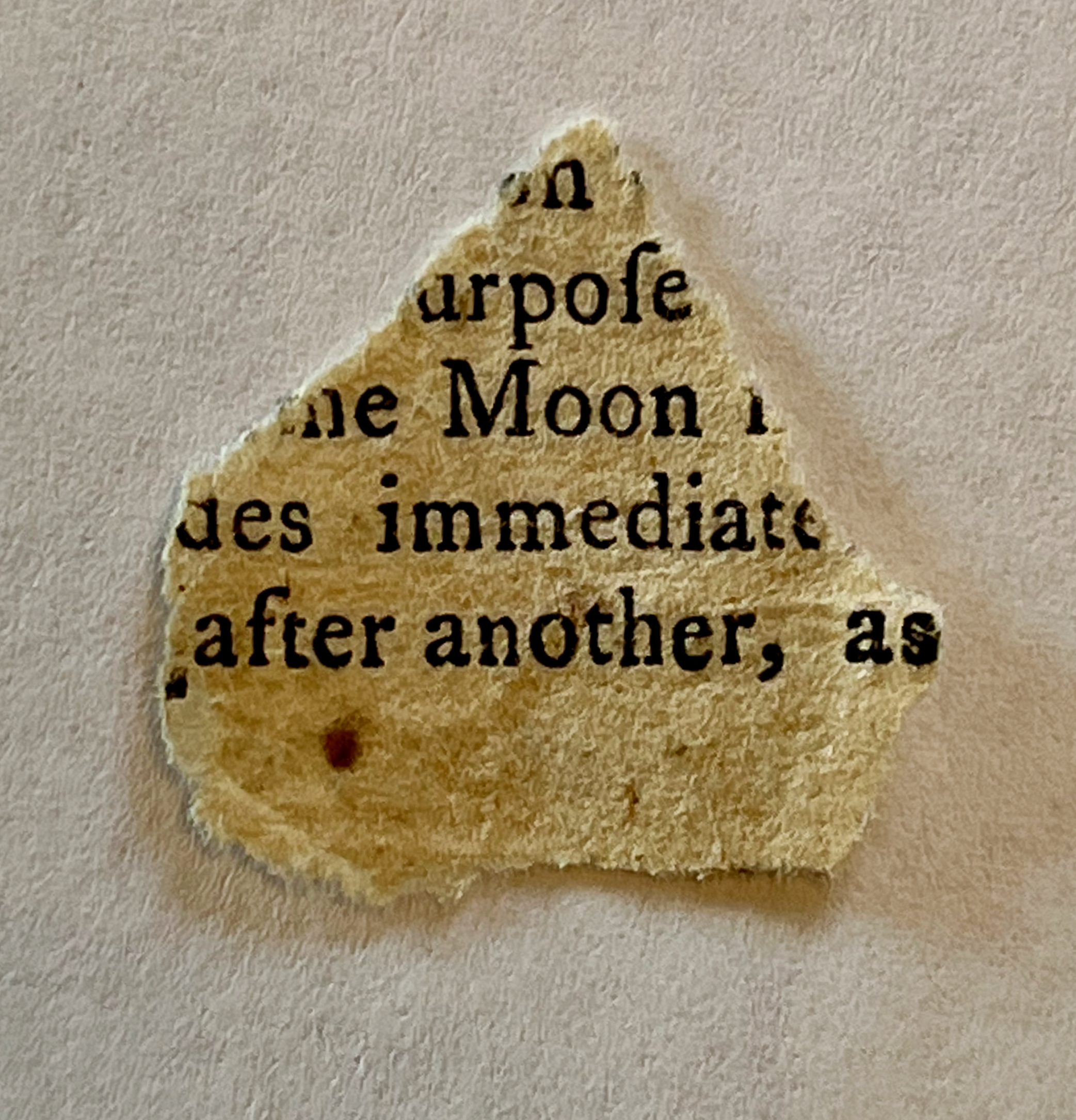
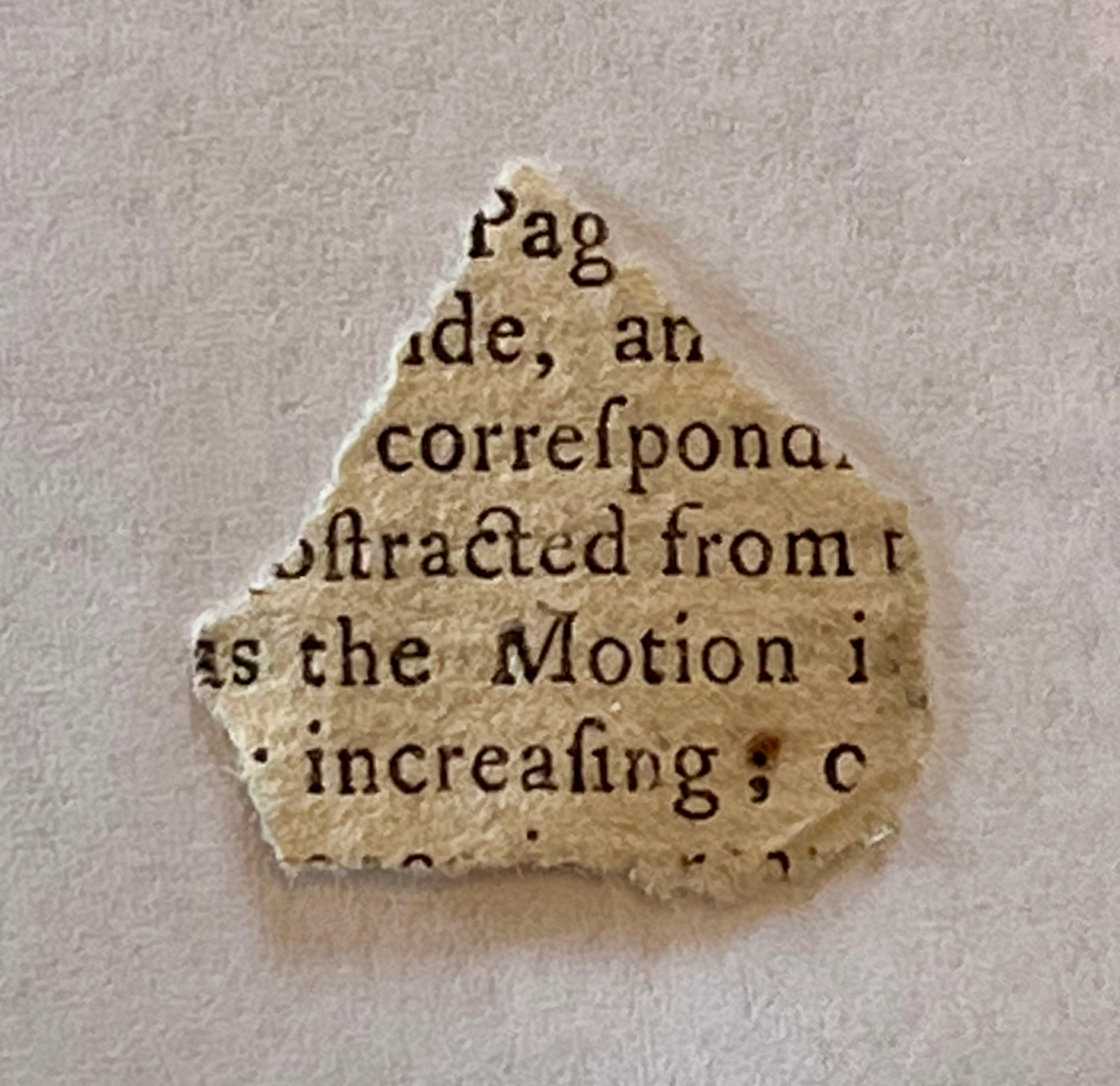
As the original post explained, I had been examining a number of loose Bonniwell papers, scraps, and other ephemera that were donated to the Clark House along with the Bonniwell family Bible itself, and I was particularly interested in one little fragment of printed text that had me baffled.

The mysterious fragment, sides A & B, photo credit: Reed Perkins, 2022.

In my original post, I examined the text and typography of the fragment and estimated that the it was published sometime between the late-sixteenth century (at the very earliest) and—at the very latest—the first decades of the nineteenth century. And the mentions of “Moon” and “motion” and such suggested a source that might be more scientific or philosophical, and not necessarily a sacred text, but I couldn’t think what that might be.

A new possible source: Almanacs!

In his comment, James observed: My hunch is that this triangular scrap /bookmark came from an almanac, likely as common in 1800-1820 U.K. as in U.S. a half-decade later. Many fairly good or detailed ‘scientific’ discussions appeared in the old almanacs or ‘farmer’s friends.’

I think James is on to something. Almanacs seem like a very plausible source. But how common were farmer’s almanacs in the UK, and how likely was it that the Bonniwells had access to these annual “farmer’s friends” in Chatham, Kent, England, in the years before their 1832 immigration to North America?

Continue reading

Help the Historian: Mysterious (Bible?) Fragment

I’m spending some of my time this winter on projects related to the cataloging, interpretation and display of our historic Bonniwell Family Bible. One of the items on my “to do” list involves the study of a number of Bonniwell papers and other ephemera that were donated along with the Bible itself. Some of the miscellaneous papers are self-explanatory and easily understood. But one little fragment of printed text has me baffled, and I need your help, history lovers!

The fragment, sides A & B

Photos credit: Reed Perkins

Continue reading

Bonniwell background: clues from the Great Fire reports

Today I’d like to share two rare and unusual official documents, and note how there are early 19th-century Bonniwell family genealogical clues hidden in each.

The Bonniwells and related families in Kent, 1667-1832

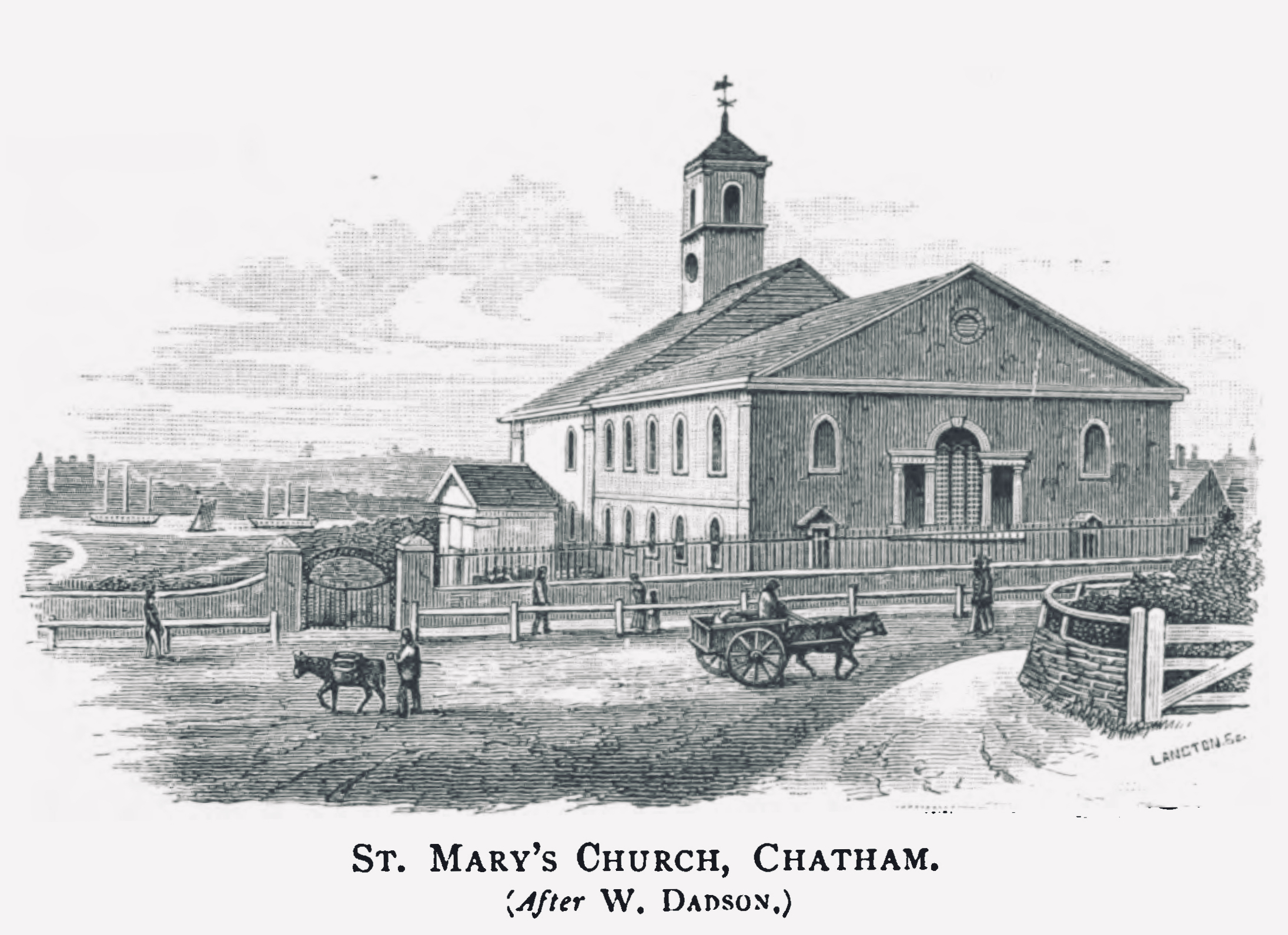
The image below is of St. Mary’s Church, Chatham, much as it looked at the time of Alfred T. Bonniwell’s christening there in 1826. It’s likely that the Bonniwells regularly attended services here during their years in Chatham. St. Mary’s has had a long and eventful history as a parish church, and has been reconstructed several times.1

Engraving based on original art by W. Dadson, in Robert Langton’s The Childhood and Youth of Charles Dickens, Manchester, 1883, page 72. GoogleBooks, accessed 1 Aug. 2023.

A surprising number of our early Mequon immigrants had ancestors in southeast England’s venerable Kent county. Early Mequon settlers (and their spouses) from the Ashby, Bonniwell, Dunning, Eastree, Hills, Long, Moss, Munn, Smith and Whitehead families all had roots in Kent, many of them in or around the town of Chatham. For an introductory overview of this, see Monday: Map Day! – the Bonniwells in Kent, featuring a very cool map of the county from 1665, with added annotations that indicate many of the of the family’s various Kent residences, christenings, marriages, and burials over the subsequent decades.2

Family history before the census of 1841

The first modern, “all name,” census of England was enumerated in 1840 and published in 1841 and, as with every succeeding decennial census, the 1841 Census of England and Wales is full of useful information for historians and genealogists. But the Bonniwells left England for North America in 1832, almost a decade before the 1841 census was enumerated. How do we reconstruct and understand family relationships and local history, especially on the female branches of the family tree, before 1841? Today we’ll look at two obscure bureaucratic reports that may offer some useful clues.

Continue reading

Monday: Map Day! – the Bonniwells in Kent

OK, this “Monday: Map Day!” is a few days late (and has been updated since posting, see notes 7 & 8). But I needed a bit more time to edit this beautiful and historic map of the County of Kent for you. Kent was home to Mequon’s pioneering Bonniwell family and their kin for almost 150 years, and taking a close look at its geography may prove helpful for understanding the family and its history, including some of the earlier inscriptions in the Bonniwell family Bible.

Cantivm Vernacule Kent, 1665

Let’s begin with a view of the complete, original map. It was made in 1665, just before James Bonniwell (1636-1709) moved his family from Sutton-Courtney, Berkshire, in south-central England, to Kent, in the southeast.1 As always, I encourage you to click the images to view higher-resolution versions of each map in a new window. Take some time to zoom in and out and scroll around. There’s a lot to see, so I’m going to keep the commentary to a minimum.2

This 1665 map, titled Cantivm Vernacule Kent [Cantium, in the vernacular, Kent], is part of a much larger work, Joan Blaeu’s magnificent Atlas Maior Sive Cosmographia Blaviana, published in Amsterdam between 1662-1672. This is another amazing map made available online by the David Rumsey Map Collection, whose staff provided this commentary:

Continue reading

Finis, 2022

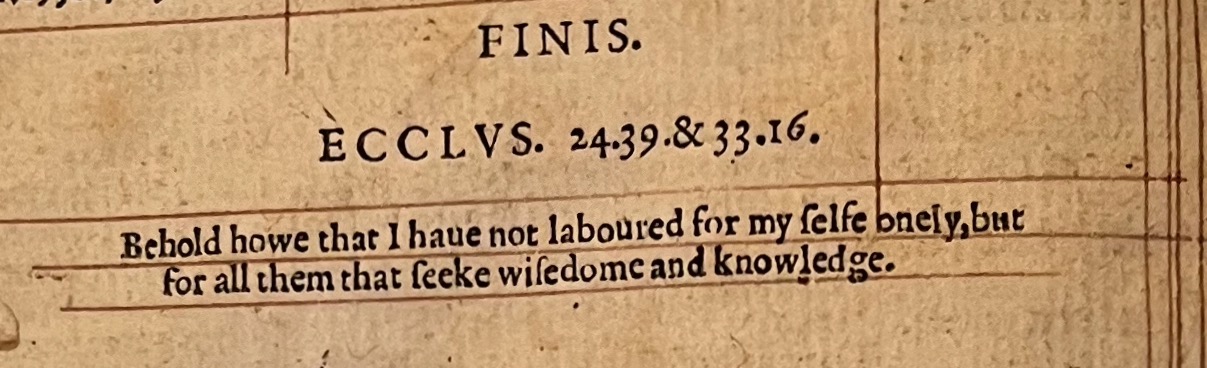
[The Bible,] Geneva version, published by Christopher Barker, London, circa 1580-1588. Collection of the Jonathan Clark House, photo credit: Reed Perkins, 2022.

What a year!

Finis. The End. Today is December 31, the last day of a long and eventful 2022. I’m not up to the task of summarizing all the highs and lows of the past year. I’ll leave that to others.

But I thought recalling one special summer day at the Clark House might make a nice valediction at the close of the old year and the beginning of the new. And for me, without question, the best day for the Clark House this year was July 23, 2022, the day we celebrated the generous donation of the historic Bonniwell family Bible and papers.

Continue reading

The Bonniwell Bible’s provenance or, Who Owned It & When?

Provenance

Provenance is an important concept for historians, collectors and museums. It refers to the chain of ownership of any collectible item, including manuscripts, artworks, official documents or, in our case, a family Bible. Establishing the provenance of an item—such as the Bonniwell Bible—from its creation to the present day is important for several reasons:

  • By studying this Bible as an artifact, a book published on paper, we are establishing its history and authenticity as a Bible, published in London, England, by Christopher Barker, in the Geneva translation, including copious notes, helps and other additions, probably during the reign of Queen Elizabeth I and, more specifically, circa 1580-1603.
  • By studying the inscriptions in this Bible, we can also try and establish who owned the book, and when they owned it. The more we know about this, the more confident we can be about the historical and genealogical information found in the Bible’s many inscriptions.

Who owned it first?

That’s still a bit of a mystery. On the one hand, we do have a solid—though perhaps not unbroken—history of Bonniwell family inscriptions in this Bible, beginning in 1697 and continuing through the early 1900s. First-person family recollections record the Bible’s direct descent from that time until the present day. And we know that this Bible was first in the possession of a related branch of the Bonniwell family and then owned by “our” Bonniwells no later than 1795:

Bonniwell Bible, detail, showing inscription by William Bonniwell, 1798, and ligature WBonniwell, 1795. photo credit: Kendalyne Gentile, 2022.

Continue reading