Veterans Day, 2025

Veterans Day is today. For a perspective on the day—and our early Mequon veterans—here’s a post originally published at Clark House Historian on November 11, 2016, and revised, expanded and republished several times since.

Armistice Day — Veterans Day

One hundred and seven years ago today, at the eleventh hour, of the eleventh day, of the eleventh month—Paris time—the Armistice of Compiègne took effect, officially ending the fighting on the Western Front and marking the end of World War I, the optimistically named “War to End All Wars.”

In the United States, the commemoration of the war dead and the Allied victory began in 1919 as Armistice Day, by proclamation of President Woodrow Wilson. Congress created Armistice Day as a legal holiday in 1938. Starting in 1945, a World War II veteran named Raymond Weeks proposed that the commemorations of November 11 be expanded to celebrate all veterans, living and dead. In 1954 Congress and President Eisenhower made that idea official, and this is what we commemorate today. There are many veterans with a connection to the Jonathan Clark house. We honor a few of them in this post.

114th Regimental Reunion, May 30, 1897, Norwich, N. Y., Library of Congress [cropped and adjusted]. Many Clark neighbors served during the Civil War, and many remained active in the Grand Army of the Republic, the national organization for Union Army veterans, including these men from rural New York, gathered together in 1897.

Continue reading

Finding what you want: a few tips for readers

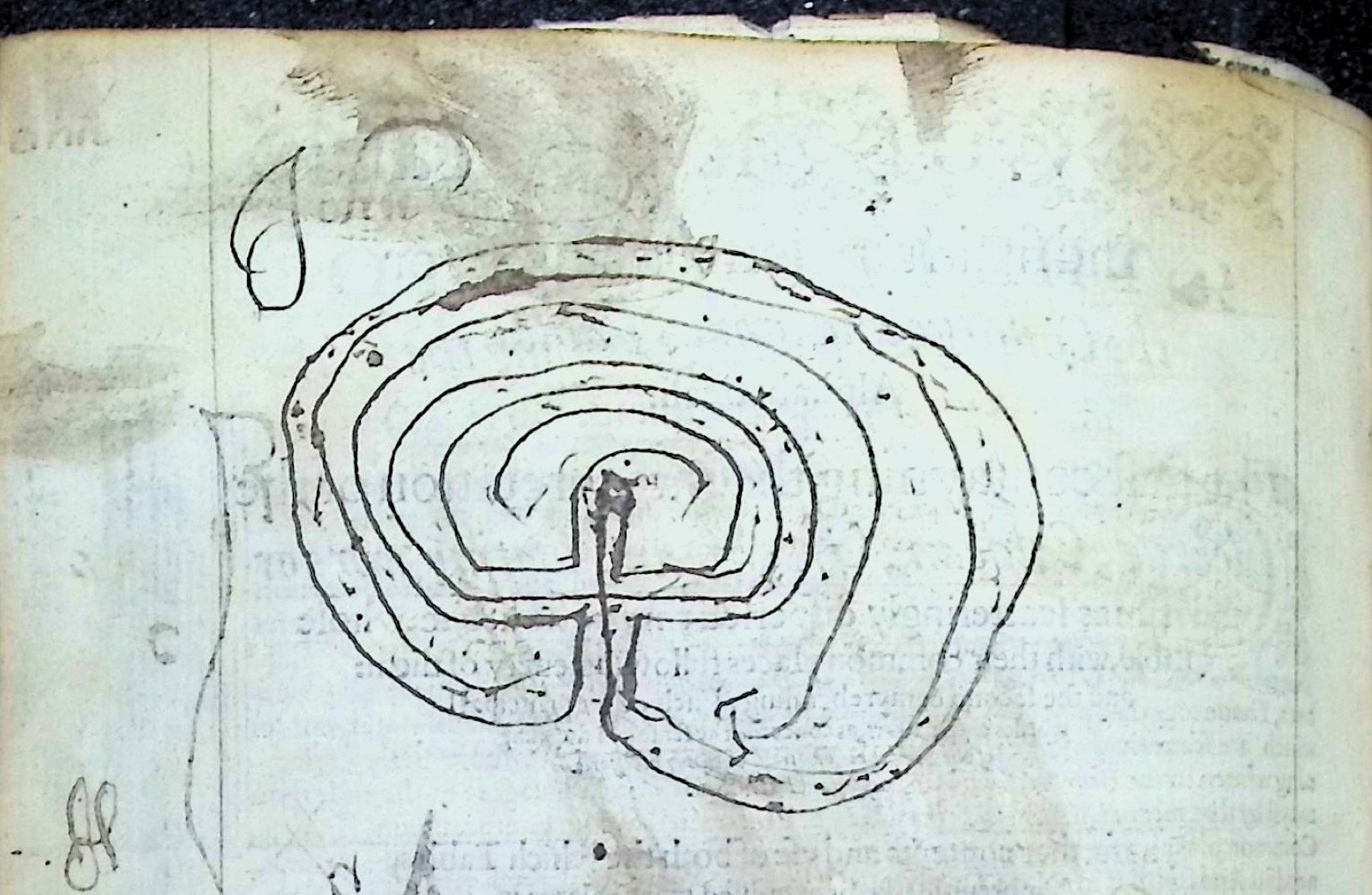
Sometimes a blog is like a labyrinth…

JCH Bonniwell family Bible, MS inscription “John” and drawing of a Labyrinth, First […] Concordance, sig. A1 verso (detail)

I’m looking forward to blogging more regularly, and I hope you enjoy the upcoming posts. But I’ve been publishing Clark House Historian for almost ten years (!), and I know it can be hard to navigate the blog and find the particular historical information, photos, maps and other images that you might be looking for. Today’s post has a few tips to help you make your way through the twists and turns of the Clark House Historian information labyrinth.

Tip No. 1: Click the links!

If you’d like to view a larger, clearer version of almost any image on the blog: click the image (or, sometimes, the link in the caption), and a new full-size image will open in a new window. Other links (highlighted in the blog’s signature minty-green color) will connect you with related blog posts and online sources for further information.

And by the way, you can read the blog on your phone and open and zoom in on the photos, drawings, maps and other images. But I create the CHH posts on a device with a good-sized screen, and I recommend viewing on the largest screen that you can.

Finally, and most importantly, be sure to click the Continue reading—> link, typically found after the first image and paragraph or two. There is a lot more to be found “below the fold.”

Continue reading

Memorial Day, 2025

Lest We Forget

Our annual Memorial Day post, first published in 2020, more relevant with each passing year.

Graves of Unknown Union Soldiers, Memphis National Cemetery, photo by Clayton B. Fraser, (Library of Congress), public domain. Memphis National Cemetery is the final resting place of Mequon’s Watson Peter Woodworth, and almost 14,000 of his Union Army comrades.

Today is the day our nation officially observes Memorial Day. For many Americans, Memorial Day represents “the first day of summer,” and is traditionally celebrated with trips to the lake, picnics, parades, and sales on cars, appliances, and other consumer goods.

But for many of us, Memorial Day remains rooted in its origins as Decoration Day. The first national observance was in 1868, when retired general John A. Logan, commander and chief of the Grand Army of the Republic—the Union veterans’ organization—issued his General Order Number 11, designating May 30 as a memorial day “for the purpose of strewing with flowers or otherwise decorating the graves of comrades who died in defense of their country during the late rebellion, and whose bodies now lie in almost every city, village, and hamlet churchyard in the land.”

On this Memorial Day, let’s take a moment to remember what this day truly represents.

Continue reading

JCH News & Events – Spring, 2025

Howdy! Sorry for the long blog silence. It’s not that I’m lacking for topics or material to share with you all, but I’ve been busy “behind the scenes” at the Clark House for the last month or so.

In particular, I’ve been working on two big projects. JCH executive director Nina Look and I have just published the Spring | May 2025 issue of the JCH Newsletter, and Nina and I have been collaborating with JCH intern Nicole Buerosse on a major, archival-quality upgrade for the preservation and display of the museum’s irreplaceable Bonniwell Family Bible.

Scaffolding at the Clark House? What’s up with that? Read on for more info…

Continue reading

Help the Historian: Mysterious (Bible?) Fragment – a clue!

Among the real pleasures of writing a blog like this are the comments I receive from CHH readers. Recently, I heard from reader James Cornelius of nearby Grafton, Wisconsin,1 who had some thoughts about our January 24, 2025, post “Help the Historian: Mysterious (Bible?) Fragment.” 2

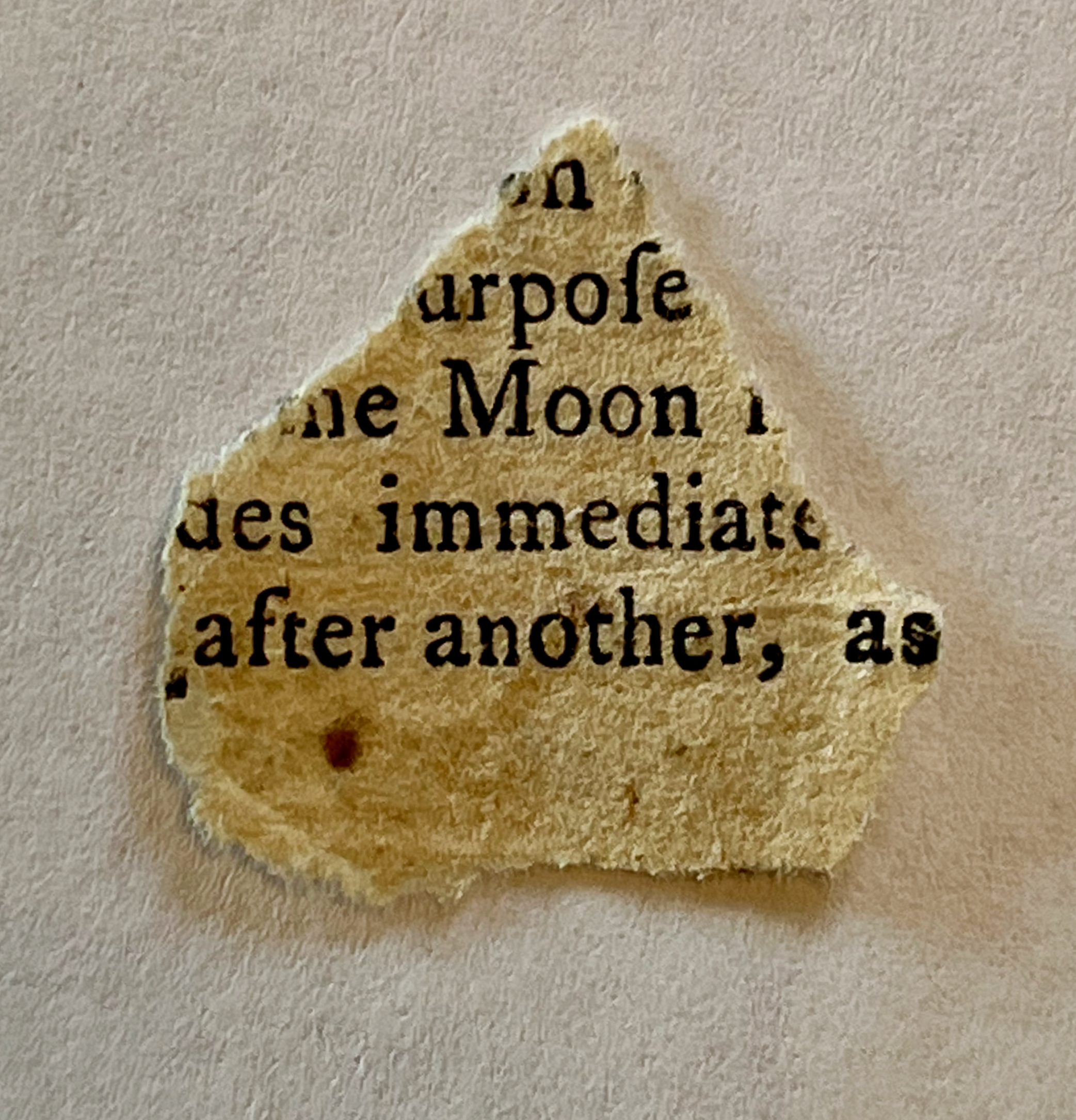
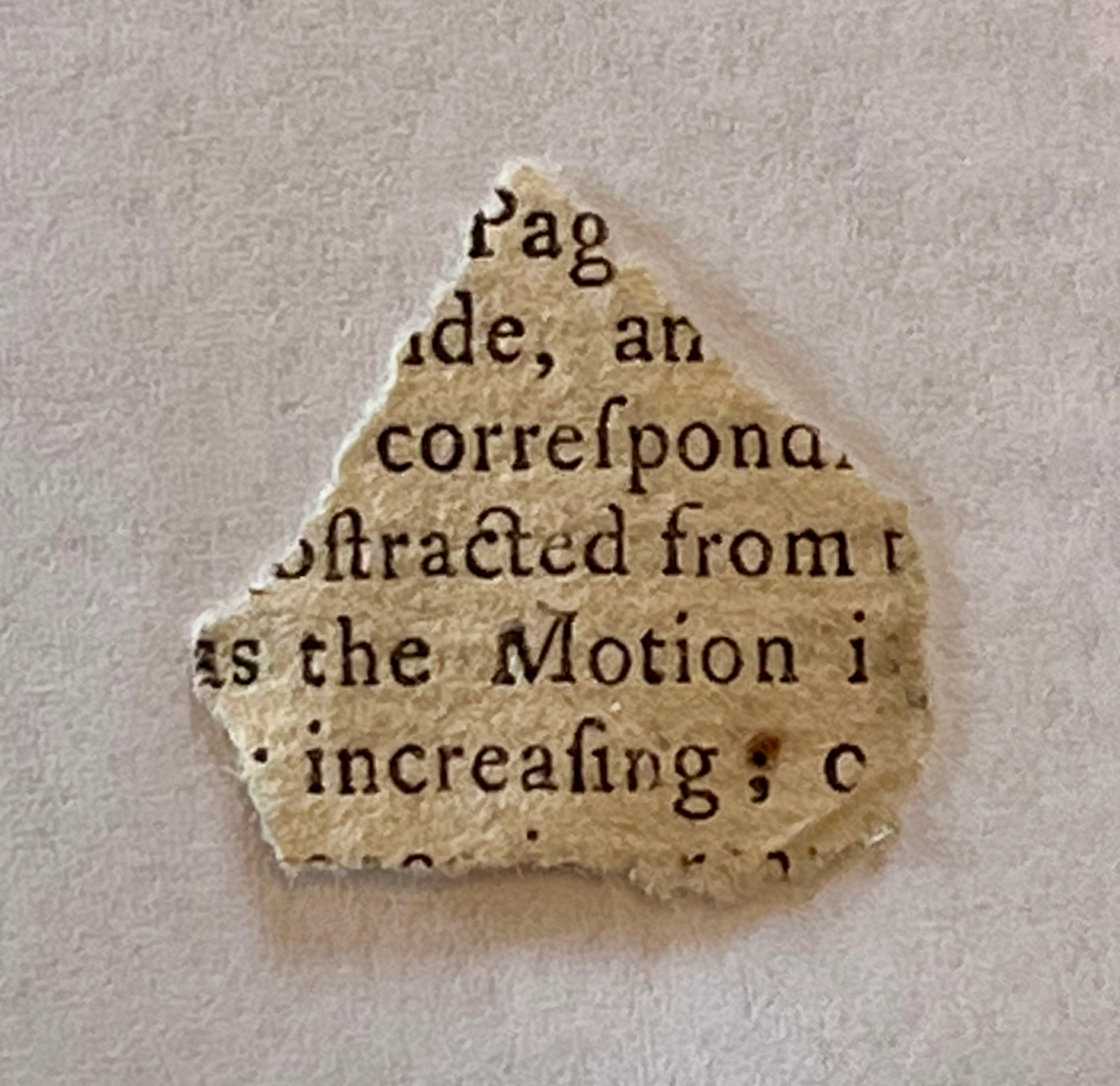
As the original post explained, I had been examining a number of loose Bonniwell papers, scraps, and other ephemera that were donated to the Clark House along with the Bonniwell family Bible itself, and I was particularly interested in one little fragment of printed text that had me baffled.

The mysterious fragment, sides A & B, photo credit: Reed Perkins, 2022.

In my original post, I examined the text and typography of the fragment and estimated that the it was published sometime between the late-sixteenth century (at the very earliest) and—at the very latest—the first decades of the nineteenth century. And the mentions of “Moon” and “motion” and such suggested a source that might be more scientific or philosophical, and not necessarily a sacred text, but I couldn’t think what that might be.

A new possible source: Almanacs!

In his comment, James observed: My hunch is that this triangular scrap /bookmark came from an almanac, likely as common in 1800-1820 U.K. as in U.S. a half-decade later. Many fairly good or detailed ‘scientific’ discussions appeared in the old almanacs or ‘farmer’s friends.’

I think James is on to something. Almanacs seem like a very plausible source. But how common were farmer’s almanacs in the UK, and how likely was it that the Bonniwells had access to these annual “farmer’s friends” in Chatham, Kent, England, in the years before their 1832 immigration to North America?

Continue reading

Help the Historian: Mysterious (Bible?) Fragment

I’m spending some of my time this winter on projects related to the cataloging, interpretation and display of our historic Bonniwell Family Bible. One of the items on my “to do” list involves the study of a number of Bonniwell papers and other ephemera that were donated along with the Bible itself. Some of the miscellaneous papers are self-explanatory and easily understood. But one little fragment of printed text has me baffled, and I need your help, history lovers!

The fragment, sides A & B

Photos credit: Reed Perkins

Continue reading

“Dear Santa,”

The Clark House Historian’s Christmas Wish List

Kriss Kringle’s Christmas Tree [title page], E. Ferrett & Co., Philadelphia, 1845. Library of Congress

I grew up in the Chicago suburbs, and I remember the holiday thrill of riding the Chicago & Northwestern commuter train downtown with my parents, and then walking into the majestic State Street headquarters of Chicago’s grandest department store, Marshall Field & Company. Our mission? A trip up to the “toy floor” at Field’s, where we would wait in line to tell Santa all the wonderful things we would like to receive for Christmas that year.1

It goes without saying that I haven’t been able to fit on Santa’s lap for a very long time. But as the Clark House Historian, I still have holiday dreams and wishes, and today I’d like to share some of them with you. Who knows, perhaps Santa will work his magic once again?

(Official disclaimer: I do not serve on the JCH Board of Directors, or any of its committees. This is my Christmas daydream, a fantasy of what I’d like to see unfold at my favorite museum, given unlimited resources. And besides, as the great Chicago architect and city planner Daniel Burnham famously said: “Make no little plans. They have no magic to stir men’s blood!”)

My list is organized into several parts, the first of these is…

Continue reading

Veterans Day, 2024

Veterans Day is today. For a perspective on the day—and our early Mequon veterans—here’s a post originally published at Clark House Historian on November 11, 2016, and revised, expanded and republished several times since. These stories, by the way, are not the only stories of local veterans that I have collected. My recent research has discovered some amazing stories of German immigrant and Black American soldiers that fought for the Union—and Ozaukee county—as part of Wisconsin’s Civil War experience. And I still have much to learn about the Civil War service of Mary Clark’s brother, Benjamin Turck and the post-war travails of Persie Clark’s husband, the war-wounded U.S. Navy veteran and pensioner Henry D. Gardner. I hope to tell those stories here, at Clark House Historian, in the near future.

Armistice Day

One hundred and six years ago, on the eleventh day, of the eleventh month, at the eleventh hour—Paris time—the Armistice of Compiègne took effect, officially ending the fighting on the Western Front and marking the end of World War I, the optimistically named “War to End All Wars.”

In the United States, the commemoration of the war dead and the Allied victory began in 1919 as Armistice Day, by proclamation of President Woodrow Wilson. Congress created Armistice Day as a legal holiday in 1938. Starting in 1945, a World War II veteran named Raymond Weeks proposed that the commemorations of November 11 be expanded to celebrate all veterans, living and dead. In 1954 Congress and President Eisenhower made that idea official, and this is what we commemorate today. There are many veterans with a connection to the Jonathan Clark house. We honor a few of them in this post.

Jonathan Clark, Henry Clark, and the U.S. Army

Jonathan M. Clark (1812-1857) enlisted as a Private in Company K, Fifth Regiment of the U. S. Army, and served at Ft. Howard, Michigan (later Wisconsin) Territory, from 1833 until mustering out, as Sargent Jonathan M. Clark, in 1836. In the 1830s, Fort Howard was on the nation’s northwestern frontier. Jonathan’s Co. K spent much of the summers of 1835 and 1836 cutting the military road across Wisconsin, from Ft. Howard toward Ft. Winnebago, near modern Portage, Wisconsin.

Fort Howard, Wisconsin Territory, circa 1855, from Marryat, Frederick, and State Historical Society Of Wisconsin. “An English officer’s description of Wisconsin in 1837.” Madison: Democrat Printing Company, State Printers, 1898. Library of Congress. Click to open larger image in new window.

Continue reading

Music instruction in Milwaukee, 1845

I ran across this advertisement while doing some research on the Bonniwell Band, purportedly the first band to perform in the new Wisconsin Territory. The band featured brothers—and Clark House neighbors—James, Charles, William, Henry and Alfred Bonniwell, and their brother-in-law Philip Moss.

But the Bonniwell Band was not the only source of music in the area…

“Music.” [John M. Windus, music instruction], advertisement, Milwaukee Daily Sentinel 17 Nov 1845, page 3.

Music.
John W. Windus informs the lovers of good music that he has established himself in Milwaukie for the purpose of teaching the above science. His forte is principally marshal [sic] music, and he considers himself fully competent to teach Bands or persons on any wind instrument. References can be had of Holton & Goodall.
Mijwaukie [sic], Oct. 1845

Yep. In 1845, Milwaukee area “lovers of good music” could learn band instruments from Mr. Windus. And martial music was his forte.

Continue reading