Labor Day – a photo essay

UPDATE: This was supposed to go out on Monday. I hit “publish” before the piece was ready. Here’s the updated 2025 version for your reading enjoyment. Sorry for any confusion (and, for you CHH subscribers, the premature email in your inbox).

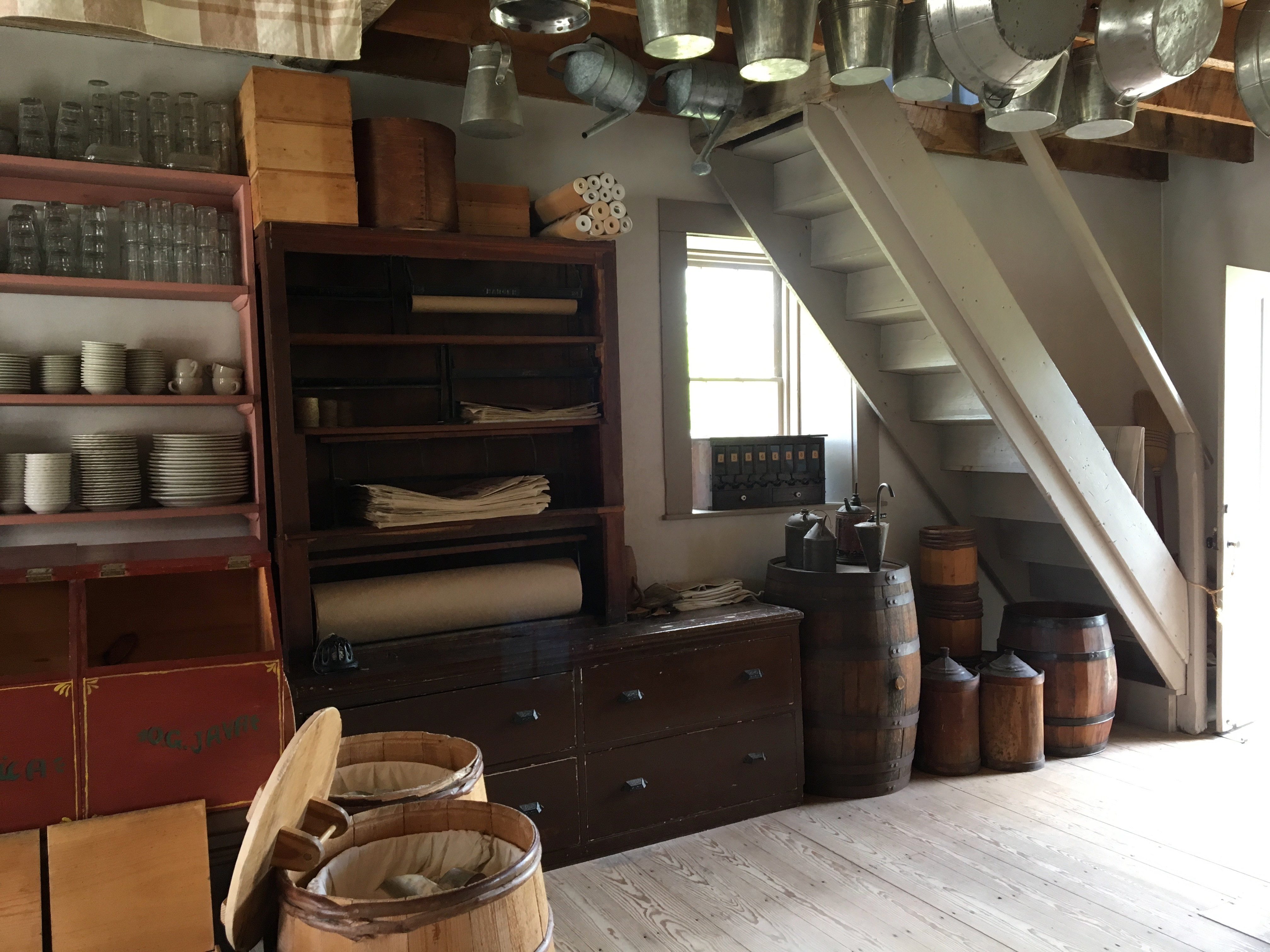
Monday, September 1st, is Labor Day, the holiday celebrating the working men and women of our nation, and I thought I’d commemorate the day with a lightly-revised re-post of this CHH piece from 2023. This Labor Day, as in 2023, I have to work a shift at our local mercantile establishment. You know, a store kind of like this one, only much bigger, stocked with just about anything you need for modern living:

Like many Americans, I don’t have the day “off” on Monday, and won’t be marching in a parade, but I’d still like to honor the holiday and salute the American worker, past and present. With that in mind, let’s revisit some of the nineteenth-century occupations we’ve talked about previously at Clark House Historian, highlighting a few of the many skills, trades, and occupations common during the Clark House era.

Since it is a holiday, I’m not going to add long commentaries to each photo. Enjoy the photo galleries, and be sure to click each gallery—and photo—to open and peruse larger versions of each image. And click the highlighted links to visit the original CHH posts, filled with lots more information about the different skills, tools, and jobs, and the full image credits.

Continue reading

The Clarks, a family of readers…

Some of our recent and upcoming posts are focused on reading and evaluating source materials. The first of these posts, JCH Sources, part 1, was illustrated with this drawing…

Whistler, James McNeill, artist, Reading by Lamplight, etching and drypoint, 1859. MetMuseum. Bequest of Julia H. Manges, in memory of her husband, Dr. Morris Manges, 1960

This is James McNeill Whistler’s 1859 Reading by lamplight, an evocative drawing of a young woman, reading by the light of an oil lamp, a cup of tea at her side. The lamp is supported on a tall, slender metal stand. It’s light is raised even further by placing the lamp stand on a large, overturned bowl.

If I didn’t know better, I’d think this was Caroline Clark, or one of her other well-read sisters. Caroline would have been about 19 years old in 1859, when Whistler made this drawing. She was in the middle of her pioneering two-year high school course in Milwaukee, a talented, energetic young woman on the way to living a remarkable life of service. Here she is circa 1889-1900, around age 50, in the prime of life:

Continue reading

JMC: a soldier’s life at Fort Howard, 1834

In the summer of 1834, the U.S. Army’s Brevet Brigadier General Hugh Brady made an inspection tour of many of the posts under his command. One of those posts was Fort Howard, at Green Bay, in the then Michigan Territory. In an earlier post, I briefly mentioned the General’s July 17, 1834, visit to the fort and how “Gen. Brady reviewed all the troops, who made a brilliant display of military evolutions, highly gratifying to those who witnessed them, and evidently meriting the approbation they received from the worthy and excellent commander-in-chief.

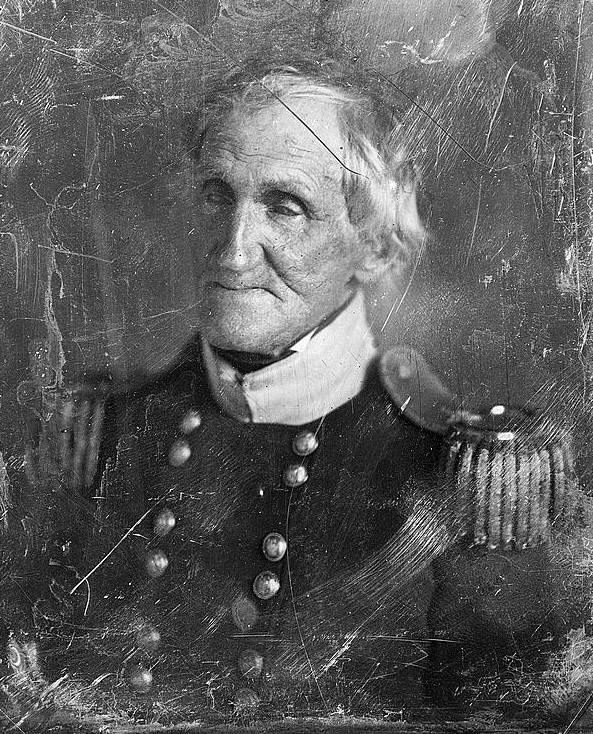
Gen. Hugh Brady, c. 1844-1851. Photo credit: see note 1

I have since located the official report of the inspection that Brady sent to his superiors back in Washington, DC. and I want to share it with you today. I think you’ll find that a close reading of the general’s report will give some insights into the daily lives and routines of soldiers—including our Jonathan M. Clark—as they served their country “on the frontier” in the mid-1830s.

Continue reading

Labor Day – a photo essay

Today is Labor Day, the holiday celebrating the working men and women of our nation, and I thought I’d commemorate the day with a lightly-revised re-post of this piece from 2023.

This Labor Day, I’ll be at home, working on my upcoming lectures for the state DAR and the Cedarburg History Museum. Last year, I had to work at our local mercantile establishment. You know, a store kind of like this one, only much bigger, stocked with just about anything you need for modern living:

I don’t really have the day “off” today—too much writing to do—and won’t be marching in a parade, but I’d still like to honor the holiday and salute the American worker, past and present. With that in mind, let’s revisit some of the nineteenth-century occupations we’ve talked about previously at Clark House Historian, highlighting a few of the many skills, trades, and occupations common during the Clark House era.

Since it is a holiday, I’m not going to add long commentaries to each photo. Enjoy the photo galleries, and click each gallery to open larger versions of each image. And click the highlighted links to visit the original CHH posts, filled with lots more information about the different skills, tools, and jobs, and the full image credits.

Continue reading

Meet the neighbors: the Loomis family

I’m in the middle of several larger CHH research projects and I find myself swamped with information on early Mequon area pioneers. So rather than wait until I’ve got it all sorted out and then organize it into a big essay or two (or more!), I’ll be putting up some of these new bits and pieces on the blog as I find them.

Today’s subjects are the families of Jonathan Loomis (1776-1849) and his eldest child, Issac Chester Loomis (1802-1882), two of old Washington/Ozaukee county’s first white settler families. I’ve mentioned some of these folks in previous CHH posts. And while the Loomis name does appear in some of the early county histories and land records, so far I’d not been able to learn much about the family or how they came to the Wisconsin Territory in the 1830s. In fact, given that the mid-1800s penmanship on some of the source documents was often florid to the point of being unreadable, I was sometimes unsure whether documents discussing or signed by “J. Loomis” versus “I. Loomis” represented the same man, or two individuals. Today’s source goes a long way toward solving these questions.1

Descendants of Joseph Loomis in America

Loomis, Elias, and Charles Arthur Hoppin. Descendants of Joseph Loomis in America, and his antecedents in the old world. edited by Loomis, Elisha S [Berea? O, 1909], Library of Congress.

As luck would have it, I just ran across a useful digitized book in the collection of the Library of Congress, titled Descendants of Joseph Loomis in America, and his antecedents in the old world. I’m not an expert in Loomis genealogy, and thus not entirely sure how accurate this book is, but what I have read here mostly checks out when compared to what I have found elsewhere. With that said, below are the key bits of the book that are related to very early Washington/Ozaukee county history and, in particular, Isaac Chester Loomis and his family. What follows is taken verbatim from pages 193 and 390-391, though I’ve taken the liberty of expanding many of the abbreviations and adding a few paragraph breaks for ease of reading. I’ve also added a few footnotes to explain some possibly obscure references.

Let’s begin with the patriarch of the family, Jonathan Loomis…

Continue reading

Labor Day – a photo essay

Even thought it’s Labor Day, the holiday celebrating the working men and women of our nation, I’ll be at work, back at our local mercantile establishment. You know, a store kind of like this one, stocked with just about anything you need for modern living:

I don’t have the day off, and won’t be marching in a parade, but I’d still like to honor the holiday and salute the American worker, past and present. With that in mind, let’s revisit some of the nineteenth-century occupations we’ve talked about previously at Clark House Historian, highlighting a few of the many skills, trades, and occupations common during the Clark House era.

Since it is a holiday, I’m not going to add much commentary today. Enjoy the photos, and click the links to visit the original CHH posts with lots more information about the different skills and jobs, and for full image credits.

Continue reading

I must have drifted off…

Inman, Henry. Rip Van Winkle Awakening from his Long Sleep, 1823. National Gallery of Art, gift of William and Abigail Gerdts. Public Domain.

A long “nap”

Unlike Rip van Winkle, I haven’t been asleep the whole time since our previous post. But we are well overdue for new blog material. I’ve got a big backlog of documents and images to share with you; all I need to do is get writing. But first…

Be sure to vote today!

It’s election day today, and your vote counts. If you haven’t already done so, get out of the house, over to your polling place, and vote. Voting is your right and responsibility as a citizen, and an indispensable element of our nation since the earliest days of the Republic.

Not surprisingly, voting and public service were an important part of life in the Clark House era. From 1840 onward, Jonathan M. Clark, Peter Turck, William T. Bonniwell and many other relatives and neighbors sought, and won, appointment or election to a wide variety of local, territorial and state offices. Voting—then limited to white males only—was a priority for Mequon’s early settlers, and they never failed to turn out in large numbers for each election. Their passion for civic engagement and electoral politics was, in turn, passed to the next generation.

Continue reading

But first, a word from our sponsor…

Caroline (Clark) Woodward, in our first Clark family endorsement!

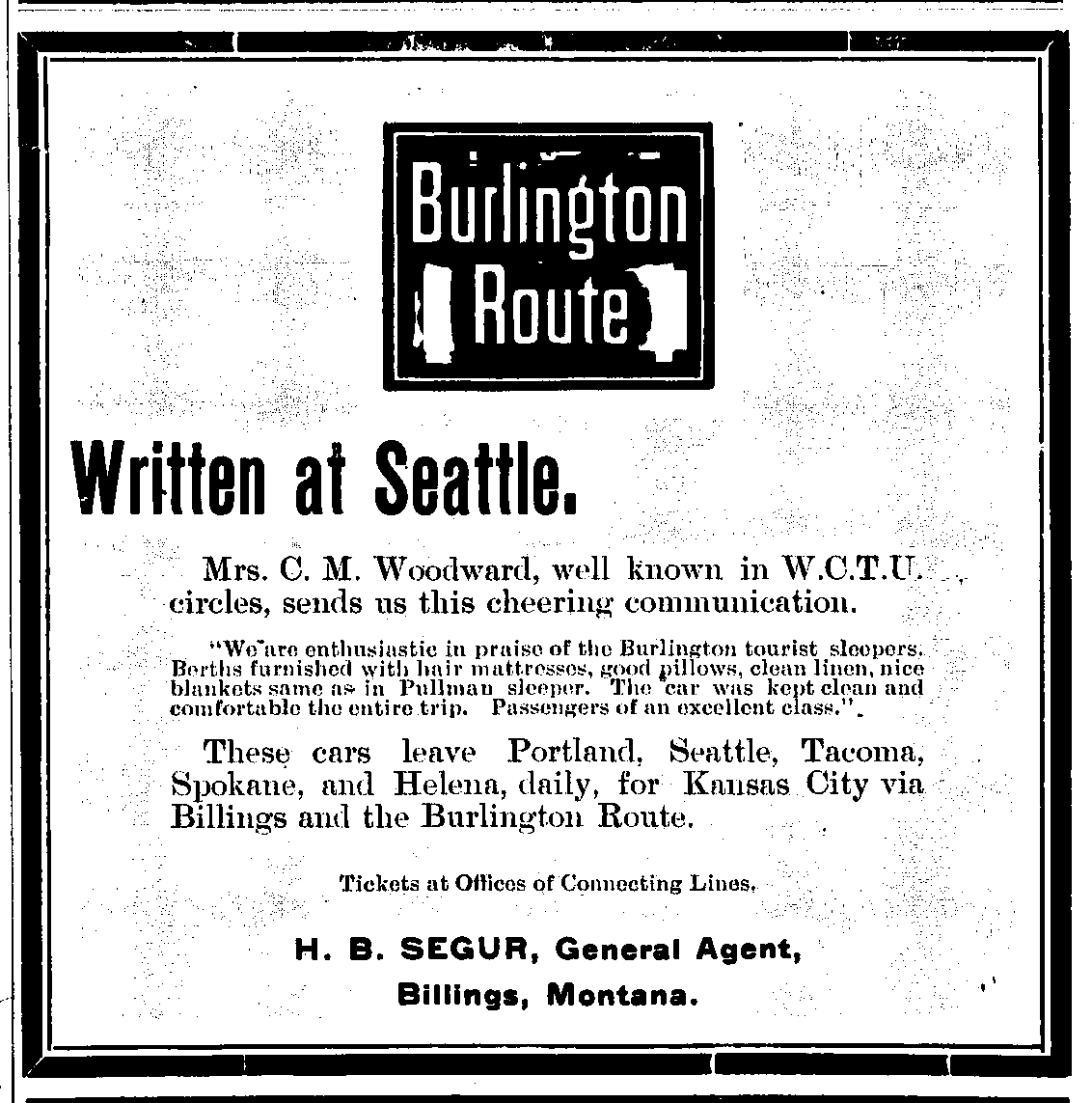
Here’s something new for Clark House Historian: a commercial endorsement from one of Jonathan and Mary Clark’s children! In June, 1900, our own Caroline M. (Clark) Woodward recommended travel on the Burlington Route in this newspaper ad…

Woodward, Caroline in railroad advertisement, Red Lodge Picket, Red Lodge, Montana, June 1, 1900, page 3. Click to open larger image in new window.

Mrs. C. M. Woodward, well known in W.C.T.U. circles sends us this cheering communication.

“We are enthusiastic in praise of the Burlington tourist sleepers. Berths furnished with hair mattresses, good pillows, clean linen, nice blankets, same as in Pullman sleeper. The car was kept clean and comfortable the entire trip. Passengers of an excellent class.”

Continue reading

Caroline M. (Clark) Woodward: a closer look at that 1893 biography

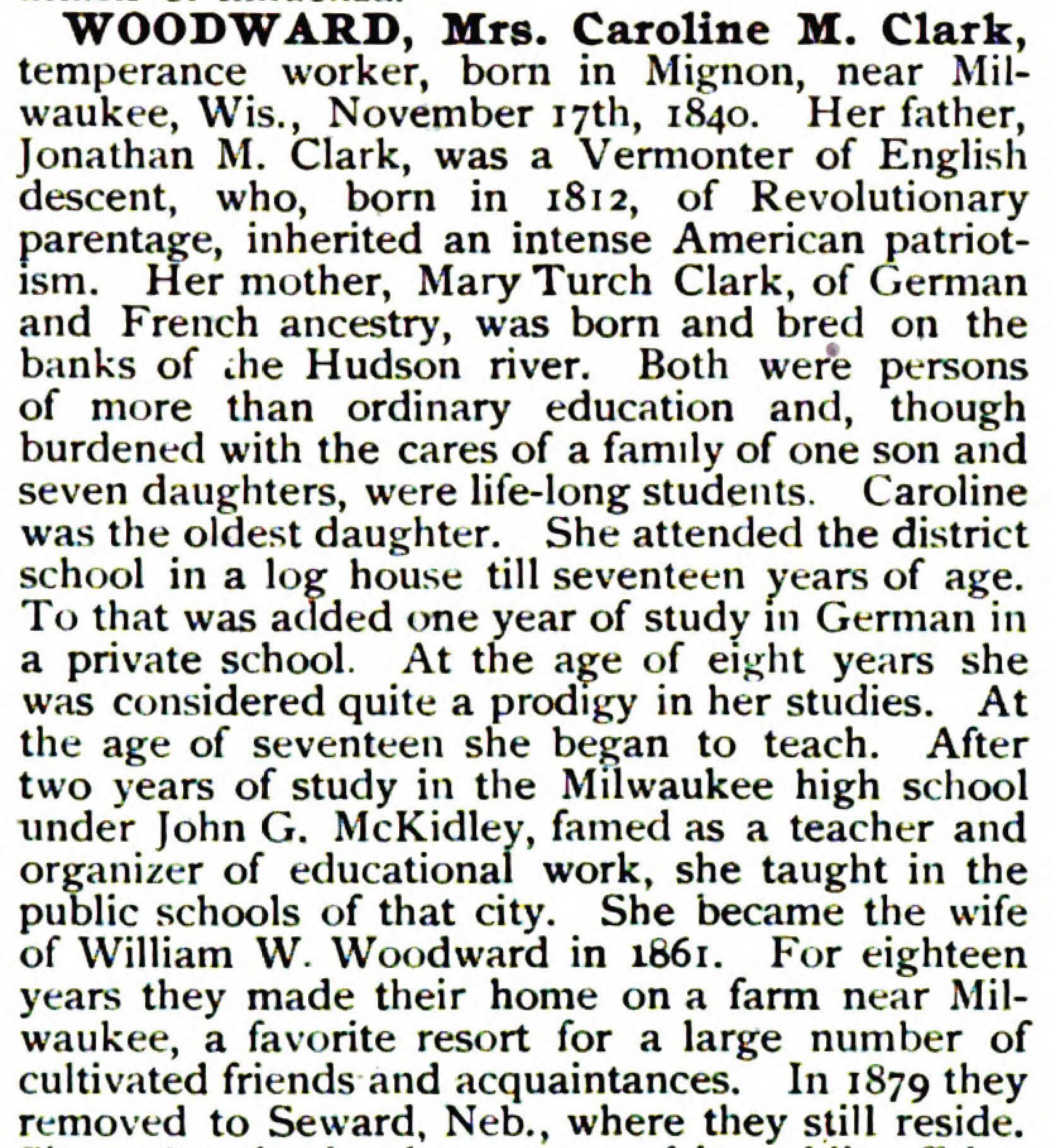
Today, as we continue to explore the life of Jonathan M. and Mary (Turck) Clark’s eldest child, Caroline Mary Clark—later usually known as Mrs. C. M. Woodward—we’ll take a fact-by-fact look at the biographical sketch of Caroline that was published in 1893, re-printed unchanged in 1897, then abridged and reprinted in 1912. For a full discussion of these three publications, see last Monday’s Caroline M. (Clark) Woodward: first steps toward a biography.

Willard, Frances E., and Mary A. Livermore. 1893. A woman of the century ; fourteen hundred-seventy biographical sketches accompanied by portraits of leading American women in all walks of life ; ed. by Frances E. Willard and Mary A. Livermore, assisted by a corps of able contributors, title page and page 779.

Today’s post will be less of a fully-formed essay, and more of a running analysis, commentary, and proof-reading of this 1893 biographical sketch. We’ll take one portion at at time, starting at the beginning. The source text will be presented as a shaded quotation, followed by my commentary and corrections in simple black text on white background, with highlighted links to additional sources and explanations and, of course, a few footnotes, too. Here we go…

Continue reading

Caroline M. (Clark) Woodward: first steps toward a biography

In our most recent blog post, Another family portrait! Caroline (Clark) Woodward, c. 1890s, we located and discussed the history of a previously unknown photo of Jonathan M. and Mary (Turck) Clark’s eldest child, Caroline Mary Clark, later usually known as Mrs. C. M. Woodward:

Townsend Elite Studio, [Portrait, Caroline M. (Clark) Woodward], inscribed “Mrs. C. M. Woodward, Supt. Work among Railroad Employes, N.W.C.T.U.”, photograph, circa 1889-1900. Photo courtesy Frances Willard House Museum & WCTU Archives, Evanston, Illinois. Click to open larger image in new window.

Caroline’s life was the most public—and perhaps best documented—of all the members of Jonathan M. Clark family, and is overdue for a closer examination. So today we begin a multi-part look at Caroline’s story, starting with three biographical sketches that were published during her lifetime.

Continue reading