I’m still investigating the cabinet card and tintype photos of Cyrus Clark. More on those coming soon. Meanwhile, it’s Back to School time for many of us, so here’s a page with a transcription of the earliest known school records in old Washington county prior to 1845:
Continue readingAuthor: Clark House Historian Reed Perkins.
No post today
I’m upstairs in my home office, working on the blog. Be well, stay safe. See you soon.

Jonathan M. Clark house, Mequon, Wisconsin. Stairs to second floor.
Photo by Reed Perkins, 2015.
Sarah and Cyrus: A Closer Look
Dating and interpreting old photographs, part 1
Our recent look at the lives of Cyrus Clark and Sarah Strickland Clark (here, here, here, and here) would not have happened without the interest of—and information shared by—Clark and Strickland descendants Steven Clark Van Slyke and Lynnette Thompson. I love “filling in the blanks” of local and family history, and discovering more about Cyrus and Sarah has been a very enjoyable challenge.
For me, one of the real pleasures of the project came from the Cyrus and Sarah (Strickland) Clark photos that Steve and Lynette were so kind to share. Both were keen to learn more about the photos, where and when were they taken, how old were the sitters, and so forth. So, in the spirit of adventure, here is our first Clark House Historian attempt at analyzing historic photos1.
We’ll start with the only photograph I have of Sarah Strickland Clark. Here’s the front:
Continue readingMid-week Miscellany
Here are a few quick odds and ends while I finish working on the last of our Cyrus Clark and Sarah Strickland Clark posts.
Burying the lede: Cyrus Clark edition
For the last week or so we’ve been looking at the lives of early Mequon and Wisconsin Territory settlers Cyrus Clark and Sarah (Strickland) Clark. If you missed those, you can catch up here, here, here, and here. And in one of those longer posts, I pretty much managed to “bury the lede,” of the breaking news of the week, namely: We found the missing documents that answer the question “who were Cyrus Clark’s parents, and was he related to the builder of the Clark House, Jonathan M. Clark? “
Clark and Strickland descendant Lynette Thompson contacted researchers from the New England Historic Genealogical Society via their site, americanancestors.org, and managed to locate the 1866 will and probate file for one Kellogg Clark of Sandisfield, Berkshire County, Massachusetts. He had been cited as a possible father for Cyrus Clark, but without supporting documents.
But his will and probate papers confirm that Kellogg Clark had a son named Cyrus Clark, and that in 1866 son Cyrus was in Wisconsin. Other information in the documents list siblings of Cyrus Clark, including a brother, Alexander Clark, who was previously known. We are now convinced that Kellogg Clark and wife Charity of Sandisfield, Berkshire County, Massachusetts were the parents of Mequon settler Cyrus Clark.
And, since every clue we have about Jonathan M. Clark indicates that his family lived in either Derby, Orleans County, Vermont or nearby Stanstead, Lower Canada (later Province of Quebec), I am quite convinced that Cyrus Clark is not (closely) related to Jonathan M. Clark. (For now, I will hedge my bets with that “closely” modifier—there are, after all, a whole lot of Clark families in New England and they moved around a lot in the 1800s and who can tell who is related to whom—but I don’t believe Cyrus and Jonathan are related, or knew each other before coming to Wisconsin.)
“Follow Blog Via Email” issues…
According to reliable reports, the “Follow Blog Via Email” widget in the right-hand column of this blog is not working properly. I think my old widget may not be 100% compatible with the current WordPress blogging software. I will look into that and see what I can do.
In the meanwhile, if you’d like to follow the blog, skip the widget and just send me a note via the CONTACT link in the top menu. I’ll be glad to issue an emailed “invitation” to follow the blog and then you will get an email each time new material appears here at Clark House Historian (typically each Monday, Wednesday and Friday morning).
A photo for Wednesday…
As a salute to Cyrus Clark’s roots in Berkshire County, Massachusetts, here’s a photo I took there a few years ago. It’s the Housatonic River near the old town of Stockbridge. Not too far from Cyrus Clark’s boyhood home in Sandisfield.

And by the way, “The Housatonic at Stockbridge“…
is also the title of the last movement of Three Places in New England, one of the masterworks of the great American composer Charles Ives (1874-1954). Standing on a small bridge over the river reminded me of the composer’s own description of the piece: … River mists, leaves in slight breeze river bed–all notes and phrases in upper accompaniment…should interweave in uneven way, riverside colors, leaves & sounds–not come down on main beat…”
Here’s a link to a video of a fine performance by the New England Conservatory’s Philharmonia orchestra, Hugh Wolff, conductor. Enjoy.
Monday: Map Day! – Railroads!
If you look at the timeline and other recent posts about early Mequon settlers Cyrus Clark and Sarah A. Strickland, you realize that these two did a lot of moving about in mid-1800s Wisconsin.
How did they do all that traveling? Back and forth between Mequon and Cedarburg in Washington/Ozaukee county and Potosi in Grant county, Waldwick and Moscow in Iowa county, the city of Oshkosh—back east, so to speak, in Winnebago county—and then “moving to” Madison, Lake Co., South Dakota—and still traveling back to (and living part-time at?) Oshkosh. By foot? Canoe? Horse? Buggy? Stagecoach?
The answer is…
Continue readingSarah and Cyrus: part 3
UPDATE May 31, 2021: timeline revised to include “1864” in the dates of enlistment for sons Albert Byron Clark, Charles E. Clark, and Albert Byron’s brother-in-law Francis Rasey.
“The other Clarks” from Mequon to “the other Madison”
Today’s post is the third in a series of several focused on early Mequon settlers Cyrus Clark his wife, Sarah A. Strickland. You know, these folks:


Courtesy Steven Clark Van Slyke and Lynette Thompson.
If you missed it, here are the links to Part 1, Part 2, and an earlier related Map Day post. You might want to take a minute to look at those posts first.
New families, new documents, new understandings
Because I’d spent less time researching Cyrus Clark’s and Sarah Strickland’s families than those of Jonathan Clark and Mary (Turck) Clark, I had a lot of catching up to do. Fortunately, I have been helped along the way by descendants Steven Clark Van Slyke and Lynette Thompson who have generously shared their notes and documents (and photographs!)
Inspired by their work, I have given Sarah and Cyrus the Clark House Historian “full treatment” (at least the pandemic-restricted, online-only version). So my Sarah Strickland and Cyrus Clark knowledge is definitely a work in progress, but it’s one that has yielded many new facts and sources that will help guide further research.
With that in mind, today’s post is less of an essay and more of a timeline, documenting what we know about this family, and what we don’t. We’ll focus on Sarah and Cyrus’s time in Mequon and the years afterward elsewhere in Wisconsin, before they “settled” in Madison, South Dakota.
Continue readingMeet the Neighbors: Cyrus Clark and Sarah A. Strickland
This is the second in what was originally planned to be a three-part1 series on early Mequon settlers Cyrus Clark and Sarah A. Strickland Clark. If you missed it, click here for part one. Also, I suggest you read this post to view maps that will prove useful in following today’s discussion.
The Jonathan Clark House Museum, and my work as Clark House Historian, is not just about Jonathan M. Clark, Mary Turck Clark and their family. The mission of the museum—and this blog—is to:
Collect, preserve and share the history of the Jonathan Clark House and the early settlers of Mequon and Thiensville.
Jonathan Clark House Museum mission statement
So with that in mind, I like to explore the stories of the Clark’s friends and neighbors in order to develop a more comprehensive picture of early Washington/Ozaukee county and it’s settlers. This week—thanks to an unexpected contact from blog reader Lynette Thompson—we will be focusing on not one, but two of Mequon and old Washington/Ozaukee county’s earliest settlers, Sarah Allise Strickland and her husband, Cyrus Clark. Why them? Just look at what I got in my inbox:
Continue readingMonday: Map Day! – Another Clark Family
This week we take a break from our usual focus on the extended Jonathan M. and Mary (Turck) Clark family and begin a week of posts about two remarkable, original Mequon settlers and Clark House neighbors: Sarah Allise Strickland (1823-1891) and her husband, Cyrus Clark (1815-1905).
Sarah A. Strickland was born and raised in Nova Scotia, the eldest child of Daniel and Matilda Strickland. Her family was one of the original white settler families in the area; they were enumerated in Milwaukee County on Wisconsin’s first territorial census in 1836.1
Cyrus Clark was born in western Massachusetts and was in Mequon by about 1839. He married Sarah Strickland in Grafton, Washington (later Ozaukee) County, on March 1, 1841. They lived almost forty years in Wisconsin. First in Mequon and Cedarburg, Washington/Ozaukee) County, and then divided their time between their farm in Moscow, Iowa County, and homes of one or more adult children in Oshkosh, Winnebago County. So how—and why—did they end up in South Dakota at the end of their days?
It’s an interesting story, and one that illustrates a characteristic type of pioneer experience: the continued drive to push westward, on to new frontiers and new challenges. It may seem cliché to us, but it was a real, lived experience for many of Cyrus and Sarah’s generation. This week’s posts will look at a number of key moments in their long lives, especially the decades they spent in Wisconsin. And we have some unique and new sources to share, too.
Beginning at the end…

Gravestones of Cyrus Clark and Sarah A. (Strickland) Clark, Graceland Cemetery, Madison, South Dakota.
Photo by Steve Van Slyke, used by permission.
We begin the story of Cyrus and Sarah Clark at the end, in Lake County, South Dakota, their final resting place. And not one, but two maps today, all of which take us far from Mequon and the Jonathan M. Clark house.
Continue readingBusy researching…
I’m in the middle researching and writing several multi-part Clark House Historian posts, so no essay today. How about a sunny photo of the Clark House parlour, instead?
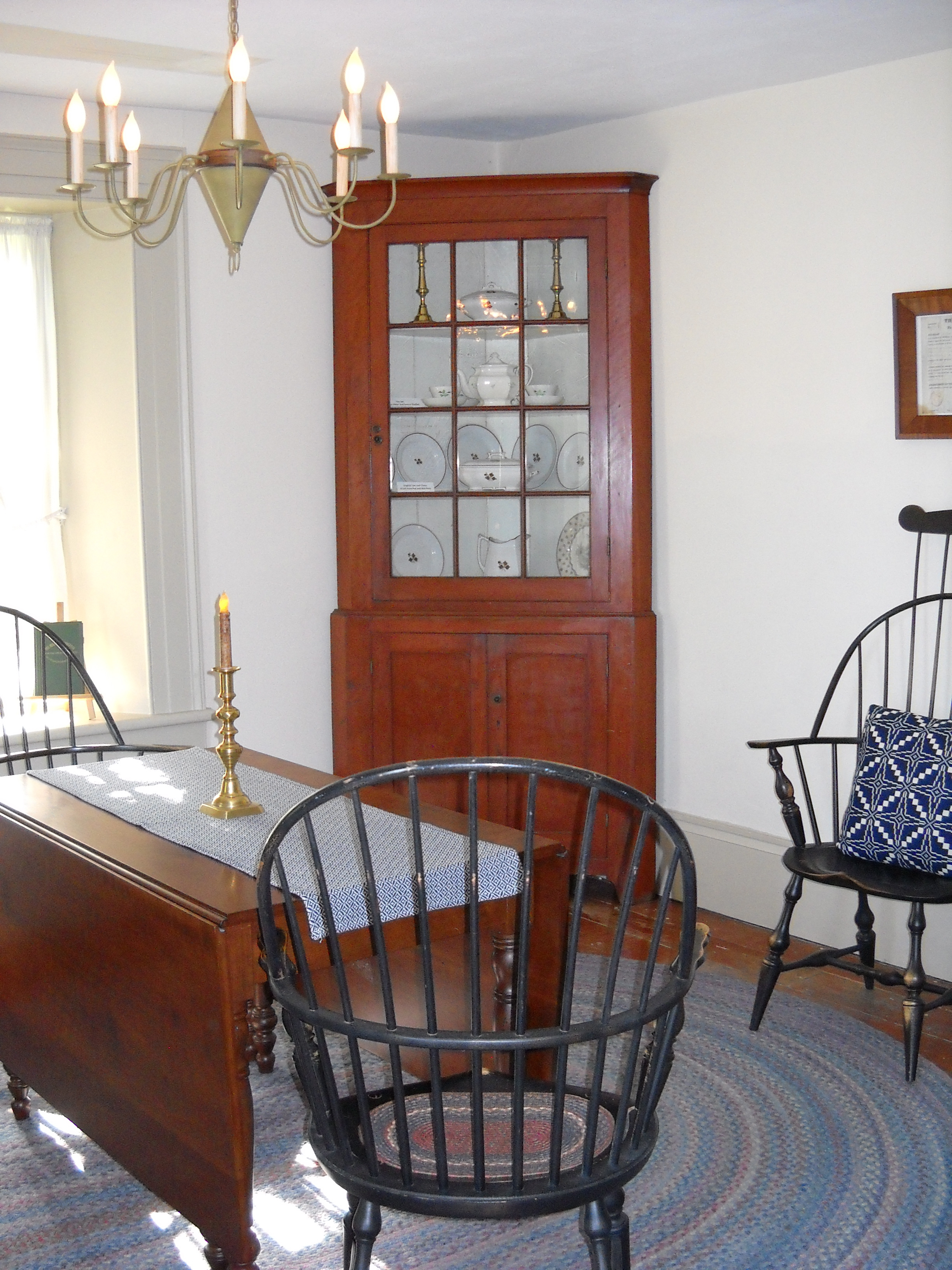
Photo by Reed Perkins, 2015. Click to open larger image in new window.
The cherry gate-leg drop leaf table dates from about 1850, and is used at Jonathan Clark House Museum board meetings. The bow backed Windsor chairs are based on 1840s originals. These reproductions date from around the 1940s or so.
The cherry corner cupboard is from about 1840. The finish and most of the glass are original. The tea leaf pattern china and twig pattern tea set in the parlour cupboards were donated by local antiques collectors. And the period reproduction light fixture was made in a small shop in Vermont.
Hope you have a fine day and a lovely weekend.
Back soon with surprises!
Clarks and Turcks: 1864-1865
No Milwaukee city directory in 1864
As we discussed previously, it appears that there was no Milwaukee directory published in 1864. Did the publisher go out of business? Did the war years cause manpower shortages that made canvassing for information impossible? Do any of our readers know more about this missing 1864 directory? If so, please reply. I’d like to know more.
Clark Mary Mrs. r. 474 Jefferson
As you can see in the new and improved Edwards’ Annual Director […] in the City of Milwaukee for 1865, Mary still resided at 474 Jefferson street in Milwaukee’s seventh ward.
Continue reading Clark House Historian