No posts this past Wednesday or Friday. I’ve been enjoying some fun time with my family.

No posts this past Wednesday or Friday. I’ve been enjoying some fun time with my family.

UPDATED, April 26, 2021, to incorporate some interesting observations and corrections from reader Sam Cutler. (See the comments, below.)
I’ve had a busy weekend, and not much time to write. But I found an interesting, Clark- and Mequon-related map you may not have seen before.

The Jonathan M. Clark House is located in Mequon, Ozaukee (formerly Washington) County, Wisconsin. In our previous post, Mequon – What’s in a name?, we looked into how Mequon became a political entity and how its goverment evolved from the county system to the town system.
From…which archives?
Where do you look when you’d like to read (and download) the handwritten minutes of the meetings of old Washington county’s commissioners, circa 1841-1846? How about…the Washington Co. Highway Department!
This actually makes more sense than you might think, since many of the county’s earliest decisions and expenditures involved proposing, surveying and cutting roads to connect new settlements to each other, to the rest of Wisconsin Territory, and beyond. So—in a fine example of professional organization and public service—the Washington county highway department has gathered together and put online many of their oldest records.
The County Highway Register was an attempt to search out, correlate, and record all known information concerning the laying out of all roads in the county. Some of these books have not been updated since the mid to late 1950’s. Read the forward in the index to understand how these books were created.
If you follow the link, you’ll find an long list of pdfs, organized by Washington County towns, that contain the collected official highway records and some of the earliest records of county government.
But…Washington County?

UPDATED, April 20, 2021 to include another historic misspelling of “Mequon,” this one from the 1837 first official map of Wisconsin.
____________________________
Mequon is the home of the Jonathan M. Clark House. Mequon is a unique name, and its source, pronunciation, spelling—and, occasionally, location—are the source of a fair amount of confusion and error. So I thought I would gather a few pertinent facts about the name that might help readers avoid some of the pitfalls in Mequon research.
As a reminder:

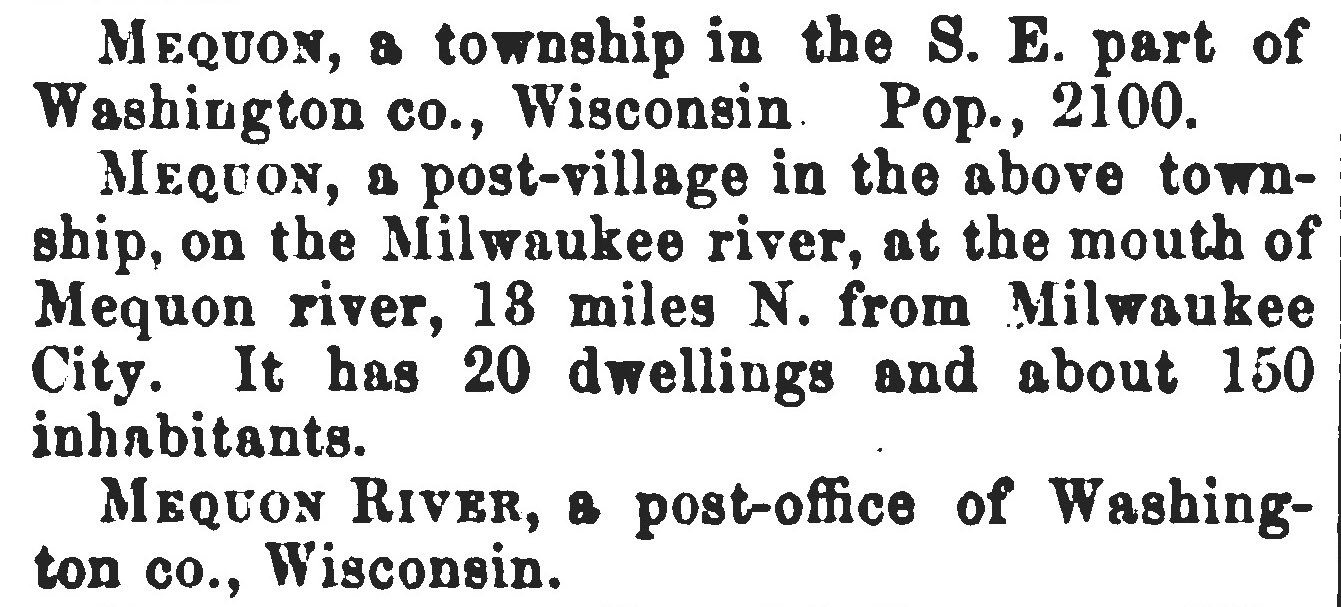
Baldwin, Thomas and J. Thomas, M.D., A New and Complete Gazetteer of the United States […], Philadelphia, 1854, p. 687. Via GoogleBooks.
That’s a pretty accurate, “just the facts,” description of Mequon in 1854. (Although it looks like Gazetteer editors Baldwin and Thomas didn’t get the news that on March 7, 1853, the east part of Washington county—including the Town of Mequon—had split from its parent county to form the new Ozaukee county. And the town vs. township distinction could be more precise, too.)
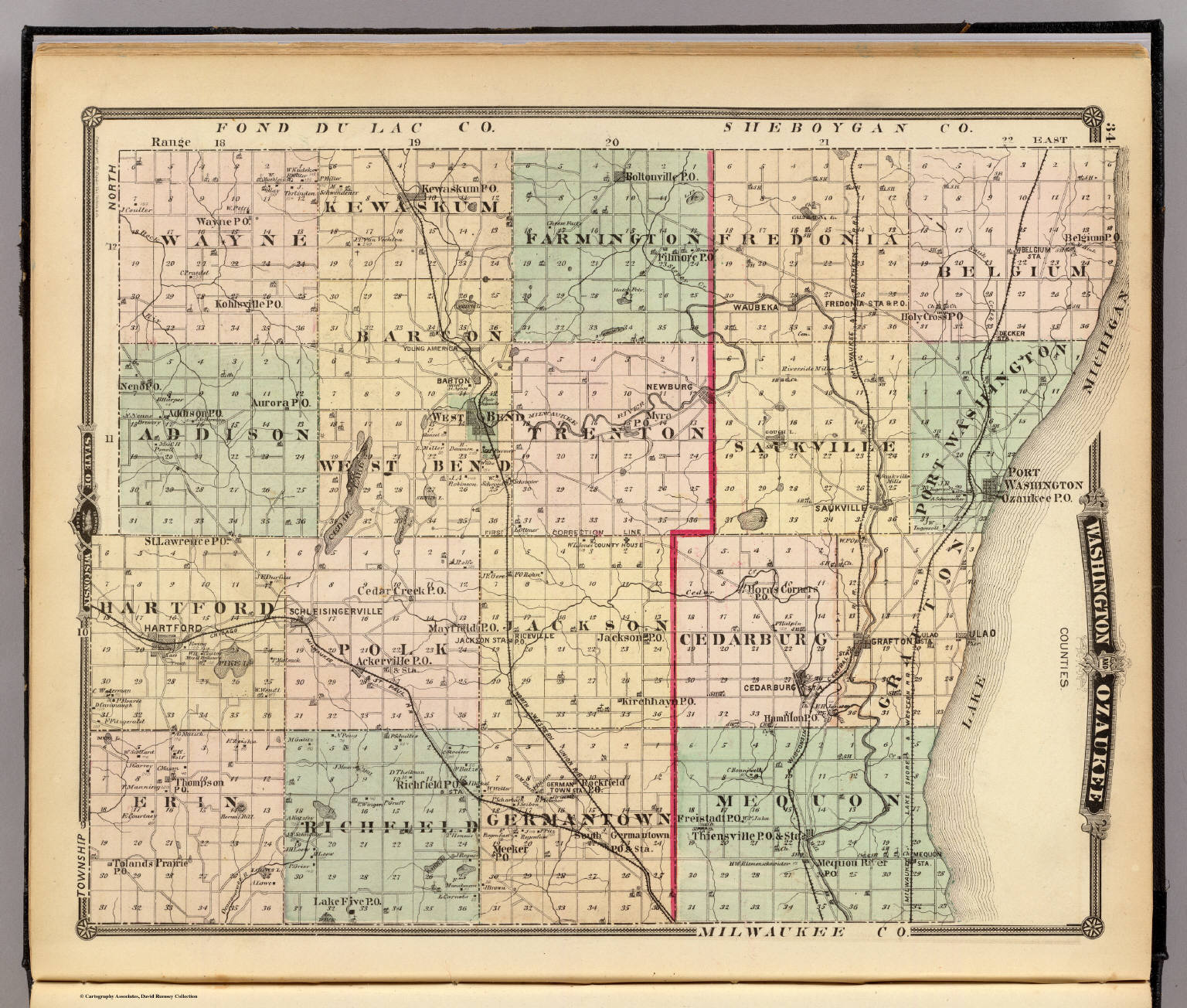
Continue readingToday’s map is another unique and wonderful map from the University of Wisconsin–Milwaukee, American Geographical Society Digital Map Collection. It is map of Washington and Ozaukee Counties from 1874, and it is packed with information and unique details.

Map of Washington and Ozaukee Counties, Wisconsin 1873-4 / drawn, compiled and published by G.V. Nash & M.G. Tucker ; engraved & printed by J. Knauber & Co. ; colored and mounted by E.M. Harney. University of Wisconsin-Milwaukee, American Geographical Society Digital Map Collection. Full copyright notice here, presented in this post as a public domain item and/or under fair use provisions of U.S. copyright law. Click map to go to the UWM collection and open larger image in new window.
Continue readingSpring is here and things are happening at the Jonathan Clark House Museum. All the info is in our latest newsletter. Click the image or this link to open (and save) your own copy of the full pdf:

It’s early April, and the growing season is not far off. For a farmer like Jonathan M. Clark, it’s a little early yet for plowing and sowing, but not too early to make plans and sharpen the tools. For a farmer’s wife, like Mary (Turck) Clark, it’s not too soon to think about the farm garden, its crops and layout.
I don’t know if Mary and Jonathan were regular readers of the popular and affordable farmers’ almanacs of their era; I wouldn’t be surprised if they were. There were many to chose from. Perhaps they had a copy of something like:

The Cultivator […], New Series, Vol. VII, Albany, 1850, title page. Click to open larger image in new window.
Continue readingThere were a lot of deadly, infectious diseases in 19th-century North America. When Jonathan M. Clark was young, the causes and cures for most of these illnesses were a mystery. Germ theory was unknown, and for many people hygiene was, at best, a hit-or-miss affair. But even in that era, we can be certain Jonathan M. Clark was inoculated against one of the worst recurring plagues of all time: smallpox.
General Regulations of the U.S. Army, 1821, Art. 73, no. 90
As a new recruit to the U.S. Army, Jonathan M. Clark was subject to the army’s regulations, including article 73, number 90:

Click to open larger image in new window. Original via Internet Archive
Continue readingClark House Historian is 5 years old today!!

Jonathan Clark House, Mequon, Wisconsin, July, 2015. Photograph by Reed Perkins. Click to open larger image in new window.
Our very first post, announcing the new blog, went live on March 29, 2016. The information in that post has now been revised and expanded into the About and Disclaimers sections of the blog.
The first posts with historical content followed in April, 2016. I still link to one of those posts—Where are we?—when I need to explain the evolving place names and political geography of the Mequon area.
Since the first Clark House Historian posts in 2016 we have learned a lot more about the Clark house, its occupants and their families, friends and neighbors. If you’re new to the blog—or the Jonathan M. Clark House—here are some good places to begin reading (and be sure to click the links in each article):
Continue readingThe Jonathan Clark House Museum is searching for a Part-Time Executive Director
The Friends of the Jonathan Clark House are pleased to announce an opening for a (paid!) part-time Executive Director. The Friends, a 501(c)3 non-profit group, were organized in 2012 with a mission “to collect preserve and share the history of the Jonathan Clark House and the early settlers of Mequon-Thiensville.” Now—in addition to our amazing volunteer staff and supporters—we’re adding this part-time executive director position.
Details
Please click here for the handy two-page pdf of the job description and application process, or click on these images for a full-size look at the same info:
Executive Director position description, page 1 of 2. Click to open larger image in new window.
Continue reading