Big News! I’ve found a photograph of Jonathan M. and Mary (Turck) Clark’s eighth and final child, Jennie Marietta Clark, at the age of about 25 years old. This is one of only a handful of photos we have of any members of Jonathan and Mary Clark’s family and (to the best of my knowledge) the first image we have of Jennie:
Jennie Clark Morrison (“Mrs. F. S. Morrison”), detail from “Class of 1882, University of Michigan School of Dentistry; UM_DDS_1882.” Public domain, courtesy of University of Michigan Bentley Historical Library, University of Michigan Library Digital Collections. Accessed: September 15, 2021. Click to open larger image in new window.
Dental College, Class of 1882
Our portrait of Jennie is a detail taken from this composite portrait of the University of Michigan’s School of Dentistry, Class of 1882:
UPDATED, September 17, 2021, to add a few details about the Morrison children, Jennie’s dental practice in the 1880s and ’90s, and the date of her divorce from second husband A. G. Widger.
Due to unforeseen circumstances, I won’t be blogging much this week. (Let’s just say that the cause of my hiatus has inspired today’s post, featuring a brief introduction to the life of the Clarks’ youngest child, Dr. Jennie M. Clark, D.D.S.)
Unknown photographer, [Dentist], daguerreotype with applied color, circa 1855. Smithsonian American Art Museum, Museum purchase from the Charles Isaacs Collection made possible in part by the Luisita L. and Franz H. Denghausen Endowment. CC0. si.edu. Click to open larger image in a new window.
Clark House dentists
I’m not sure who Mequon’s first dentist was, or when he set up shop. It’s entirely likely that the Jonathan Clark family did not visit a dentist until they moved to Milwaukee (and they still may not have seen a dentist once there). But Mequon’s Jonathan Clark House plays an important part in the lives of two Mequon/Milwaukee area dentists.
I had the day off from work yesterday, and spent most of it outside.
Winslow Homer, Making Hay, wood engraving from “Harper’s Weekly”, July 6, 1872, p.529. National Gallery of Art, Gift of Addie Burr Clark. Public domain. Click to open larger image in new window.
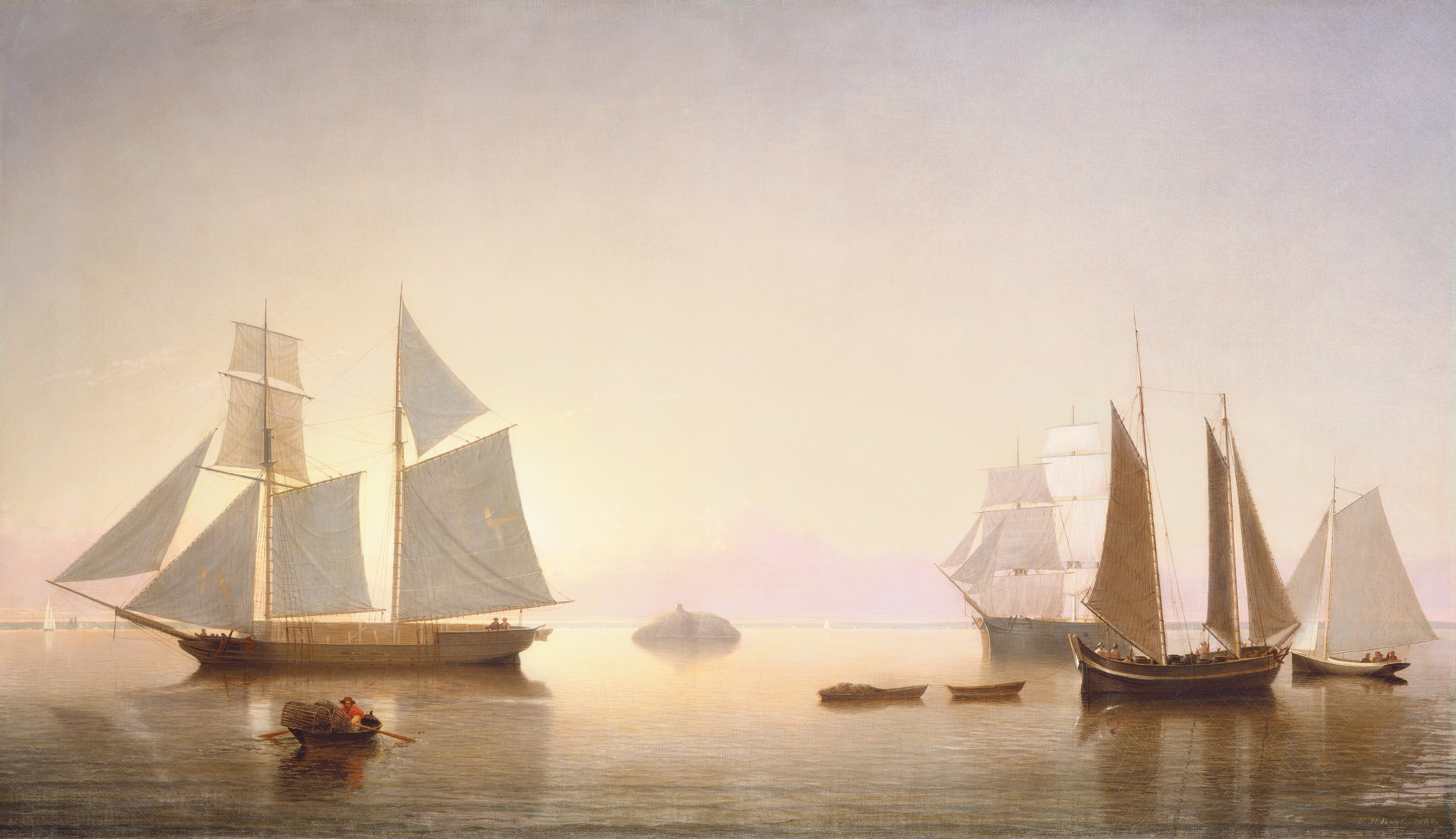
Fitz Henry Lane, painter (American, 1804-1865), Becalmed off Halfway Rock, 1860, oil on canvas, National Gallery of Art, Collection of Mr. and Mrs. Paul Mellon, in Honor of the 50th Anniversary of the National Gallery of Art. Public Domain. Click to open larger image in new window.
Observed the first Monday in September, Labor Day is an annual celebration of the social and economic achievements of American workers. The holiday is rooted in the late nineteenth century, when labor activists pushed for a federal holiday to recognize the many contributions workers have made to America’s strength, prosperity, and well-being.
Labor Day is often celebrated with parades and festive “end of summer” get-togethers in parks or at the beach. This year, with the continuing rise in Covid-19 cases, I think I’ll avoid the large gatherings. But a peaceful picnic with the family might be just the thing:
Tracey, John M. [Untitled—Picnic Scene], circa 1870. Smithsonian American Art Museum, Gift of Mary Glancy Bragg, CC0. Click to open larger image in new window.
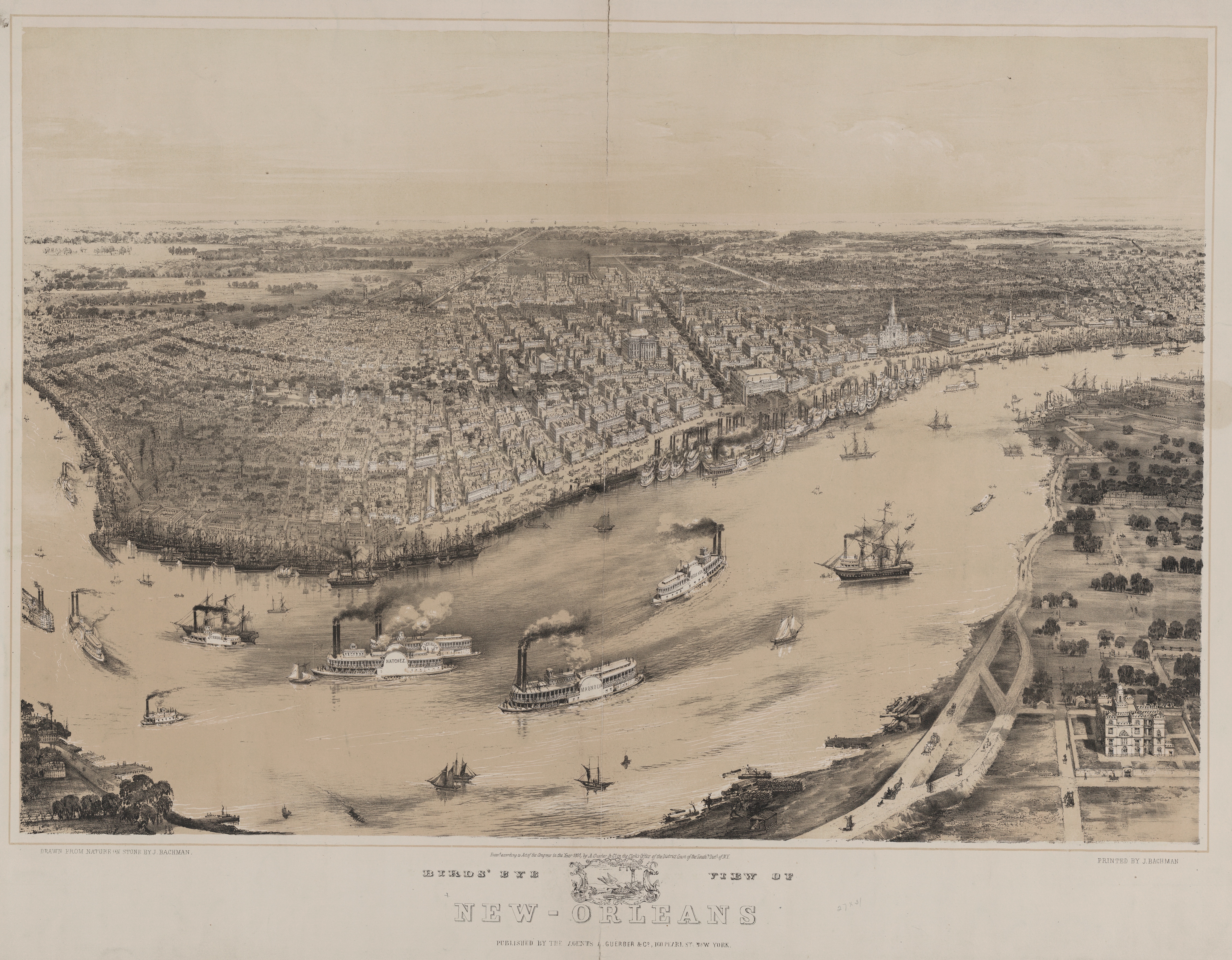
This week our attention has been turned to New Orleans, the adopted home of Peter Turck’s eldest son—and Mary (Turck) Clark’s younger brother—Joseph R. Turck. Our previous post, J. R. Turck – from Mequon to New Orleans, sketched a brief outline of Joseph’s life, including a half century lived in the Crescent City. That post also discussed Joseph’s very brief service in a Confederate “home guard” militia unit during the Civil War, and how he had lost touch with his Wisconsin family during and after the capture of New Orleans in 1862.
A rare Peter Turck manuscript
We have a number of examples of Peter Turck’s signature—and an occasional bit of text in his hand—from various land documents, marriage licenses, federal census pages, citizen petitions, and other documents from the 1840s to the 1860s. Today’s document is the only letter I have seen in Peter Turck’s own hand, and it gives us a rare insight into Peter Turck’s paternal feelings (as expressed in the typically florid and deferential language of the era) and some additional details about the life of his eldest son, Joseph.1 It’s an interesting letter, and I thought you might like to read it.
Turck’s letter is preserved as part of National Archives and Record Administration (NARA) publication M345, Papers Relating to Citizens, compiled 1861 – 1867. These are letters sent by U.S. civilians to the Provost Marshal’s office of the Union Army. The Provost Marshal was, essentially, the chief of the military police in an area occupied by Union troops.
This letter was published in NARA series M345, microfilm roll 0270, item Joseph R. Turck. It’s accessible online at Fold3.com (pay site). The transcription is mine, and preserves Peter Turck’s occasional curious spelling or punctuation errors. The original letter appears to cover two sides of a single sheet of paper. The original envelope was not microfilmed; it was probably discarded by the New Orlean’s provost marshal’s staff in 1862.
Milwaukee, July 25th 1862
Turck, Peter to Gen. Benjamin F. Butler, July 25, 1862, page 1 of 2. NARA publication M345 Papers Relating to Citizens, compiled 1861 – 1867. Roll 0270, Joseph R. Turck, Fold3.com, accessed 20 March 2014. Click to open larger image in new window.
Previously, we turned our thoughts to the historic city of New Orleans, and the disastrous impact of then-ongoing Hurricane Ida. Once again the Crescent City was hit by a major hurricane. Ida has since moved on and lessened in intensity, but leaves in its wake significant wind and water damage; over one million Louisiana residents are currently without electricity, gasoline, and fresh water, and it looks like it will take weeks to restore services. We wish a speedy recovery for all those in the affected areas.
I have a more-than-passing interest in New Orleans because our Clark House family has ties to the city; Mary (Turck) Clark’s brother, Joseph Robert Turck (1823-1902), spent most of his adult life there.
New Orleans, Louisiana Sugar and Rice Exchange, c. 1891. Source and credits, below (note 1). Click to open larger image in new window.
Joseph R. Turck
Like his big sister Mary, Joseph R. Turck was born in Athens, Greene county, New York. He was about five years old when the family moved to Wayne county, New York, and about fourteen years old when the family migrated west to Mequon in 1837.
In February, 1845, Joseph purchased 40 acres of his father Peter Turck’s Mequon land.2 Joseph did not keep it long; he sold it back to his father in September of the same year. What happened next? We’re not sure. But by 1848 Joseph had left Wisconsin and relocated to New Orleans.
Once again, several states along and north of the Gulf of Mexico face the force of a major hurricane. As I type this, New Orleans, one of the most historic cities in the United States, is without power, and hundreds of thousands of citizens—and large parts of the the area’s industries and environment—remain threatened as Hurricane Ida makes its way inland. I’ll let other, more knowledgable sources report the news. For now, I encourage you to remember and support our compatriots as they endure and recover from this major natural disaster.
Bachmann, John, Birds’ eye view of New-Orleans / drawn from nature on stone by J. Bachman, [i.e., Bachmann], ca. 1851. New York: Published by the agents A. Guerber & Co., Printed by J. Bachman. Library of Congress. Click to open larger image in new window.
I don’t usually post on Saturdays, but today is a special day. It’s the 100th anniversary of my Dad’s birth, and I thought it deserved at least a short CHH mention.
John H. Perkins, 1921 – 2004
My dad lived a long and eventful life, too much to cover in a single blog post. But since our recent Clark House Historian posts have been focused on historic boats and other Clark-era modes of transportation, I thought I’d share a few choice photos of Dad on the go—on water and on land—with a few biographical remarks to set the scene.
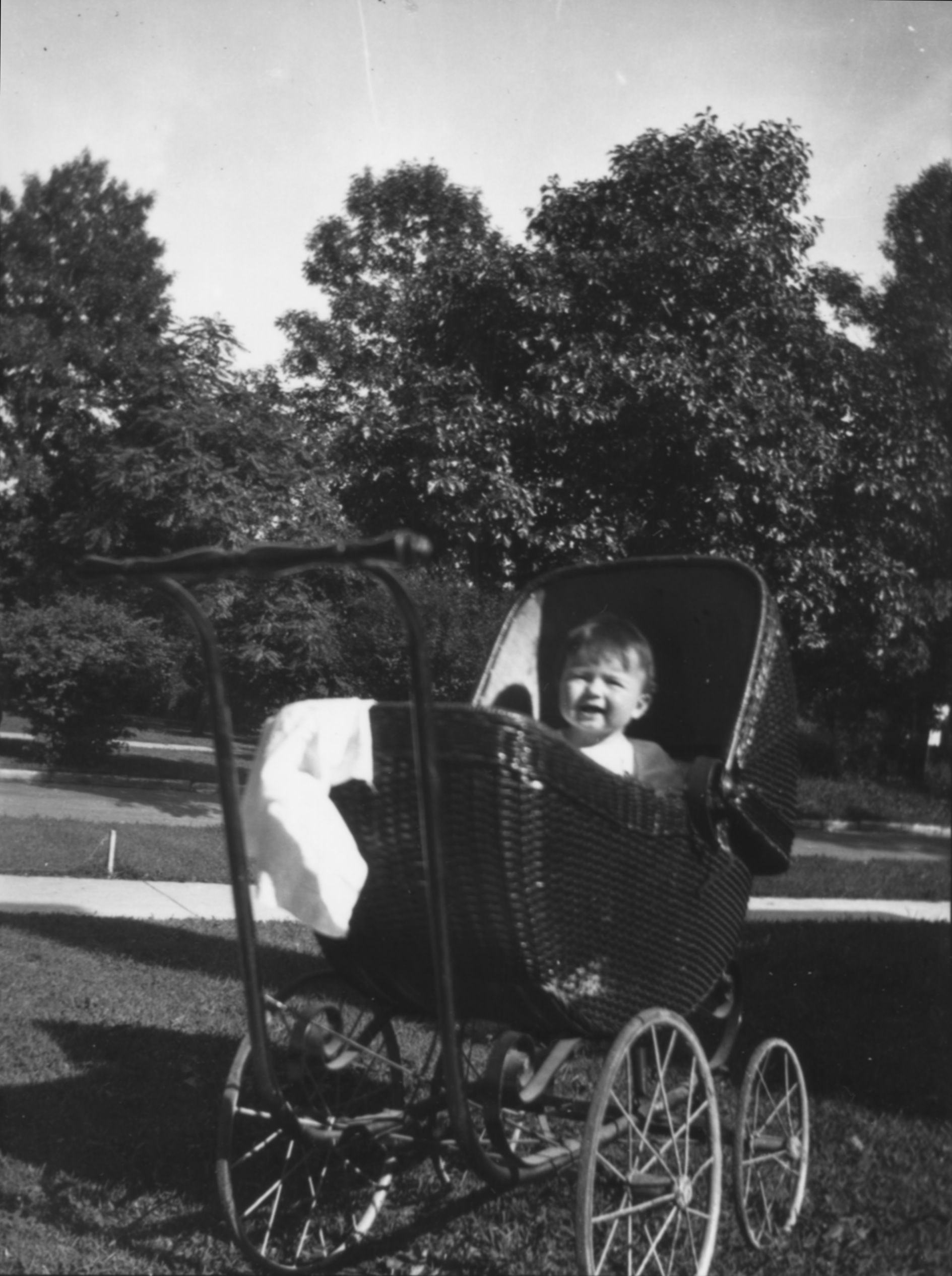
Here’s an early example:
John H. Perkins in baby carriage, probably Evanston, Illinois, circa Spring or Summer, 1922. Perkins family collection. Click to open larger image in new window.
Our series of “How’d they get here?” posts is written to illustrate the nuts and bolts of how our early Mequon pioneers travelled from their original homes or ports of arrival in North America to the newly opened federal lands in Wisconsin Territory, circa 1830-1850. Today’s post continues our westward journey from Buffalo; see Note 1 (below) for links to earlier posts in the series.
The ships at Detroit, 1837
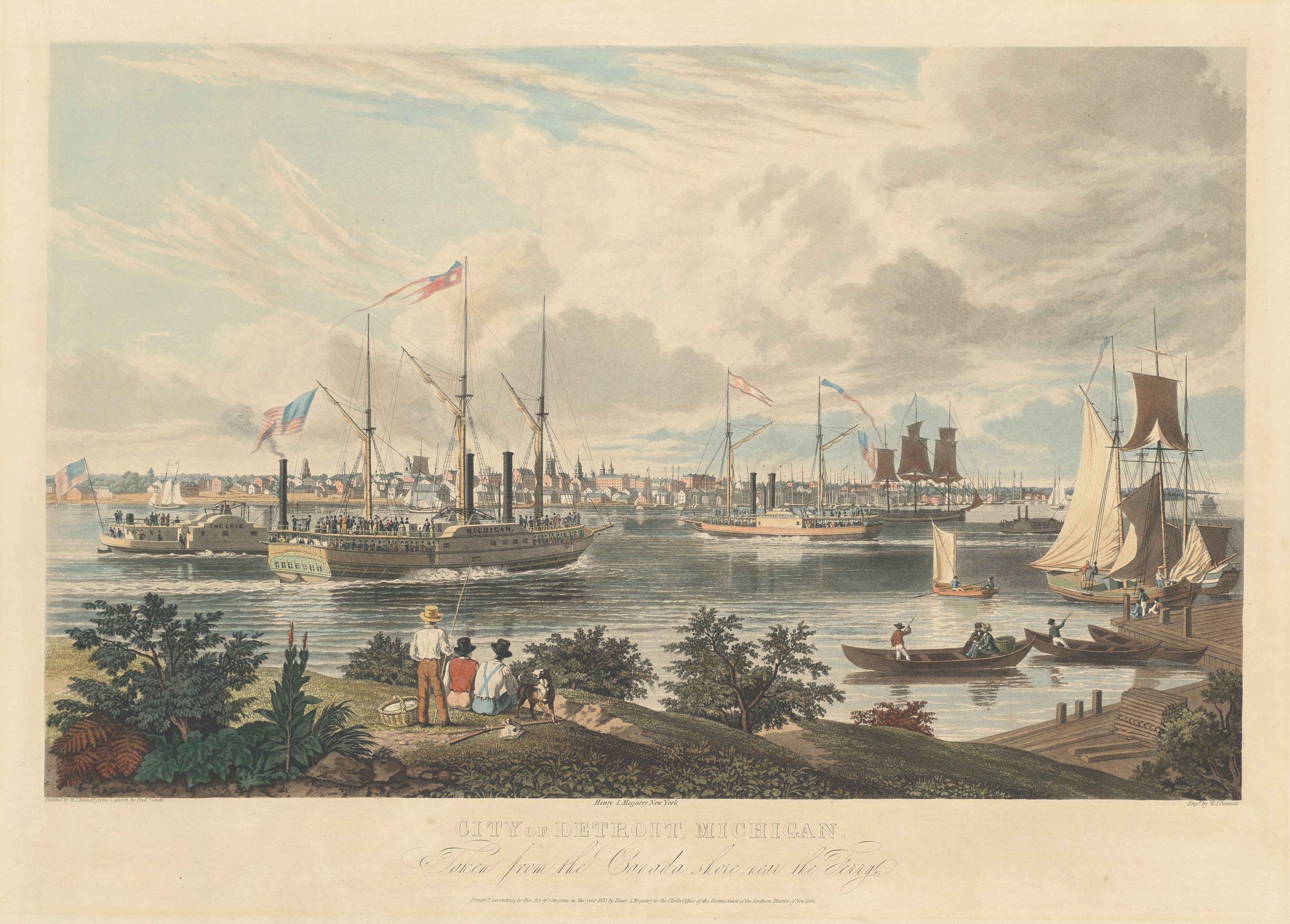
We closed our previous post with a brief look at a colorful aquatint of the ships and small craft on the Detroit River, a major port on the Great Lakes route between Buffalo and Chicago in the 1830s and ’40s. The print was published in 1837, and is an excellent illustration of almost all of the important types of ships in use during the years of Wisconsin Territory settlement:
Bennett, William J., after a sketch by Frederick K. Grain, City of Detroit, Michigan. Taken from the Canada shore near the Ferry., hand-colored aquatint on engraving, ca. 1837. National Gallery of Art, Collection of Mr. and Mrs. Paul Mellon. Public Domain. Click to open larger image in new window.
If you’re not clear on your Michigan and Upper Canada (now Ontario) geography, the artist was standing on the Canadian shore, looking west across the river to the city of Detroit. The two steamboats at the left center of the picture are headed north, upstream on the Detroit River that connects Lake Erie to Lake St. Clair and, via the St. Clair River, to Lakes Huron, Michigan and Superior.
Given that the picture shows leafy green foliage and men in shirt-sleeves, it was probably drawn in the spring or summer of 1837 (or a perhaps a year or two earlier?). In August, 1837, the Peter Turck family—including eldest daughter Mary Turck—migrated from Wayne county, New York, to Milwaukee via this exact route and, perhaps, on one of the ships shown in this picture. Other Mequon immigrants, including the Bigelow, Bonniwell, Loomer, Strickland and Woodworth families (and many others), would have seen similar views as they travelled from the eastern seaboard to Wisconsin Territory in the ’30s and ’40s.
There is a lot to see here. Let’s take a closer look…




 Clark House Historian