Sewing for the family

Updated February 22, 2022 to fix a few minor typos, and to add a link to a brief history of American samplers, with an illustrated list of 73 of the 137 American samplers in the Textile Collection of the National Museum of American History.

In addition to raising and educating her children, a 19th-century farm wife like Mary Turck Clark had many other responsibilities, including planning and tending a farm garden, preserving its produce, preparing daily meals for the family and hired hands, and keeping the farm house clean and organized. And Mary, like many women of her era, probably made some or all of her own and her family’s clothes.

The sewing arts

Like most girls of her era, Mary Turck (born in New York, 1821) probably learned the craft of needlework from her mother and, perhaps, as part of her school education. When a young girl like Mary mastered some of the many practical and decorative sewing stitches, she might demonstrate her proficiency by making a sampler.

A sampler might feature simple examples of sewn letters, numbers and perhaps a popular saying or Bible verse. But many samplers were more complex and artistic. An accomplished embroiderer might produce an elaborate sampler featuring detailed images and texts, as in this 1829 sampler from Connecticut.

Thompson, Mariette (1817-1851), [Sampler with family register], 1829. Yale Art Gallery, public domain. Click to open larger image in new window.

Continue reading
What did you do on Sunday?

Updated Feb. 14, 2022 to add the qualifier “English-speaking” to the second paragraph.

Did you watch the Big Game? Go out to eat? Maybe you had to put in a shift at work? Or did you just take a break and relax at home, gearing up for another week on the job? Perhaps you went to church on Sunday.

In Jonathan and Mary Clark’s era, many of their Mequon neighbors would honor the Sabbath by refraining from all work and worshiping privately at home with their families, or gathering with small groups of neighbors to pray and hear the Word. Beginning in the early-1840s, the English-speaking Protestant Christians living near the Clark House—including many members of the Clark, Bonniwell and Turck families—gathered at the new, one-room, Bonniwell School to worship together at Sunday services; these were often led by their neighbor, the farmer and evangelical Methodist preacher Rev. James W. Woodworth.

Rev. Woodworth has concerns…

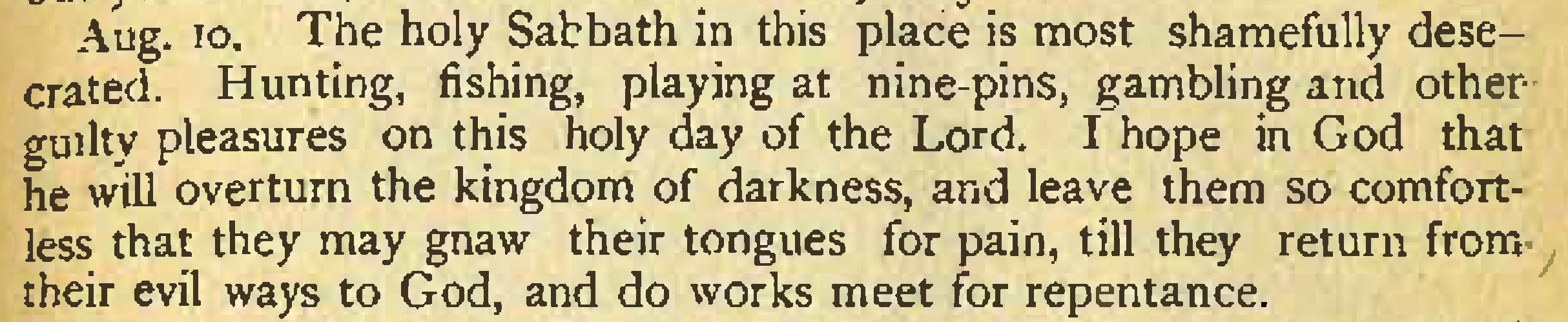
We have talked about Rev. Woodworth previously and, as we have seen before, he was constantly concerned about the state of his neighbors’ souls. It seems that even though the nation was still riding the wave of several decades of the religious revival now known as the Second Great Awakening, the settlers of the young Wisconsin territory and state were not always very good at “keeping the Sabbath holy.” In his diary entry for August 10, 1855, the reverend lamented:

Aug. 10. The holy Sabbath in this place is most shamefully dese­crated. Hunting, fishing, playing at nine-pins, gambling and other guilty pleasures on this holy day of the Lord. I hope in God that­ he will overturn the kingdom of darkness, and leave them so comfort­less that they may gnaw their tongues for pain, till they return from- their evil ways to God, and do works meet for repentance.

Woodworth, James W., My path and the way the Lord led me, Milwaukee, 1878, p. 79.

Continue reading

How’d they get here? – JMC, the Bonniwells, and Whitehall, NY

We’ve mentioned Whitehall, New York, on several occasions. Located just east of the south end of Lake Champlain, the town of Whitehall has long claimed to be the “Birthplace of the U.S. Navy.” More importantly for our story, in 1823 Whitehall became the northern terminus of the Champlain Canal, connecting the Hudson River and the Erie Canal to Lake Champlain and points further north.1

Port of Entry

More importantly for our story, Whitehall served as an international port of entry for immigrants coming to New York and New England from Canada and overseas via the St. Lawrence River and Lake Champlain. In the early 1830s, these immigrants included Jonathan M. Clark, who came from Lower Canada in April, 1831,2 and the entire Bonniwell family, who arrived the following year.3

What did our immigrants of 1831 and ’32 see just before they stepped ashore in the United States? The hustle and bustle of a major harbor and center of commerce such as New York, Boston or Philadelphia? Er, no. Instead, this is what greeted our intrepid newcomers:

Whitehall, Lake Champlain

Milbert, Jacques Gerard, Amerique Septentrionale – Etat de New-York. N. 21, pl. 1…White Hall, Lake Champlain, Lithograph by Bichebois and Adam, Paris, 1828–1829. Yale Art Gallery, Mabel Brady Garvan Collection. Public Domain. Click to open larger image in new window.

Continue reading
Winter fun, 1868

Updated Feb. 11, 2022, with information about Milwaukee’s “original Ice Bear,” Henry Kroeger (see comments, below).

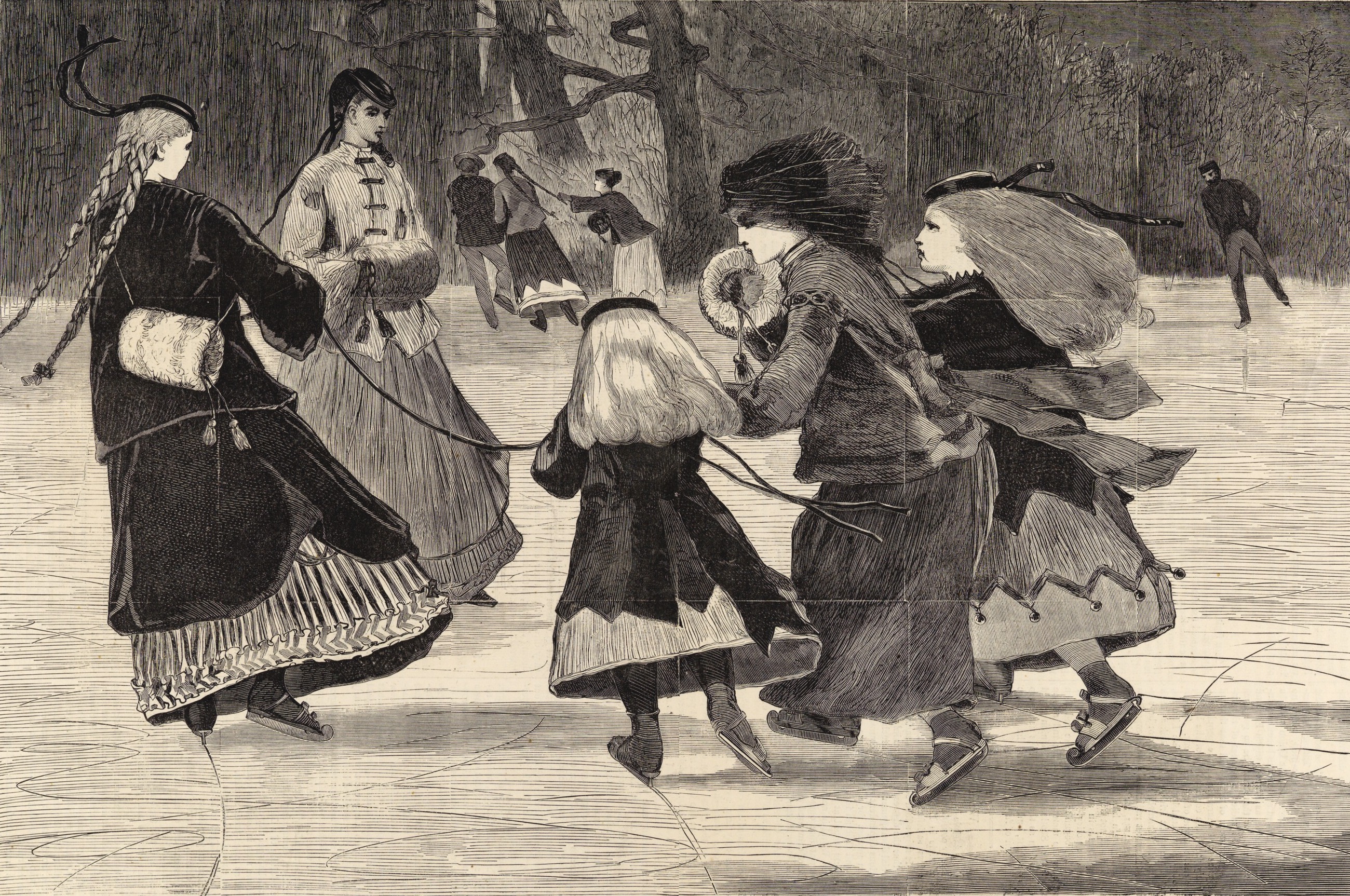
The 24th Winter Olympic Games are now under way in Beijing, with a dizzying profusion of modern sliding and gliding winter sports. Of course, outdoor winter games and sports pre-date the modern Olympics by hundreds, if not thousands, of years. Among the oldest and most popular of these is ice skating.

Homer, Winslow, “Winter” — A Skating Scene, from Harper’s Weekly, January 25, 1868. Smithsonian American Art Museum, The Ray Austrian Collection, gift of Beatrice L. Austrian, Caryl A. Austrian and James A. Austrian. Public domain, CC0. Click to open larger image in new window

Continue reading

Stuff Happens – on a sleigh ride!

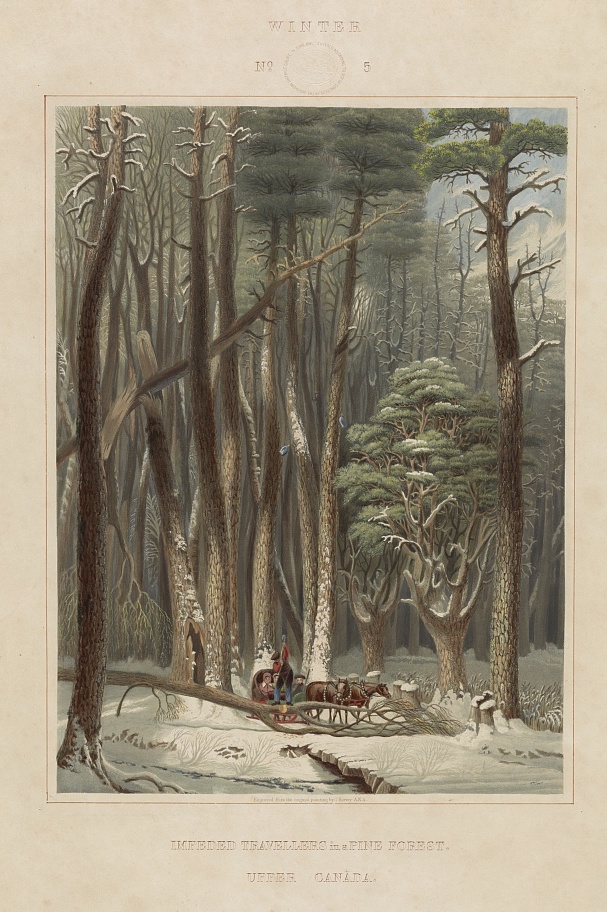
In Jonathan and Mary Clark’s era, if you needed to get somewhere during the winter—for business or for pleasure—you probably rode in a a horse-drawn sleigh. Travel in a sleigh could be fun, even exhilarating, but was not without its perils, most of which came from inadequately maintained roads and trails:

Bennett, W. J. , Engraver, and George Harvey. Winter. No. 5., Impeded Travelers in a Pine Forest, Upper Canada / engraved from the original painting by G. Harvey A.N.A., New York, 1841. Color aquatint. Library of Congress. Click to open larger image in new window.

Continue reading
Snow!

Much of this post appeared last year, but since we—finally!— got some snow in southeast Wisconsin last night, I thought I’d share it again, with a few additions and revisions, and a new, hand-colored, version of the artwork.

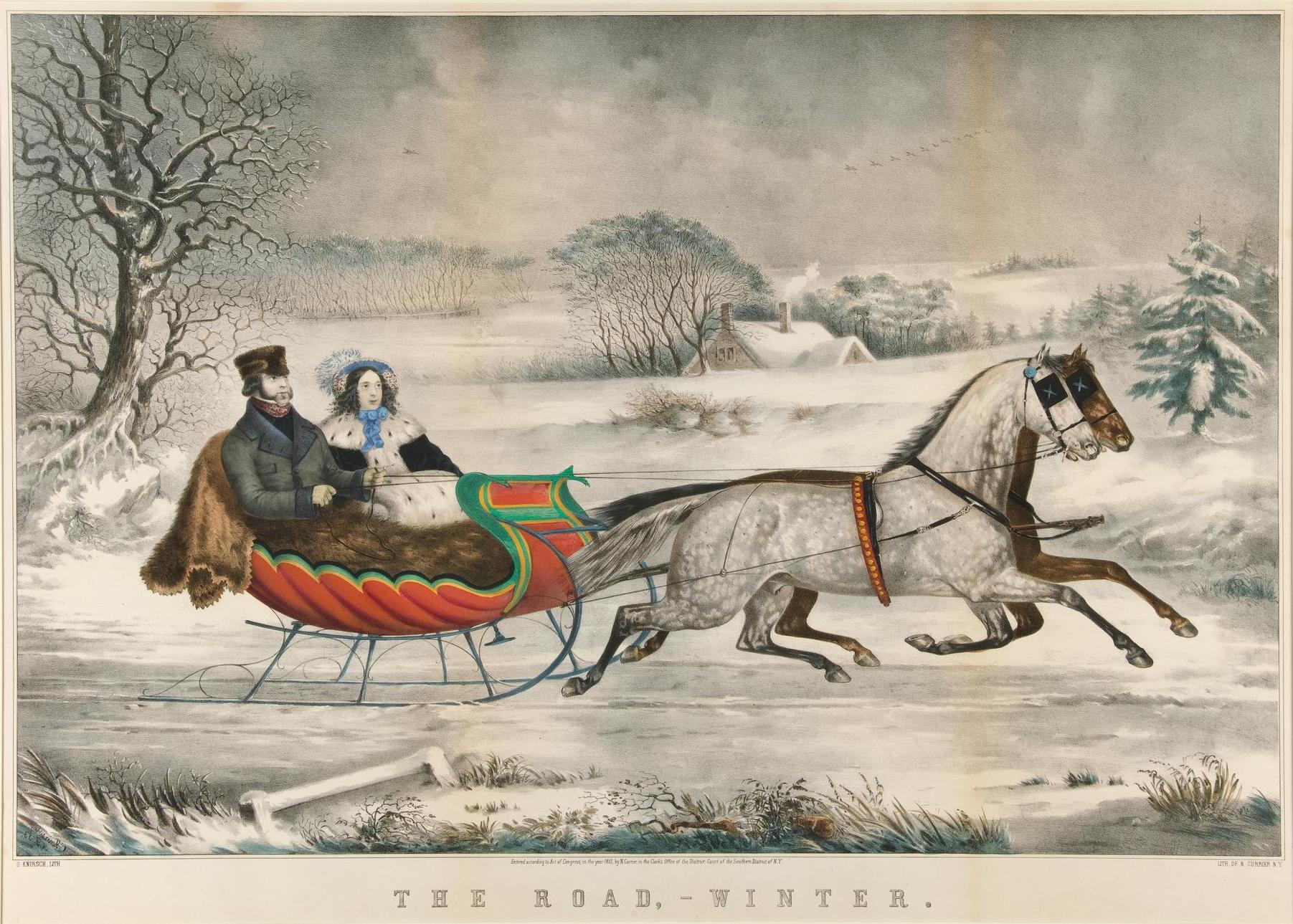
Snow, and often lots of it, was a feature of Jonathan and Mary Clark’s life in Wisconsin. So if you wanted to go to town or church or visit your neighbors during the snowy Wisconsin winter—or just enjoy a pleasant winter ride in the country—you’d need a sleigh.

Currier, Nathaniel (1813-1888), The road, winter / O. Knirsch, lith., 1853. New York: Published by Currier & Ives. Yale University Art Museum, Whitney Collections of Sporting Art, given in memory of Harry Payne Whitney (B.A. 1894) and Payne Whitney (B.A. 1898) by Francis P. Garvan (B.A. 1897) June 2, 1932. Public domain. Click to open larger image in new window.1

We don’t know if the Clarks owned a sleigh while they lived in Mequon. I suspect they did, though their sleigh—and their clothing—may not have been quite as posh as those in this Currier & Ives lithograph from 1853.

Continue reading

2021 Blog Roundup

It’s a New Year (yikes!—we’re already three weeks into the New Year!), and I thought I’d take a break from researching and note-taking for quick look back at our 2021 year of blogging at Clark House Historian. The blog is about to celebrate its seventh anniversary (on March 29), and 2021 was our most productive year so far, sharing more posts, documents, and historic maps and images with our readers than ever before.

The author, hard at work. For full photo credits, see below. Click to open larger image in new window.

Continue reading
Hail, Smiling morn! – 2022 edition

Happy New Year to all, and best wishes that 2022 will be an improvement on the past year. (A low bar, I know.) Anyway, when I first published this post, on January 1, 2021, I wrote: I’m almost done with my research on the second half of the 1843 concert by the Milwaukie Beethoven Society. (If you missed our earlier posts on that concert, links are here and here.) But it’s New Year’s Day, and I’m not quite done writing about “Part Second.”

Well, it turns out that “not quite done” was an optimistic estimate, as I became distracted by so many other research topics and posts and never got around to discussing the second part of the Milwaukee Beethoven Society’s concert. New Year’s Day is here again, and I’m still not done, alas, but I have not forgotten and—with luck—I will finish that post some time this winter.

A spot of Spofforth to ring in the New Year…

Meanwhile, let’s start the New Year on a cheerful note by reprising last year’s festive musical selection, drawn from that second part of the Milwaukee Beethoven Society’s 1843 premiere concert:

Milwaukee Weekly Sentinel March 15 1843, page 2. Click to open larger image in new window.

Continue reading

Holiday Fun in NYC, 1864

It’s the week after Christmas. Perhaps you have family or friends visiting from out of town. If you have children, they’re home from school. How to keep them entertained? If you lived near New York City in 1864, you were in luck. Barnum’s American Museum was ready with spectacular and unique holiday exhibits for the whole family, all for the low, low, price of 25 cents for adults, 15 cents for children under age ten!

Barnum’s American Museum. Christmas and New Year holiday bill, 1864. [New York: Wynkoop, Hallenbeck & Thomas, Book and Job Printers, 113 Fulton St. N.Y], Library of Congress. Click to see larger, easier to read, image.

Continue reading

Santa Claus visits Milwaukee, 1867

Tonight is Christmas Eve, and I thought you might enjoy an expanded reprise of our 1867 Santa Claus story, originally posted December 25 and 30, 2017. This year I have combined the two original posts and incorporated some new illustrations and a few revisions of the text. Here it is again, for your holiday enjoyment. Ho! Ho! Ho!

Christmas in early America

For many years now, Christmas has been celebrated by Americans as an important religious and (increasingly secular) community holiday. Christians gather to worship and commemorate the birth of Jesus, and they and other Americans enjoy a break from work to gather with family and friends to feast and exchange gifts. But it was not always this way.

In many of the American colonies, Christmas was not observed as a religious or secular holiday. The seventeenth-century Puritan leaders of the Massachusetts Bay Colony considered Christmas to be non-biblical and pagan influenced. In Boston and other parts of New England any observance of Christmas was prohibited and, for a few years, actually illegal:

Penalty for Keeping Christmas, 1659

Records of the Governor and Company of the Massachusetts Bay in New England. Printed by order of the Legislature, edited by Nathaniel B. Shurtleff, M.D., Vol. IV, Part I, 1650-1660, online at mass.gov (accessed 21 Dec. 2021). Click to open larger image in new window.

Transcription:
For preventing disorders arising in several places within this jurisdiction, by reason of some still observing such festivals as were superstitiously kept in other countries, to the great dishonor of God and offence of others, it is therefore ordered by this Court and the authority thereof, that whosoever shall be found observing any such day as Christmas or the like, either by forbearing of labor, feasting, or any other way, upon such accounts as aforesaid, every such person so offending shall pay for every such offence five shillings, as a fine to the country.

Christmas was not generally accepted as a holiday in many parts of the United States until after the federal government made December 25 a national holiday in 1870.

On the other hand…

The Massachusetts Puritans may not have approved of “observing any such day as Christmas or the like, either by forbearing of labor, feasting, or any other way,” but Christmas was “kept in other countries” and increasing numbers of immigrants from those countries to the United States—particularly from Victorian England, Catholic Europe, and the German Lands—celebrated the day in their new American homes with many of their accustomed religious observances and national traditions.

Continue reading