No Mequon history today. Here at the historian’s house we’ve been expanding the garden again, and I’m done for the day. So how about a revised repeat of this nice Clark-era drawing?
I think I’ll just sit on my wheelbarrow and look at a frog for a while.
Our last two posts focused on the evidence we have that documents the Bonniwell family’s two-part trip west to the gold fields of California: by the Panama shortcut in 1849 and by the overland route in 1850. Today I’d like to focus on the members of Bonniwell company after the end of their westward voyage(s), and give you a sense of their experiences as newly-arrived prospectors in the California gold diggings through period drawings, lithographs, photographs, and a substantial excerpt from the Bonniwell Gold Rush diary.1
Currier & Ives. Gold mining in California. California, ca. 1871. New York: Published by Currier & Ives. Library of Congress. As always, click the images to open larger versions in new window.
This colorful Currier & Ives lithograph presents a somewhat idyllic view of “Gold Mining in California” as imagined in 1871 by a New York artist who, most likely, had never been west of the Alleghenies. On the one hand, the lithograph does give us an hint of the splendors of the Sierra Nevada, and some idea of the typical activities of California miners. But as we’ll see, life in gold country when the Bonniwell party arrived—in the early, frenzied days of 1849 and 1850—was much less bucolic.
“Working the bar”
Much of early California gold prospecting involved looking for smaller and larger bits of gold found within the loose alluvial soils and sediments of the rivers and dry riverbeds of the Sierra Nevada. In particular, the miners spent a lot of time “working the bar.” And no, my fellow Wisconsinites, this does not mean they were strenuously pub-crawling in El Dorado county, circa 1849-1850.
Our annual Memorial Day post, first published in 2020. This revised edition, originaly published in 2022, was inadvertently updated for the further-revised 2023 edition, making a few minor edits and adding new information about Evander B. Bonniwell’s service. So the original 2022 post is “gone” and I’m going to leave this revised-revised version of that post here for reference, in case it is bookmarked elsewhere on the blog or in a readers’ notes.
Graves of Unknown Union Soldiers, Memphis National Cemetery, photo by Clayton B. Fraser, (Library of Congress), public domain. Memphis National Cemetery is the final resting place of Mequon’s Watson Peter Woodworth, and almost 14,000 of his Union Army comrades.
Today is the day our nation officially observes Memorial Day. For many Americans, Memorial Day represents “the first day of summer,” and is traditionally celebrated with trips to the lake, picnics, parades, and sales on cars, appliances, and other consumer goods.
But for many of us, Memorial Day remains rooted in its origins as Decoration Day. The first national observance was in 1868, when retired general John A. Logan, commander and chief of the Grand Army of the Republic—the Union veterans’ organization—issued his General Order Number 11, designating May 30 as a memorial day “for the purpose of strewing with flowers or otherwise decorating the graves of comrades who died in defense of their country during the late rebellion, and whose bodies now lie in almost every city, village, and hamlet churchyard in the land.”
On this Memorial Day, let’s take a moment to remember what this day truly represents.
Continuing our look at old and new evidence about the Bonniwell family’s trip west to the gold fields of California. If you’re keeping track, this is also part 9 of our series documenting the life of Clark family neighbor (and in-law) Alfred T. Bonniwell and his family.
We closed our previous post, Gold! – The Bonniwells go west…but when? and who?, with a surprising news item from page 2 of the Saturday, April 7, 1849, edition of the Milwaukee Sentinel and Gazette:
FOR CALIFORNIA.—Henry V. Bonniwell, Geo B. Bonniwell, Alfred Bonniwell, Joseph Loomis, and Richard Taylor from Mequon, Washington county, are to leave to-day for California. They proceed to Fort Independence, to fit out.
This April 7, 1849, announcement raises a number of questions, and complicates—if not contradicts—our understanding of the Bonniwell family’s better-known overland trek to California in 1850. I think I have figured out what happened, and the easiest way to explain full story of the Bonniwells and their trip West to the gold fields is by making a timeline of our new evidence. And before we do that, we need to remind ourselves that…
There was more than one way to get to California
When “gold fever” first hit the nation in 1848-1849, traveling to California via wagon trail from one of the major departure points—such as Ft. Independence, Missouri, at the head of the Oregon Trail—was the least expensive but most treacherous option for would-be gold seekers. On the one hand, the overland route was the shortest, about 3,000 miles from the eastern states, but it was fraught with dangers that included bad “roads,” lack of food and water, a whole spectrum of diseases and illnesses, as well as potential attacks by Native Americans or wild animals. Whatever their reason, it appears that sometime during the first stage of their journey, between April and September, 1849, our lads decided to skip the overland route and try something safer and faster, if more expensive:
The Panama Shortcut
“For California, Via Chagres,” advertisement for USMS Steamship Co., New Orleans Daily Crescent, Wednesday, 12 Sept 1849, p 3 (tinted, sharpened). As always, click each image to open larger copy in new windows.1
UPDATED, May 27, 2022 with a few minor edits for clarity.
Today, in part 8 of our series documenting the life of Clark family neighbor (and in-law) Alfred T. Bonniwell and his large extended family, we begin a fresh look at some documentary evidence that complicates and enriches our understanding of how the national “Gold Fever” that began in 1848 shaped the years around 1848-1851 in the lives of Bonniwells and some of their Mequon neighbors.
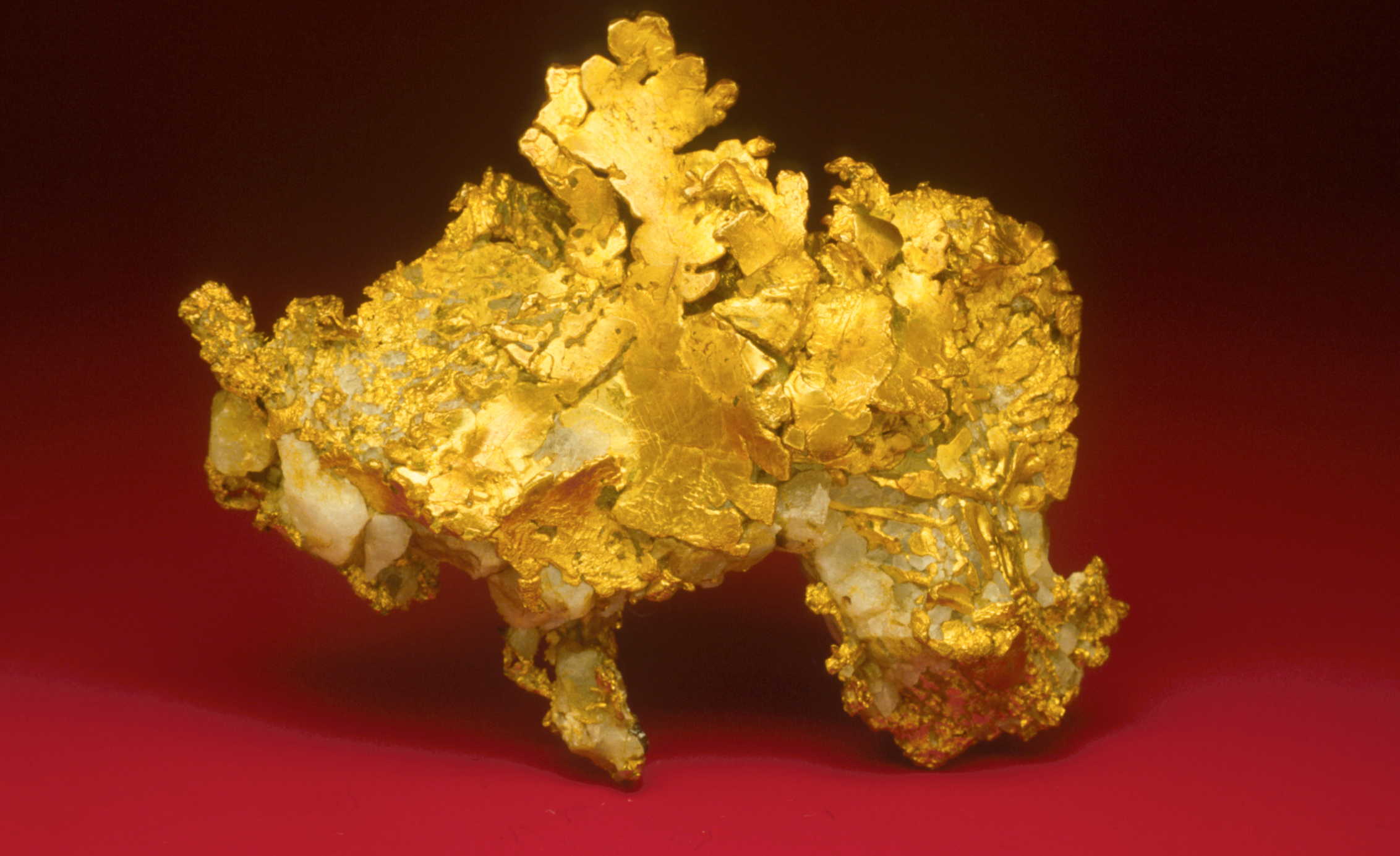
Gold, Placerville [formerly Hangtown], El Dorado County, California, Smithsonian Institution, NMNH-79-9911 (public domain, CC0). Click to open larger image in new window.
Our current knowledge of the Bonniwell family’s California adventures is nicely summarized by George B. Bonniwell at the start of chapter 12 of his book, The Bonniwells: 1000 Years.1
In January, 1848, gold was discovered at Sutter’s Mill in California. By 1849, the gold rush was on. The Bonniwells couldn’t resist another adventure. William Bonniwell, as Captain, led a wagon train of six wagons and 16 men, including Charles, James, Henry, George, Alfred and young William who was only 14 at the time. They started from Milwaukee on April 12, 1850, headed down into Illinois, through Iowa, joined the Oregon Trail in Nebraska, proceeded through Wyoming, into Idaho, down into Nevada and finally to Sacramento, California and the gold region. After four months enduring sickness, hostile Indians, more sickness, mountains, desert, more sickness, lack of water, starvation, etc., they finally made it to their destination in California on August 11, 1850.
Then, after “remaining anywhere from two to four years, they returned to the ‘Bonniwell Settlement.’ It is believed that they returned by the Isthmus of Panama (although some thought that they returned home around Cape Horn.”2
The whole story reads like a tale from a movie script or Western novel, but it’s not. It is, indeed, a true story. But what do we really know about the Bonniwells’ epic trek, and how do we know it? Well, we’ve got some outstanding contemporary sources; some are well-known and some are newly-discovered. Let’s start with what we know.
I’m feeling a bit under the weather today, so Clark House research will have to wait. Fortunately, I’ve had my shots, so it looks like the usual advice of bed rest, fluids, and such should be all I need. If not, perhaps a swig of a potion like Dr. C. V. Girard’s Ginger Brandy will do the trick.
Dr. C.Y. Girard’s ginger brandy, for sale here / lith. of Robertson, Seibert & Shearman, 93 Fulton St. New York. , ca. 1860. New York: Robertson, Seibert & Shearman, 93 Fulton St. Library of Congress. Click to open larger image in new window.
After all, it’s “A Certain Cure for Cholera Colic Cramps Dysentery, Chills & Fever” and “is a delightful and healthy beverage.” Ya can’t beat that!
Of course, if Dr. Girard’s Ginger Brandy doesn’t help, there were so many other elixirs to choose from during the pre-Pure Food and Drug Act era, such as…
We have new partnership project with the Mequon Nature Preserve and MATC’s Kate Erickson, the Brown Bag Series: Mother Earth is Where We All Meet. Today is the second installment in the series, and our executive director Dana Hansen will be speaking on “European Settlement and the Shift of Mindset About the Earth.”
Old World Wisconsin, July, 2016. Photo credit: Anna Perkins. Click to open larger image in new window.
Guess what I did instead of writing a new Clark House Historian post! Here’s a clue, from about this time last year (revised and expanded for 2022)…
Spring weather in southeastern Wisconsin is pretty hard to predict these days. Spring 2021 was awfully dry. This year, spring has been wetter overall—I think—but the days have zigzagged rapidly and unpredictably between chill and damp or hot and humid. It’s almost like we haven’t had a proper Midwestern spring at all. And yet, the grass around the Historian’s house has already gotten pretty tall and scruffy. So it was time to get out the mower and tidy up (some of) the yard.
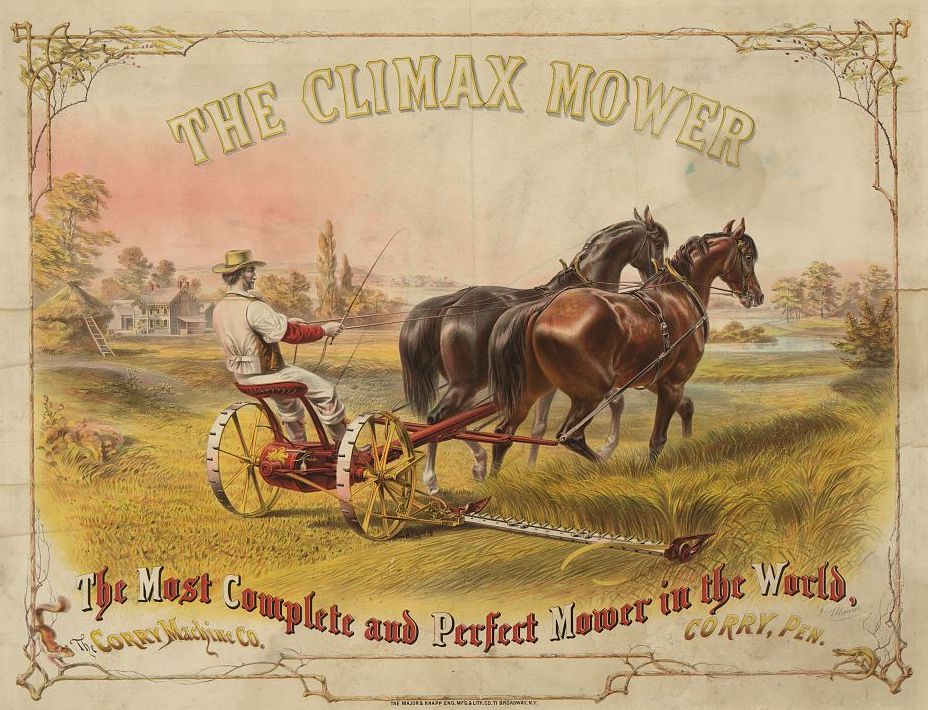
Maurer, Louis, Artist. The climax mower, most complete and perfect mower in the world, the Corry Machine Co., Corry, Pen. / L. Maurer. United States, None. [NY: the Major & Knapp Eng., Mfg. & Lith. Co., between 1869 and 1872] Photograph. Library of Congress.
I’m still tied up with other projects, so I thought you might enjoy a repeat of this seasonal post from last May. I’ll be back soon with new Clark House history.
It’s mid-May in southeastern Wisconsin, and with luck the last frost is behind us. For the past weeks and months farmers and gardeners have been tending to the soil and preparing for planting. At this time of year in the 1840s and ’50s, Jonathan M. Clark would have done much the same, hitching up his team of oxen to a steel-bladed plow to cut and turn over the tough prairie grasses and break up the soil of his newly-cleared lands.





 Clark House Historian