We have new partnership project with the Mequon Nature Preserve and MATC’s Kate Erickson, the Brown Bag Series: Mother Earth is Where We All Meet. Today is the second installment in the series, and our executive director Dana Hansen will be speaking on “European Settlement and the Shift of Mindset About the Earth.”
Old World Wisconsin, July, 2016. Photo credit: Anna Perkins. Click to open larger image in new window.
Guess what I did instead of writing a new Clark House Historian post! Here’s a clue, from about this time last year (revised and expanded for 2022)…
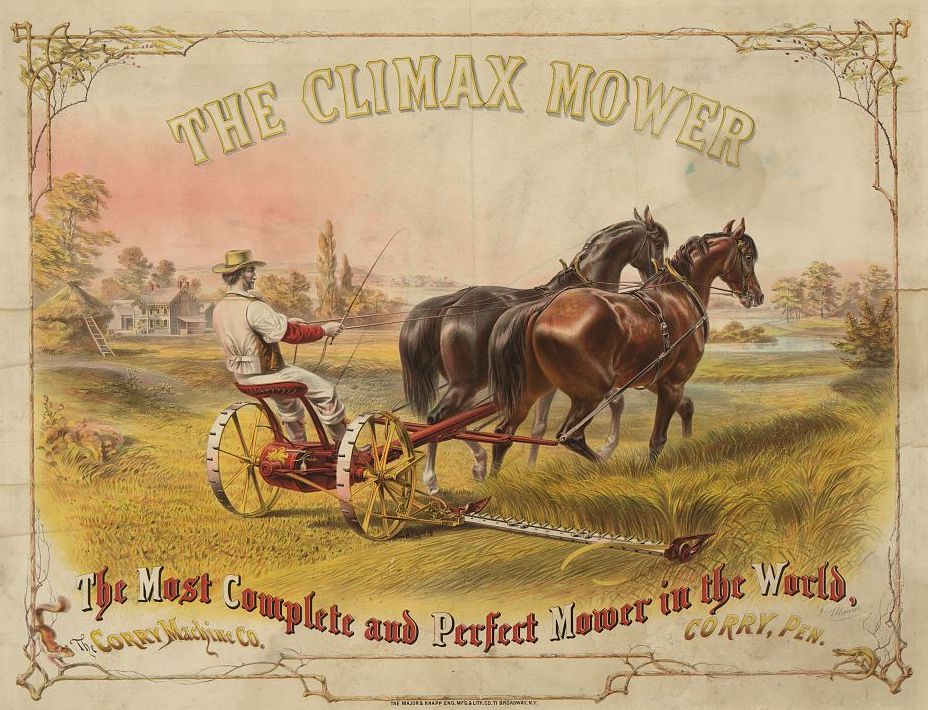
Spring weather in southeastern Wisconsin is pretty hard to predict these days. Spring 2021 was awfully dry. This year, spring has been wetter overall—I think—but the days have zigzagged rapidly and unpredictably between chill and damp or hot and humid. It’s almost like we haven’t had a proper Midwestern spring at all. And yet, the grass around the Historian’s house has already gotten pretty tall and scruffy. So it was time to get out the mower and tidy up (some of) the yard.
Maurer, Louis, Artist. The climax mower, most complete and perfect mower in the world, the Corry Machine Co., Corry, Pen. / L. Maurer. United States, None. [NY: the Major & Knapp Eng., Mfg. & Lith. Co., between 1869 and 1872] Photograph. Library of Congress.
I’m still tied up with other projects, so I thought you might enjoy a repeat of this seasonal post from last May. I’ll be back soon with new Clark House history.
It’s mid-May in southeastern Wisconsin, and with luck the last frost is behind us. For the past weeks and months farmers and gardeners have been tending to the soil and preparing for planting. At this time of year in the 1840s and ’50s, Jonathan M. Clark would have done much the same, hitching up his team of oxen to a steel-bladed plow to cut and turn over the tough prairie grasses and break up the soil of his newly-cleared lands.
I’ve been happily busy doing some special, behind-the-scenes research and event organizing for the Jonathan Clark House museum, and I don’t have a new post ready for our ongoing Alfred T. Bonniwell documents series. So how about a short historical nature break, instead?
It’s spring in southeast Wisconsin, and the birds are returning to the banks of the little creek in our backyard. (Okay, our “creek” is really a man-made storm water drainage ditch, but it’s filled with native plants and grasses and we like to think of it as a creek.) Anyway, the birds love it, and every now and then a really big bird will drop by for a snack. Like this guy, who paid us a visit last week:
Havell, Robert, engraver, after John James Audubon, Snowy Egret or White Heron, 1835, plate 242 from The Birds of America (1828-1838), hand-colored engraving and aquatint on Whatman wove paper. National Gallery of Art, Gift of Mrs. Walter B. James. Public domain. Click to open larger image in new window.
On Monday, I mentioned how I’ve been reading a lot of interesting documents lately, including some very cool and very old Clark House related manuscripts, and I was puzzled by this bit of manuscript marginalia, found in an old religious book, a real History Mystery:
I noted that this handwriting may (or may not) be a variation on the English writing style known as Secretary hand. I was stumped, and asked you readers to Help the Historian! with this mysterious passage. And although I didn’t have any prizes to award—except eternal fame and glory throughout our vast Clark House Historian readership—I hoped someone would step forward and claim their virtual laurel wreath. Well, the week is over, and the winner is…
If I read my calendar correctly, that means you can just drop in this Friday, May 6, or next Saturday, May 14, between 11 and 2, and enjoy a tour of the historic home of Mequon’s pioneer Clark family. Other open days will follow on first Fridays and second Saturdays throughout the summer. If you have a group of 6 or more, please call ahead. More info on Clark House tours can be found at this link. Questions? Give us a call at 262-618-2051 or send us an e-mail at jchmuseum@gmail.com.
History Mystery! update…
Did you see our CHH History Mystery! post on Monday? Have you been working on your transcription of our early English manuscript text? Are you stumped? Do you still want to win eternal fame and glory throughout the Clark House Historian readership? Here’s an update to that initial post, with two more clues to help you solve our handwriting puzzle:
I’ve been reading a lot of interesting documents lately, including some very cool and very old Clark House related manuscripts. (More details on these exciting documents coming later this spring or early summer.) We’ve looked at many old manuscripts here at Clark House Historian, and I think I’m pretty good at deciphering most older English handwriting from about 1700 until the present and, with help, I can even figure out many German scripts from the late 18th- through the 19th-century.
But then there’s this, a real Clark House Historian History Mystery:
That’s the handwriting of a literate English-speaking man or woman of a certain era. I’ve seen handwriting like this before in old Cornwall parish records of my Perkins family. In my (limited) experience I’ve seen this style of writing on documents dating from the later-1600s through the early 1700s, perhaps as late as 1750 or so. But I’m not an expert on Early Modern English or English orthography, and it’s possible that this hand was in use as early as the 1500s. It may (or may not) be a variation on the English writing style known as Secretary hand.
For some reason, this writing style remains very difficult for me to read. I’ve spent enough time with examples of this hand—and the many spelling conventions of the era—that I’m not completely lost, but there is a lot here that I don’t understand. So I’m asking you readers to take a crack at it, and Help the Historian! with this mysterious passage.
Along the way, I recommend you click on each image to open it in a new, larger window. You’ll get the best, enlargeable, view of each mystery text and my annotations. Here are your clues:
When the extended Bonniwell family arrived in Wisconsin Territory in May, 1839, youngest son Alfred T. Bonniwell was not quite two months past his 13th birthday, and his brother Walter was only two years older. Because of their youth, neither Alfred nor Walter were able join their mother and brothers as they purchased government land and established what became known as Mequon’s Bonniwell Settlement.1
That changed for Alfred on June 7, 1845, when his mother, Eleanor (Hills Bonniwell) Hyde, gave him the eastern 80 acres of her original federal land patent.
Hyde, Eleanor (grantor) to A. T. Bonniwell (grantee), deed for 80 acres, June 7, 1845. See note 2 for source and details. Click to open larger image in new window.
Alfred would buy and sell several other properties in the 1850s and ’60s, but he held on to this parcel until his death, fifty years later. Let’s see what he got…
I just got some fun news from Jonathan Clark House executive director Dana Hansen:
While the weather doesn’t feel like it at the moment, our fundraiser game with the Chinooks is coming up very soon! Make sure to purchase your packages asap for the game on June 3rd as they will be opening up general ticket sales May 2nd, and expect to sell out. See the poster below for more information, and hope to see you out at the ball game!
______________________________________
Click to open larger image in a new window.
Batter up! for history.
So if you’d like to support the Clark House—andenjoy an fun evening at the ballpark—call and reserve your game package for Friday, June 3rd, 2022, and don’t forget promo code JCH.
And even though the Chinooks and the Rafters will play by modern rules, I’m sure Old Abe would approve…
Today’s post in our Bonniwell document series1 focuses on one important item, Alfred T. Bonniwell’s Petition for Naturalization as a United States citizen, completed in Milwaukee, at the U.S. District Court for the District of Wisconsin, November 6, 1849.
Bonniwell, Alfred, Petition for Naturalization 6 Nov 1849; for full citation see note 2, below. Click to open larger image in new window.
This petition was the final step in a relatively simple citizenship process whose basic outlines had not changed much since the early days of the republic. Alfred T. Bonniwell’s 1849 citizenship petition follows a form typical of such documents, but has a few extra bits of information that are particular to his immigration story. Let’s take a closer look.