Bad Handwriting: not just a problem from the past

I hope you enjoyed Monday’s post Help the Historian — what’s Nellie’s last name? and that you’re now working on your best guess for Nellie’s almost-illegible surname.

A historical handwriting puzzle like this is fun when the stakes are low and you don’t have any pressure to get the job done quickly. But did you know that there are several hundred federal employees in Salt Lake City who decipher thousands and thousands of bad or damaged printed and handwritten addresses every day? Let’s let YouTube’s excellent experience-it-yourself man, Tom Scott, show us how it’s done:

How the U.S. Postal Service reads terrible handwriting

It’s an amazing system, when you think of it. To begin with, the speed and accuracy of optical character recognition (OCR) technology has improved dramatically over the years. But when the writing is really bad, or smudged? Then the mail is viewed by the men and women of the USPS Remote Encoding Center in Salt Lake City process, and they read and key in 1.2 billion (that’s billion with a B) images of mail every year. My hat’s off to the USPS employees that can do this fast-paced detective work so efficiently, day after day. Meanwhile, how about you and your deciphering skills?

Continue reading

Help the Historian — what’s Nellie’s last name?

Today was supposed to be a lavishly illustrated “Monday: Map Day!” post, to accompany our recent posts on the Bonniwell family’s roots in Chatham, Kent, England. But, of course, I ran into some interesting—although pretty much off-topic and confusing—Bonniwell documents. These records added a previously unknown1 second marriage to the story of early Mequon pioneer, Jonathan Clark House neighbor, and Washington/Ozaukee county mover-and-shaker William T. Bonniwell.

It’s a complicated story. A second marriage for him, a second marriage for her, and there is a seven-year-old child named Nellie (of somewhat obscure parentage) living with them. So, of course, I dropped what I was doing and dug in to try and solve these new mysteries. I’m now close to understanding what happened with W. T. Bonniwell’s short-lived second marriage, but I have a problem.

Cn u rd ths?

Can you read this?

As always, click the images to open higher-resolution versions of each.

I read a lot of handwritten documents, mostly from about 1600 to the present day. I’m pretty good at deciphering most English and German writing styles from those years, but every now and then I’m stumped.

This is an 1870 document in the hand of young Nellie’s trustee, one Jedd P. C. Cottrill (sp?), acknowledging the receipt of her share of the estate of her deceased foster father, Nelson Webster. Nellie’s name is inside the red rectangle: Nellie J. [hmm?]. What do you think Nellie’s surname is supposed to be? Is the first letter an F or a T or something else? And after that? Is it ?urck, ?urch, ?inck, ?inch? I’m leaning toward Finch or, maybe, Finck. But I’m not sure. Perhaps if we compared other examples of Nellie’s surname from the same probate file…

Continue reading

Bonniwell background: more Chatham links & docs

I’m still thinning out my backlog of Bonniwell-related documents that currently crowd my computer desktop. Today’s post includes some multimedia links, too. I hope you enjoy them.

A long, narrow, disagreeable, ill-built town…

Unlike the glowing prose of the description of Chatham we discussed earlier in Bonniwell background: Chatham, Kent 1832, not everyone was impressed by the Bonniwell’s home town, at least not in the late-1700s. For example, Edward Hasted (1732-1812), in his monumental History and Topographical Survey of the County of Kent (second edition, vol. 4, Canterbury, 1798, pp. 191-226) had this to say:

THE TOWN OF CHATHAM, the greatest part of which has been built since the reign of queen Elizabeth, adjoins to that of Rochester, which, with Stroud [sic, Strood], makes one long street of more than two miles in length, of which Chatham is one, being commonly called the Three Towns, through which the high road leads from London to Dover, as above mentioned.

It is situated close to the bank of the Medway for about half a mile, after which the river leaving the town flows north-north east. It is like most sea ports, a long, narrow, disagreeable, ill-built town, the houses in general occupied by those trades adapted to the commerce of the shipping and seafaring persons, the Victualling-office, and the two breweries, and one or two more houses, being the only tolerable built houses in it.

The 12 volumes of the second edition of Hasted’s complete magnum opus have been digitized and made available at British History Online. The quoted bits above are a brief excerpt from Hasted’s almost 9,000 words devoted to the parish history of Chatham. Click the link for online access, or download a PDF copy here.

I discovered Hasted’s sour appraisal of 1798 Chatham while watching an interesting YouTube video devoted to the history of two major disasters that befell the town—and our Bonniwell and Hills families—in the early 1800s:

Continue reading

Bonniwell background: Chatham, Kent 1832

Time for some housekeeping. I’m trying to wrap up my “brief” survey of the documentary life of Mequon pioneer (and Clark House brother-in-law) Alfred T. Bonniwell, and I need to thin out my collection of “not-specifically-Alfred, but still interesting and Bonniwell-related” documents that currently crowd my “to do” list. Today’s gem is a view and description of the Bonniwell family’s hometown of Chatham as it was in 1832, the year they left England and sailed to North America:

Continue reading

More munching mammals!

We have a vegetable garden in the backyard of our southeastern Wisconsin house. It’s not large, but we still manage to grow a nice quantity of green peas, heirloom tomatoes, green beans, peppers, basil, and squash, enough to top off several dozen vacuum-sealed mason jars and fill a chest freezer each year.

Nature being what it is, we are not the only critters in the neighborhood that enjoy the bounty of our labors. Last May I mentioned our ever-expanding population of Rabbits! and the efforts needed to keep them from our young and ripening produce. This week we face a new foe…

Continue reading

Thomas Day: farmer, prospector, preacher

I’m still collating information about how and when the members of the Bonniwell gold rush expedition(s) returned to Wisconsin. I hope to have the full list posted here, shortly. In the meanwhile, I thought you might be interested in learning more about Clark family neighbor Thomas Day. He was a member of the Bonniwell 1849 by-land-and-sea expedition to the California gold fields and was a friend and colleague to Clark House neighbor and Methodist evangelist William W. Woodworth. Thomas Day’s life story sheds light on the early Washington/Ozaukee county settler experience, and illuminates various aspects of immigration, religion, and family life in pioneer days.

As we begin, be sure to note that our subject, Thomas Day, immigrated to Wisconsin from England in 1846, and is not directly related to the Tennessee-born, 1836 Mequon pioneer Isham Day.

Rev. Thomas Day, 1809 – 1901

Let’s start at the end, with the longer of two versions of Thomas Day’s obituary, as published on page 3 of the Indianapolis News, Sunday, April 21, 1901:

Continue reading

1836: Astounding Produce News!

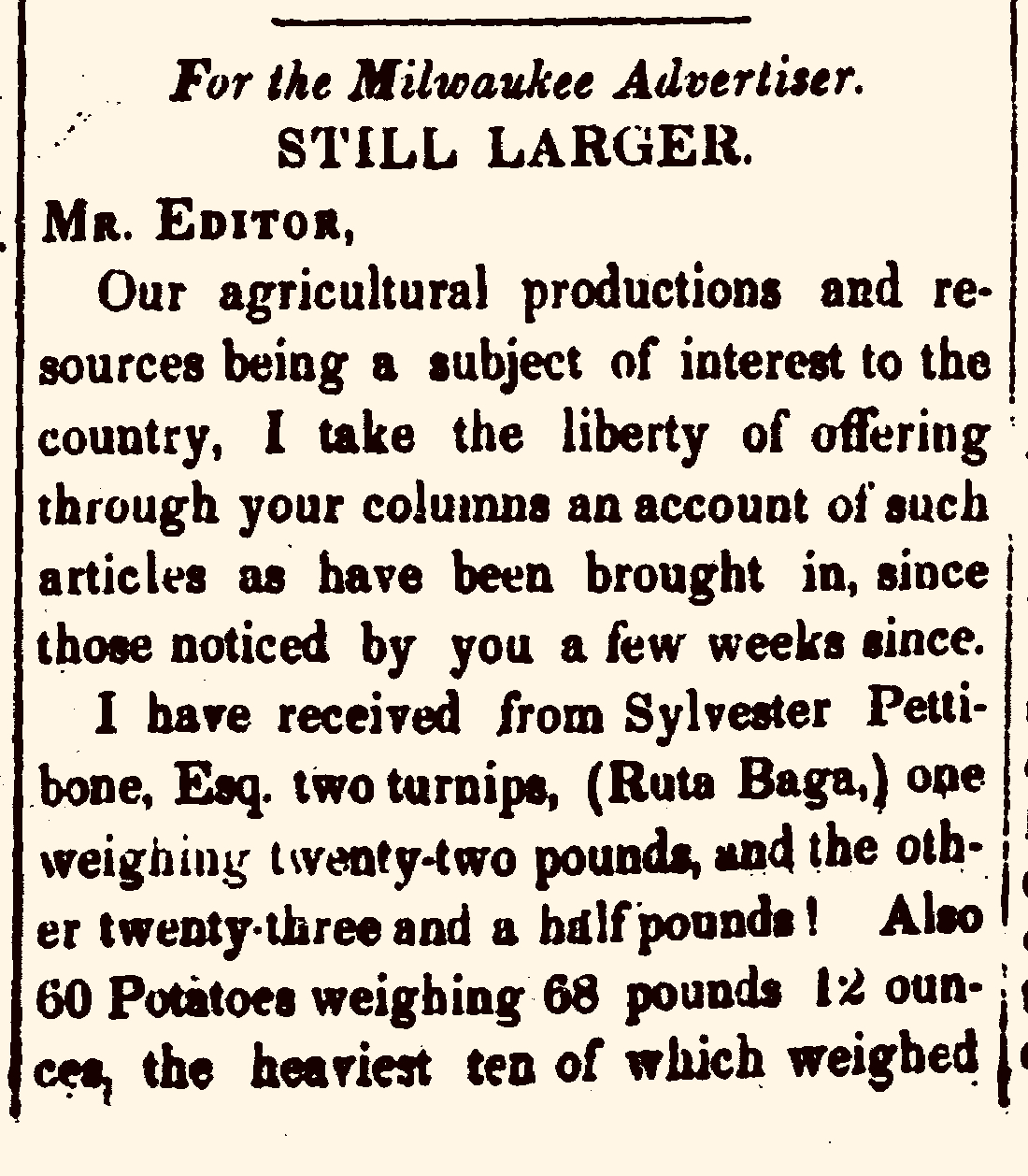
While researching the life of one of Mequon’s first white settlers, Isham Day, I ran across the following breathless bit of regional puffery and promotion, penned by Milwaukee co-founder Byron Kilbourn. It’s from page 2 of the November 17, 1836, edition of the Milwaukee Advertiser:

Lawyer Pettibone has, indeed, grown some astounding turnips (“Ruta Baga”), ‘taters, and carrots in the fertile soil of Milwaukee. Likewise Mr. Douglass with his enormous radishes and “common English” turnips. Have others done anything comparable? Indeed they have, and Mr. Kilbourn has the details…

Continue reading

Isham Day: Civil War casualty

Isham Day was one of the very first white pioneers to settle in the future Town of Mequon, Wisconsin Territory. I first wrote about Isham Day, and his historic house—later Mequon’s first post office, and also known as the Yankee Settlers’ Cottage—in an earlier post, River Walk. You might want to read that before continuing with today’s essay.

Isham Day was not only one of the first settlers in this area, he was active member of the small but growing community in what would become Washington and, later, Ozaukee counties. There is a lot to say about his role in the early decades of pioneer life in the Clarks’ neighborhood, some of which is already known through early local histories and various federal and local primary sources. (And he appears in six different posts here at Clark House Historian.)

One thing that is less well known is what happened to Isham Day after those early days in Milwaukee and Mequon. I wanted to know and, after an extended search, I found out. In many ways, it’s a story of the stereotypical moving-ever-westward American pioneer experience. But it’s also a story of a man trying to live a peaceful life in the midst of violence and rebellion. In our recent post, Memorial Day, 2023, we remembered some of our local men that fought and died to preserve the Union and end the scourge of slavery in “the land of the free.” Today we examine one of the many civilian casualties of that conflict: Isham Day.

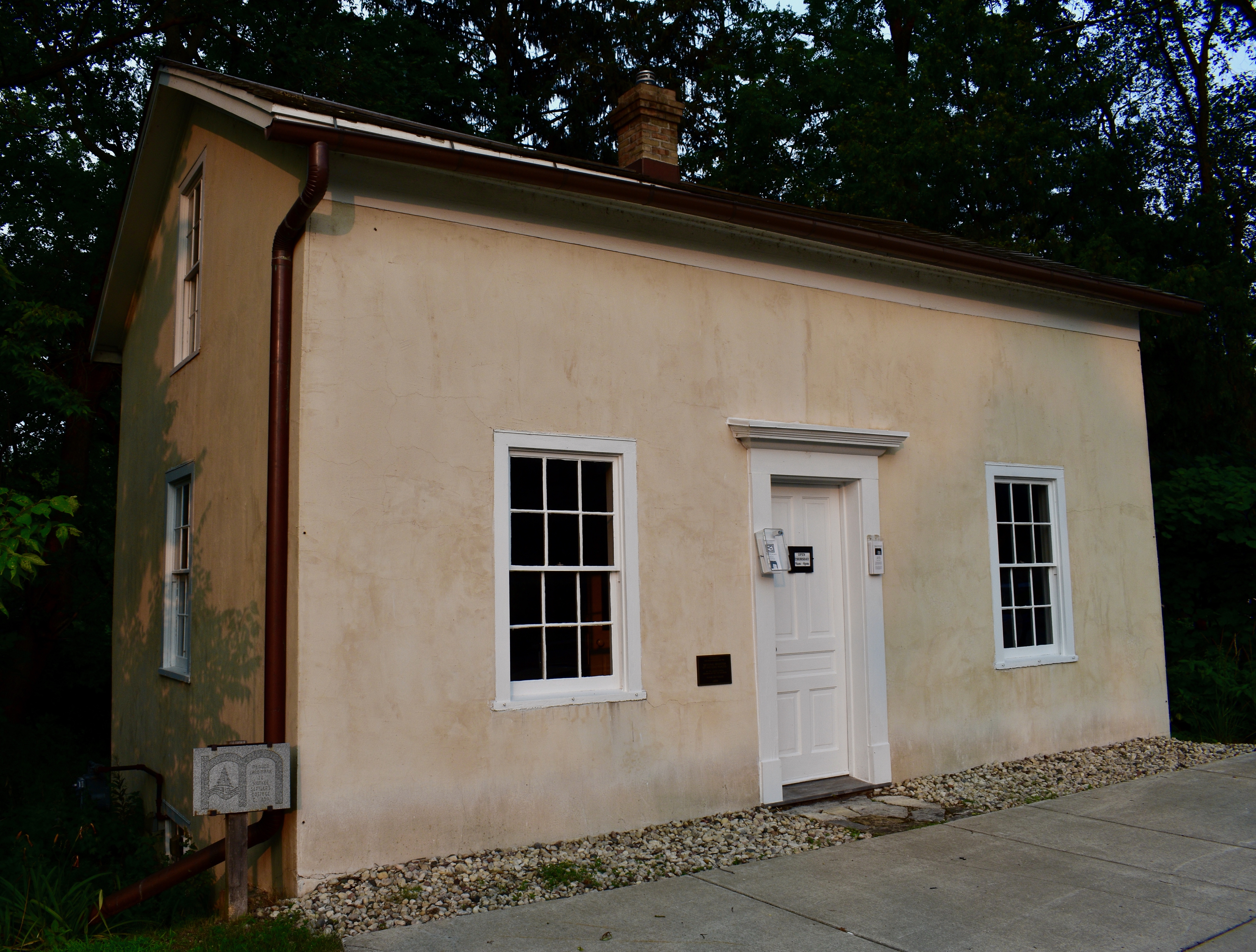
Isham Day house (“Yankee Settler’s Cottage”), built 1839, Mequon, Wisconsin. The oldest house in Ozaukee county still on its original foundation. Photo credit: Anna Perkins, 2021.

Please note: sensitive or younger readers may find some of the language and events documented below to be disturbing.

Continue reading

Nope. Not our…Henry Clark in the Civil War

Today we introduce a new category on Clark House Historian, one that I’m calling “Nope. Not our…”

What’s “Nope. Not our…” all about? Well, it’s about keeping track of some of the most important dead ends and disambiguation efforts that are—in fact—a huge “behind the scenes” part of the research that goes into this blog.

“Nope. Not our…” An all-too typical day in the Clark House Historian’s office.1

The fact is, I spend a lot of time chasing down “hot tips” for various unsolved Clark House history mysteries and, sadly, many of those promising clues turn out to be duds. From time to time I have written blog posts discussing specific erroneous or misleading bits of information, and then adding clarifying or corrected information and documents for the record.

But some ambiguous or promising Clark House Historian research paths are so complicated—and have taken so much time to research and document before being proven incorrect—that I need to create a more organized record of which research approaches were tried, and how each succeeded or failed. And since this blog is where I “show my work” as we uncover new chapters of Clark House history, I thought it was time for a CHH category dedicated to eliminating confusion and error in our search for a more complete and accurate history of the Clark House and its pioneering residents and neighbors.

And so we present our new category: “Nope. Not our…” And the honor of the first “Nope” post goes to:

Continue reading

Memorial Day, 2023

Lest We Forget

Our annual Memorial Day post, first published in 2020. Updated for 2023 with new information about Evander B. Bonniwell’s service.

Graves of Unknown Union Soldiers, Memphis National Cemetery, photo by Clayton B. Fraser, (Library of Congress), public domain. Memphis National Cemetery is the final resting place of Mequon’s Watson Peter Woodworth, and almost 14,000 of his Union Army comrades.

Today is the day our nation officially observes Memorial Day. For many Americans, Memorial Day represents “the first day of summer,” and is traditionally celebrated with trips to the lake, picnics, parades, and sales on cars, appliances, and other consumer goods.

But for many of us, Memorial Day remains rooted in its origins as Decoration Day. The first national observance was in 1868, when retired general John A. Logan, commander and chief of the Grand Army of the Republic—the Union veterans’ organization—issued his General Order Number 11, designating May 30 as a memorial day “for the purpose of strewing with flowers or otherwise decorating the graves of comrades who died in defense of their country during the late rebellion, and whose bodies now lie in almost every city, village, and hamlet churchyard in the land.”

On this Memorial Day, let’s take a moment to remember what this day truly represents.

Continue reading