Home Sweet Home., ca. 1876. [New York: publisher not transcribed]. Library of Congress.
One of the first and most important tasks for any settlers arriving in the recently “opened-for-settlement” Wisconsin Territory was to create some sort of dwelling to shelter themselves as they carved out new farmsteads amid the dense hardwood forests. But what sort of quickly-built structures did our immigrants first construct and take shelter in?
Obviously, the big, stone, full-basement, two-story, Greek Revival style Jonathan Clark House, with its “1848” inscription carved over the front door, and its many double-hung sash windows, was not a hastily-made “first shelter” for newlyweds Jonathan and Mary (Turck) Clark. They must have had another, smaller, first home. What was that first home like? Until now we have assumed that the Clarks’ first home was probably a log cabin, and not some kind of “shanty,” but we didn’t really know. In today’s post, we share with you a recently discovered document that—I believe—solves this mystery once and for all…
Wigwams, shanties, log cabins
Fortunately for us, quite a few of the first immigrants to old Washington/Ozaukee county left accounts of their 1830s and ’40s arrivals and early days pioneering in the area. These recollections almost always describe their first Wisconsin Territory homes as either log cabins or “shanties” of some kind. (And on a few occasions, some of these white settlers even took temporary shelter in unoccupied wigwams or lodges of the local Indigenous peoples.) But shanties and log cabins were the preferred first shelter for our Mequon immigrants. Which asks the question: what do we mean when we talk about log cabins and shanties?
Well, it turns out that in the 19th-century “shanty” was a very versatile word. It could mean shelters of all sorts, anything from a cloth tarp strung between two trees, to a hastily built “nest” of boughs made from half-downed fir trees, to “log cabins” of all sorts. The types of shelter described by the word shanty were so varied, I need to save that discussion for another post or two.
Starter homes, 1840s style…
“Shanty” may be a vague description. but how about “log cabin”? Most of us have at least a general idea of what a log cabin should look like. Perhaps something like this:
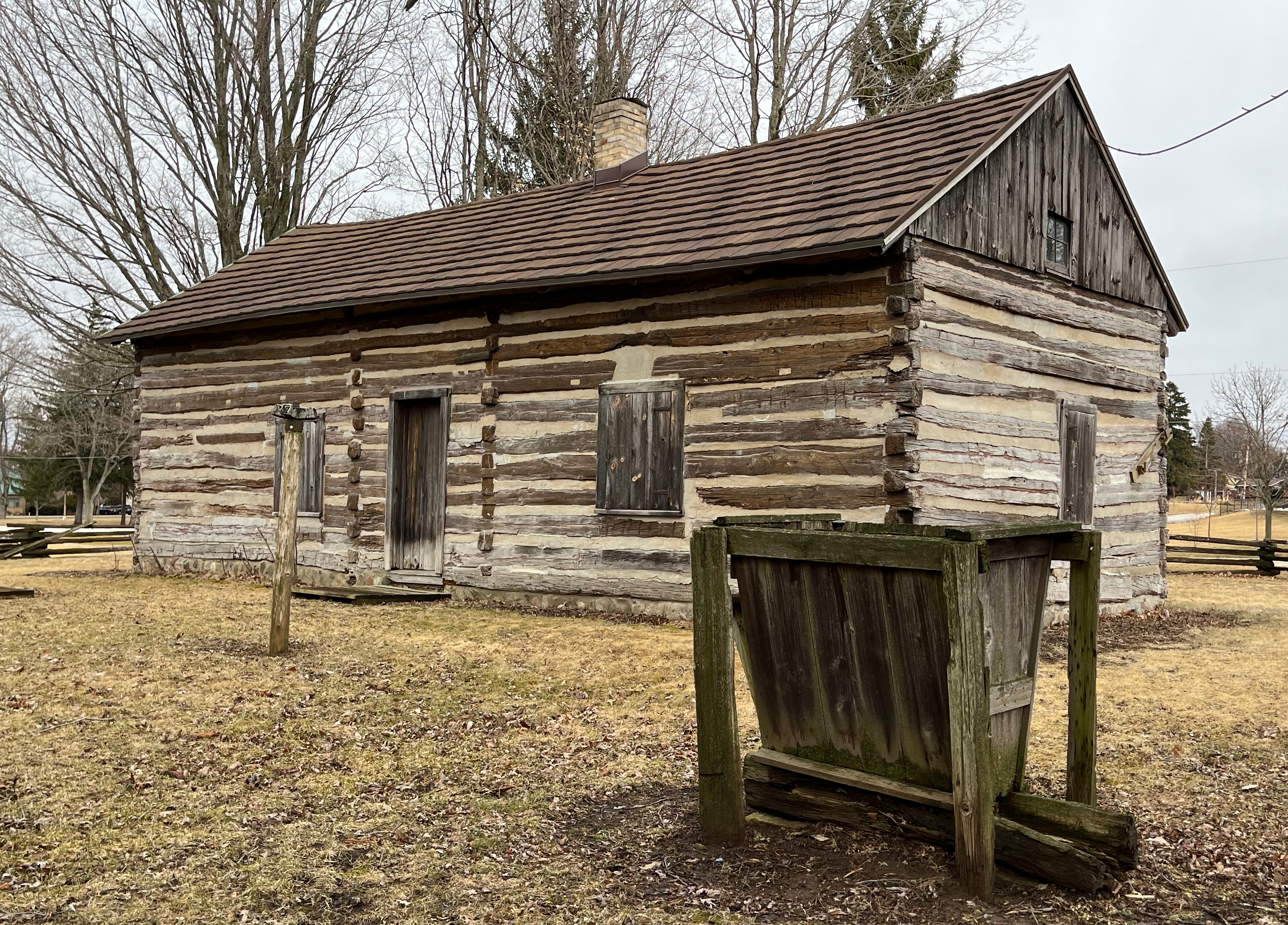
Photo credit: Reed Perkins, 2026.
That’s the Baeseman Log Cabin. It was built near the present intersection of Highland Road and Wasaukee Road, in Germantown, about six miles west and a mile south of the Clark house, and is now part of the Trinity Freistadt Historical Site in western Mequon. Exactly when this cabin was built is not known, but Frederick Baeseman purchased his 40 acres of government land, section 12, T9N-R20E, just west of the Freistadt Settlement, on October 8, 1841, and he probably began work on this cabin around that time.
With a closer look, you’ll find that Baeseman’s cabin, with its central door and fireplace, a large room on either side of the door, and lofts—with windows—above both big rooms is, in some ways, rather “deluxe” for a first home in the 1840s wilderness. Although small by modern standards, the Baeseman cabin is actually about twice the size of many “starter homes” of his era. Early Wisconsin log cabins often looked more like this, the 1840s Norwegian settler’s cabin at Old World Wisconsin:
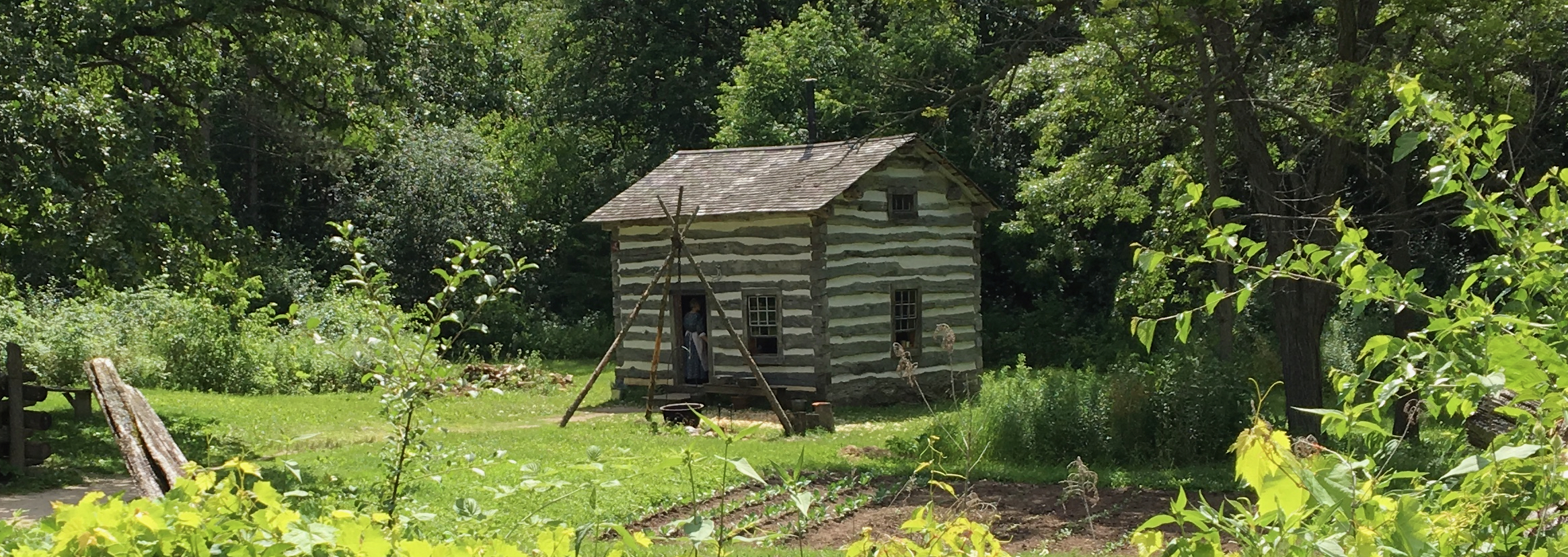
Photo credit: Reed Perkins, 2016.
This cabin, and many like it, is about half the size of the Baeseman cabin. It comprises one door, one main room with a small iron stove on the ground floor, a loft or attic above, and a few windows. I believe this sort of one-room cabin was a very common first shelter for pioneers in the “big woods.” In fact, for many immigrants with smaller farms or fewer funds, a one-room cabin like this may have been their only home for many decades of living and farming in Wisconsin.
What about the Clarks?
We’re not sure exactly when Jonathan Clark came south from Green Bay to look at land for sale in old Washington/Ozaukee county. It was sometime between mid-September, 1836, and late-1839. I often wonder whether Jonathan arrived in the area well before his 1839 land purchase and, like several other settlers that we know of, was offered shelter—and perhaps a job—at Peter Turck’s sawmill. This might explain both why JMC purchased land near the Turck mill, and how he met, and eventually wooed, Turck’s daughter Mary.
In any case, on December 12, 1839, Jonathan M. Clark went to the land office in Milwaukee and purchased his first 80 acres of government land, the west half of the southeast quarter of section 3, T9N-R21E. And the following spring, on March 15, 1840, he married Peter and Rachael (Gay) Turck’s eldest child, 20-year-old Mary Turck. Their first child, daughter Caroline Mary, was born about eight months later, on November 7. Which brings us back to wondering: did the Clarks live in a “shanty” of some kind or a log cabin?
It was a log cabin.
The answer appears in the lead paragraph of a long, and quite accurate, biographical sketch of Caroline M. (Clark) Woodward that appeared on page 1 of the Lincoln, Nebraska, “The New Republic” newspaper, August 20, 1891:
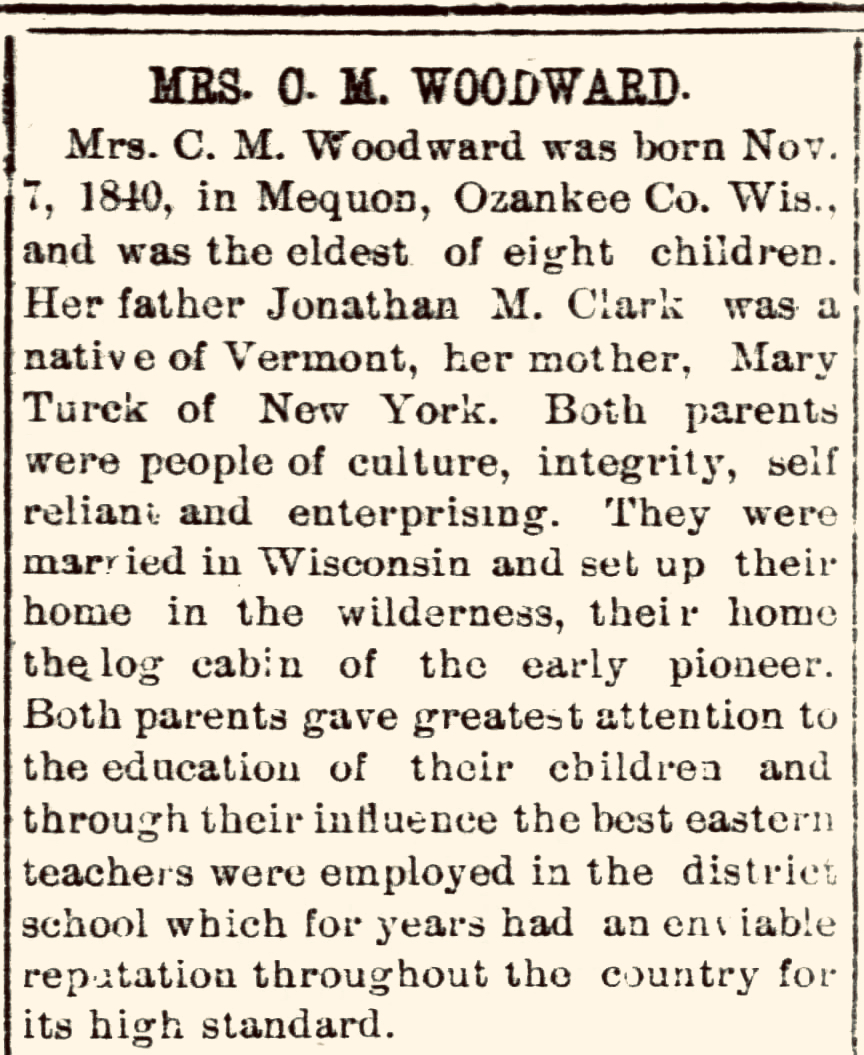
The key sentence, of course, relates that Jonathan Clark and Mary Turck “[…] were married in Wisconsin and set up their home in the wilderness, their home the log cabin of the early pioneer.” Given that this information probably came directly from Caroline herself (in fact, given how well-written, and how accurate the whole profile is, I wonder if Caroline wrote it herself), I believe the matter is settled. The first home of Jonathan and Mary (Turck) Clark was a log cabin.
More questions…of course!
Now… I’d like to know where was that first Clark log cabin located? Near its big stone successor? Off some distance to one side or the other? Perhaps to the east, near the now-gone stone barn? Or was it—or is it still—part of the single-story “addition” to the north side of the existing Jonathan Clark house? There are Clark House Museum projects in the planning stages that may give us answers to these, and other related questions.
Coming up on CHH
I’m working on several projects, all of which will receive posts here on the blog. I’m well along in studying the Bonniwell family Bible and have much to say on that. I have much more to say about shanties, wigwams and other early Wisconsin dwellings, and I have found some amazing period artwork to illustrate those posts. Those shanty and log cabin posts will also include some vivid first-person memoirs, including an interesting letter from early German immigrant William Opitz. And that 1891 profile of Caroline (Clark) Woodward, quoted above, is a good one, and deserves to be posted in full.
I give live presentations, too. Later this spring I’m presenting a revised and updated version of my Fred Beckmann talk for the Milwaukee County Genealogical Society, and I’m preparing two talks for the Cedarburg History Museum. One will examine Native American and settler relations in Jonathan and Mary Clark’s Wisconsin (as they really were), and the other will look at early local roads and how they were built, with a special focus on JMC & his neighbors and the construction of the Milwaukee-Cedarburg Plank Road.
As you can see, there’s a lot of Clark House history in the works. I’ll be back with more, soon.
__________________
UPDATED, March 20, 2026 to correct the name of the 1891 Nebraska newspaper cited in the text; it should be “The New Republic.”
 Clark House Historian
Pingback: Caroline M. (Clark) Woodward – profile, 1891 | Clark House Historian