Mark your calendar! This Saturday, March 7, 2026, from 9:00 a.m. to 12:00 noon, the Jonathan Clark House Museum is hosting a St. Patrick’s Day event.
Graphic from the JCH website News & Events page
Did you know that in the early days of settlement, much of Cedarburg—and a surprising portion of Mequon—was home to Irish immigrants? Come by the Jonathan Clark House Museum on Saturday and find out if your home had Irish neighbors! Come look at historical maps while you nibble on house made butter and Irish soda bread and enjoy festive music on the Celtic Harp. Event co-sponsored by the Cedarburg History Museum.
The museum is located at the corner of Bonniwell and Cedarburg roads in Mequon, Wisconsin. We look forward to seeing you on Saturday! And as St. Patrick’s Day approaches, you might be interested in catching up on some previous, Irish-themed Clark House Historian posts. Just read on, click all the links, and Erin go Bragh!
Peter Turck and Irish Relief

“To Irishmen and the Friends of Ireland,” Milwaukee Sentinel, Friday, December 11, 1846, page 2
For a previous St. Patrick’s Day, I wrote a post that looked at a few aspects of Irish immigration and life in early southeast Wisconsin. The post centered around an 1846-1847 Milwaukee effort to help relieve Irish suffering and starvation during the early years of the Great Famine. The list of participants in the relief activities included Mary (Turck) Clark’s father Peter Turck. For the full story, click to our most recent version of that post, Peter Turck and Irish Relief.

Unknown artist, “Irish emigrants leaving home — the priest’s blessing,” Illustrated London News, 1851. The Miriam and Ira D. Wallach Division of Art, Prints and Photographs: Picture Collection, The New York Public Library, via The New York Public Library Digital Collections.
Meet the Neighbors: the Desmond family
One of our more recent CHH discoveries was a first-person memoir of one of the Jonathan Clark family’s closest neighbors, the Irish immigrant Desmond family. I shared extensive excerpts of that memoir in the two-part series Meet the Neighbors: the Desmond family ( click here for part 1 and part 2 ).
The Thomas and Dennis Desmond farm parcels were located in the NW quarter of Section 3, T9N-R21E, Town of Mequon. The Desmond farms, and the adjacent John Corcoran farm, were situated due north of the Jesse Hubbard, Jr., farm, due west of the Ferdinand and Friedrich Groth properties, and immediately adjacent to the northwest corner of the Jonathan and Mary Clark farm, which occupied all of the southeast quarter of section 3:

“Shoolmap” of Mequon, Wisconsin (T9N-R21E, detail showing Section 3), pre-1872, AGSL UWM Library Collection
There are some unique and interesting stories in the Desmond memoir; I think you will enjoy reading both posts.
Irish families on the pre-1872 “Shoolmap” of Mequon
The Desmonds and Corcorans were not Jonathan and Mary Clark’s only Irish immigrant neighbors. A closer look at the whole of that pre-1872 “Shoolmap” of Mequon will uncover a large number of Irish surnames. For a link to the full map, see our July, 2020, “Shoolmap” post. Open the link to the full map and zoom in.
You may notice that there were a lot of Irish families that settled (like the “Yankee-Yorker” Clark family) along the north side of the Town of Mequon. Here’s a look at that top row of sections, the sections numbered 1 (on the east/right) through 6 (on the west/left). The Clarks, Desmonds and Corcorans occupy most of section 3:

“Shoolmap” of Mequon, Wisconsin (T9N-R21E, detail, Secs. 1-6, color adjusted), pre-1872, AGSL UWM Library Collection
Some of the likely Irish surnames found in just the first six of the 36 sections of T9N-R21E, include: Dockery, O’Leary, Shaw, Desmond, Corcoran, Leary, Dooley, Kenney, Degan, Bowe, Mahony, Murphy, and O’Neil. Some possibly Irish surnames in these six sections include: Burke, Cannophy, Rice, Gurnee, Hooper and others. So far, I don’t know much about these probably-or-possibly Irish neighbors, but a look at the 1850, 1860 and 1870 federal census schedules would tell us more about their national origins.
When the Shoolmap was made (sometime between 1857 and 1872), the 151-acre Jonathan Clark farm was still owned by “Widow Clark” and her daughters. The Clarks sold the farm to the Irish immigrant Doyle family in 1872. I took a quick look at the Shoolmap and found one Doyle family living on section 11; I think this is John Doyle and his wife Catherine. I seem to recall other Doyle families or farms elsewhere on the full Shoolmap, but can’t find them at the moment. I don’t (yet) know exactly when the Doyles arrived in Mequon; federal and state census schedules document the Doyles living in Mequon as early as mid-1860.
FYI, I suspect the Bowe family in sections 5 and 6 were related to Johanna Bowe, the wife of Thomas Desmond; see our two Desmond posts—and the complete Desmond memoir—for more details.
Irish neighbors in 1855
Speaking of census records, the Desmonds and many other Irish families may also be found on many early federal and territorial or state censuses for the Mequon area, including the 1855 state census:
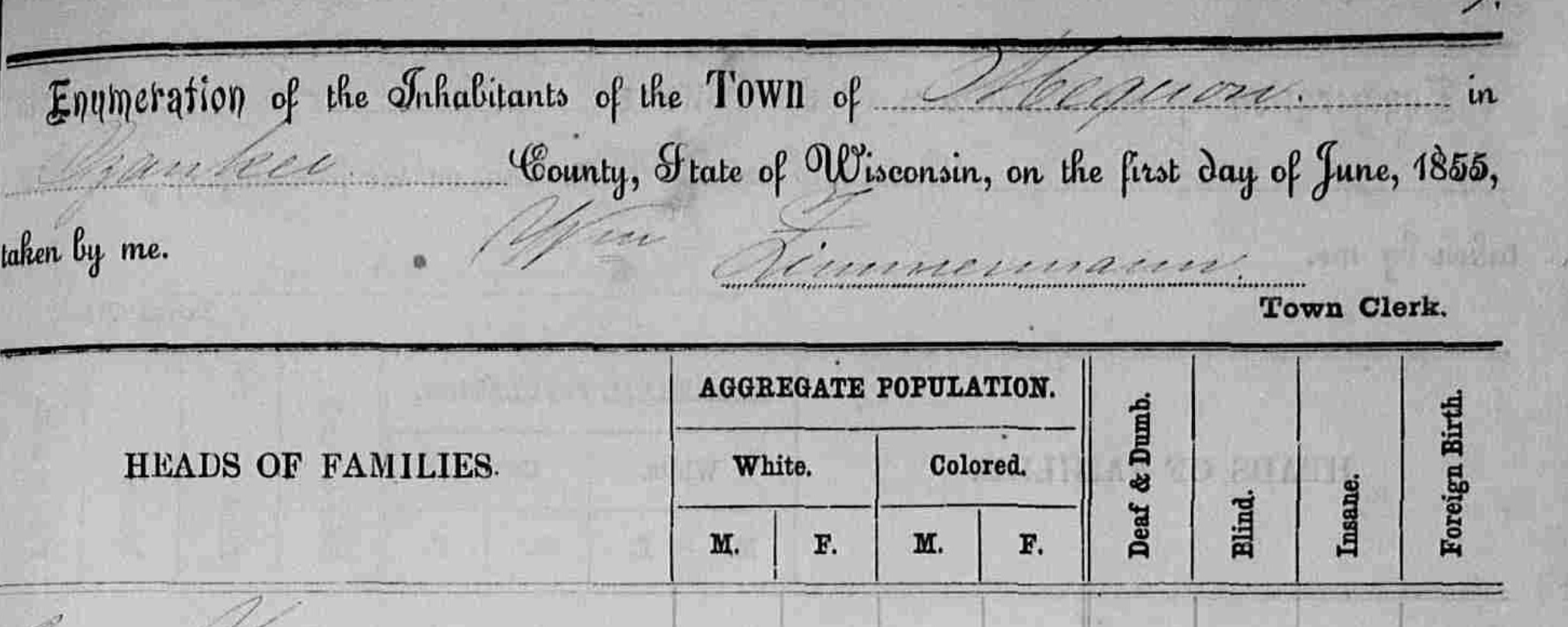
Wisconsin state census 1855, Mequon p 1 detail
A look at our June, 2020 post, Census Records for the In-Between Years: 1855 — Part 2 will give you an idea of who lived near the Clarks between the 1850 and 1860 federal decennial censuses. (Remember that beginning in 1850, the decennial federal census recorded “place of birth” which, for immigrants, meant country of birth.) As always, be sure to click the highlighted links for related additional info.
Irish immigrants at Old World Wisconsin
Somewhat off the Mequon-Cedarburg track, but relevant all the same, are some of the living history exhibits at Old World Wisconsin. Among these are two of the first buildings you encounter as you walk past the admissions desk and up the road to the Crossroads Village part of the site, the Mary Hafford House, and St, Peter’s Church.
Mary Hafford’s House
This historic building was the Watertown home of Irish immigrant, widow, mother, and laundress, Mary Hafford.
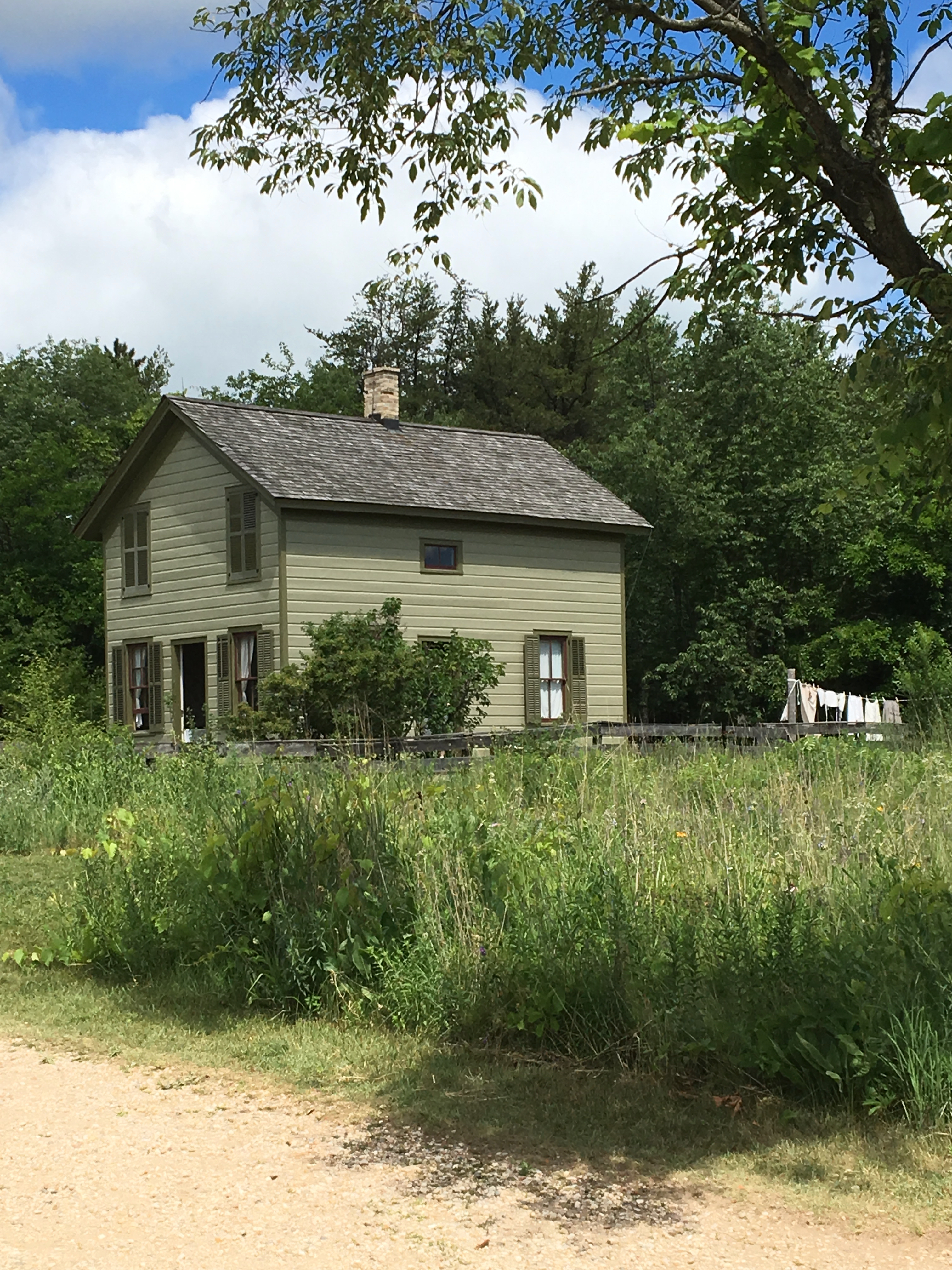
Irish immigrant Mary Hafford’s 1880s Irish townhouse, Old World Wisconsin, July, 2016, photo credit: Reed Perkins.
I mentioned Mrs. Hafford and included a photo of her outdoor laundry workspace in my annual Labor Day photo essay, in the section on “Women’s Work.” And for more info about her life, and some excellent additional photos, see this post at Priscilla Galasso’s blog scillagrace. (Ms. Galasso once worked as an interpreter at the Hafford house.)
St. Peter’s Church
St. Peter’s Roman Catholic Church was built in Milwaukee in 1839, two years after young Mary Turck arrived in Wisconsin Territory with her parents, Peter and Rachael (Gay) Turck, and her six siblings, and the same year that Jonathan M. Clark and the Bonniwell family first appeared in the Milwaukee-Mequon area. St. Peter’s was the first Roman Catholic church in the city. It was erected by Rev. Patrick Kelly, a native of Kilkenny County, Ireland, and the first resident catholic pastor in Milwaukee. For a brief biography of Rev. Kelly, see this WHS essay.
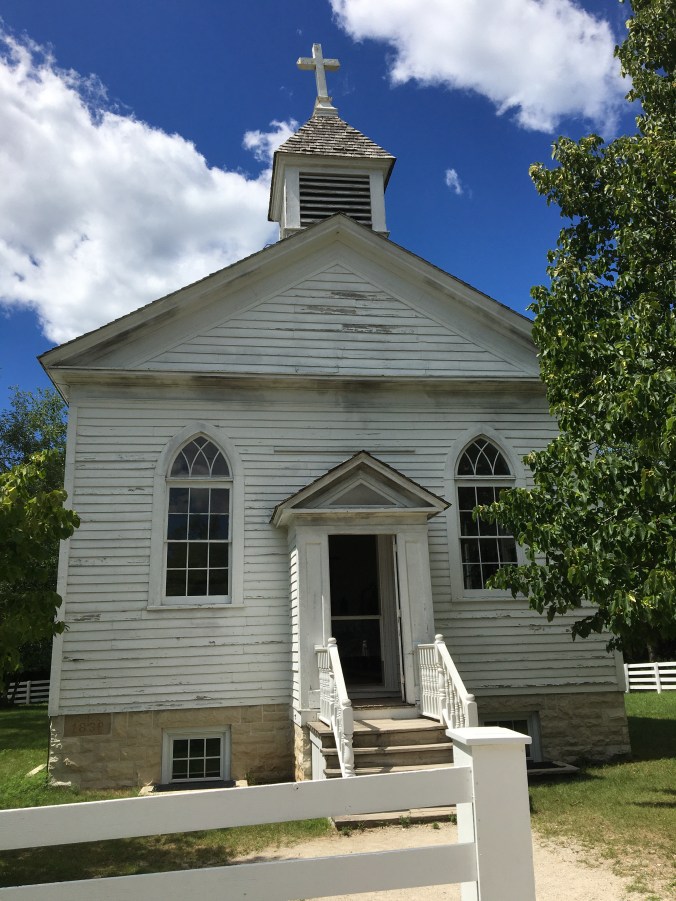
A familiar sight
How do we know that this building was part of the Clark and Turck families’ world? I have not seen any written references to St. Peter’s—or any other Milwaukee buildings—in the few family documents that we have from the period. And as devout, 19th-century protestant Christians it seems unlikely that members of the family ever attended services there. (I believe the Clark and Turck families worshiped at Milwaukee’s Summerfield Methodist Church in the 1860s, ’70s and ’80s.)
But the Clarks and Turcks couldn’t have missed St. Peter’s exterior, with it’s tall (for its day) steeple, as it was only a few blocks from the 1860s and ’70s residence(s) of Peter Turck and his widowed daughter Mary (Turck) Clark and her seven unmarried children. For more details, photos, and maps of the Clarks’ and Turcks’ 1860s and 1870s Milwaukee neighborhood—including the location of St. Peter’s Church—see our 2022 post, A familiar sight: St. Peter’s Church, 1839.
So much more to discover…
We’ve only begun to scratch the surface of the Irish immigrant experience in Mequon and Cedarburg. I have collected numerous documents that illustrate aspects of the lives of the Irish that arrived in the area from the late-1830s to the 1870s or so. These stories often center around issues of Irish heritage, culture, language and religion, and I’ll have more to say about these topics later this year.
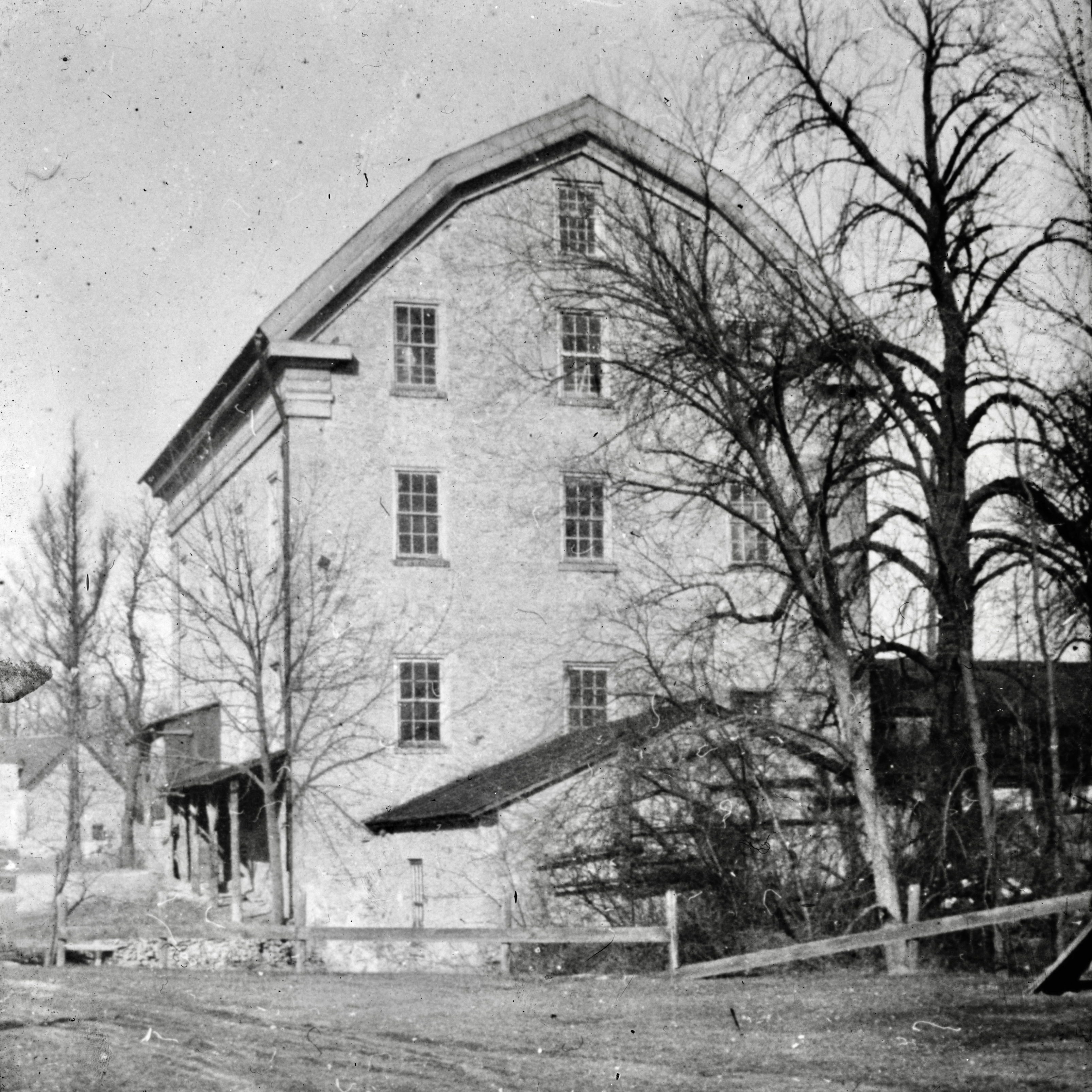
Concordia Mills, Hamilton, Ozaukee County, WI (cropped), Historic American Buildings Survey, [1934]. Library of Congress
And on a related note, current Mequon and Cedarburg residents may have heard that the crossroads hamlet of Hamilton, home of the Concordia Mill (Fred Beckmann’s 1860s employer) and other early area businesses and residences, was originally so Irish in character that the settlement was called “New Dublin.” But exactly when the “New Dublin” name began to be used, and whether it was actually a U.S. Post Office address, is not fully understood. I’m gradually finding documents that will, I hope, make all clear.
More Clark House history coming. See you soon.
 Clark House Historian