UPDATED, Feb. 28, 2026, to correct erroneous dates of publication of the two Cedarburg News “letters.“
Migration memories, 1848, continued
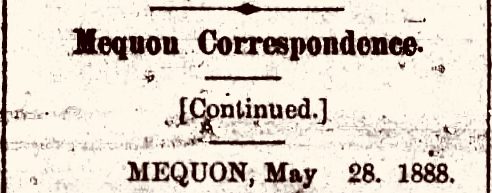
In our previous post we presented the first part of a personal memoir of travel from Germany to New York City and, eventually, Mequon-Thiensville, circa 1848. Those recollections were published as the first of two “letters” to the Cedarburg News in May, 1888. Both letters were pseudonymous, signed only with the initial “L.”
The first letter of the pair, titled “Mequon Corrspondeence” [sic], was published on page 2 of the Cedarburg News on May 16, 1888, but note that the letter itself was dated, in its headline, “May 21, 1888.” If you missed it, I recommend you begin with that earlier post and then come back here for the conclusion. Today we complete the author’s reminiscences with excerpts from his second letter, titled “Mequon Correspondence. [Continued.]” appeared the following week, May 23, 1888, also on page 2, but the letter was dated, in its headline, “May 28, 1888.”
An 1840s “prank” in NYC
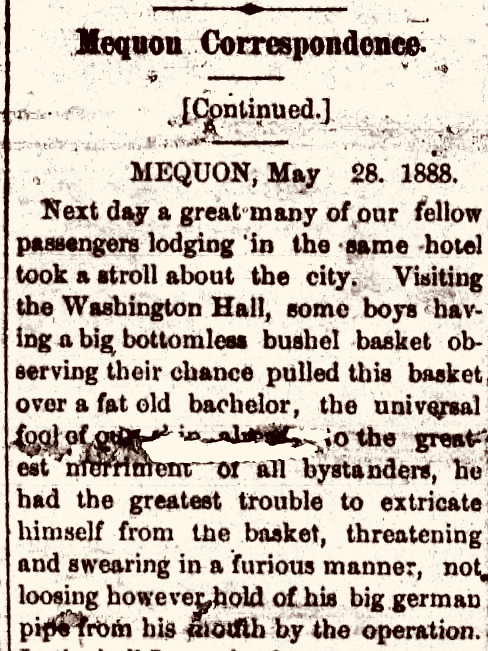
The May 28th, 1888, letter begins with two anecdotes from our immigrant’s first day in New York City. The first incident involves a schoolboy “prank” in which a bottomless peach basked is used to trap the arms of an unsuspecting “fat old bachelor, the universal fool of our ship [illegible] to the greatest merriment of the bystanders.”
A first gift in America
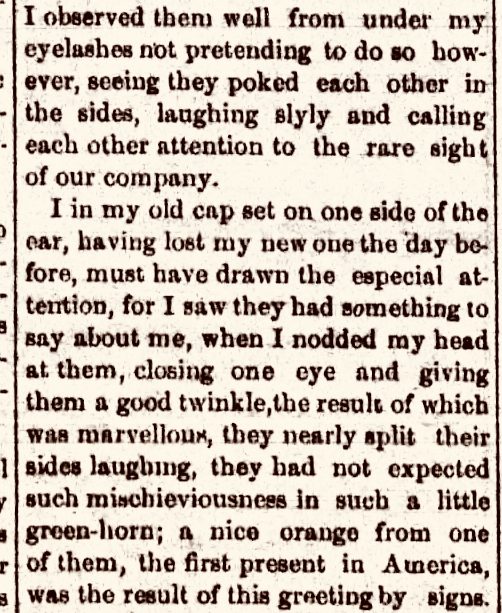
Our immigrant’s next tale relates his first encounter with Black Americans, in which he played a kind of “peek-a-boo” with two Black New York women. According to our narrator, his winking and blinking from under the brim of his cap proved amusing to the ladies, and they rewarded him with the gift of a “nice orange.”
On to Thiensville & Mequon
The memoir’s next paragraphs describe his arrival in Thiensville on the first of May (1848? 1849?), taking temporary lodgings at “Mr. Alten’s Tavern,” exploring his new neighborhood, and—after a wallow through a local swamp—washing his muddy shoes, socks, and trousers in the sweet, clear, spring water of a newly excavated, barrel-lined, drinking water well.
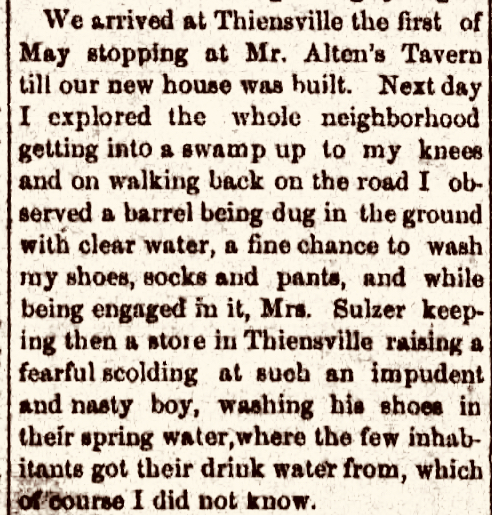
Needless to say, Mrs. Sulzer was not amused.
Study with Mr. Brown, 1849
Our correspondent continues with tales of his time at Mr. J. T. Brown’s district school in Mequon village. In these paragraphs our narrator reveals a few interesting facts about his young life and education. In 1849, he chose to attend Mr. Brown’s school “to learn good English,” (In another paragraph, not shown here, he says that he had studied French and English languages for the last two years of his German school days.)
Later, after a bit of in-school nonsense, our memoirist recalls asking an irritated Mr. Brown whether the author wasn’t “too big a boy to be whipped” for his pranks, and mentions that he was primus at his pro gymnasium the previous year. This indicates that he attended the top academic tier of German secondary education, the Gymnasium (or Pro Gymnasium), and that in 1848 he had achieved distinction as his school’s primus, equivalent to a modern American secondary school valedictorian. As the primus, our author would have been aged 18 to 20 years old in the year prior to his 1849 schooling in Mequon-Thiensville.
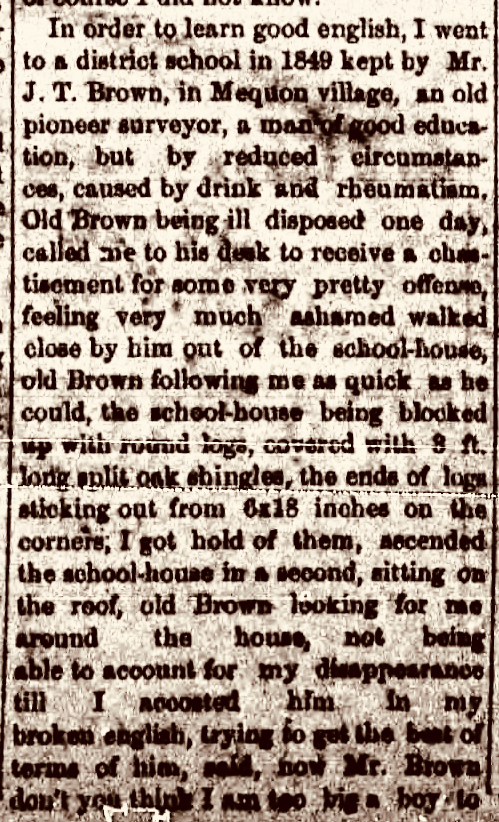
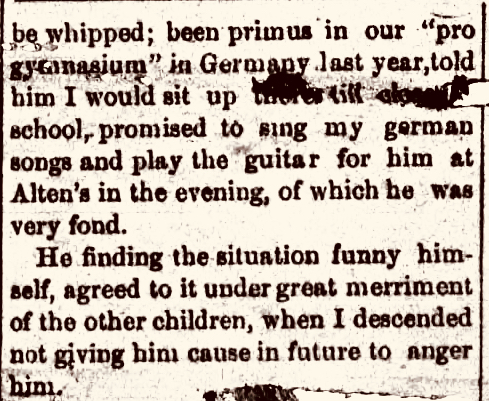
The author’s school days stories conclude with the observation that he liked to play the guitar and sing German songs, and that Mr. Brown enjoyed hearing such music in the evenings at Alten’s tavern.
Mr. Brown’s district school, 1849
Mr. J. T. Brown’s 1849 Mequon school, as described by our 1888 memoirist, seems very similar to Mequon’s first school, the Bonniwell School, built in 1843 just about a mile west of the Jonathan Clark house on what is now Bonniwell Road. The main difference is that the logs of Mr. Brown’s schoolhouse were “covered with 8 foot long split oak shingles,” which does not appear to be the case in the earlier Bonniwell school, as sketched in 1867:
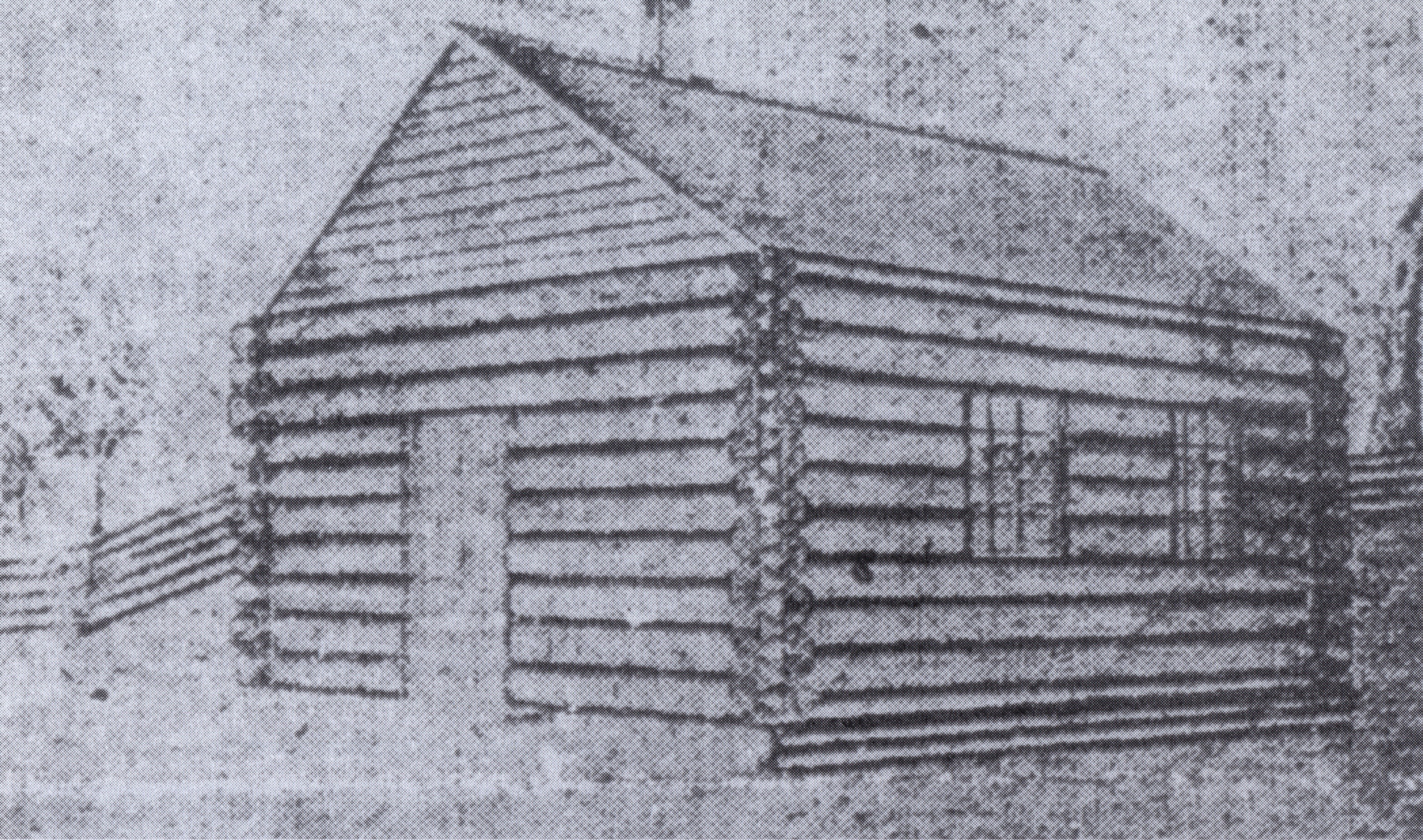
Bonniwell, Evander B., artist. [Mequon’s first school, the Bonniwell School, c. 1864], from George B. Bonniwell, The Bonniwells: 1000 Years, page 71. (Used by permission.)
Encounters with Native Americans
This second letter to the Cedarburg News concluded with interesting recollections of some interactions between our German immigrant and the Native Americans that were still present in Mequon in the late-1840s, more than a decade after the “conclusion” of the federal plans for “Indian removal” from southern Wisconsin.
I will be writing more CHH posts specifically about these interactions, and about other encounters between the county’s white settlers and original Native American inhabitants. FYI, some of these stories will also be featured in the talk I’m giving on Saturday, May 9, 2026, 6:00 p.m., at the Cedarburg History Museum. My presentation is part of the museum’s March 4 to Nov. 1, 2026, “First Nations” exhibit. Mark your calendars! I hope to see you there.
Postscript
That’s the end, for now, of our young German scholar’s recollections of his 1848-1849 migration from the advanced, gymnasium education of his native Germany, across the storm-tossed North Sea and Atlantic Ocean, to New York City and then onward to adventures in the rapidly settling frontier of old Mequon-Thiensville.
I hope you enjoyed these first-person tales. But! — as often happens when reading interesting historical documents—these two letters to the Cedarburg News raise almost as many questions as they answer. Who was Mrs. Sulzer and what sort of store did she run? Who was Mr. Alten, and what do we know of his tavern? What’s the story with J. T. Brown, and where was his school? And last, but not least, who was “L.,” the roughly 60-year-old, German-born author of these two 1888 letters? It would be interesting to know.
So there are History Mysteries! to be solved, and we will take a look at a few in our next post. See you then.
 Clark House Historian
Pingback: Mysteries (and errors)… | Clark House Historian