UPDATED, Feb. 28, 2026, to correct erroneous dates of publication of the two Cedarburg News “letters.”
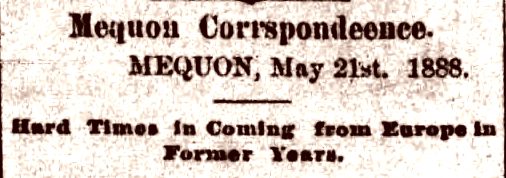
Hard Times in Coming from Europe
You may have wondered why I haven’t written much about the German immigrant history and heritage of our corner of southeast Wisconsin. After all, since the late-1830s, and especially following the “Revolutionary Year” of 1848 in Europe, waves of Europeans—including hundreds of thousands of emigrants from the German Lands— left their homes in the Old World and set out to make a fresh start in America. Many of these German-speaking emigrants would find their way to Wisconsin, where they and their descendants would leave a lasting imprint on the culture and development of the new state.
The story of the Jonathan Clark House, however, centers around the lives of the Clarks and their immediate neighbors and in-laws, especially the Bonniwell and Turck families. All were prominent players in the earliest days of white migration to and settlement of Mequon, old Washington/Ozaukee county, and the city of Milwaukee. The Clarks, Turcks and Bonniwells came to Wisconsin Territory from New York, New England, English-speaking Canada and the United Kingdom in the later 1830s. Their Wisconsin story was not so well known or documented, so I have spent much of my time over the past decade or so researching their families, lives, and the events of their day.
Having said that, we need to remember that these “Yankee-Yorkers” and other English-speaking pioneers were not the only early immigrants to our area. Irish and German families were, indeed, already present and establishing farms and businesses in old Washington/Ozaukee county by the late-1830s, including at the large German Freistadt Colony and the early Irish neighborhood centered between the Jonathan Clark House and the crossroads hamlet of Hamilton. All of these overseas immigrants were the Clarks’ neighbors, and their stories are intertwined throughout the early history of Mequon.
And one thing those 19th-century Irish and German and British immigrants all had in common was time spent on a ship, making the uncertain and difficult voyage from Europe to America. In the next few posts we will look at some first-person recollections of a school boy who came with his mother and brother from the German Lands to Mequon-Thiensville around 1848, as recollected and published in 1888.
“Back in my day…”
Our next few CHH blog posts are based on a vivid, first-person memoir that I thought you might find interesting. It’s a “Back in my day…” type of personal reminiscence, published in 1888 in the form of two “letters” received by the Cedarburg News newspaper. The first letter of the two, titled “Mequon Corrspondeence” [sic], was published on page 2 of the Cedarburg News on May 16, 1888, but note that the letter itself was dated, in its headline, “May 21, 1888.” the second letter, titled “Mequon Correspondence. [Continued.]” appeared the following week, May 23, 1888, also on page 2, but the letter was dated, in its headline, “May 28, 1888.”
“Letters” like these were a common approach to sharing news and personal stories (and filling column-inches) in 19th-century newspapers. Sometimes such articles would be signed with the author’s full name. Other times, such letters would close with a pseudonym (especially when discussing controversial matters). Or, as was often the case, if the letter was “personal” in any way, the Victorian-era author would preserve his or her modesty by signing correspondence with just an initial or two.
Who wrote this two-part, 1888 memoir of an 1848 (or thereabouts) migration from Germany and early days in Mequon-Thiensville? Our author signed the piece with only the initial “L.” Various mentions in the complete text indicate he was an older boy or young man at the time, perhaps as old as 18 or 20 years, was well educated in the German gymnasium, and that he was accompanied on the journey by his mother and one or more brothers.
FYI, It’s a long article, and I didn’t feel like transcribing the whole thing. If you have trouble reading the sometimes blurry microfilmed images, click the picture of each clipping to open a higher resolution image in a new window and then zoom in and scroll around for easier reading. Let’s get started…
Hamburg to Scotland
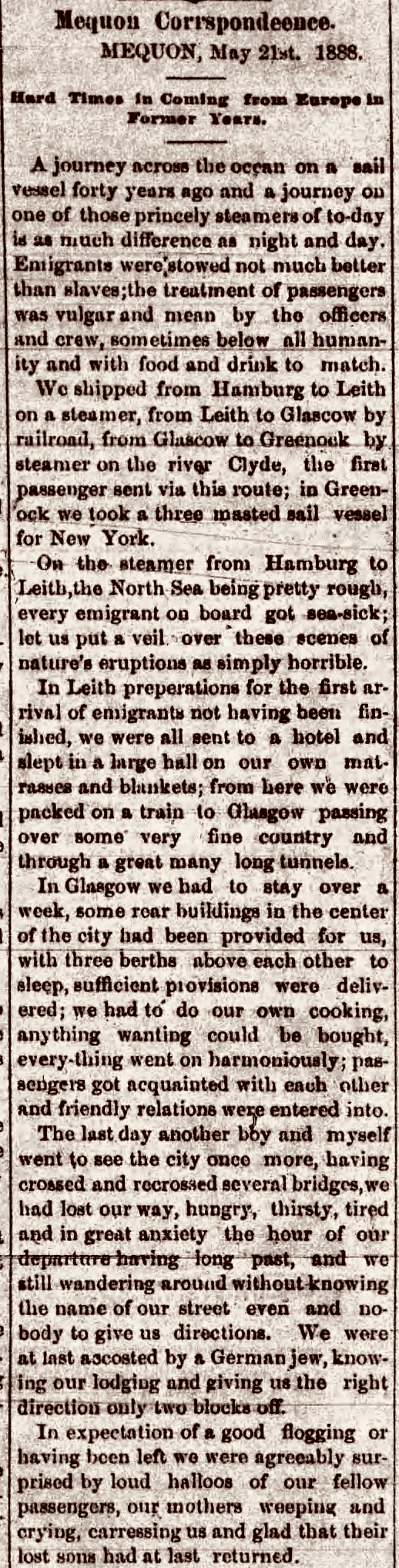
The narrative begins with an overview of the voyage. As you will read, the trip was a rough one; the weather—and the crew—turning nasty at times. The trip began with a shorter—and very unpleasant—first leg, via steamship, across the North Sea, from the main German emigration port of Hamburg, to Leith, on the east coast of Scotland.
Down the Clyde to Greenock
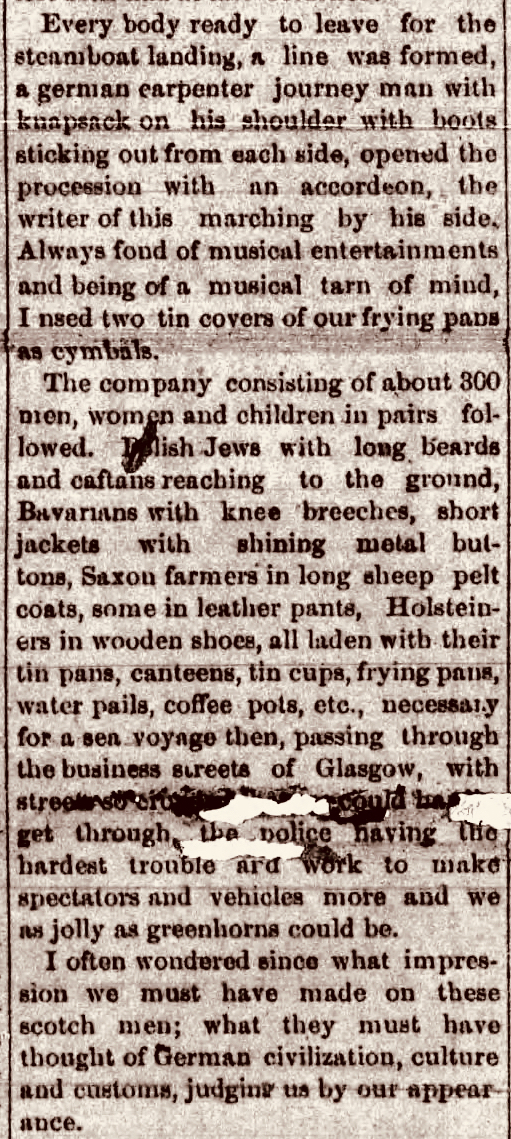
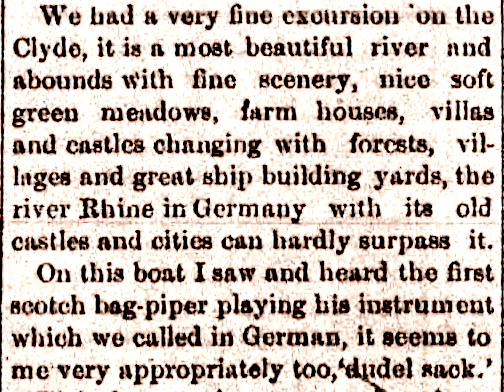
After a week in bunk-house style housing in Glasgow, the emigrants took a steam ship down the river Clyde to the Scottish port city of Greenock. The trip to Greenock began with a parade-like procession of some 300 passengers from their Glasgow lodgings to the riverside docks, where steamboat lay in wait to take them to Greenock, where the River Clyde deepens and become the Firth of Clyde. The 300 passengers made a colorful sight including, among others, Polish Jews in long caftans, Bavarians in knee-breeches, Saxon farmers in long sheepskin coats and Holsteiners shod in wooden shoes.
The 1840s lithograph (below) shows Greenock much as our correspondent saw it in 1848. The train he rode on could well have been the one pictured in the lower right foreground. Commercial and industrial buildings line the near side of the Clyde, while many three-masted, ocean-going ships can be seen lining the docks and riding at anchor in the Clyde.
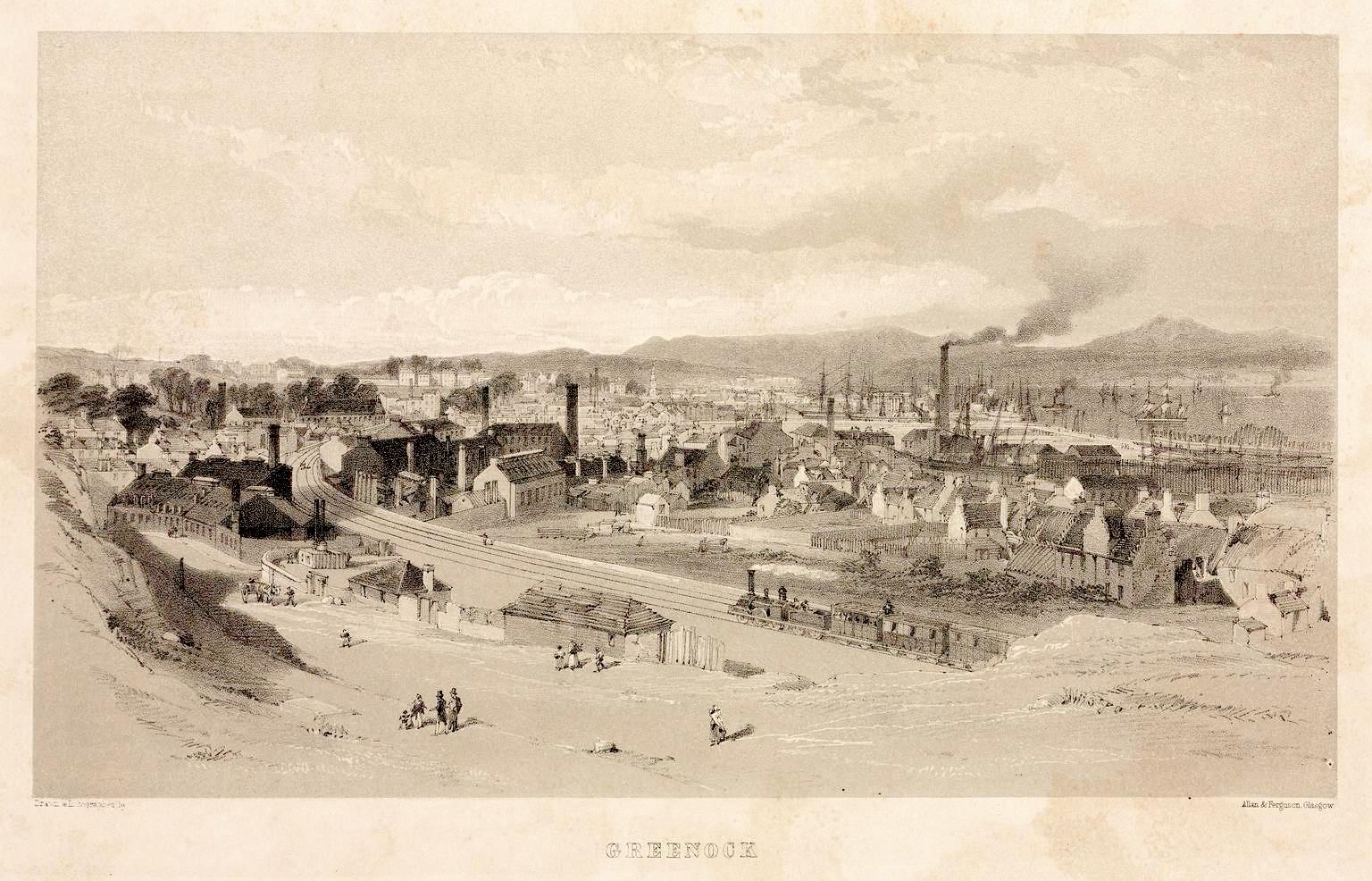
“Greenock, by Allan and Ferguson, lithograph, Glasgow, c.184-?. Science Museum Group Collection Online. CC BY-NC-SA 4.0
Down the Firth, to the skirl o’ the pipes…
Our emigrant enjoyed his trip down the Clyde, comparing it favorably to the River Rhein (a serious compliment from a typical, proud, German), and describes his first encounter with Scottish bagpipes.
“Hard times“ crossing to New York
Trans-Atlantic travel in the 1840s was typically slow, crowded and generally unpleasant under the best of circumstances. In foul weather the passengers had to remain below deck, in their cramped quarters, as in this engraving of a German ship crossing from Rotterdam via Le Havre to New York in April, 1849.
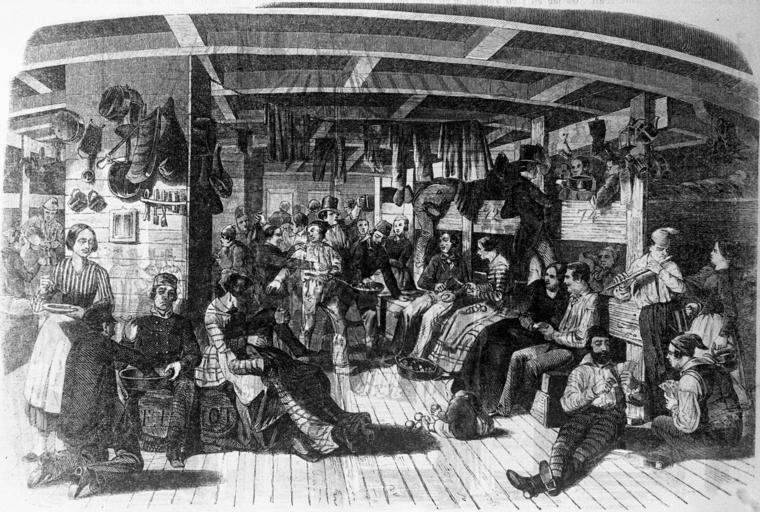
German emigrants to America, April, 1849. For full citation, see notes, below.
Stormy weather
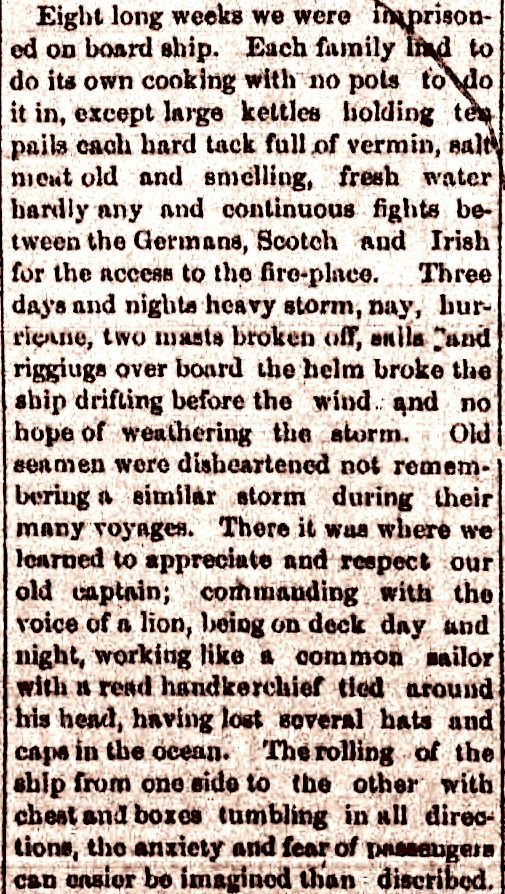
The voyage lasted eight weeks. Each family had to cook for themselves with inadequate gear, spoiled provisions, and constant quarrels between the Scots, Irish and Germans. The ship was left adrift after a three-day storm that tore away two of the three masts, sent the “sails and riggings over board,” and broke the helm.
After the storm
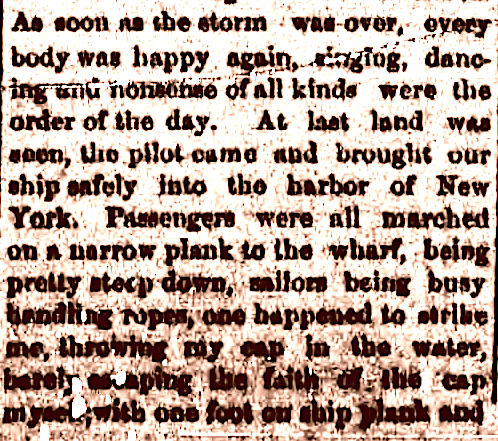
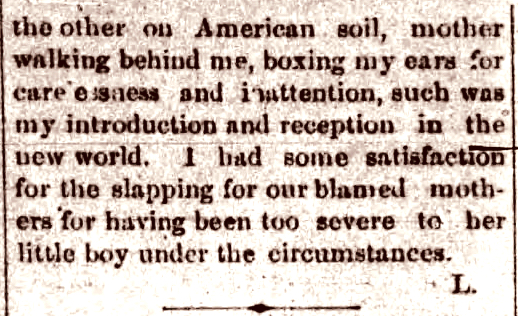
After the storm, the captain managed to regain control of the ship and complete the trip to New York harbor, much to the relief of the emigrants. Once arrived at New York, the passengers disembarked by walking a narrow plank between ship and wharf. In the process, our young narrator lost his new cap, and almost fell into the water, much to his mother’s displeasure.
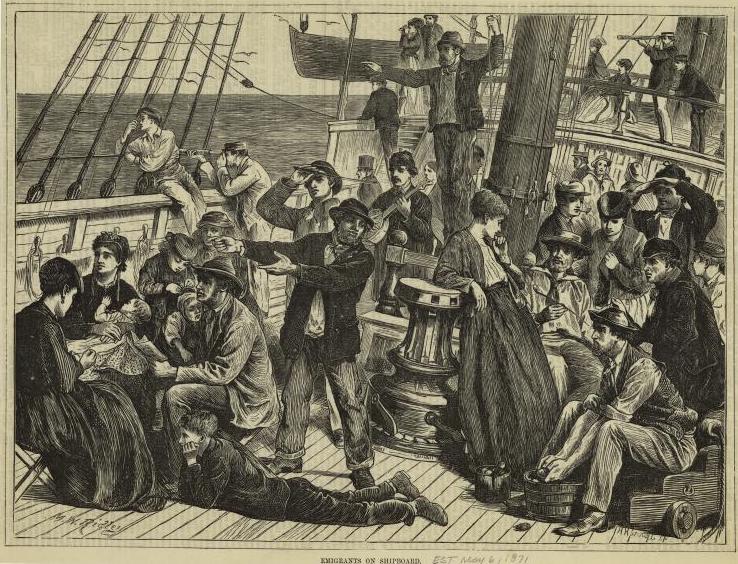
Emigrants on Shipboard,” from “Every Saturday.” (Boston [etc.] Houghton [etc.] 1866-), May 6, 1871. NYPL Digital Collections.
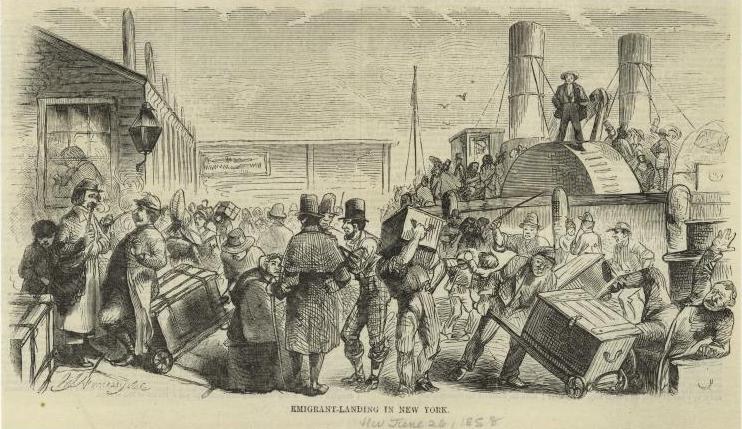
“Emigrant-landing in New York,” Harper’s weekly : a journal of civilization. (New York : Harper’ s Weekly Co., 1857-1916), June 26, 1858, NYPL Digital Collections.
Next time…
That concludes part one of our 1888 migration memories of the late 1840s. I hope you are enjoying this first-person tale of leaving the Old World for a new life in America. Any questions? Comments? Let me know.
Next time, our correspondent recalls some early adventures in New York City, followed by arrival in Thiensville and some Mequon school days tales. See you then.
_______________________
NOTES:
The source(s) and full citation(s) for our “German emigrants to America,” April, 1849 engraving is complicated. The image is available from the German Federal Archive (Bundesarkiv), and also appears in its orginal context in the Leipziger Illustrirte Zeitung, available via the online Austrian National Library (Österreiches Nationalbibliotek), and it appears with somewhat different, and less precise, credits as a WikiMedia illustration. I originally got the image from the German Bundesarkiv online site, but have recently updated the caption to match the more detailed citation info available from the Austrian National Library.
Deutsche Auswanderer auf dem Weg in die USA über Rotterdam und Le Havre auf dem Schiff “Samuel Hop” im April 1849 (Zeichnung von Leo von Elliot aus: Leipziger Illustrirte Zeitung, 10. November 1849, S.292).- Passagiere auf dem Passagierdeck u.a. beim Kartenspiel, Musizieren.
roughly translated as:
German emigrants on the way to the USA via Rotterdam and Le Havre on the ship “Samuel Hop” in April 1849. Drawing by Leo von Elliot from: Leipzig Illustrated News, 10 November 1849, page 292. Passengers on the passenger deck, [doing] among other things, playing cards and making music.
 Clark House Historian
Pingback: How’d they get here? – Germany to Mequon, c. 1848 (part 2) | Clark House Historian
Pingback: Mysteries (and errors)… | Clark House Historian