In an earlier post, “Intensely Cold Weather,” we examined the negative effects of several episodes of bitterly cold winter weather during the Clark family’s era and shortly afterwards. Today we look at some of the positive aspects of frigid winters in our part of the Old Northwest.
It’s no secret. Wisconsinites like to do stuff outdoors in the winter cold. Ice fishing. Skating. Cheering for the Packers.
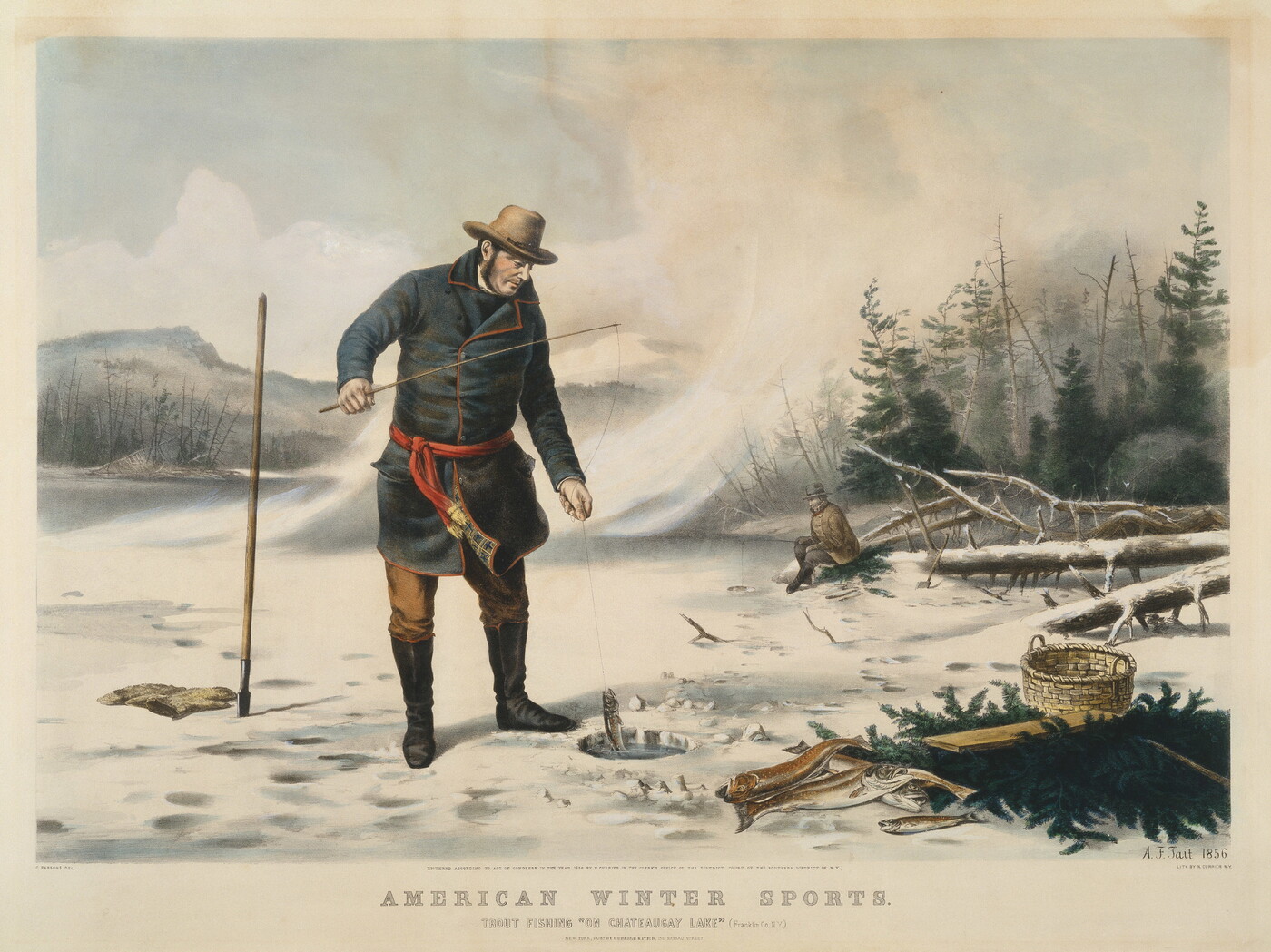
But the Green Bay Packers professional football team wasn’t organized until 1919, a full eighty years after Jonathan M. Clark bought his first parcel of Mequon land in 1839. So what did our intrepid Wisconsin pioneers do back in the mid-1800s when those deep snows fell and cold north winds began to blow? Well, if you believe the newspapers of the era, there was no finer way to occupy a clear, frosty day—or moonlit evening—than to bundle up, go outside, and enjoy a…
Sleigh ride!
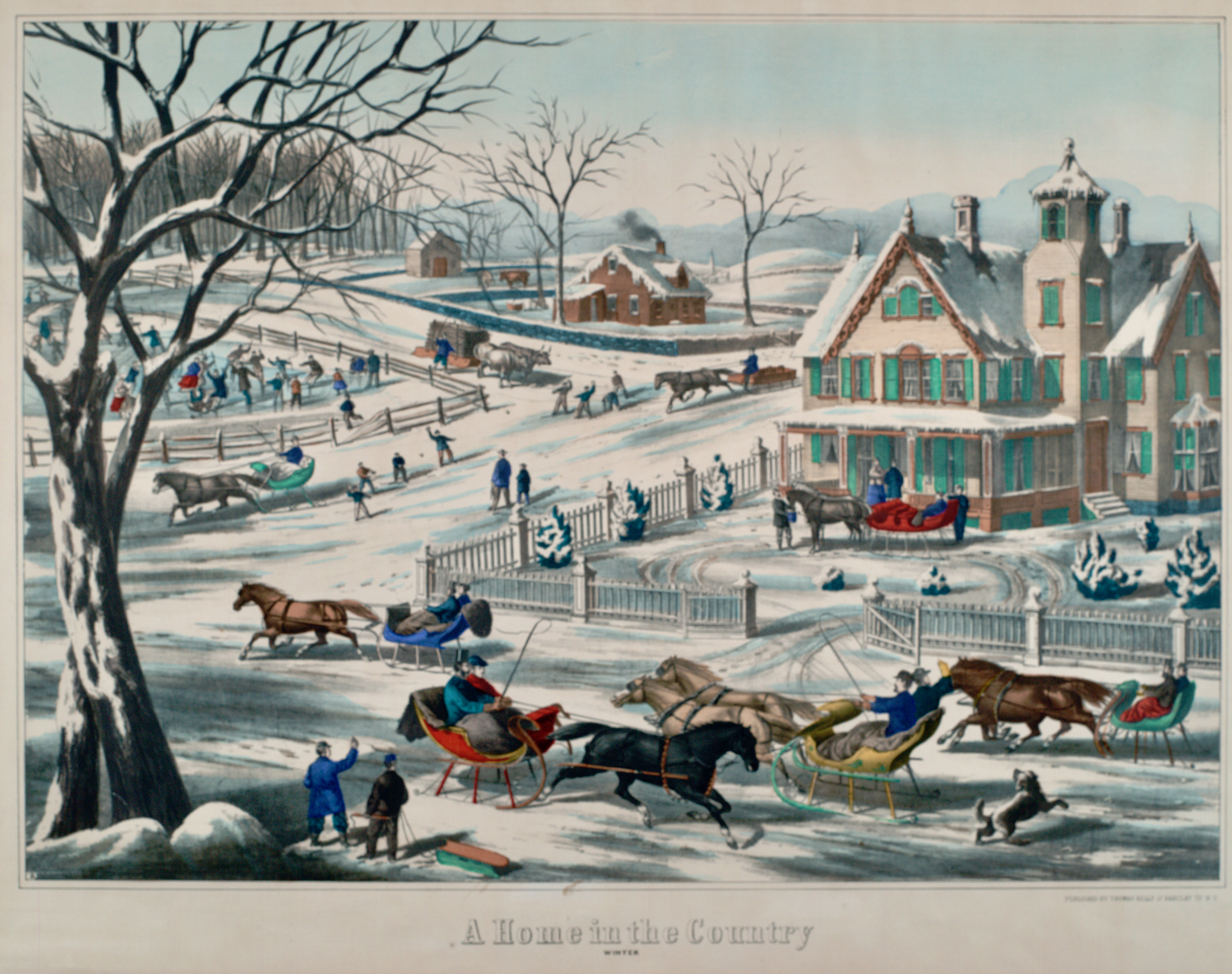
Yep. No Packers? no snowmobiles? no TV ? No problem. Just like the New Yorkers shown enjoying the outdoors in this 1869 lithograph (below), for our early Wisconsin pioneers it seems it was never too snowy or too cold for a sleigh ride.
I know I have written several CHH posts about sleighing, including “Dashing through the snow…” and Stuff Happens – on a sleigh ride, and I realize that some of my readers may not be all that excited by another sleigh riding post.
However! In my research for “Intensely Cold Weather” I came across several other news articles that suggest that our early Wisconsin settlers were not only capable of enduring really cold weather, many of them welcomed it. In fact, from Wisconsin’s earliest days, freezing cold weather meant it was not only time for a sleigh ride, but also an opportunity to encourage immigration by promoting the “mild and pleasant” climate of the Territory! For example…
The Season, 1837
By early March, 1837, Jonathan M. Clark had been a civilian for almost half a year. He had completed his three-year U.S army enlistment in October, 1836, and appears to have stayed in Wisconsin for the next three years, until he purchased his first parcel of Mequon land, at the Milwaukee land office, in late 1839. Exactly where he went and what he was doing during those three years is not clear, but we now know that he purchased several parcels of government land at the Green Bay land office during the years 1837-1839.
So JMC was likely somewhere in the Wisconsin Territory for “The Season,” the winter of 1836-1837, as described on page 3 of the Belmont [Wisconsin] Gazette of March 8, 1837:
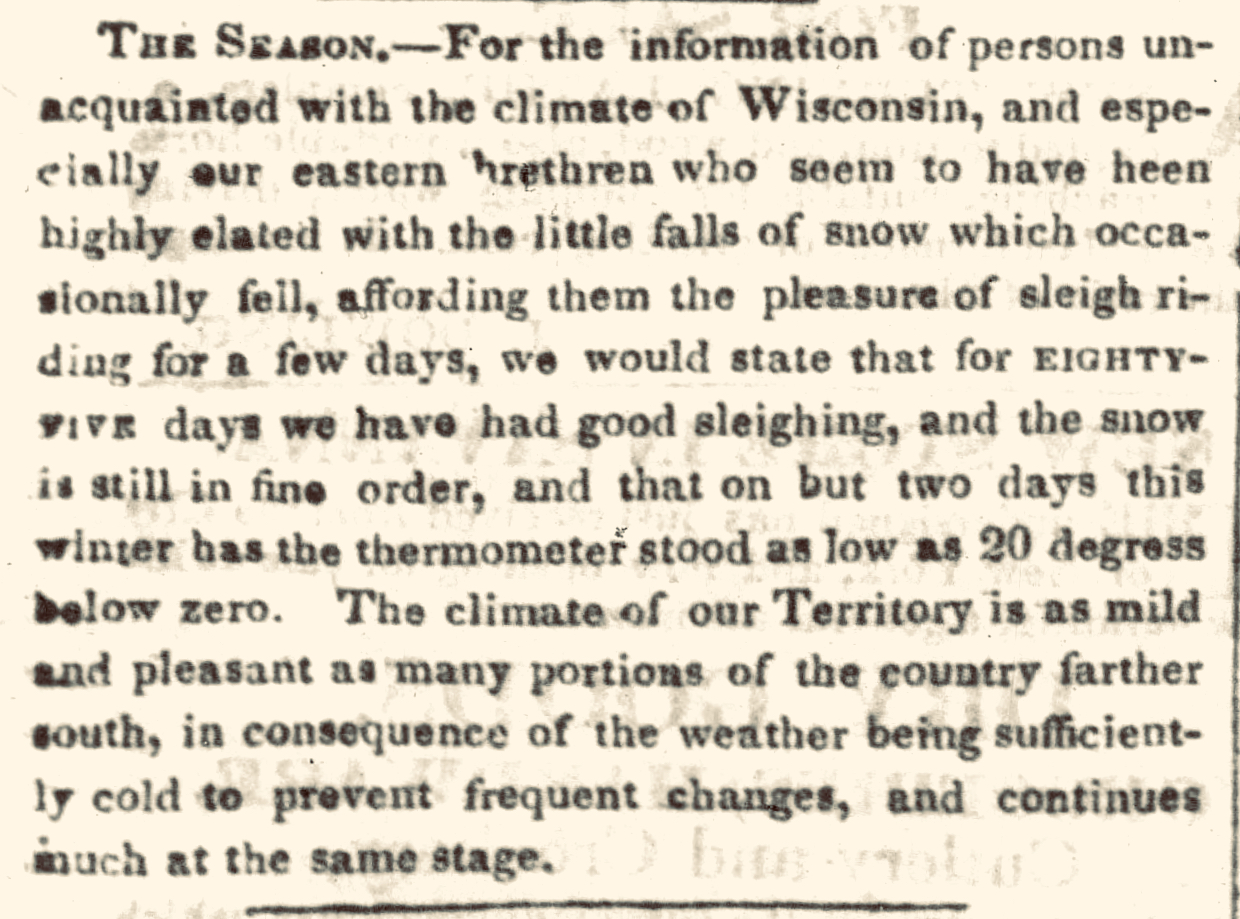
Oh, yah! It’s time for a little territorial boasting, 1837 style. While readers back East might have been satisfied with the occasional trifling snowfall and a few random days of sleighing, in our new Territory we’ve had EIGHTY-FIVE days of good sleighing so far this winter, and “the snow is still in fine order.”
Sure, on two days in 1837 the temperature did drop “as low as 20 degrees below zero.” That’s cold, ya know? But what are a few frostbitten days when (and I’m not sure I follow the author’s logic here) the “climate of our Territory is as mild and pleasant as many portions of the country farther south, in consequence of the weather being sufficiently cold to prevent frequent changes”?
Severe Cold, 1849
In any case, cold, snow, and sleighing conditions were frequent topics in the winter editions of early Wisconsin newspapers. A dozen years after that 1837 Belmont Gazette article, page 2 of the Milwaukee Daily Sentinel for Friday, January 19, 1849, featured this brief news item:
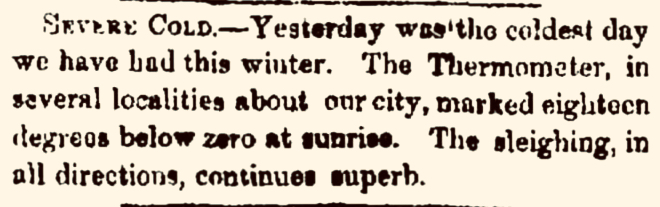
The morning of Thursday, January 18, 1849, was the coldest day, so far, that year: 18 degrees below zero at sunrise. But—as the article cheerfully concludes—the “sleighing, in all directions, continues superb.” Who wouldn’t want to bundle up and enjoy a sleigh ride in those conditions?
Not everyone was on board
Well, not everyone enjoyed a brisk trot through the town or the countryside in the midst of a Wisconsin winter. Five weeks after the previous news item, the second page of the Milwaukee Daily Sentinel for Saturday, February 24, 1849, featured several poems, including this bit of anonymous nonsense (transcribed by me from the hard-to-read microfilmed original, for your reading pleasure):
            POETRY.

         Sleigh Riding.

  Sleighriding! isn't it very good fun,
  With the mercury almost too thick to run
  Down below zero twenty-one?
     When if you sneeze,
     The spray will freeze.
And your legs are numbed by the dreadful breeze,
  Glorious pastime is this, I ween;
  How you admire the silvery scene,
  As your lungs collapse in the blast so keen!
  Of nose and ears, as the steeds progress,
  You steadily loose all consciousness;
     And the buffalo hide,
     And the cap well tied.
And the woolen et ceteras too, beside,
  Are powerless all to shield off the blast,
  That knives you through. In hurrying past,
Oh! It's fine on a moonlight night,
Thus with the icy winds to fight!
  And frostbitten ears, when the race is done,
  Aptly close the "capital fun."
One vocabulary note for you poetry lovers: “I ween” is an archaic expression meaning “I think.”
Whoa!
And those, I promise, are my last words (for this year), on sleigh riding during the Jonathan M. Clark era.
I’ll be back with more Clark House history in a bit. See you then.
_____________________
NOTES:
Today’s artworks, from the top, are:
- Tait, Arthur Fitzwilliam, American Winter Sports. Trout Fishing “On Chateaugay Lake,” 1856, hand-colored lithograph, Nathaniel Currier, New York. Amon Carter Museum, public domain.
- Giles, John Lawrence, A Home in the Country, lithograph by Thomas Kelly, NMAH, Harry T. Peters “America on Stone” Lithography Collection, c. 1869. Creative Commons CCØ license.
For a timeline of JMC’s activities, including information about JMC’s activities during and after his army service at Fort Howard, Green Bay, see our July, 2024, post JMC: The missing years, 1836-1839. More recently, I’ve found some land records that shed some light on JMC’s whereabouts during these “missing years.” I’ll be writing about that here on CHH in the coming weeks.
 Clark House Historian
Pingback: Indexing. Again! | Clark House Historian