In an earlier post, I mentioned a local history source that was previously unknown to me, the Memoir of Thomas Desmond, written by his son Henry Desmond. It was cited by Walter D. Corrigan in the bibliography of his otherwise error-prone and forgettable History of the town of Mequon, Ozaukee County, Wisconsin, brought down to about 1870.
I was intrigued. I already knew that Thomas Desmond and his brother Dennis were pioneer residents of the Town of Mequon and neighbors of the Jonathan Clark family for several decades. The Thomas and Dennis Desmond farm parcels were located in the NW quarter of Section 3, T9N-R21E, Town of Mequon. The Desmond farms, and the adjacent John Corcoran farm, were situated due north of the Jesse Hubbard, Jr., farm, due west of the Ferdinand and Friedrich Groth properties, and immediately adjacent to the northwest corner of the Jonathan and Mary Clark farm, which occupied all of the southeast quarter of section 3.

You can see the Thomas Desmond and Dennis Desmond parcels in the upper left quadrant of this detail from the Shoolmap of the Town of Mequon / School Map of the Town of Mequon, pre-1872, UW-Milwaukee–AGS Digital Map Collection, showing Sec. 3, T9N-R21E. The southeast quarter section is labeled “Widow Clark,” and suggests that the map was made sometime after Jonathan Clark’s death in 1857, but before Mary Turck Clark and her daughters sold the property in 1872. (For more on this unique, useful map, see our post Monday: Map Day! – “Shoolmap” of Mequon, c. 1872.)
A Memoir
A memoir of any early Mequon settler, especially a Clark family neighbor, is always something I’d like to read. But the Desmond memoir was privately published, in 1905, in an edition of only 50 copies, to be distributed only to the immediate family. I checked Worldcat, and it had a citation for the book, but did not know of any libraries that had a copy. Might someone, somewhere, have this little book? Well…
I found a digital copy! In 2004, one of the descendants, William “Des” Desmond, transcribed a copy of the original and put the full text online. You can read the whole thing at this link, which is a part of William’s admirably organized and comprehensive online genealogy project The Desmond Archives. I contacted Mr. Desmond, and he was gracious to share these materials with me and grant permission to put them on Clark House Historian. Once again, I’d like to thank Des for his generous assistance, and for letting me share this information with you.
The subjects and author
A Memoir of Thomas Desmond, with a chapter on The Desmond Genealogy, by Humphrey J. Desmond, 77 pages, was published in a private, limited edition of 50 copies, in Milwaukee, 1905. It included several photographs, including the first two of these:
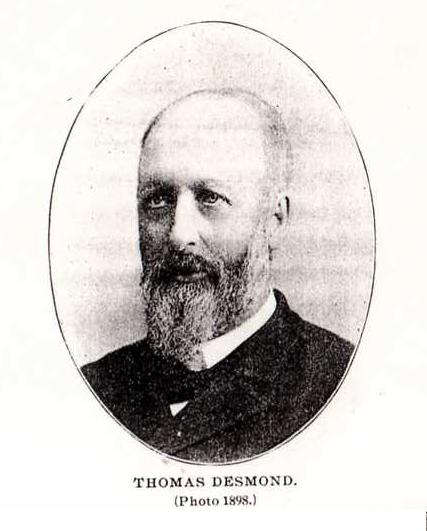
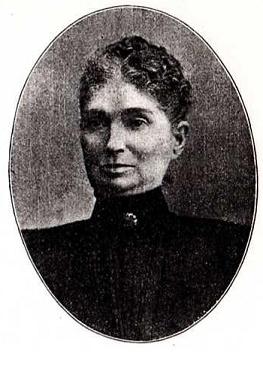
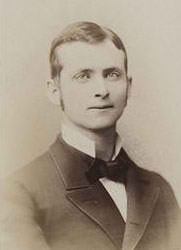
From left to right: Thomas Desmond (1833-1901) at about age 65, the principal subject of the Desmond memoir; Johanna Bowe Desmond (c. 1836-1917), wife of Thomas Desmond, at about age 63; Humphrey J. Desmond (1858-1932), their son and author of the memoir, at about age 22.
The Irish come to Mequon
The Desmonds were not the first Irish immigrants to settle in or near Mequon, but they were among the earliest. The memoir of Thomas Desmond gives new dimensions to our understanding of the early settlement of Mequon and the surrounding area, particularly regarding matters of faith, language, national heritage and ethnic pride.
The Turck, Clark and Bonniwell families were among the first, and more politically and economically influential, white settlers in what would become the Town of Mequon. They migrated from New York, New England, the United Kingdom, and various parts of English-speaking Canada. If they professed a religion, it was most often some kind of Protestant Christianity. When immigration issues were discussed in the 19th-century, they were often referred to—by politicians, religious and business leaders, historians and the press of their day—as simply “Americans.” In their day, immigrants such as these were considered the preferred, most desirable sort of settlers by many of those same civic, political, religious and business leaders.
But from the earliest days, the white settlement of Mequon involved many others, including many from overseas. Among these were many non-English speakers, including Gaelic speakers from Ireland and many emigrants from the German lands, including the large group of German-speaking Lutherans that formed the Freistadt Colony in the western sections of Mequon in 1839.
However, Protestant Christianity was not the only faith professed by Mequon’s early immigrants. In particular, there were immigrant Roman Catholics, some German and many Irish, including the Desmond family. Thomas Desmond was proud of his Irish heritage and his Catholic religion, and he took pains to see that his family, and especially his children, maintained that pride and heritage while, at the same time, becoming Americans in their own right.
Thomas Desmond remembered
Humphrey J. Desmond’s memoir of his father is well-written and speaks for itself; it needs little editing. The original format of the text includes many very short “paragraphs.” I have maintained this format for the most part by employing line breaks and small indents at the start of these paragraphs. Otherwise, I have merely selected, but not altered, what I think are the most relevant portions of Desmond’s text; I hope you enjoy these excerpts. And remember, the whole book, including a great deal of Desmond genealogical information, is available online here.
Also, when you see a number in square brackets, like this [21], it indicates the start of a new page in the original 77-page book. For our CHH purposes, let’s begin with a bit background from chapter 1.
[21]        I. ANCESTRY

    BANDON is a town of some six thousand inhabitants located twenty miles west of Cork. It is in that position of the former domains of the Earls of Desmond that was granted to Court favorites, who, however, did not hold it long. by the year 1602 these lands came into the possession of Boyle, Earl of Cork, who sought to substitute English colonists in place of the Irish inhabitants, and who in the process founded the unprepossessing town of Bandon.
    [22] A farmland or ploughland district adjacent to Bandon is known as Gurteen. Here, about the year 1750, lived Patrick Desmond. He was grandfather of Thomas Desmond (1833-1901), in whose memory these pages are written.
    So far as family traditions go we cannot trace our ancestry further back than 1750. There may (though I doubt it) be records extant in Ireland which might enable us reliably to date our family history from 1700 or 1650. This may be worth investigation later. For the present I pass on. […]
Coming to America
Chapter 2 tells the story of how the first Desmond, also named Humphrey, came to America.
[26}        II. HUMPHREY DESMOND

HUMPHREY Desmond was born in 1782. In his thirty second year (1814) he married Dorothy Allen, then nineteen years of age. They were married in the parish church at Neucestown, now Bandon. she was of a Protestant family and was baptized in the Episcopalian church. but her mother became a Catholic while Dorothy Allen was a child.
    I find this passage in a letter my father wrote me in 1896 while I was in Europe: "Mother had two brothers, [27] Thomas and John, after one of whom I was named.*** She had a sister, Lucy, and possibly other sisters. Her mother became a convert to the Catholic church when she was but a year old, but I understand her father died in the Church of England."
     Bandon and its vicinity was notoriously plagued with sectarian feuds. Humphrey Desmond belonged to the secret society known as the "Whiteboys," organized to defend the rights of his class.
    In 1829 he came to America, crossing the ocean in nine weeks, and bringing with him his wife and five children, ranging in age from twelve to two years. He was then in his forty-seventh year.
    [28] He landed at Quebec, and shortly after moved to Kingston Mills, near Kingston Ontario. Here he lived four years and here, October 14, 1833, his youngest son, Thomas Desmond was born.
    The next year (1834) the family moved to Utica, N. Y., and in 1835 they settled at Little Falls, in Herkimer county. The building of a railroad and the enlargement of the Erie canal attracted many settlers to this vicinity. Here my father spent his childhood years and here two of his sisters, Julia and Mary, were married--the first to Edward Sweeney and the second (Mary) to Simon McGrath, who planned to make his home in the great West.
    This circumstance may have determined [29] the subsequent migration of our family, but it is also quite likely that settlement on the rich lands of the West was the original plan of Humphrey Desmond. At any rate he purchase one hundred and sixty acres of land in Ozaukee county, Wisconsin, paying the Government twelve shillings an acre therefor in gold. and in 1842 the family began its journey westward over the great lakes from Buffalo. Milwaukee was reached August 29, 1842.
    Humphrey Desmond was then sixty years of age. He was a man of superior education and, from what I can learn, of considerable force of character. His decision in his sixtieth year to venture into what was [30] then known as the far West in order to found a home for his family was no mediocre act. In this, of course, he was assisted by his wife, a most capable woman, and by a growing family. Three sons--Dennis, aged nineteen; Patrick, aged twelve, and Thomas, aged nine, and a daughter, Elizabeth, aged fifteen, made up the pioneer household. A daughter, Mary (Mrs. Simon McGrath), was settled a few miles distant on a farm.
    The oldest daughter, Julia, now the wife of Edward Sweeney, remained in New York, and the oldest son, John, then twenty-one, remained in Utica.
More to come…
That’s all for today. The Desmond memoir continues in our next CHH post, with recollections of pioneer days in Mequon, the Bonniwell family and school, Thomas Desmond’s marriage and family and, like the Clark family in the 1860s, relocation to Milwaukee in the 1860s. I think you’ll find it interesting. See you then.
 Clark House Historian
Pingback: Meet the Neighbors: the Desmond family (part 2) | Clark House Historian
Pingback: Celebrating our Irish history | Clark House Historian