The American War of Independence began 250 years ago, more than half a century before the forced removal of Wisconsin’s original native peoples and the beginnings of large-scale, government-sponsored, white settlement in the Wisconsin Territory of the 1830s.
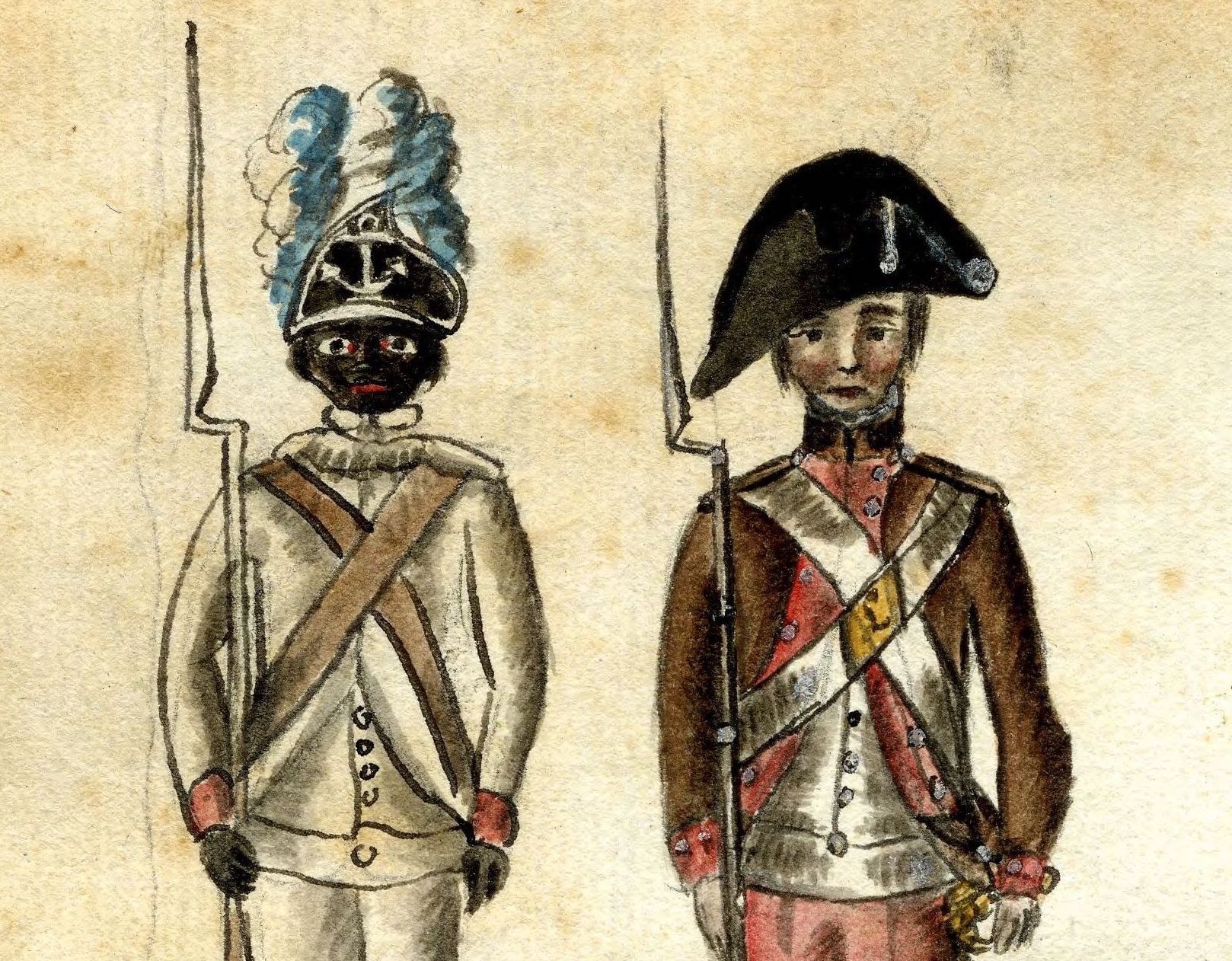
Verger, Jean Baptiste Antoine De, artist, [Soldiers in Uniform], 1781 (detail). The soldier on the right was a New England militiaman, one of many New Englanders (including, we believe, Jonathan Clark’s kin) that fought for the Patriot cause. More on this image, below.
PBS is commemorating the big anniversary by sponsoring and broadcasting “The American Revolution,” a six-part, 12-hour documentary film by Ken Burns and company, exploring the roots of the conflict, the military and diplomatic progress of the war, and the contributions to, and effects of, the war on its many military and civilian participants, including white, Black, and Native American men and women, both Loyalists & Patriots.
I’ve seen the first four episodes and found them lively, interesting, informative, and sometimes deeply moving. I’m no expert on the Revolutionary era, but I know quite a bit, and I find the series includes all the “important” events and persons that one would expect, along with all kinds of nuance and detail which are new to me.
It’s an excellent documentary, well worth your time, and is currently streaming—for free—on PBS.org. And in case you are wondering: yes, there are many topics in this Revolutionary War documentary that connect to, and later influence, the lives many of the early Mequon settler families, including the Clark and Turck families. In particular, be sure to watch the whole first episode, a clear and detailed explanation of the complex background and causes of the fight for American independence.
Clarks and Turcks in the Revolution
As we’ve discussed previously, we know very little about Jonathan M. Clark’s ancestors or their military service. According to a biographical sketch of his daughter Caroline (Clark) Woodward, JMC was “a Vermonter of English descent, who, born in 1812, of Revolutionary parentage, inherited an intense American patriotism.” Unfortunately for our research, Vermont and the other New England states sent a lot of men named Clark to fight in the American Revolution, and I’ve not yet been able to connect JMC to any particular Revolutionary ancestors.
We do know that Mary (Turck) Clark’s ancestors supported the Patriot cause. Her granduncle, Johannis A. also known as John A. Turck, or Turk (1763-1839) was a Patriot, and signed the Articles of Association in June or July 1775. He also fought in the Revolution in Col. Snyder’s Regiment (New York) and in 1832 he received a federal pension for his Revolutionary service. I believe Mary’s Groom and Gay ancestors also fought, but this still needs clarification.
Patriots of all sorts
One thing that this new documentary does particularly well is to illuminate the lives and Revolutionary stories of the full range of participants in the war (both soldier and civilian, willing and unwilling). Which reminded me of one of my favorite bits of original Revolutionary War art:
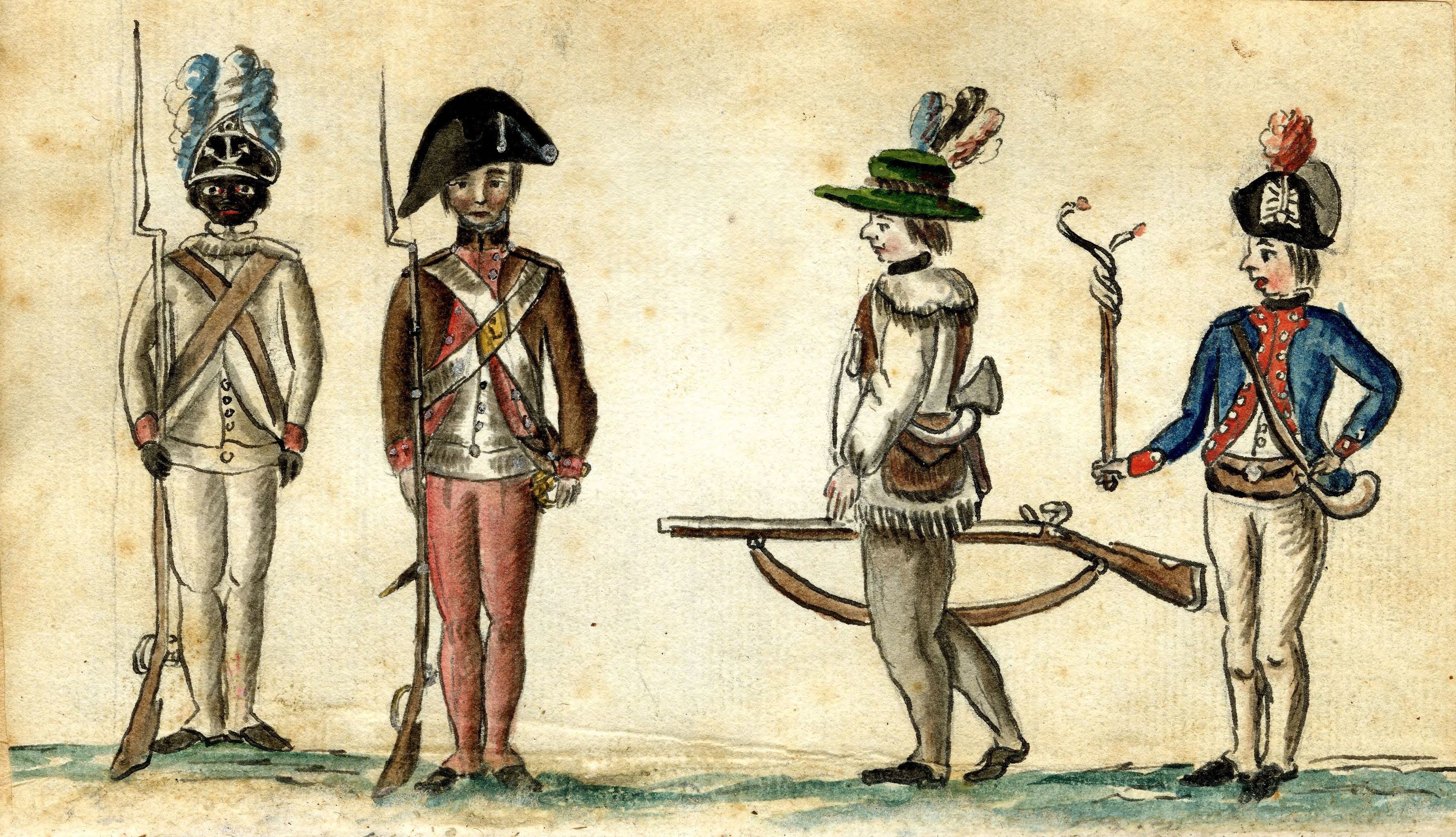
This drawing was made in 1781, during the war, by a French lieutenant named Jean Baptiste Antoine De Verger. The image is from the Anne S.K. Brown Military Collection at the Brown University Library, via the Library of Congress. It has been given the title Soldiers in Uniform, and dates from 1781, and is believed to have been created in or near Williamsburg, Virginia.
As you can see, Lt. Verger was not, shall we say, a “great artist.” His figures and their faces lack sophistication and realistic proportions. However—and this is a big “however”—Verger was on the scene, had an eye for detail, and managed to record a nice example of the wide range of Patriot soldiers and the varied details of their uniforms as they presumably made their way from Williamsburg to the Siege of Yorktown and the ultimate surrender of Cornwallis’s combined British forces there on October 19, 1781.
Who were these men?
If your knowledge of the key figures of the Revolutionary era is limited to the most famous Founders, such as George Washington and Thomas Jefferson, you might be puzzled by some of the soldiers in Verger’s drawing. Helpfully, the staff of the Library of Congress have assembled some useful information about our 1781 watercolor, to which I have added a few links for further reading:
This watercolor from the American War of Independence is by Jean Baptiste Antoine de Verger (1762-1851), a French artist who himself fought in the war as a sub-lieutenant in a French regiment and who kept an illustrated journal of his experiences in the war. The watercolor, which appears in the journal, shows the variety of soldiers fighting for American independence, depicting, from left to right, a black soldier of the First Rhode Island Regiment, a New England militiaman, a frontier rifleman, and a French officer [most likely an artillery officer, holding a two-match linstock – ed.].
An estimated 5,000 African-American soldiers fought in the Revolutionary War. Although most black soldiers from New England fought in integrated regiments, the First Rhode Island was an exception–it was made up of 197 black men commanded by white officers. Nevertheless, it was considered an elite unit, and saw action at the Battle of Rhode Island and the Siege of Yorktown.
The watercolor is part of the Anne S.K. Brown Military Collection at the Brown University Library, the foremost American collection devoted to the history and iconography of soldiers and soldiering, and one of the world’s largest collections devoted to the study of military and naval uniforms.
I hope you tune in and watch all six parts of “The American Revolution,” and I’m curious to know what you think. Questions? Comments? Join the conversation with the “Leave a comment” feature, below.
I”ll be back soon with more Clark House history. See you then.
_________________________
REVISED 20 November 2025 to correct a potentially misleading section header and a few clunky phrases.
 Clark House Historian
Pingback: Indexing. Again! | Clark House Historian