It’s been a while, I know! One thing led to another and this summer ended up being a very quiet summer here on the CHH blog, with just a post or two over the past few months. My apologies to you all. However, I have been very busy “behind the scenes,” reading, researching and writing all summer long, and I have lots of new historical information and stories to share with you.
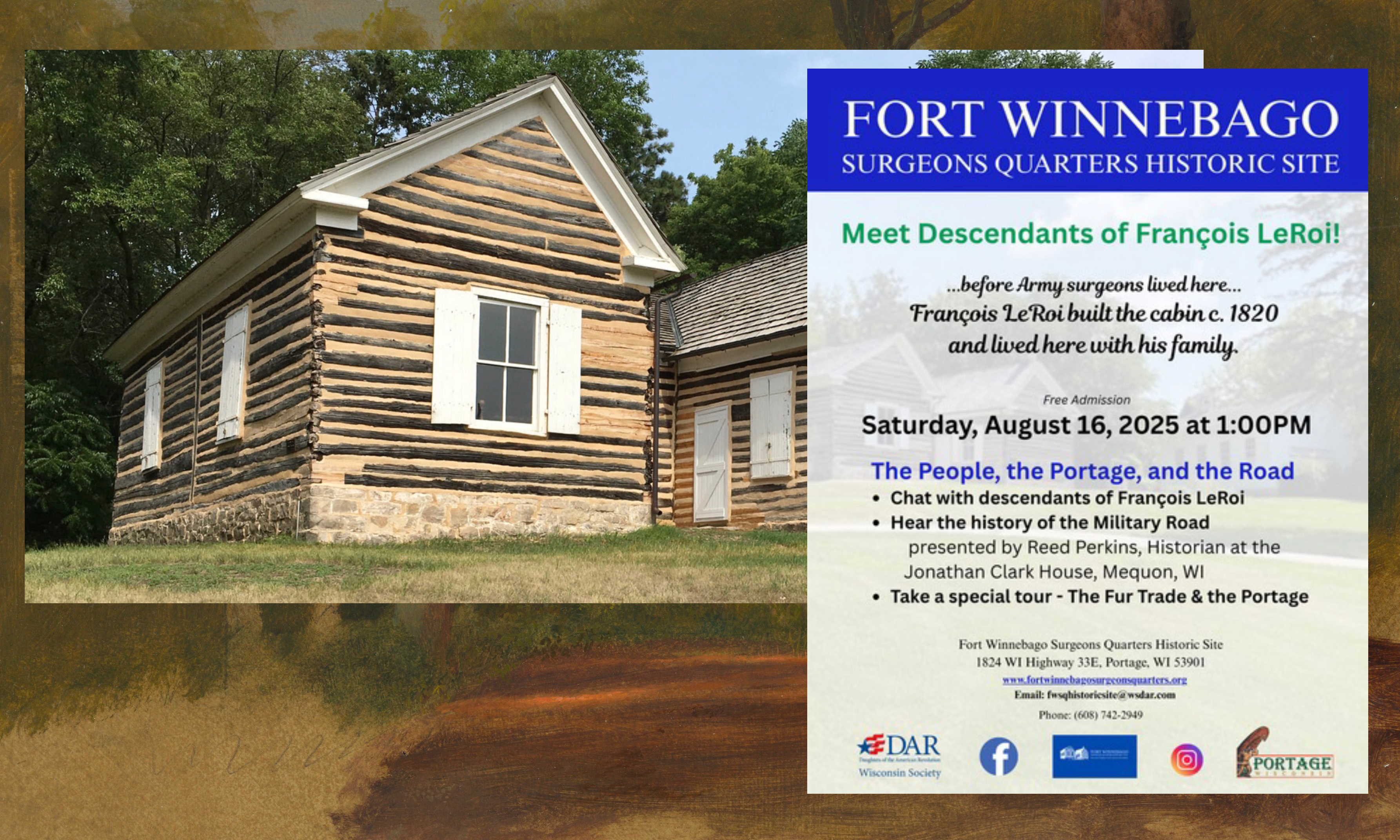
Fort Winnebago Surgeons Quarters—and more
One of the projects that has kept me busy this summer was researching and preparing a presentation that I gave last Saturday, at the historic Fort Winnebago Surgeons Quarters museum as part of their The People, the Portage and the Road event. Originally, my talk was going to be a lightly-revised update of my September, 2024 talk at the Wisconsin Society of the Daughters of the American Revolution’s Fall Workshop in Oshkosh.

That talk, “Building the Military Road,” contained about 45 minutes of detailed information about Wisconsin’s first federal road, and the men that built it—including our own Sgt. Jonathan M. Clark—tightly squeezed into about a half-hour time slot. The presentation was well-received, and I was invited to repeat that talk at this August, 2025, event at the WSDAR’s Fort Winnebago Surgeons Quarters museum in Portage.
However! The August 16th event was also going to be a reunion of the descendants of François LeRoi (aka Francis LeRoy or Roy)—the man that first built and occupied the historic surgeon’s quarters (1816-1829), and it was suggested that I include some Francis LeRoy related information in my talk, a very reasonable request. Since I already knew quite a bit about the Military Road, the Portage, and the life and times at Forts Howard and Winnebago in the 1830s, I thought I would just need to make a few minor cuts to my original talk, find a few, possibly obscure or unknown, LeRoi documents, add them to the presentation and, well, that would be just the thing! Well…
I ended up finding A LOT of historic documents, many of them previously not online and/or hidden in lengthy, unindexed rolls of microfilm and collections of historic records, which led me to make a some substantial changes in my talk. So the planned reprise of “Building the Military Road — Wisconsin Territory’s First Federal Road” became “Along the Military Road —LeRoi Family Connections in Early Wisconsin.”
JMC was involved, too…
As I did last September, I noted that the builder of the handsome stone house that is now our Mequon museum, Jonathan M. Clark was, in fact, one of the soldiers that actually built the Old Military Road, during the summers of 1835 and ’36.
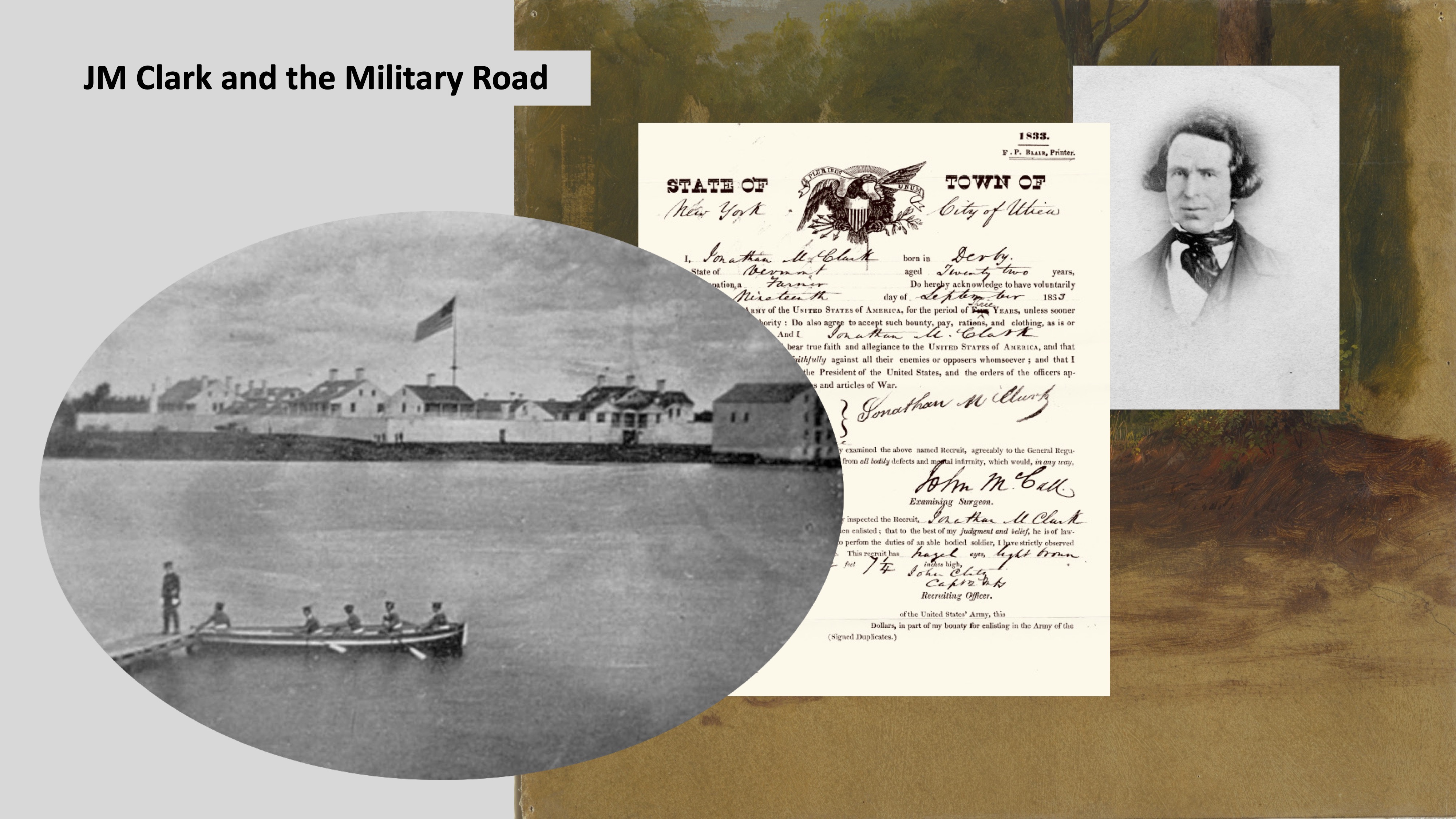
Born in 1812, in either Derby, Vermont, or the adjacent Stanstead, Lower Canada (now Quebec), in 1833 JMC enlisted in the U.S. Army and spent three years with the army’s Company K, 5th Regiment of Infantry, stationed at Fort Howard, Green Bay. And, during the “construction seasons” of 1835 and ’36, he and his army comrades worked on the section of the road leading from Fort Howard to the east bank of the Fond du Lac river, at the south end of Lake Winnebago.
Did JMC meet Francis Leroy?
Did Jonathan M. Clark ever meet Francis Leroy? Leroy was born about 1781 and died sometime after 1857 or 1860. As far as I know (and I am new to Leroi/Leroy research), Francis Leroy spent most of his life in the area that would become Wisconsin, and in particular at homes in Green Bay and the Fox-Wisconsin Portage, and in transit between the two.
JMC was garrisoned at Fort Howard from 1833-1836, and his work on the military road extended, at most, from the fort west- and southward to the east side of the Fond du Lac river as it enters the south end of Lake Winnebago. During the 1830s, Francis Leroy was, generally, based at the Portage and sometimes hauled loads for the army’s Fort Winnebago troops. These men were building the road from Fort Winnebago eastward toward the opposite bank of the Fond du Lac River.
We have duplicate receipts from the files of the Third Auditor of the U.S. Treasury that show that Francis Leroy was hauling timber for the army around the time that the men of Forts Winnebago and Howard were at work on the road, including this one:

The receipt reads:
The United States | To Francis Roy | 1835 Sept 3rd
For hire of Oxen, hauling Timber on the Ouisconsin river in March 1834 $5.00.
Received Fort Winnebago September 3rd 1835 of Lieutenant E. M Lacy, Act[ing] Ass[istan]t Quartermaster
Five dollars in full to the above account
[Frances Roy signed in the lower right corner with his usual “X” mark.]
So did JMC and Francis Roy cross paths? This receipt is not conclusive, particularly as it pays for services rendered in 1834, the year before full-scale construction (and funding) for the Military Road began. But in the 1830s, Leroy had family and, I believe, property in Green Bay, and he traveled to, and lived there, from time to time. All of this suggests that it’s not impossible that the two men might have passed each other on the Military Road back in 1835 or ’36, but it is doubtful that either man was acquainted with the other.
Many thanks…
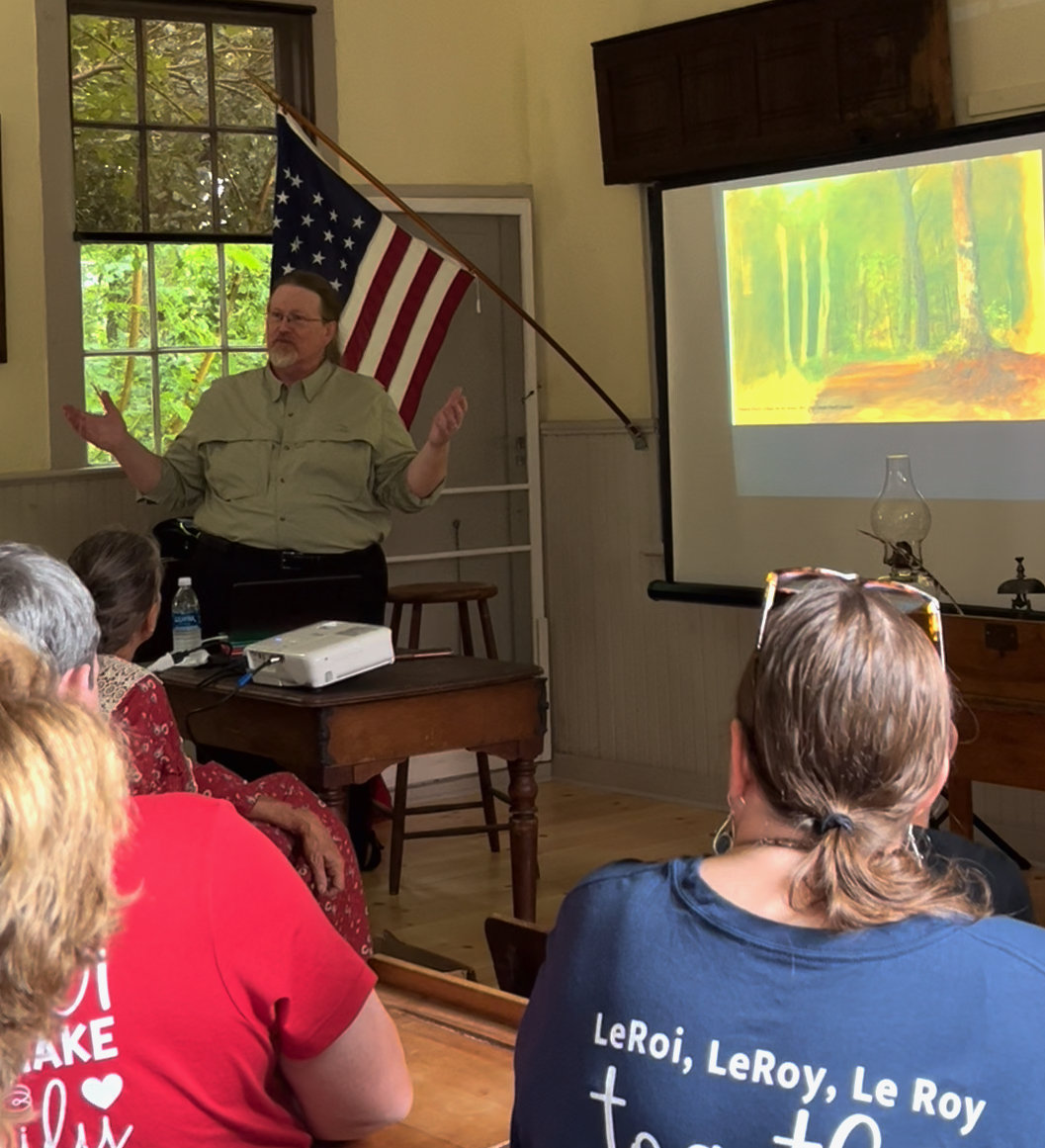
Speaking to the Leroi reunion 16 Aug. 2025. It’s not often I get to lead the discussion from the front of an 1850 one-room school house!
Thanks again to the members of the Wisconsin Society of the Daughters of the American Revolution, and in particular honorary state regent Sandra Snow for the invitation to speak at Saturday’s event and for the guided tour of the Surgeon’s Quarters and the adjacent historic Garrison School House (1850-1960). And many thanks for the additional kind assistance of WSDAR members Sue Cowan and Fort Winnebago Surgeons Quarters site curator Nancy Olson.
But that’s not all!
The day before my talk, I spent a fascinating afternoon at another fine Portage museum, with deep historic connections to Fort Winnebago, the army, and Wisconsin’s native peoples, in particular the Ho-Chunk Nation. I’ll have more on that in my next post. See you then!

 Clark House Historian
Pingback: Editing… | Clark House Historian
Pingback: I’ve been busy…at the Portage! (part 2) | Clark House Historian
Pingback: CHH Year in Review, 2025 | Clark House Historian
Pingback: Indexing. Again! | Clark House Historian