In the summer of 1834, the U.S. Army’s Brevet Brigadier General Hugh Brady made an inspection tour of many of the posts under his command. One of those posts was Fort Howard, at Green Bay, in the then Michigan Territory. In an earlier post, I briefly mentioned the General’s July 17, 1834, visit to the fort and how “Gen. Brady reviewed all the troops, who made a brilliant display of military evolutions, highly gratifying to those who witnessed them, and evidently meriting the approbation they received from the worthy and excellent commander-in-chief.“
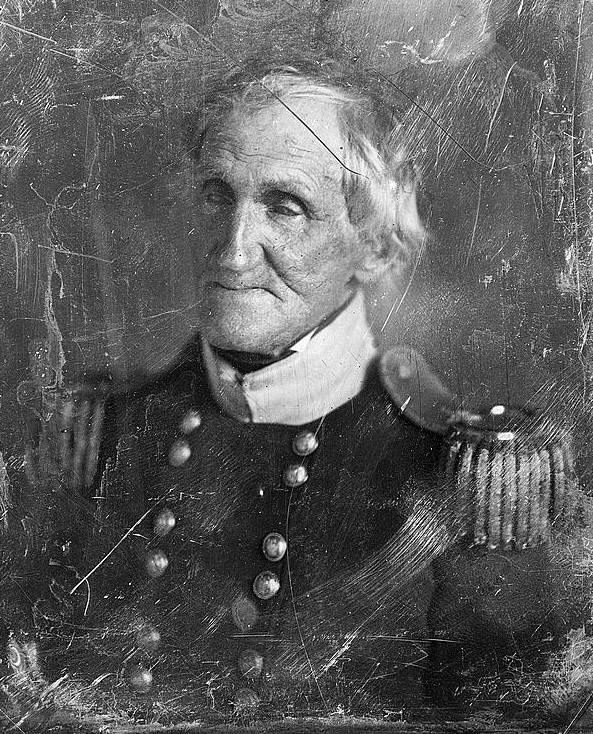
Gen. Hugh Brady, c. 1844-1851. Photo credit: see note 1
I have since located the official report of the inspection that Brady sent to his superiors back in Washington, DC. and I want to share it with you today. I think you’ll find that a close reading of the general’s report will give some insights into the daily lives and routines of soldiers—including our Jonathan M. Clark—as they served their country “on the frontier” in the mid-1830s.
General Brady’s Report
General Brady’s report was headed“Head Quarters Left Wing E[astern] Dept. / Detroit, Sept. 30, 1834.” It was addressed to Maj. Gen. W[infield] Scott, U.S.A., then commanding the army’s Eastern Department, comprising all the army’s units located east of the Mississippi River. As usual, a copy of the report was sent to the army’s chief bureaucrat, the Adjutant General, at that time Gen. Roger Jones. Our copy comes from the files of the adjutant general.2
The report is handwritten, probably by Brady’s own adjutant, and signed by Brady himself. It covers most of the four sides of two sheets of letter paper. The first full page of text looks like this:

For ease of reading, and later online searching, here’s a transcription of the report, with a few bits of commentary and explanation added when needed, as well as some links to the names of various officers and places. Please click the links if you’re wondering, for example, “where were the Hancock Barracks?”3
The preliminaries
Sir,
I have the honor to report that on the 18th of June last I inspected the post of Hancock Barracks On the 15th of July, Fort Mackinac — on the 17th Fort Howard — On the 30th Fort Gratiot, and on the 11th of August Fort Dearborn. You will perceive that I have not inspected Fort Brady or Fort Winnebago. My reason for omitting those posts is this — At the time I was at Mackinac Col. Crogham [sic]6 was inspecting at Fort Brady, and would in a few days proceed to the Mississippi, taking Fort Winnebago in his route, and I deemed it unnecessary for me to proceed any father than Fort Howard.4
“Police” in the army: noun and verb
Jonathan Clark and his regimental companions spent a lot of their time in the army—at their post at Fort Howard, or on detached duty in the field—on “police” duty. Police, in Gen. Brady’s report means to make, or keep, a military post or camp in order. This includes picking up trash and sweeping floors, but also implies that the post and its buildings, equipment, ordnance, food, medical and other supplies are clean, well-organized and ready for duty. General Brady continued:
In this tour, I have inspected eight companies of the 2nd Inf[antry], and six of the 5th — and at no previous inspection have I observed such uniformity, and equality in appearance, discipline and police, as those commands presented. The internal police of the Quarters, was excellent at every post. One who did not make allowances in this respect for the local advantages possessed by posts of Hancock Barracks and Mackinac, over all other posts within the wing would give them the preference. Nothing can surpass the excellence of the police at those posts — But the other Garrisons are entitled to equal praise, for the good condition of their police, which is not effected without much daily labor, wheras [sic] at Mackinac and Houlton [i.e., Hancock Barracks], a good rain will do more towards improving their police than five hundred brooms. The appearance of the troops on parade was very soldierlike. The new uniform is very handsome, and can not fail to give the soldier a high opinion of himself, and perhaps this has had its part in the improvements which I have observed at every post that I have inspected.5
Discipline — an essential element
Discipline and good order are essential elements of an effective fighting force. And, as many sources relate, discipline and good order were often in short supply at some frontier posts. Frontier army life was often repetitive and tedious. Food could be poor in quality and lacking in quantity. Drunkenness was often a problem, for officers and enlisted alike. But Gen. Brady was pleased to report that discipline in his wing of the army was good, and producing better, healthier, more prepared officers and enlisted men in the 2nd and 5th regiments of infantry.
The discipline is every where excellent — The arms and accoutrements are the best I have ever seen in service — It is consoling to the old members of the army, who have borne the burthen and heat of the day, to know that our little army, as regards arms, equipments & discipline was never in a better condition to take the field — for I take it for granted, the companies I have inspected are only a fair sample of the whole army.
The sick lists are small, usually, and the medical staff reports that they have a sufficient supply of good medicines and stores. The Provisions are good and contracts [with civilian suppliers] regularly complied with. The ordnance stores are sufficient for present use, and as well preserved as the means in the hands of the ordnance Sergeants would permit.
The Enlisted men are generally young and of temperate habits — Drunkenness is becoming much less frequent than heretofore. I am fully of the opinion that it is in the power of Recruiting officers to put a final check to intemperance in the army. It is only necessary to reject all persons of intemperate habits, and the object will in a great measure be attained — For the few intemperate men in service will soon be discharged, by expiration of enlistments, and sober men will have no one to entice them to drink. Neither does Ardent spirits any longer form a component part of the [soldiers’] ration, which has been the great and leading cause of intemperance among the enlisted men—
At all the posts in this wing, most of the officers, and a pretty large proportion of the men, have joined Temperance Societies — and such Officers as have not joined, are with few exceptions, as abstemious as the members—
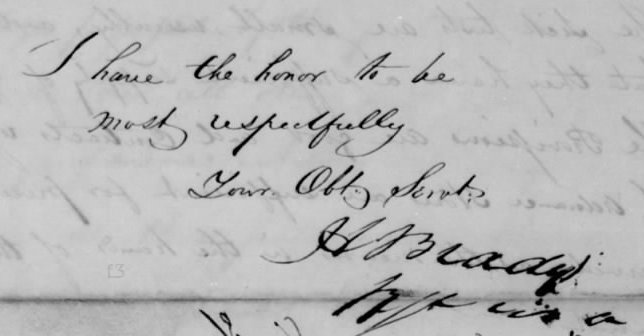
General Brady ended his report with the customary closing phrases, followed by his signature:
I have the honor to be
most respectfully
Your Obt. Servt. [Your Obedient Servant]
H Brady
Bvt. [Brevet Brigadier General] USA [U.S. Army]
Postscript
In just a bit, I’ll have more to say about Gen.Brady’s report, what it tells us about Jonathan M. Clark’s experience in Co. K, 5th Regiment Infantry and how those experiences may have shaped JMC’s character and future activities in Mequon.
See you soon, for more Clark House History.
___________________________________
NOTES:
- Brady, Mathew B., photographer, [Hugh Brady, head-and-shoulders portrait, facing three-quarters left, in military uniform], between 1844 and 1851. Library of Congress.
- National Archives and Records Administration, Letters Received by the Office of the Adjutant General Main Series 1822-1860; NARA M567 Roll 0092, page 1. Indexed as Brade, Hugh [sic, Brady, Hugh]. Accessed 2025-02-02 at Fold3 (paysite, subscription required), image https://www.fold3.com/image/291332958
- Houlton, Maine, FYI. And do click the links for the full story!
- FYI, I have searched the Fold3 “Letters Received by the Office of the Adjutant General Main Series 1822-1860,” and I cannot find any mention of Col. Crogham or his anticipated report on the state of Forts Brady and Winnebago in mid-1834.
- We’ll have more to say about the Army’s new 1833 pattern uniforms and equipment in a separate CHH post.
- UPDATE, Feb. 3, 2025:
“Col. Crogham” is almost certainly Col. George Croghan (1791-1849) who was at that time the Inspector General of the U.S. Army. As a young officer, Croghan had distinguished himself during the War of 1812; in 1835 he was awarded the Congressional Gold Medal for his gallant defense of Fort Stephenson, Ohio, in 1813. He resigned from the army in 1817, but rejoined in 1825 as one of the army’s two inspectors general.
He was, however, a man of notably intemperate habits, prone to drink to excess and spend beyond his means. It makes one wonder how—or whether—he and Gen. Brady managed to get along.
 Clark House Historian