I’m spending some of my time this winter on projects related to the cataloging, interpretation and display of our historic Bonniwell Family Bible. One of the items on my “to do” list involves the study of a number of Bonniwell papers and other ephemera that were donated along with the Bible itself. Some of the miscellaneous papers are self-explanatory and easily understood. But one little fragment of printed text has me baffled, and I need your help, history lovers!
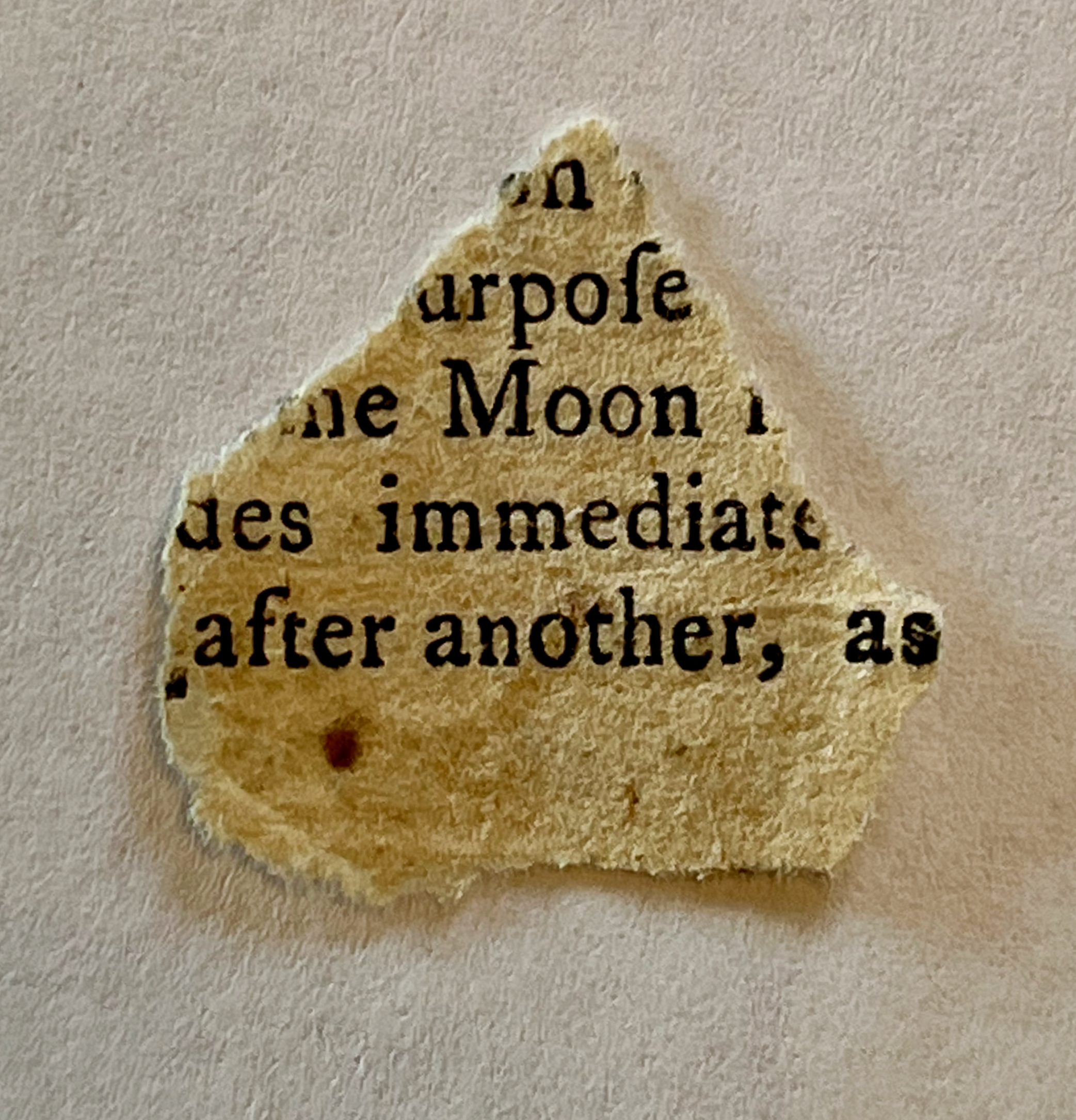
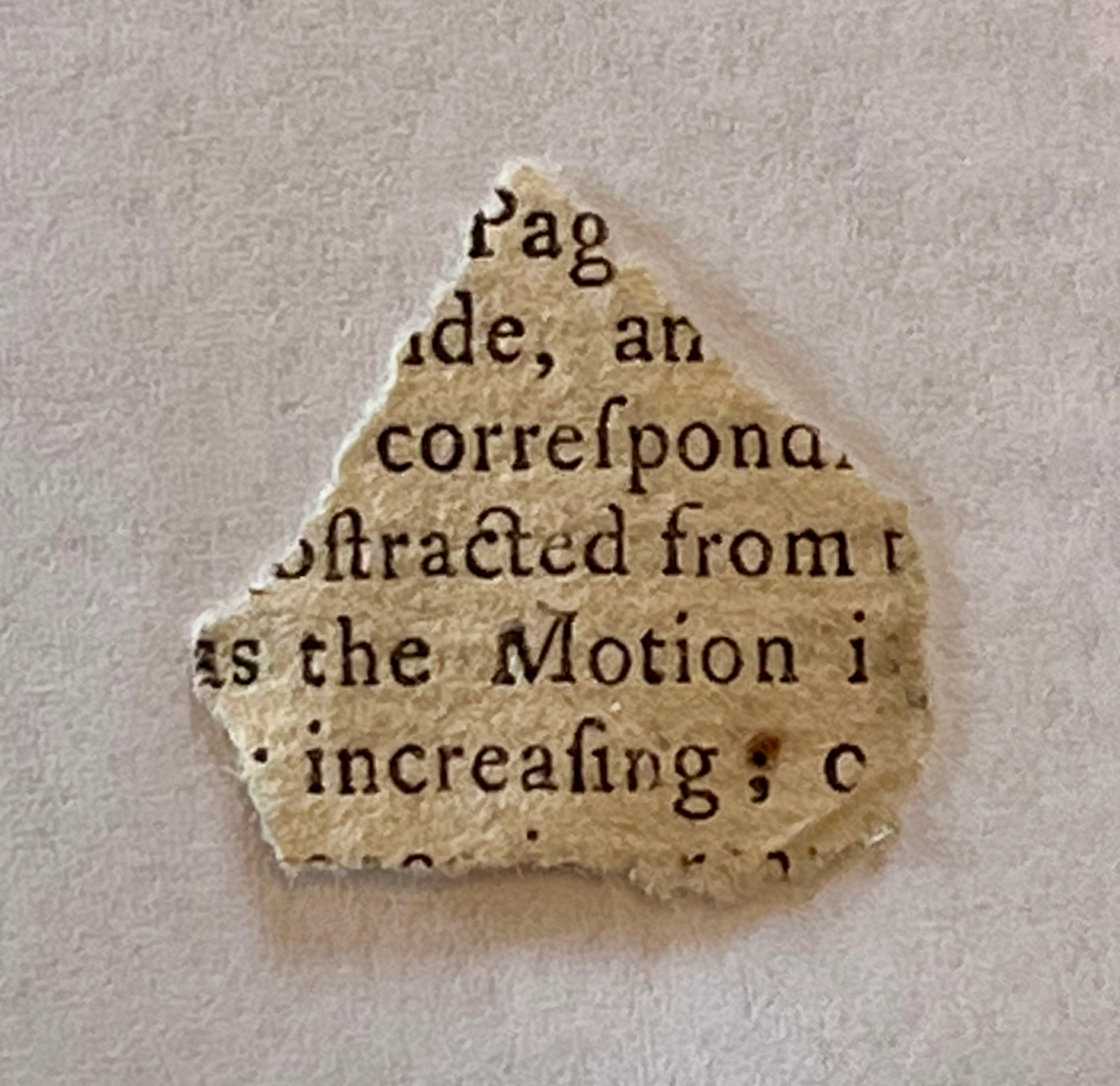
The fragment, sides A & B
Photos credit: Reed Perkins
General Description
The fragment is made of rag paper, triangular in shape and about one inch high and one inch wide at its largest dimensions. It has typeset text, in English, on both sides. For purposes of discussion and cataloging, I have arbitrarily labeled one side as side A, the other as side B. The fragment was found tucked into the gutter (margins) between pages 80 (?) and 81, covering chapters 23 (?) through 25 of Deuteronomy.1 Based on my November, 2022, examination of the book, the shape and size of this fragment does not match any of the present holes in the Bible’s other pages.2
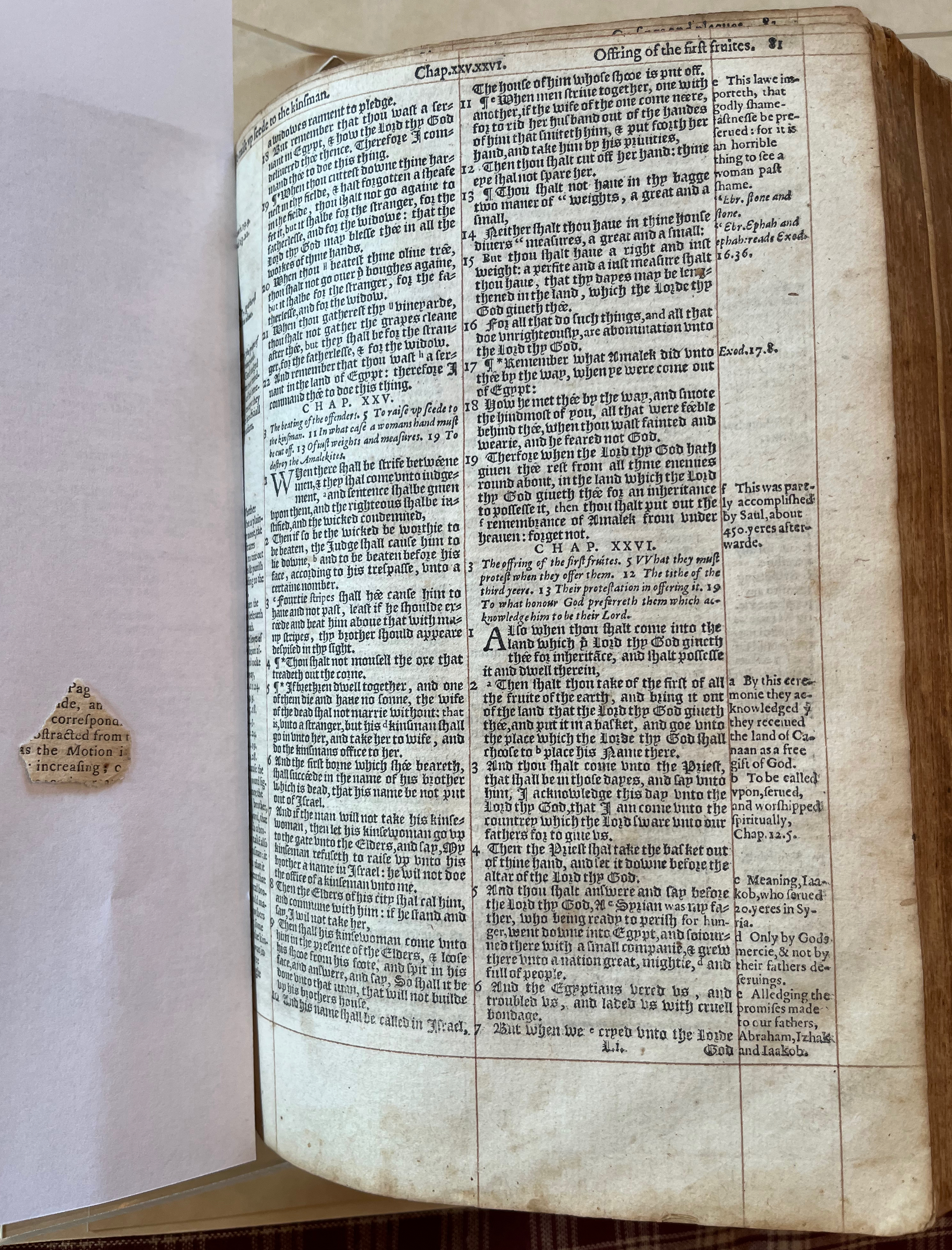
Jonathan Clark House, Bonniwell Family Bible, showing triangular text fragment near its original location in the gutter of pages 80 (?) and 81, page 81, including Deuteronomy 24:18 through 26:7, on right of image. The blank page was added for photographic reasons and is not part of the Bible itself.
All the visible text on the fragment is in a plain Roman font; no boldface, italics, or Black Letter fonts are used. The letter S is represented by both the Long S and Round S forms. The type on this fragment is similar to the Roman font used in the commentary and concordances of our 1580-1588, Geneva translation, Bonniwell Family Bible, but does not quite match the size and exact letter shapes of our Bible’s texts. Based on these clues, I estimate that the fragment was published sometime between the late-sixteenth century and, and the very latest, the first decades of the nineteenth century.
What’s it say?
Here is my transcription of “side A” of the fragment:
        n
     urpose
   the Moon
  des immediate
   after another, as
The “d” at the start of line 4, “des immediate,” is a bit of a guess on my part, and may be incorrect. Here is my transcription of “side B”:
        Pag
       de, an
     correspond
    stracted from t
   s the Motion i
     increasing ; o
“Pag” may well be Page (or Pagan or something else). The letter before “stracted” looks to me like a lower case B or O, so perhaps “abstracted” or “obstructed”? I’m not sure, and I could be completely mistaken.
Sacred or secular?
Even though this little fragment was found tucked into the pages of the Bonniwell Family Bible, it’s not certain that it is a religious text. It’s possible that it is scripture or from a religious essay or commentary, but with the mention of the Moon and Motion and [ob?]structed and things that correspond or are increasing, I wonder whether this is a fragment from some kind of scientific or philosophical book?
What do you think?
Okay, history lovers! What do you think? Do these tiny text fragments ring any bells? Can any of you Google-masters find the source of our mystery text?
If you have any thoughts, guesses, or bona fide solutions to this little puzzle, please share them with us! You can send a public comment to this post by using the Leave a comment space (below), or you can send me a private email via the blog’s CONTACT link. I look forward to your help!
______________________________
NOTES:
- I last examined the Bonniwell Bible and ephemera in detail in November, 2022. The photographs in today’s post are from that date. I took note of the fragment’s location by photographing the right hand page, only, of its location. That page contains Deuteronomy 24:18 through 26:7. I did not take a photo of the facing page, which presumable contains the rest of Deuteronomy 24 and one or more preceding chapters as well.
I’m looking forward to having time to look at the Bonniwell Bible in more detail later this winter. I’ll update this post with more precise citations at that time. - In theory, this fragment could have been part of one of this Bible’s several missing or severely torn, and now lacking, pages. But as mentioned above, the size and shape of the letters in the fragment’s font do not match the similar fonts in the Bonniwell Family Bible.
 Clark House Historian
Pingback: Help the Historian: Mysterious (Bible?) Fragment – a clue! | Clark House Historian