I’m getting back into the blogging groove, and one of my first projects is to continue our series “Not our Jonathan: other “J. M. Clarks” in 1830s & ’40s Wisconsin.” And in my research for that, I’m looking into the identities of one or more men named “J. M. Clark” that served as chaplain at the 5th Regiment’s post at Fort Winnebago.
An important primary source for this research are the monthly “Returns” or reports, sent from the 5th Regiment’s posts at Forts Howard and Winnebago back to the army’s chief bureaucrat, the Adjutant General, in Washington, D.C. We’ve examined these Returns several times on Clark House Historian, including this post from 2016 which discussed this October, 1833, bit of U.S. Army record-keeping, the Return of the Regiment [for the 5th Regiment Infantry, at Fort Howard], October, 1833, verso:
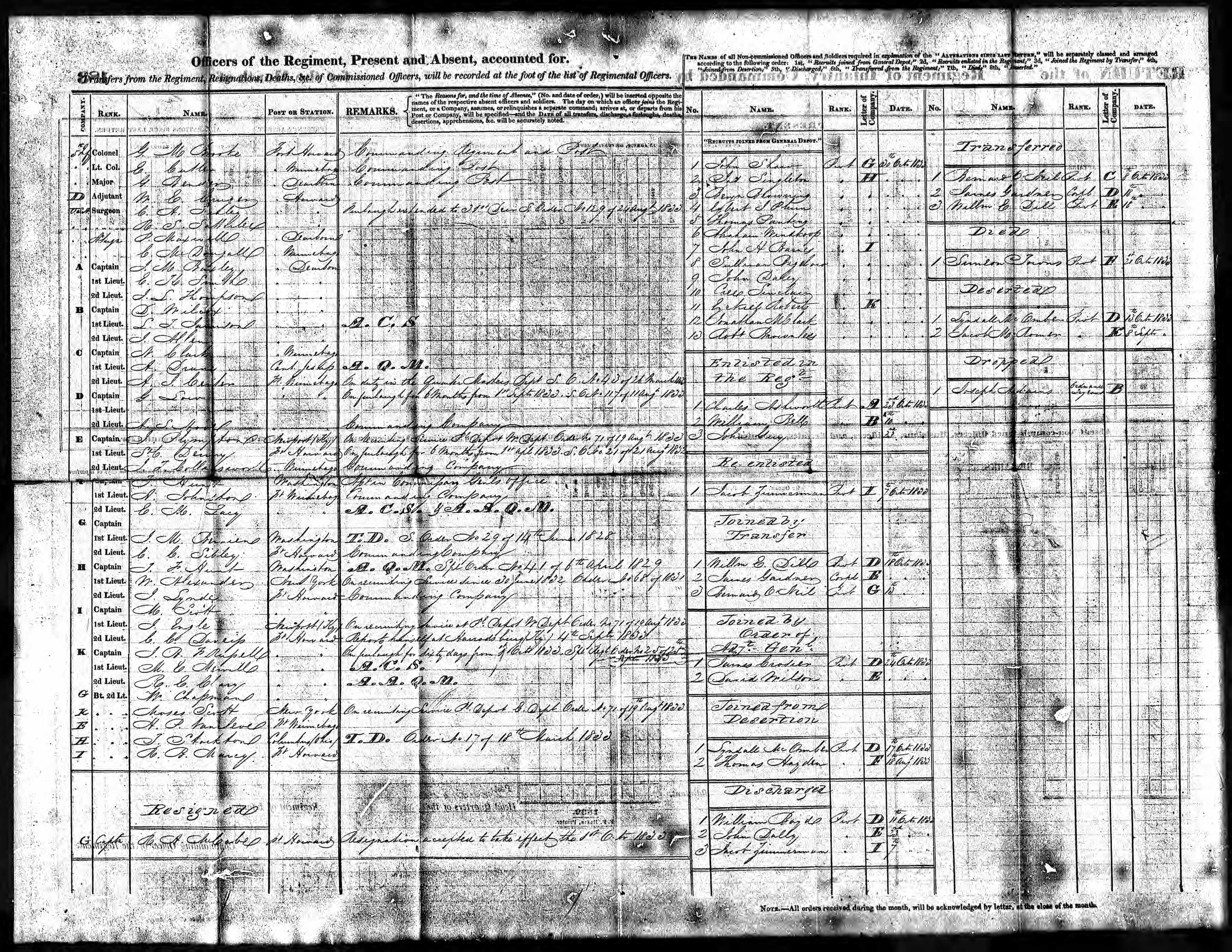
NARA, Washington, D.C.; Returns from Regular Army Infantry Regiments, June 1821 – December 1916; Microfilm Serial: M665; Roll: 54 Military Year : 1832-1842. Return of the Regiment [for the 5th Regiment Infantry, at Fort Howard], October, 1833, verso, from Ancestry.com (pay site).
What’s that name???
For our purposes, one of the most useful features of these monthly Returns is the top left section of the form, which lists the officers of the regiment by [Company], Rank, Name, Post or Station, and with a space for Remarks about their assignments, temporary duty, leaves of absence, and so on. There’s a lot of useful information here, especially the names of the officers and the companies that they lead. But click the image to open a larger version of this image, and see if you can actually read those names:
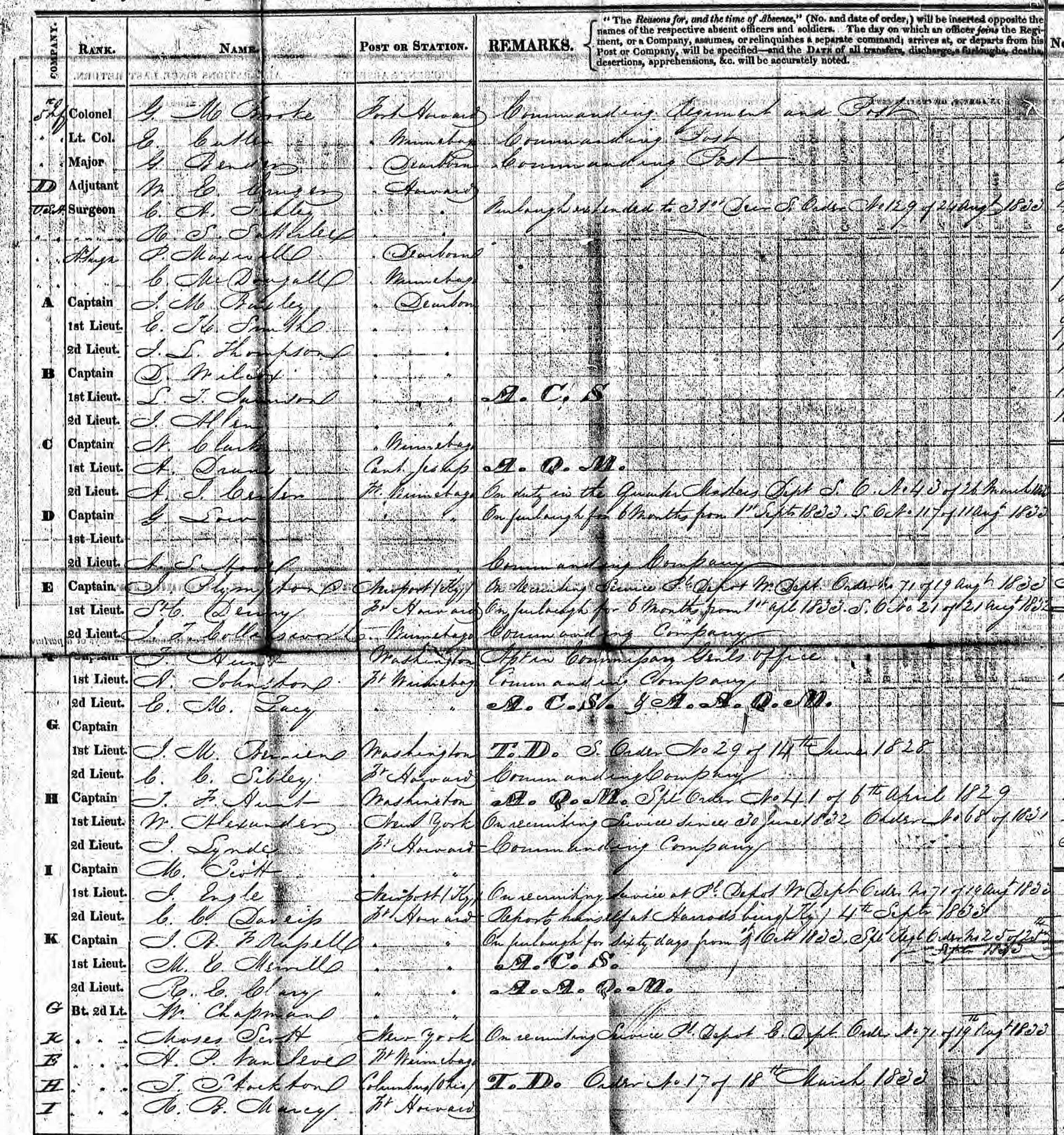
On the one hand, the regimental clerk that filled out this October, 1833, form had pretty tidy penmanship, and the digitized microfilm image is not too bad. But even so, some of the names are hard to decipher. And knowing these names can be really useful, for example when looking for correspondence between these regimental officers and the Adjutant General’s office in D.C. (See our post here, for more on this archive.)
So how do we learn “Who’s Who” on the monthly “Returns from Post” and “Returns of the Regiment”? Fortunately, the government put all that info into a series of very useful books, which are now available, for free, online…
The “Official Register” of 1829

This is the Register of Officers and Agents, Civil, Military, and Naval, in the Service of the United States, on the 30th of September, 1829 […], published by the government, in Washington, D.C., in 1830. The unabridged title (see page image) is quite a mouthful, so the book is often called simply “The Official Register.” This 1829 edition was the first in a series, published every two or three years or so. You can find links to free pdf downloads of all of the Registers at this link.
For our purposes, the most useful section is the list of the army’s regiments and their officers. The 1829 list of officers for Wisconsin Territory’s 5th Regiment Infantry are found on page 105:

Nope, not our JMC…
The 5th Regiment’s 1829 roster includes two men with the surname Clark: Captain (brevet Major) Nathan Clark(e), and 1st Lt. Henry Clark. Previously, we established that Capt.(later Major) Nathan Clark was not related to Jonathan M. Clark. First Lieutenant Henry Clark is new to me. I’ll have to investigate him further, but with a birthplace of Connecticut, chances are that he is not at all related to JMC. (One question to investigate: Is this 1st Lt. Henry Clark the inspiration for the name of Jonathan and Mary Clark’s only son, Henry M. Clark, born in 1843? Hmm…)
1835: JMC’s officers in the Register
The next edition of the Official Register of the United States is dated Septeember 30th, 1835, right in the middle of Jonathan M. Clark’s three-years service with the 5th Regiment of Infantry (1833-1836) and the beginning of the 5th regiment’s participation in the construction of the Old Military Road.

The officers of the 5th regiment from mid-1835 are listed on page 109:

1837: Completing the Military Road & other big changes
JMC mustered out of the army at the end of his term of service in September,1836. The work on the Military Road was essentially complete by the end of the 1837 construction season. 1837 also saw the permanent closure of Fort Dearborn (Chicago), the “downsizing” of the garrisons at Forts Howard and Winnebago, and the transfer of 5th Regiment headquarters from Fort Howard to Fort Crawford at Prairie du Chien and, subsequently, Ft. Snelling, Minnesota.

The Fifth Regiment’s list of officers appears on pages 129-130 of the 1837 Official Register. I have put together the header and list of 5th Regiment officers from page 129, along with the remaining 5th regiment officers found on the top of page 130, into this single image:

Postscript
If you are doing research on the personnel at Forts Howard or Winnebago—or any 19th-century U.S. Army post—these Official Registers can be a very useful resource. The more-or-less biennial (and subsequently annual) publication of these Registers continued for years, and you can find free, downloadable pdf copies of the 1829 through 1959 editions at this govinfo.gov link.
And for those of you searching for similar information on U.S. Army officers and employees from 1815 to 1837, take a look at:

This is A Compilation of Registers of the Army of the United States, From 1815 to 1837 (Inclusive) […], Washington, D.C., 1837, and it’s filled with lots of detailed information about the army’s soldiers and civilian contractors and employees all across the United States and its territories, from the end of the War of 1812 until 1837. The book is available online, including this copy at Internet Archive.
Happy researching! I hope you find these resources useful.
I’ll be back soon with more Clark House history.
 Clark House Historian