UPDATED October 5, 2024, at 9;30 pm to correct a number of typos and other infelicities.
Phew! What a busy September! I got to talk about some very interesting topics last month, to some very enthusiastic and attentive audiences. Lots of work, but very enjoyable. The first of these events was my September 13, 2024, after-dinner presentation at the Fall Workshop of the Wisconsin Society, Daughters of the American Revolution (WSDAR). My topic was “Building the Military Road, Wisconsin Territory’s First Federal Road.”

Photo credit: Laura Rexroth
I incorporated into the talk some important parts of the 1830s and ’40s army and road-building information that I’ve blogged about here at CHH, as well as new primary source materials and a whole bunch of relevant photographs and illustrations.
The WSDAR and the Military Road
An important, ongoing part of the WSDAR’s mission over the decades is historic preservation and education. The Wisconsin Society DAR’s main historic preservation effort involves the care and presentation of the last bit of Fort Winnebago still standing, the historic Fort Winnebago Surgeon’s Quarters.
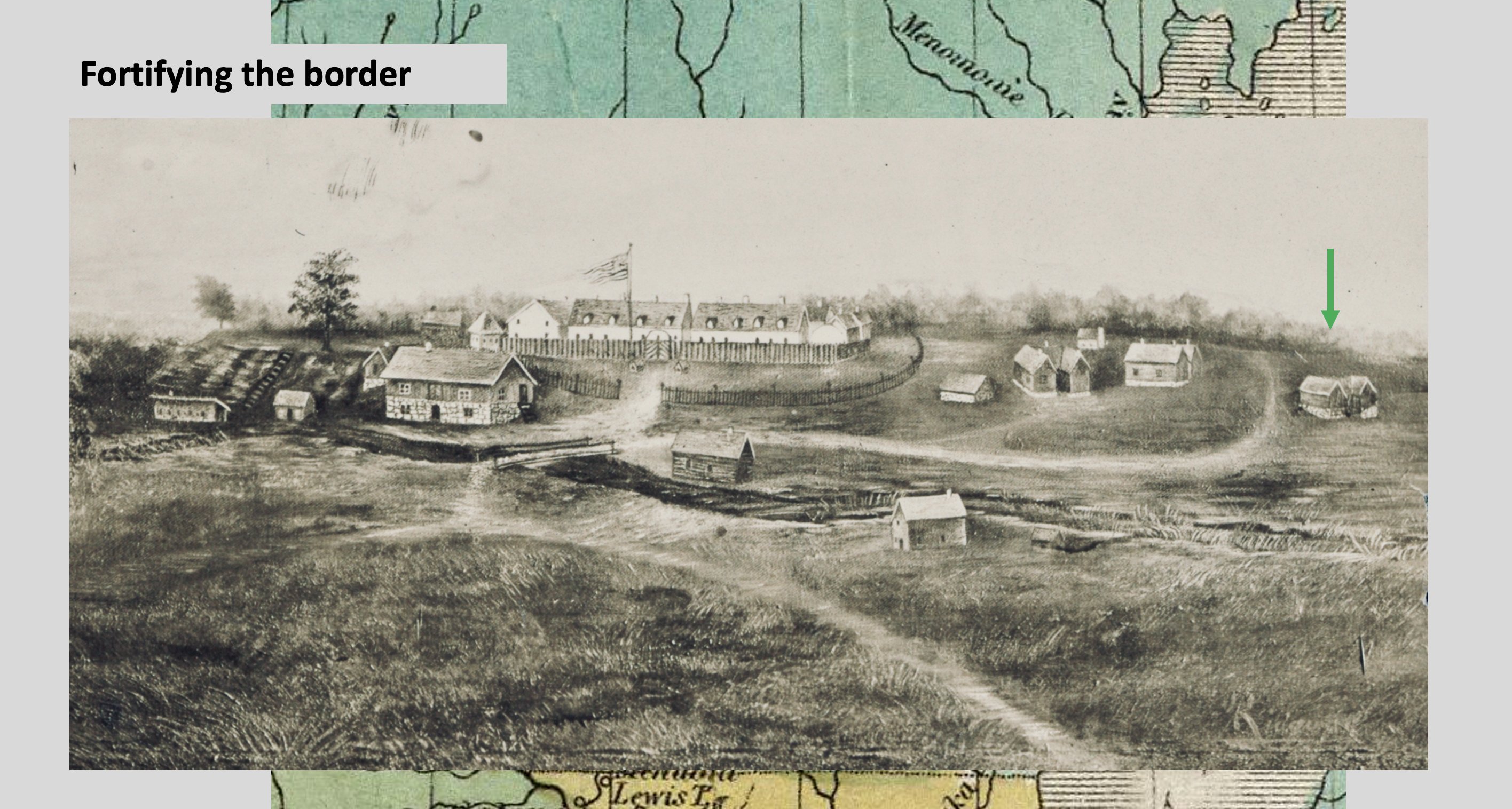
“Fortifying the Border,” slide from my “Old Military Road” presentation.
This image of Fort Winnebago, at the Portage between the Fox and Wisconsin Rivers, was created in the mid-nineteenth century and reproduced on a 1909 postcard. In the detail shown here, the building that is now the WSDAR’s historic Fort Winnebago Surgeon’s Quarters museum is indicated by green arrow. The uncropped full image—including a view of the Historic Indian Agency House—is available from the Library of Congress.
The WSDAR also has an interest in Wisconsin’s Old Military Road that dates back at least to 1930, when Columbia County’s Wau-Bun Chapter, WSDAR placed a series of handsome cast-steel markers along their portion of the route of the Old Military Road. As you might imagine, these have suffered from almost a century of Wisconsin weather and random damage or theft. State regent Sandra Snow has made the restoration and replacement of the 1930 markers one of her signature projects. Here’s a before and after of one of those markers:
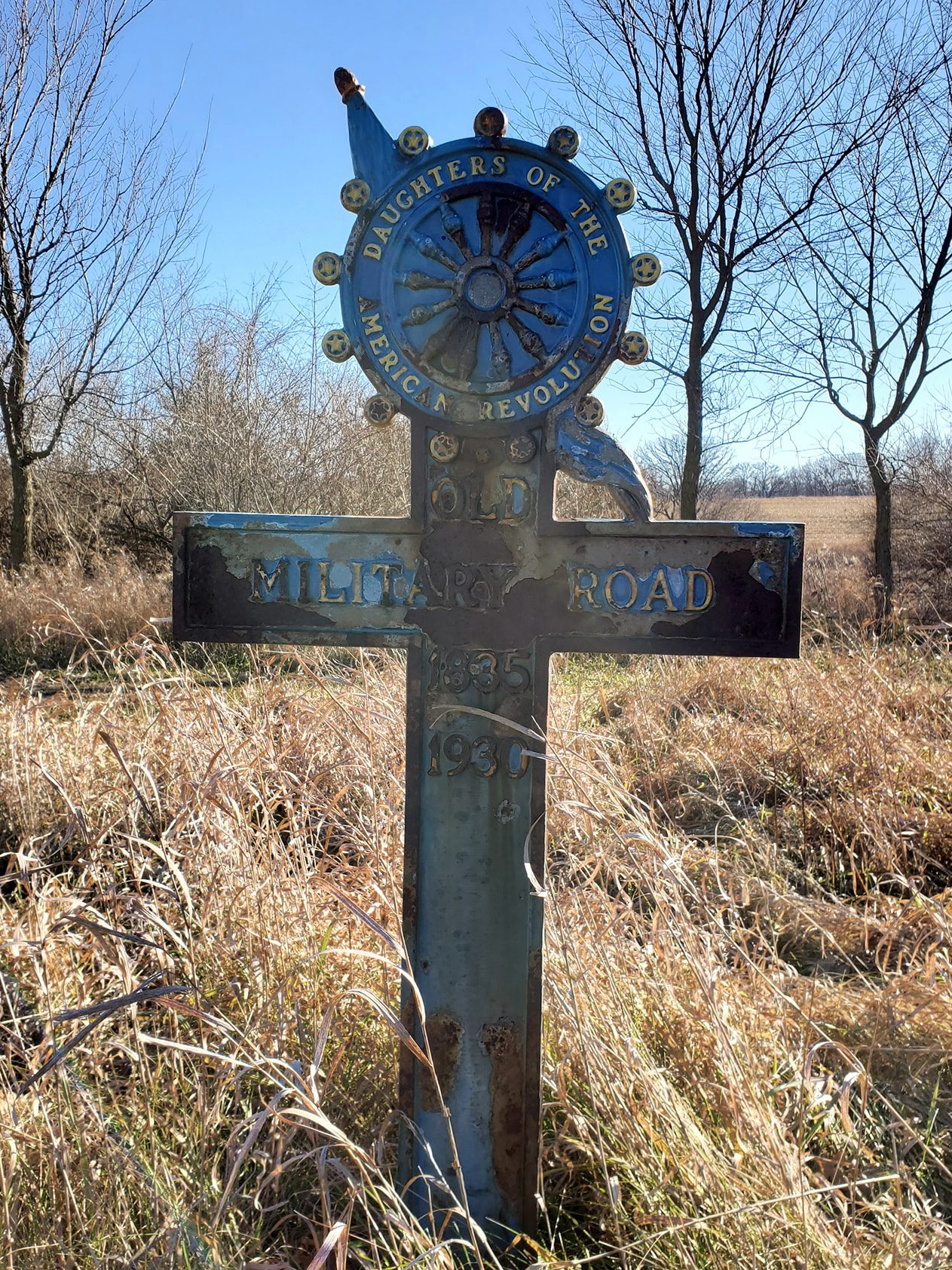
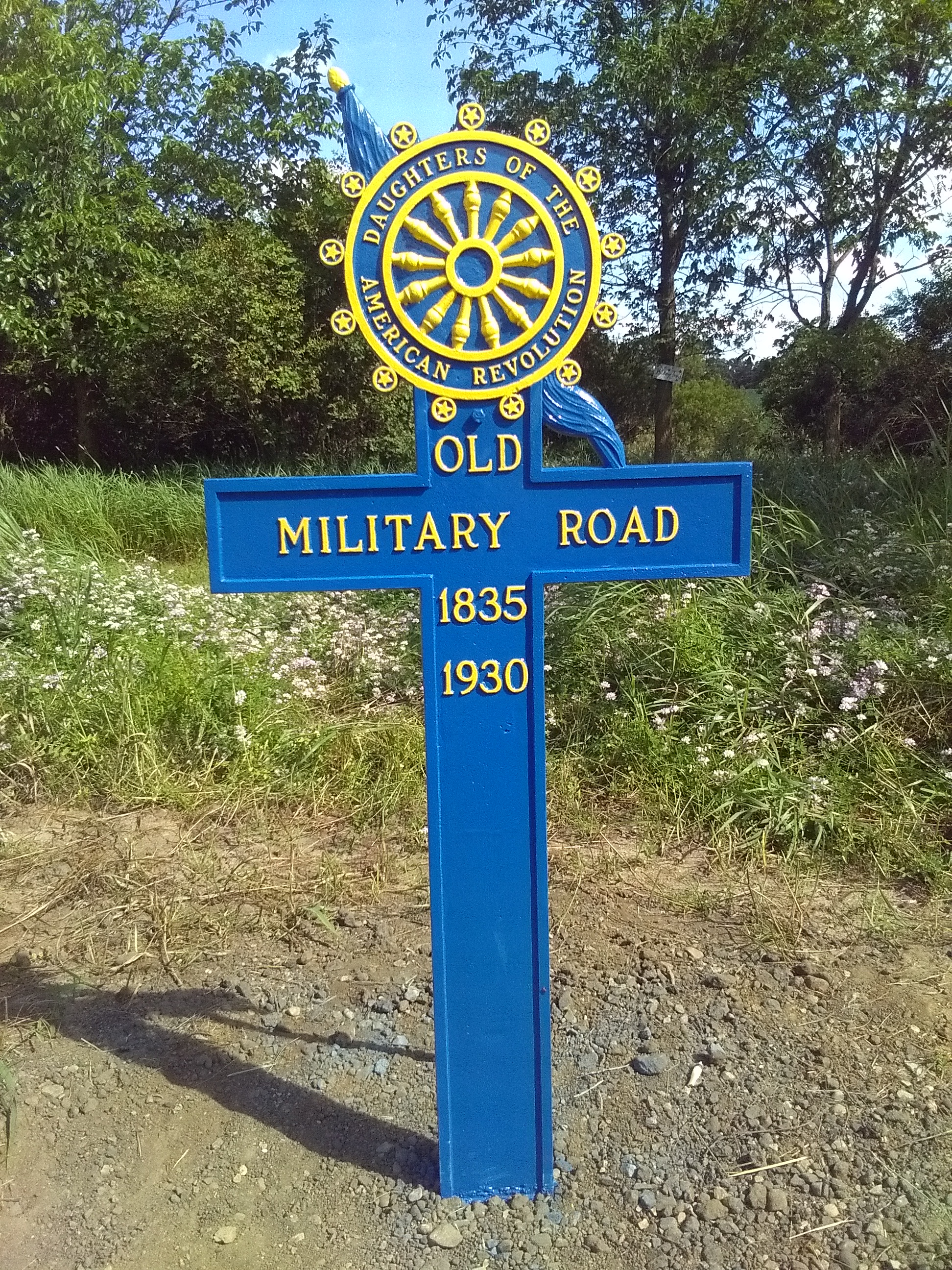
Photo credit: WSDAR 2024, with thanks to Sandra Snow, Sue Cowan, and Sally Twining.
Slide the “compare” slider over the images to see the before and after restoration photographs of one of two original WSDAR Old Military Road Markers. Originally placed in 1930, the cast-steel markers have been restored in 2024 by WSDAR in collaboration with relevant departments of Columbia County, Wisconsin, government. As Wisconsin state regent Sandra Snow explained to me:
The permit I have taken is to follow the original [marker] placements of that chapter – 6 markers, 6 miles apart. I am really only doing 3, (2 that still exist, but one of the original spots to make 6 would cause a serious case of sign pollution along the Wisconsin River).
Of course, highway safety codes have evolved over the last 95 years, and big steel historical markers embedded in the roadside are no longer considered up to standards. Columbia County was willing to grandfather in the two original 1930 markers and allow them to be repainted and left in their original locations. But for the three original markers that had disappeared and needed replacing, another, safer design, on a breakaway wooden post, was needed:

JMC and the Military Road
I was recommended to the WSDAR, I believe, because of the research I’ve done on the Old Military Road and Jonathan M. Clark’s work on that project as part of the U.S. Army’s 5th regiment of infantry, based at Fort Howard, Green Bay from 1833-1836. Talks like these also give me the opportunity to introduce the Jonathan Clark House Museum, and JMC himself, to a wider audience. And it’s remarkable to note how often seemingly unrelated places and events are actually connected by previously unnoticed relationships.
Making connections
You would probably not be reading this blog if you didn’t have at least a passing interest in U.S., state, or local history. I’m always gratified to have readers—and commenters!—and I enjoy connecting with other history lovers in person as well. These now include members of the Wisconsin Society, Daughters of the American Revolution. My new friends at the WSDAR, like my audiences at the Cedarburg History Museum and the Friends of the Jonathan Clark House in Mequon, are all interested in preserving and learning more about local history and historical sites, and for that, I am very grateful.
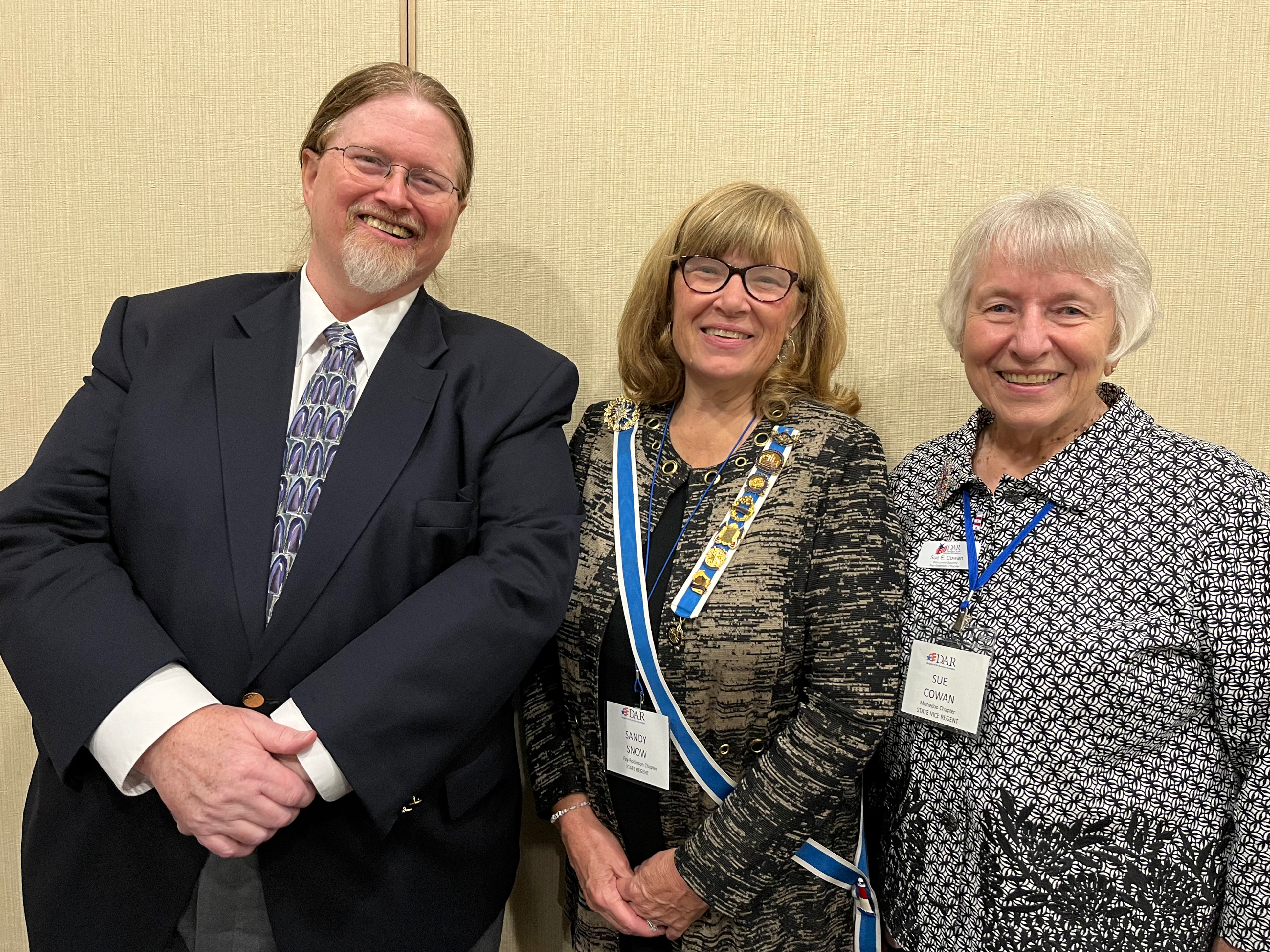
Jonathan Clark House historian Reed Perkins with WSDAR State Regent Sandra Snow and State Vice-Regent Sue Cowan following Reed’s remarks at the WSDAR 2024 Fall Workshop in Oshkosh, Wisconsin.
I’ve been learning things as I give more talks and chat with more folks at local history events. One is that there are many like-minded history lovers, working hard at various historical preservation and interpretation sites and projects, and that the threads of our individual history stories are often deeply interwoven with the stories of other places and people. And that we all benefit when we get together and share what we know—and don’t yet know—about our favorite parts of local history
Psst: everyone does not know about…
And I’ve also learned that we can never take for granted that “everyone knows about” our favorite local history site or organization. I was pleased that I could connect our own Jonathan M. Clark to the history of the Old Military Road, and bring the human side of that 1830s construction project back to life for the members of the WSDAR and their guests. And after the main presentation, I was glad to have time to answer questions.

“Postscript: Jonathan M. Clark,” slide from near the end of my “Old Military Road” presentation.
Among the first questions, I was asked “What is the Jonathan Clark House Museum, and what do you do there?” Now, it didn’t surprise me that most of the members of the state chapter of the DAR had not visited—or heard of—the Clark House (or Mequon). Wisconsin is a big state with many historical sites. So I was ready with a quick answer explaining the long history of the house, our recent transformation into a local history museum, and my ongoing relationship with the museum (and the Turck and Clark families). And it didn’t surprise me that many of the WSDAR members were enthusiastically looking forward to visiting the Jonathan Clark House Museum in the future.
But what does surprise me, is when I talk to folks at local events (such as my Cedarburg History Museum presentations), and I get asked: “”What is the Jonathan Clark House Museum?” or, even more surprisingly (for a downtown Cedarburg event), “Where is the Jonathan Clark House Museum?”
Keep in mind, these are local folks, with at least a mild interest in local history, attending a local history lecture, in a venue only 2.2 miles—a six-minute drive—due north of the Clark House. And yet some have, at best, only a vague idea of what, or where, the Jonathan Clark House Museum is. The lesson for us? We need to keep talking about our favorite history sites and organizations, inviting people to visit them and participate, and never assume that everyone already “knows all about it.”
Thanks!
Many thanks, again, to Wisconsin State Regent Sandra Snow and the members of the WSDAR for their kind invitation to speak, and for their lively conversation and ongoing interest in the Old Military Road, the early days of Wisconsin Territory settlement in the 1820s and ’30s, and the role that the U.S. Army, Forts Howard and Winnebago, and our own Jonathan M. Clark played in that history.
Particular thanks to State Regent Sandra Snow, State Vice-Regent Sue Cowan, State Historian Gena Selby, Military Road sign photo provider Sally Twining, and chief tech whisperer Lynn Schiel, for their help before, during and after my Oshkosh presentation.
One more tip of the hat…
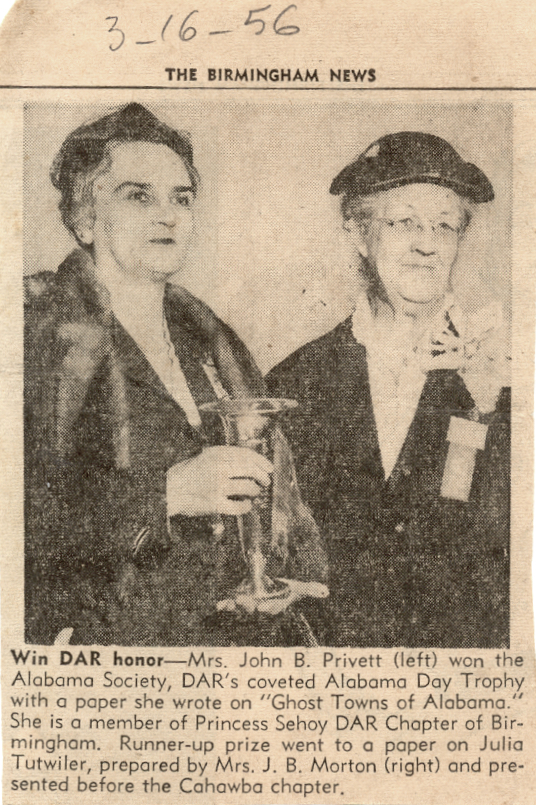
As I mentioned to my new WSDAR friends, I am not the first member of my family to address a state DAR gathering. That honor belongs to my great-aunt Harriet Kinnaird (Mrs. John B.) Privett (1903-1996).
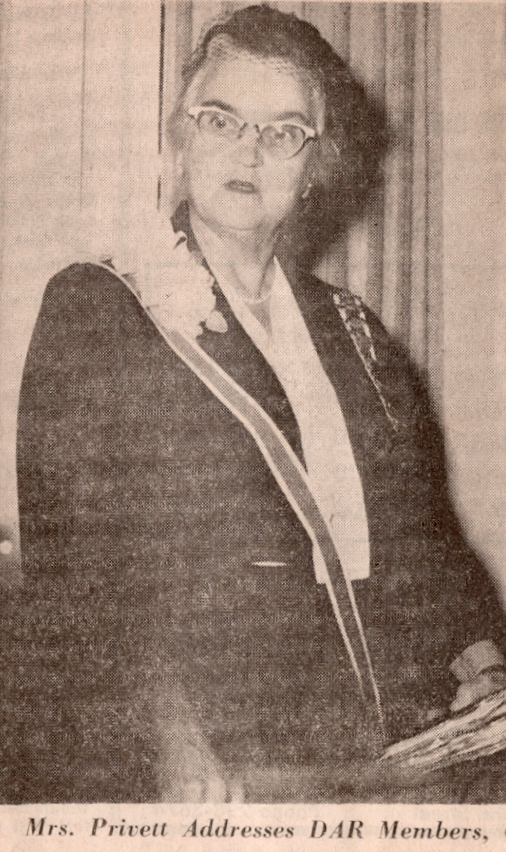
That’s Aunt Harry (yes, Harry is her original name, but that’s another story…) as Alabama State Regent in the very late 1960s or early-1970s. She was a delightful woman, brimming to overflowing with local history tales, generations of family stories, and a gift for holding an audience spellbound. She was the family historian and genealogist, and worked hard to learn the real details of the family tree and the people, and history, it represented.
She was a “joiner.” Through her research, she established her eligibility for, and became a member of, more 3-letter Lineage Societies than I even knew existed, naturally including the DAR. She was one of the thousands of remarkable women that did amazing genealogical work in those pre-computer, pre-internet (and pre-air conditioning!) days. For decades, Aunt Harry and her colleagues drove from one rural, Southern county courthouse to another, and to museums and historical societies large and small, sifting through page after page of dusty and often poorly-maintained archives. The amount of historical information that Aunt Harry and her volunteer colleagues accurately indexed, transcribed, organized or published is remarkable, and remains a gift to us all.
Thanks, Aunt Harry.
 Clark House Historian
Pingback: November! already? | Clark House Historian
Pingback: JMC: a soldier’s life at Fort Howard, 1834 | Clark House Historian
Pingback: I’ve been busy…at the Portage! (part 1) | Clark House Historian