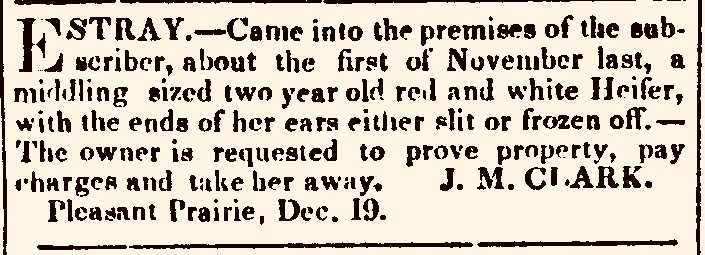
“Estray. […] J. M. Clark” advertisement, Southport [later Kenosha] Telegraph, Dec. 26, 1843, page 4
Hey! How did Mequon’s Jonathan M. Clark end up with a stray red and white heifer on his farm in…Pleasant Prairie, the most southeasterly township in all of Wisconsin, some 56 miles south of the Jonathan Clark House? The short answer is: he didn’t. The man that placed this “stray cow” advertisement in the December 16, 1843, issue of the Southport (later Kenosha) Telegraph was is not “our” J. M. Clark.
So many J. M. Clarks
Throughout the nineteenth century, many men seem to have been referred to, at least in print, by the initial letters of their first and middle names. The builder of Mequon’s Jonathan Clark House was no exception. Many of the documents made during his lifetime refer to him as “J. M. Clark,” and he often signed his name that way as well.1

“J. M. Clark,” signature of Jonathan M. Clark, from his final U.S. naturalization papers, 1853.
Unless the researcher is careful, it’s easy to make assumptions and presume that the “J. M. Clark” that built our historic Mequon home in 1848 is identical with the other “J. M. Clark” men that appear in various Wisconsin Territory documents, land patents, newspapers, and histories. Unfortunately, this is not always the case. To be certain that the “J. M. Clark” referred to in a particular source is “our” Jonathan M. Clark, we need to understand the “who, what, where and when” of each document or event that may—or may not— have involved our Jonathan.
I’m sure my list of suspects is incomplete, but (surprise!) it has turned out to be much longer and more complicated than anticipated. With that in mind, I think I’m going to need several CHH posts to sort out some of the most easily mistaken “J. M. Clark” men that lived and worked in the central and southeastern parts of Wisconsin Territory, yet were definitely not our J. M. Clark, the man born in Lower Canada (or Vermont) in 1812 that went on to build the historic Jonathan Clark House in Mequon in the 1840s.2
Let’s start with earliest and most northerly of these settlers, the first of several Christian ministers surnamed Clark that had links to Wisconsin Territory army posts that were home to our Jonathan M. Clark and his comrades during their service with the U. S. Army’s 5th regiment of infantry, 1833-1836.
1836: a tantalizing “J. Clark” on the census
In our 2020 discussion of the 1836 first census of Wisconsin Territory, we noted a man tantalizingly enumerated as “J. Clark,” living with his small family at the old Green Bay settlement, located where the Fox River enters Lake Michigan’s Green Bay, and adjacent to the U.S. Army’s post at Fort Howard. In 1836, this “J. Clark” was the only person with the Clark surname in all of Brown county (which then covered almost half of the territory). This man’s family comprised 1 male 22-44 years old (presumably “J. Clark,” himself), 1 male under 21 years (possibly a son), and one female over 21 years (presumably his wife).3
For a brief while, I wondered if our JMC had an unknown first wife—and family—prior to settling in Mequon and marrying Mary Turck in 1840. This was highly unlikely, as from 1833 to 1836, JMC was an enlisted man, and would have been living on post at Fort Howard. Army officers of the period might be married and living with spouse and children on post, but enlisted men did not. As it turns out, “J. Clark” and our Jonathan M. Clark were two very distinct persons, indeed. Green Bay’s “J. Clark” was, in fact, a pioneering Methodist missionary, the Reverend John Clark.
Rev. John Clark (1797-1854)
My first clue to identifying “J. Clark” was this 1834, “List of Letters” waiting to be picked up at the post office in Navarino, a small but ambitious settlement adjacent to Fort Howard and the old fur trading settlement of Green Bay. Navarino was home to the one and only U.S. post office in the area, as well as the Wisconsin Territory’s first newspaper, the Green-Bay Intelligencer and Wisconsin Democrat.

Clark, Rev. John in “List of Letters,” Green-Bay Intelligencer and Wisconsin Democrat, Feb. 5, 1834, page 6.
Rev. John Edgecomb Clark was born in Hartford Washington Co., New York in 1797. Like several of the men in this series of posts, this J. Clark was an evangelical protestant Christian minister. Rev. Clark had been assigned by the Methodist Church to lead their spiritual efforts on the northwestern frontier among the white and métis settlers, the soldiers at Fort Howard and, especially, evangelizing the various Native American tribes living in what we now think of as Wisconsin, the Upper Peninsula, and adjacent parts of Michigan and eastern Minnesota.
Contemporary newspaper reports show that from time to time Rev. Clark gave the invocation at various civic and military events at Green Bay and Fort Howard. And, just like our Jonathan M. Clark, the reverend’s last name was also occasionally misspelled with a final “e.”
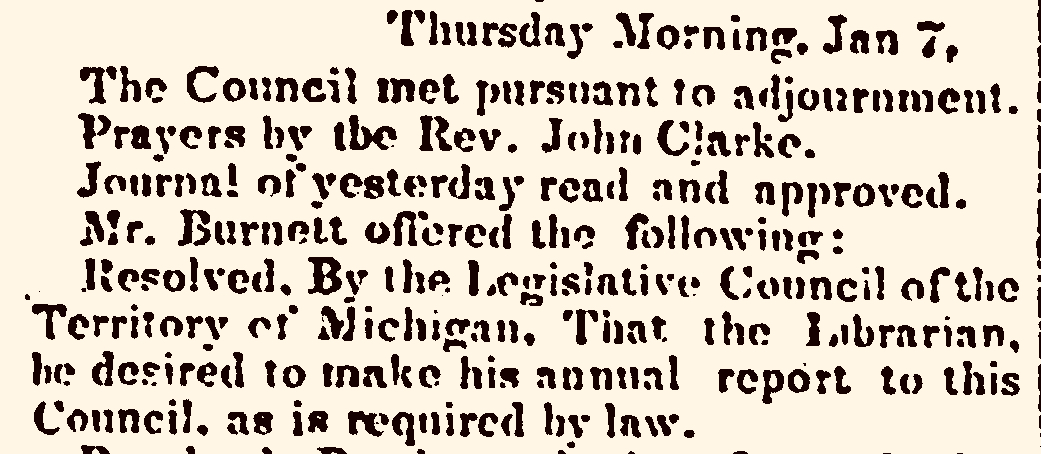
[Prayers by the Rev. John Clarke] Green-Bay Intelligencer and Wisconsin Democrat, January 20, 1836, page 1
Rev. John Clark was a well known man in 19th-century Wisconsin, a notable example of the vigorous, energetic missionary of the Gospel of his era. Like many missionaries, he had a somewhat paternalistic view of his “heathen” Indian flock, but to his credit, he seems to have had a much more sympathetic and supportive attitude toward the local Indians than many of his peers. After a number of years spent as an itinerant preacher in the the wilderness of Wisconsin, Michigan and Minnesota, Rev. Clark moved south, to Aurora, Kane Co., Illinois. He died there, of cholera, in 1854.4
Coming up
Be sure to read the future installments of this series for details about early Wisconsin settlers named “J. M Clark,” in Prairieville/Waukesha (another Reverend!), Racine & Kenosha counties, and elsewhere in central and southeastern Wisconsin Territory.
Next time, we will try and answer the question “how many post chaplains named ‘J. M. Clark’ served at Fort Winnebago in the 1840s?” Spoiler alert: the answer is either two, three… or one.
Sound confusing? It is! We’ll see if we can sort things out next time. Thanks for reading.
________________________________
NOTES:
- I’ve always wondered, did 19th-century midwestern Americans greet each other by their initials in everyday life? If one of Jonathan M. Clark’s close friends met him on the road, or in town, would he have said “Hello, Jonathan” or “Hello, J. M.”? Or was there a more Victorian sort of formality at work most of the time, and all men greeted each other with “mister,” such as “Hello, Mister Clark” ? I’m not sure. Readers, what do you know about 19th-century rural, town, and city manners and greetings?
- For the record, I have not given these other “JMC” men the full-CHH research treatment. I did do enough digging—including a fair amount of genealogy—to clarify who they were and, often, when and where they were born and died. My main goal was to untangle each unknown “J. M. Clark” from our Jonathan M. Clark.
- Be sure to re-read that post on the 1836 census. It has more info on Rev. John Clark, as well as what appears to be the (anonymous/group) enumeration of Jonathan M. Clark and his road-building comrades of Cos. G, H, and K of the army’s 5th regiment, at work on Military Road in the summer of 1836.
- For a quick introduction to John Clark’s life, with a short biography, an obituary, his burial information, and links to similar information for his wife, two of their children, and other kin, see his FindAGrave site. After his death, his admirers published a biography, The Life of Rev. John Clark, by Rev. B. M. Hall, New York, 1856, which includes many details of his days among the Indians and settlers of Wisconsin. The book’s frontispiece is an engraved portrait of Rev. Clark in his mature years. Some of Rev. Clark’s activities also feature in Josiah B. Grinnell’s autobiography, Men and Events of Forty Years […] 1850-1890, Boston, 1891.
 Clark House Historian
Pingback: Who’s Who at Forts Howard & Winnebago, 1829-1837 | Clark House Historian