
Sorry for the “radio silence” lately. I’ve been occupied with a number of tasks on- and off-line and then, early last morning, we had a big thunderstorm, and it seems that one or more of the storm’s lightning strikes managed to fry our family’s wi-fi modem-router. Imagine that. No internet! How does a blogger cope?
The cold realization of an off-line Monday was followed by the prospect of what lay ahead: going to my day job (meh), and then, after work, needing to choose and purchase a new modem-router (not too bad, perhaps) and then having to spend hours trying to follow the inevitable—and laughably & misleadingly-labeled—”few easy steps” to set up the new Wi-Fi hub and connect it to our existing internet service and other devices (I’ve done this before and, frankly, I’d rather visit the dentist).
What to do?
Rescued!
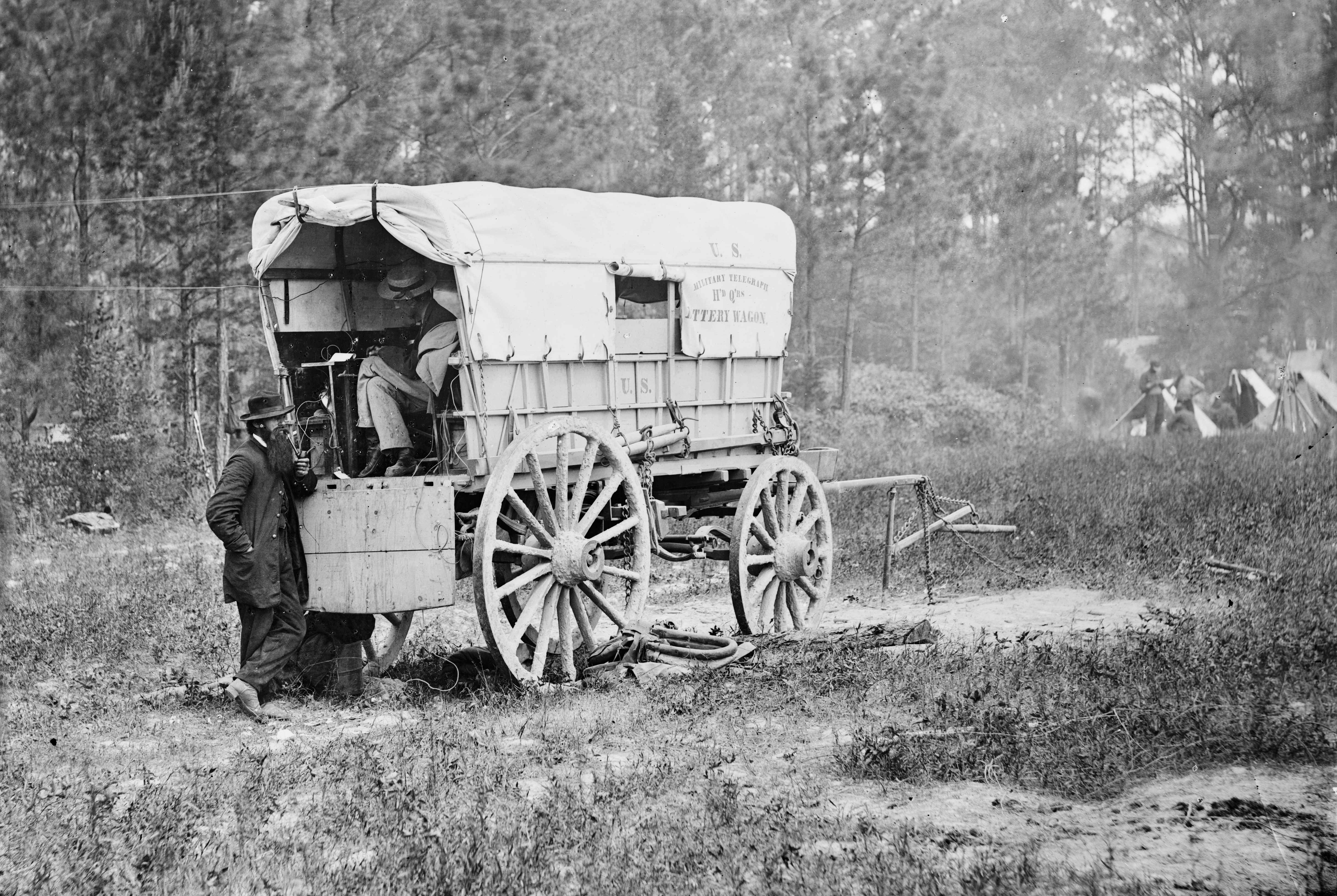
Fortunately, help was on the way, and I didn’t even need to call upon the Union Army’s telegraphic corps.

Instead, my dear spouse was willing to take charge of the onerous retail and technological tasks, and did a magnificent job.
In sum, all is well. Technical problems are solved, batteries are charged, my sanity (such as it is) is still intact, and—like the telegraph operator in the photo below—I’m back at the key(board) of my modern electronic communication device.
And Clark House Historian blog should be back “on the air” with new material later this week. See you soon!
___________________
CREDITS:
- Unknown photographer, Marconi wireless school, New York.Operators copying messages transmitted from ships at sea. New York, ca. 1912. Library of Congress.
- Waud, Alfred R., artist, and Theodore R Davis. The Army telegraph – setting up the wire during an action […] sketched by Mr. A.R. Waud. Harper’s Weekley, Jan. 24, 1863. Library of Congress.
- Knox, David, photographer. Petersburg, Va. U.S. Military Telegraph battery wagon, Army of the Potomac headquarters. Petersburg, Virginia, June 1864. Library of Congress.
 Clark House Historian