It’s already the second week of May, 2024, and summertime will soon be here. At our southeastern Wisconsin home the first spring flowers are done, and the next round of blossoms have been blooming for a week or two. The peas will soon be in the ground, and we already harvested enough rhubarb to make two and a half small jars of jam. The tomato and pepper seedlings and the squashes will go in soon, and I need to put up a trellis or two so we can start the big patch of green beans. So even though it’s “early” by the standards of previous years, we’ve got gardening on the mind here at the Historian’s house, and I thought you might enjoy a slightly-belated repost of this annual favorite, which first appeared here in April, 2021. Cheers!
Planning the garden
It’s early April, and the growing season is not far off. For a farmer like Jonathan M. Clark, it’s a little early yet for plowing and sowing, but not too early to make plans and sharpen the tools. For a farmer’s wife, like Mary (Turck) Clark, it’s not too soon to think about the farm garden, its crops and layout.
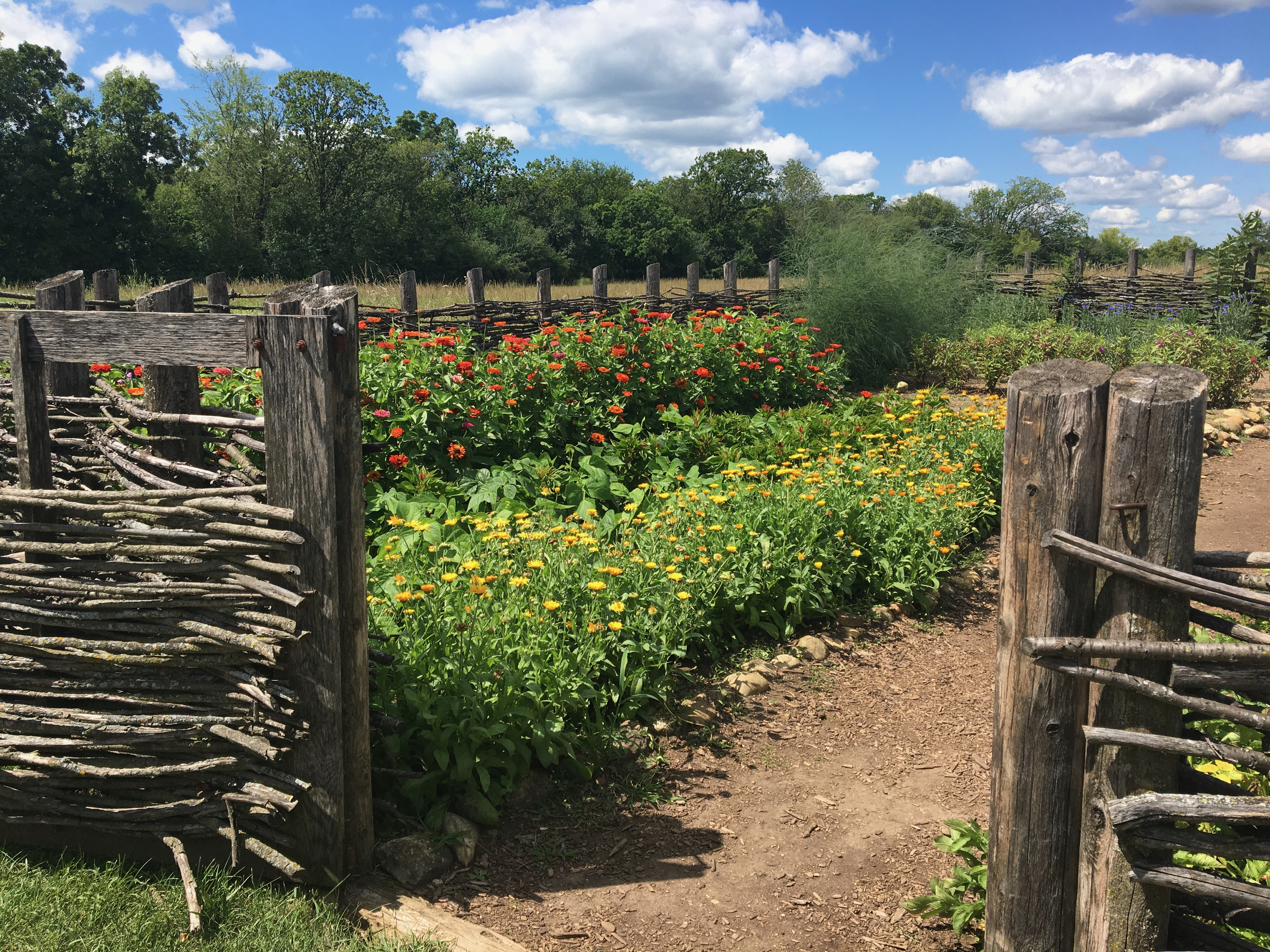
Garden at the Turck-Schottler House, 1870s Hessian Immigrant Farm, Old World Wisconsin. Photo credit Reed Perkins, 2022.1
I don’t know if Mary and Jonathan were regular readers of the popular and affordable farmers’ almanacs of their era; I wouldn’t be surprised if they were. There were many to chose from. Perhaps they had a copy of something like:

The Cultivator […], New Series, Vol. VII, Albany, 1850, title page. Click to open larger image in new window.
A growing family in a new house
Mary and Jonathan celebrated their 10th wedding anniversary on March 15, 1850. They were now parents of four children: Caroline (age 9), Henry (7), Elizabeth (5) and a 3-year-old daughter, “P. A.,” later known as Persie.
In spring, 1850, Mary was expecting once again. The Clark’s fifth child, a daughter, would be born on May 9th. On the 1850 census she was enumerated as Mary. Later, for a while, she would be called Sarah. As an adult she would be known as Theresa or Tresa.
In addition to Mary, Jonathan, and the four Clark children—and the child soon to arrive—the household included Mary’s youngest brother, Benjamin Turck (age 11) and a hired man, a 30 year-old German immigrant named John Buck. With eight people in the home, it’s good that the big, two-story stone house was completed around 1848.
The farm garden
To feed all those hungry mouths, the Clark farm almost certainly included a substantial farm garden. Such a garden would have been near the house and would have included all manner of fruits, vegetables, tubers, legumes, herbs and—possibly—some purely decorative flowers. Mary, as head of all things associated with the home and kitchen, would have been in charge of the garden, too. The older children would have helped with planting, weeding and harvesting, or by minding the youngest children so Mary could focus on the garden and her other household tasks.
By 1850, the Clarks were well established on their farm and in their new, large home. We don’t know what Mary’s farm garden looked like, but perhaps she took inspiration from illustrations and suggestions in the various farmers’ almanacs, such as this page from Vol. VII, No. 1 of the 1850 Cultivator:

The Cultivator […], New Series, Vol. VII, Albany, 1850, p. 27. Click to open larger image in new window.
My guess is that Mary and Jonathan probably didn’t splurge on a large garden vase or sun dial. And the suggested geometrical shrubbery (h) or a columned “Rustic Alcove” seem a bit high-toned for 1850 Mequon. Even so, it’s still worth looking closely at this garden plan.
Of course, the farm in the engraving is laid out differently than the Clark’s farm. In the picture, the farmhouse (A) is approached via a curving drive (c) and shares a kind of courtyard or “parking area” (d) with the barns (e). The Clark farm—as best we know—lacked most of these features. From early days, the Clark farmhouse was on the west side of Cedarburg Road, and the barn and other outbuildings were on the east side.
For me, the most important reason to look at this 1850 magazine illustration is to get a sense of how large an established farm garden could be. As a very rough estimate, this suggested garden (B) covers more than 10 times the area of the farmhouse itself. This is an entirely realistic size for a 19th-century farm garden.2 I would expect Mary Clark’s garden to have been similar in size, even if it differed in its details.
What did Mary grow?
There’s much we don’t know about what—exactly—the Clarks and their Mequon neighbors grew on their farms. It’s likely that we can find out more, once I can access the 1850 and 1860 federal census’s “Agricultural Schedules” on microfilm at the Wisconsin Historical Society. Based on the compiled statistics from Washington (later Ozaukee) County’s federal decennial census for 1850, we do know that certain garden crops were grown in the area. These included peas, beans, Irish potatoes, sweet potatoes, barley and buckwheat. Other grains, such as corn, wheat and oats, were major farm crops and would have filled the large farm fields.
Not found on the 1850 census reports are garden crops such as berries, tree fruits, herbs, and other typical garden produce. I suspect this is because these crops were not grown as surplus, market produce, but simply for home consumption. We know that some 1850 Wisconsin farmers were growing strawberries, pears and apples and would continue to do so. And Mary may well have kept a beehive or two for honey production.
For more on the Clarks’ farm and garden products, see Harvest Time: 1850, part 1 and Harvest Time: 1850, part 2. For a look at the now-demolished Clark barn, see Harvest Time
Until next time, be well. And if you are gardening…watch out for rabbits!3

“Eating salad after the rain”– Rabbit in the roses and salvias. Photo credit: Laura Rexroth, 2024.
________________________________________
NOTES:
- The Christian Turck family came to the USA from Hessen-Nassau (Germany) in July, 1845. They settled just a few miles to the west of the Jonathan Clark House, in the NW quarter of the SW quarter of Section 1, T9N-R20E (Germantown), Washington county, Wisconsin Territory.
To the best of my knowledge, there is no genealogical connection between Christian Turck’s 1845 immigrant family and the family of 1837 Mequon pioneer—and Jonathan Clark’s future father-in-law—Peter Turck. Peter Turck came from an old Hudson River, Dutch-American family, whose roots in what is now New York state go back to at least the mid-1660s and before that, to The Haag, in the Netherlands.
The Blockbau style log house that Christian Turck built in Germantown sometime after mid-1845, was later owned by the Schottler family. By the early 1960s, the Turck-Schottler house had fallen into ruin; it was then dismantled piece by piece and re-assembled as one of the original exhibits at Old World Wisconsin. It’s still there, a focal point of Old World Wisconsin’s “1870s Hessian Immigrant Farm,” and remains a unique surviving example of early Wisconsin-German log house architecture. Well worth a visit. - This was not unusual in the 20th-century, either. For example, my wife’s Grandma Florence had a much smaller house and family than Mary (Turck) Clark, on a good-sized Nebraska farm. To support her family of five, she tended a farm garden of about a half-acre in size. The tubers, vegetables and fruits that she grew there and canned or kept in her root cellar lasted all year, until the next year’s fresh garden crops were ready.
- For more on rabbits—and mid-19th century ways to keep them out of your garden—see our post Rabbits! from May, 2023.
 Clark House Historian