Time for a few Random Bits of History: Early Mequon Settlers’ Disambiguation Edition.
John Weston & John Western
Mequon’s first postmaster, John Weston, is mentioned many times in the essential local history book, the History of Washington and Ozaukee Counties, Wisconsin … Illustrated. Western Historical Publishing Co., Chicago, 1881. Using the “Find” function on my PDF copy of the book,1 I found results for “John Weston” on pages 475, 476, 523, 524 and 545.
There is also an entry for “T. Weston” among the names on the “First Poll-List of Washington County” on page 316. I am confident that this is a typographical error and that “T. Weston” is actually John Weston.
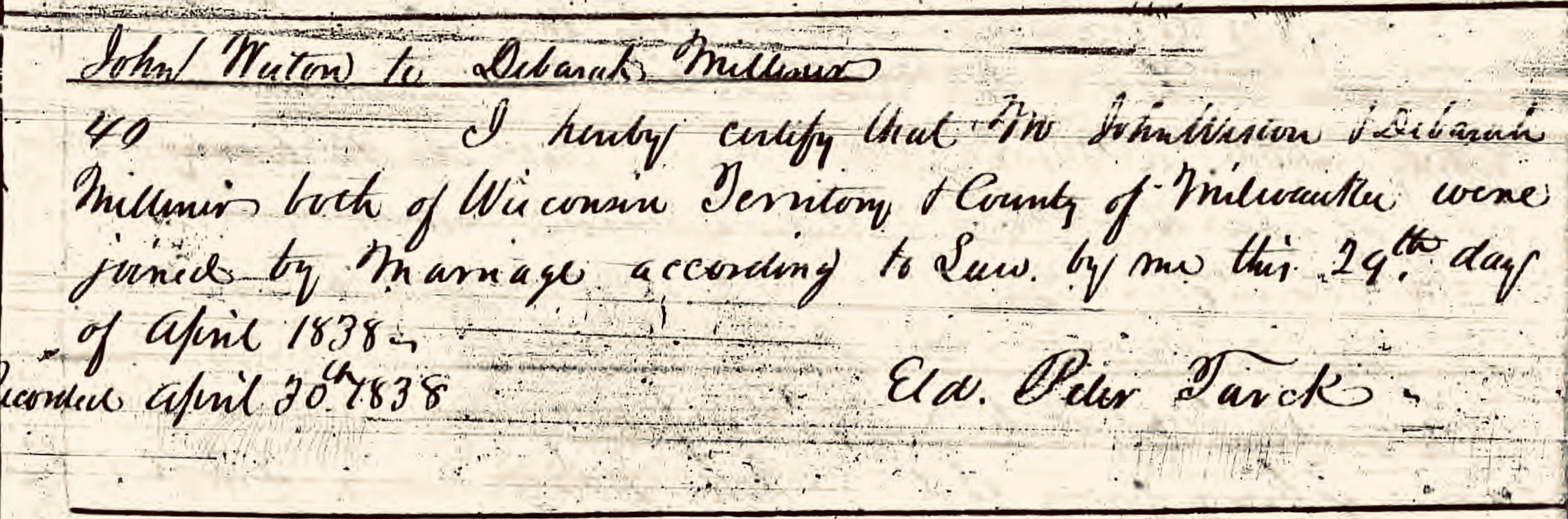
The same source also records, among the early area settlers, one “John Western,” on pages 316, 477 and 478. Is this the same man as John Weston? I have carefully compared a number of sources, including the early minutes of the county road supervisors and deeds in the Washington/Ozaukee county deed books, and I am convinced that during the early years of settlement in the Mequon-Milwaukee area, “John Weston” and “John Western” are the same person, namely John Weston, born in New York about 1800, and married to Deborah Milliner in Milwaukee County in April, 1838. I’ll have examples from the documents that explain my reasoning in a future post.
Fun fact: Mary (Turck) Clark’s father, (Baptist) “Elder” Peter Turck, was the officiant at the Weston-Milliner wedding in 1838. It was the fortieth marriage recorded in the first volume of marriage records for Milwaukee county (and its still-attached for judicial purposes neighbor counties, including old Washington/Ozaukee county).2
With the Weston & Western mystery solved—for the moment—let’s see what other bits of error and confusion we can clear up…
Loomer & Loomis
As I mentioned in a footnote to our previous post, Meet the neighbors: the Loomis family,
… the early records of old Washington /Ozaukee county are filled with mentions of this extended New England LOOMIS family, and with the (even more?) numerous Nova Scotia LOOMER family. Occasionally, some of the early records, and at least one published genealogy, have used—for reasons unknown, or possibly just in error—one surname in place of the other, making things very confusing for the historian and genealogist.
That post helped confirm much of what I already knew about the Loomis and Loomer family trees, which is a good thing, as the lives of all these folks intersect in important ways with the Clark family and their neighbors, especially the James W. Woodworth family.
All of this got me thinking, and I went in search of additional Loomer/Loomis and related genealogy books. And at the Library of Congress I found this useful volume:
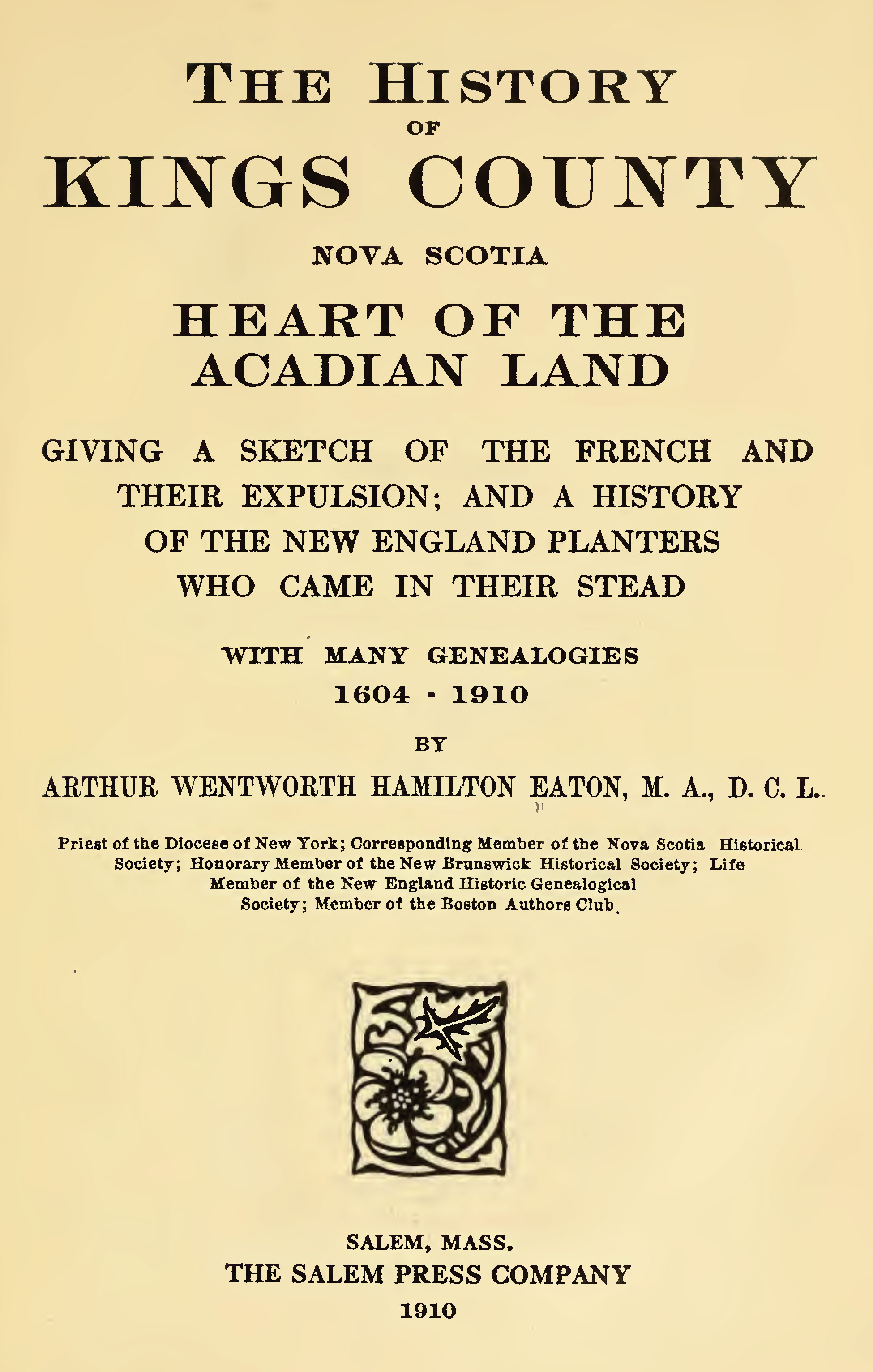
Eaton, Arthur Wentworth Hamilton. The history of Kings County, Nova Scotia, heart of the Acadian land. Salem, Mass., The Salem press company, 1910. Library of Congress.
There, on page 734, I found this “helpful” tidbit:

Note the key information: “The Loomer family of King’s County was founded in part by Ephraim and Desiah Loomer from Lebanon, Conn. In New England the name was almost universally ‘Loomis,’ but in Nova Scotia it has always been Loomer.
Seriously, y’all? Loomis and Loomer are supposedly the same family, only separated by a variable regional pronunciation? It’s possible, of course, and it would go a long way toward explaining the occasional mis-naming of a Loomer or Loomis in some of the early records. But I’m not convinced that this regional-spelling theory helps in identifying and keeping track of the various Loomis and Loomer families and individuals that settled old Washington/Ozaukee and Walworth counties, Wisconsin Territory, in the 1830s and ’40s. I think I’m going to file this theory under “Hmm…I don’t know about that.”
You say “po-tay-to,” I say “po-tah-to”…
Whether reading historical sources, or learning new facts, accurate pronunciation of names and other words can be a challenge sometimes. How so? Just click the image (or this link), and let Fred and Ginger explain.3

That brings us to a question that’s been puzzling me for a while: how do you pronounce Isham Day’s first name? There seem to be two options. One begins with a short-I vowel and sounds like DISH-’em (without the D). The other begins with a long-I and sounds like EYE-shem. In both cases, the accent is on the first syllable. So which is it?
The local preference among my 21st-century Mequon area friends and acquaintances seems to be the short-I version: ‘ISH-‘um. This also appears to be the not-well-documented but allegedly “American” pronunciation. Supposedly, the long-I, EYE-shum variant is preferred in Great Britain. But there’s not much documentation for that assertion either.
On the other hand, the only Isham I ever heard of in my youth was the long-deceased founder of one of Chicago’s oldest and most prestigious law firms, Isham, Lincoln and Beale. The Lincoln in the name was junior partner Robert Todd Lincoln, son of the late president. Senior partner Edward S. Isham was a Vermonter that came to Chicago and began to practice law in 1859. I don’t know how Mr. Isham pronounced his name in the mid-1800s, but a century later, his name—still first on the corporate title—was universally pronounced by Chicagoans as EYE-shum, with the long-I.
Also favoring the long-I pronunciation is noted contemporary musician and film composer Mark Isham. And for what it’s worth, Wikipedia informs us that New York City’s Isham Park is named after one William Bradley Isham, and is definitely pronounced EYE-shem. William B. Isham used this land as a summer retreat and place of repose; his heirs donated the land to the city for a park in the early twentieth century.
Speaking of land, there is also an unincorporated place in Scott county, Tennessee, called Isham. Is there any connection to our Tennessee-born Isham Day? I have no idea.
What say you, readers? Do we pronounce our Mr. Day’s given name Isham with a long-I or short? Share your thoughts (and sources, if you have them!) in the Leave a Reply / Comment here… box (below) and I’ll publish them as they arrive.
__________________________
NOTES:
- Just a reminder: searchable PDF texts are incredibly useful, but imperfect. The accuracy of any PDF “Find” search depends on the completeness and accuracy of the original scan of the book or document and on the completeness and accuracy of the optical character recognition (OCR) used upon the scanned original source.
Some documents, especially older books, newspapers and many microfilmed images, just don’t present a really clear text that can be accurately read and processed by OCR. A lot of digitized books and documents online have been scanned and processed and the OCR is only able to recognize—accurately—a fraction of the words on the page. And accurate OCR of manuscript sources is definitely a work in progress, and liable to even more omissions and errors. So OCR is great, but flawed, and it’s always possible that I’ve missed, for example, a few Weston/Western mentions in my searches. Sometimes you just have to read the whole book… - The image of the register entry for the Weston-Milliner marriage is from Ancestry.com. Milwaukee, Wisconsin, U.S., Marriages, 1838-1911 [database on-line]. Lehi, UT, USA: Ancestry.com Operations, Inc., 2018.
Original data: Milwaukee Public Library. Milwaukee Vital Records. Call Number: 929.3. Milwaukee, Wisconsin. Vol. A, 1838-1849, page 8, marriage no. 40. As I often do, I have cropped and adjusted the image to make it a bit easier to read. - Fred Astaire and Ginger Rogers perform George & Ira Gershwin’s classic song “Let’s Call the Whole Thing Off,” from the 1937 film “Shall We Dance,” via YouTube.
 Clark House Historian