I’m behind in my writing. Sorry about that. My Clark House history research continues “behind the scenes,” but I’ve been busy with typical fall chores around the house and garden, and that’s kept me from writing, proofreading, and annotating fresh blog posts.
Anyway, Thanksgiving is almost here, so look for my annual holiday post (with historic recipes!) later this week. And in the meantime, let’s reflect on how thankful we should be that we don’t have to process a barn full of harvested corn by hand anymore…
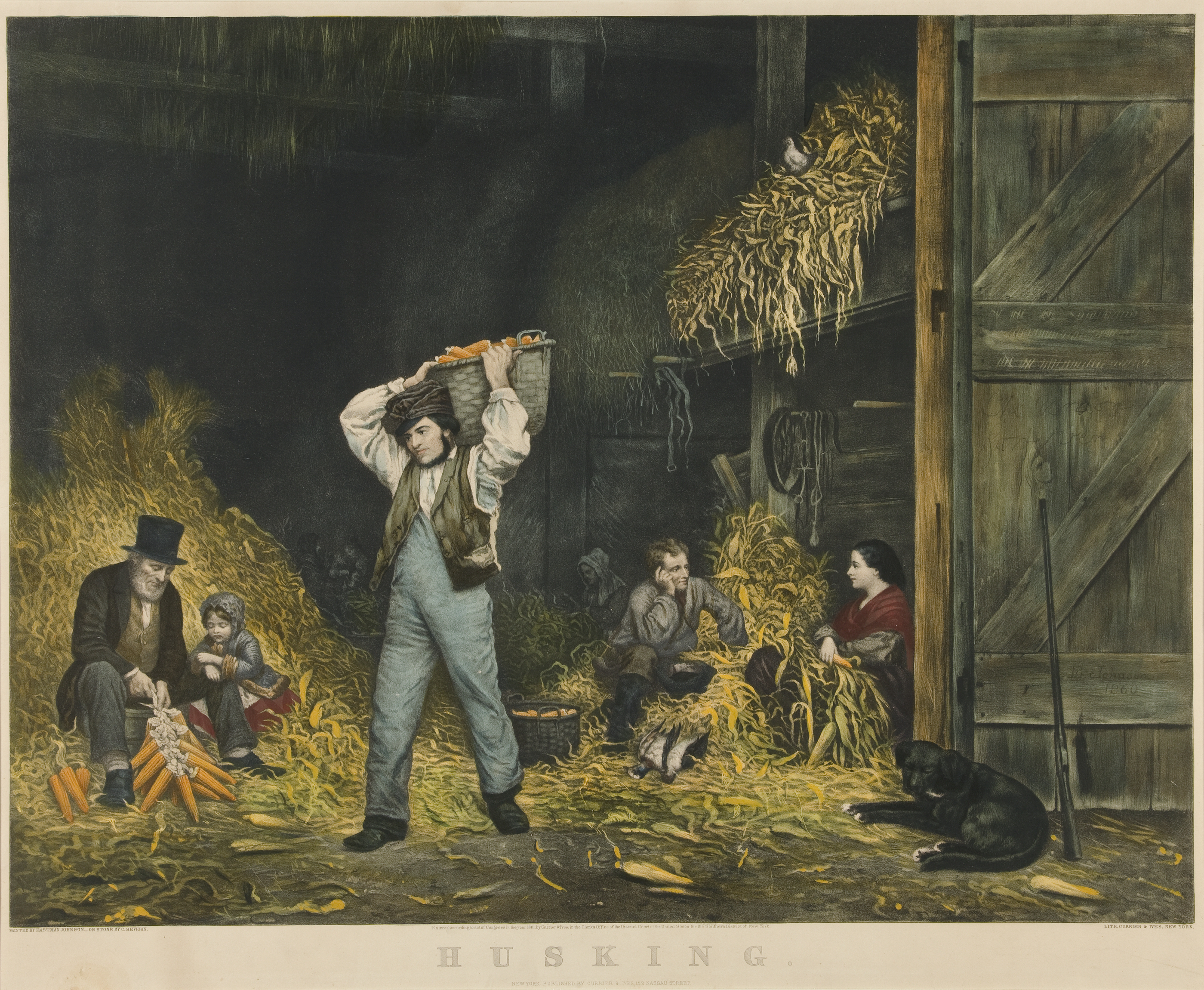
Johnson, Eastman, artist, Husking, lithograph, Currier and Ives, New York, 1861. Yale University Art Gallery, Mabel Brady Garvan Collection.
This Currier & Ives lithograph was published in 1861, around the time that the recently-widowed Mary (Turck) Clark moved her family from the big stone farmhouse in Mequon, to her father’s house in downtown Milwaukee.
I’m not sure (yet) whether the Clarks grew corn on their 160 acres in Mequon. I suspect they did. As early as 1850, the federal census returns show that old Washington/Ozaukee county farmers had a total of 42,963 acres of “improved” land, meaning land cleared for grazing, grass or tillage, or fallow. Those acres were devoted to a variety of crops. “Indian corn”—presumably what we would think of as dry “feed corn”—was among the top four crops grown and harvested in the year ending June 1, 1850:
- 123,806 bushels of wheat
- 102,859 bushels of oats
- 42,189 bushels of rye
- 34, 524 bushels of Indian corn
For more about Washington/Ozaukee county farm production circa 1850, see our posts Harvest Time: 1850, part 1 and Harvest Time: 1850, part 2. And for a closer look at the handsome (but, alas, now gone) Jonathan Clark farm barn, don’t miss our original Harvest Time post.
What’s going on here?
Calling all farmers! I need your help figuring out what, exactly, is going on in today’s lithograph. As usual with “slice of life” Currier & Ives prints, there’s quite a bit to discover, if we look closely. I can figure out the basic story of our image, but I’m curious to know more about the historic “why we do this on the farm” details of the picture.
Our print is titled “Husking” and clearly, that’s the main activity in our image. There are several big piles of un-husked ears of corn in the barn, and (almost) everyone in the barn (are they all related, perhaps?) is busy removing the husks from the ears.
The leading man
Our attention is drawn to the standing man, in the center, in the brightest light, walking away from the barn with a full basket of husked ears of corn. Where’s he going? Will he use this to feed the livestock? Will he take it to the mill and have it ground into cornmeal? (Is the corn even dry enough to be milled?)

Braiding ears
In the lower left corner of the picture we see an older gentleman, bearded and with a top hat, sitting on an upturned bushel basket (or small barrel?) making a braid from the still-attached husks of a dozen or so ears of corn. A young girl (perhaps a granddaughter?) is watching him intently (or falling asleep?), kept warm by her cap and fur-trimmed overcoat.

Is Grandpa just making some seasonal decorations for the farm house? Or is there a purpose behind braiding ears of corn together? Do they dry better that way? Or will hanging the ears keep them away from small critters during the long winter? It seems like a lot of work to make more than a few of these braids. How common was this activity?
The hunter and his lady. And his dog.
Turning to the lower right part of the picture, we find a handsome gent (perhaps in his twenties?) giving his full attention to an equally attractive woman of a similar age. She is holding a husked ear of corn; clearly she’s been doing a lot of the work here.
It looks like our young man has returned from a successful hunt. There are two dead fowls at the man’s feet; they may be a pair of mallard ducks. Meanwhile, his trusty hunting dog rests by the barn entrance, next to the man’s shotgun.
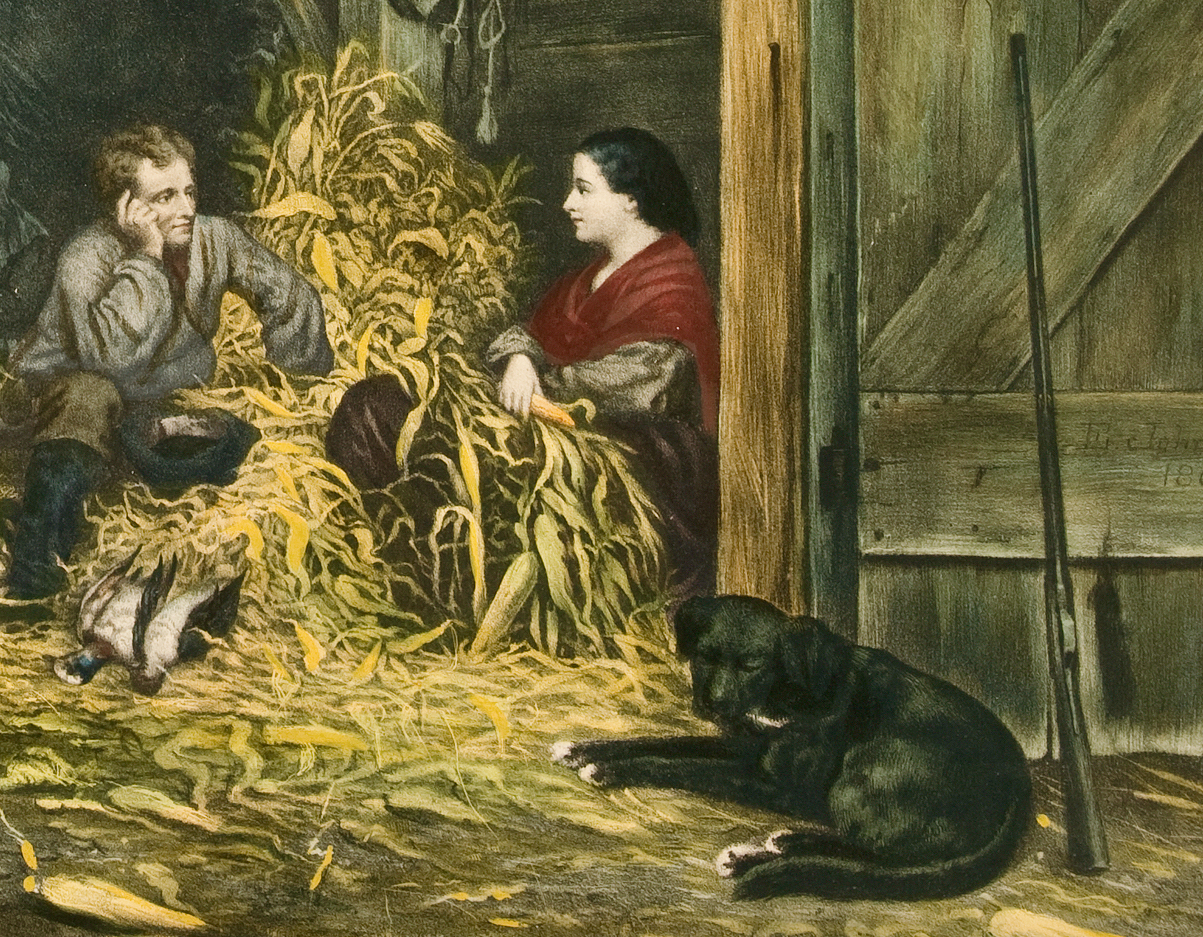
Are they husband and wife? The owners of the farm? Or a local lad wooing his neighbor lass? He certainly seems entranced by her. Is she equally smitten? Or is she wishing he’d join in and get busy with the husking? We can only guess.
What about Granny?
Just in case you missed it, take a look over the young man’s shoulder.

Who’s that at the back of the barn? Is it Grandma? Or maybe just a middle-aged woman wearing what appears to be an old-fashioned head covering (looks almost 1620s Pilgrim-style). What’s up with that?
And why is this lady stuck in the shadows at the back of the barn? Is it warmer or less-drafty back there? And what is she doing? Is she also husking ears of corn? Or is she…reading?
More mysteries in the background…
Speaking of mysterious figures. Take a look in the background, in the shadows to the left of our main figure. Are there more individuals back there?
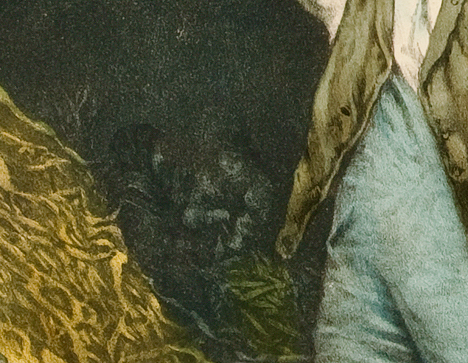
How many figures are there, back there? I think I see three. From left to right:
• A woman in profile, facing right, with a dark, patterned, shawl over her head
• An infant or small child, held in the arms of:
• A woman in profile, facing left, perhaps with a dark head covering and lighter hair.
So perhaps we see a new mother, with child, attended by another woman. All three of whom have taken shelter away from the chill autumn winds at the open front of the barn. Nothing exceptional, perhaps. But as I looked at this detail, I wondered if the artist has drawn this trio of shadowy figures as an homage to his artistic predecessors. Don’t they look at least a little bit like a Renaissance Madonna and Child (and friend)? Hmm…
What do you think?
I hope you enjoyed our closer look at this 1861 depiction of after-harvest farm chores and family life. If you have any insights into the farm activities depicted in the picture, or any other comments or questions, I’d love to hear from you. Please join the conversation and leave a reply below. And thank you for reading Clark House Historian.
 Clark House Historian
We should ask farmer Fred to look at the painting.
Nina
LikeLike
A fine idea!
LikeLike