Our previous post, Searching for JMC’s roots: Stanstead’s original Associates petition, 1792, went into some detail about the creation of the original petition to the Crown for the township that would become Stanstead, Lower Canada. In order to avoid repetition—and keep today’s post to a manageable length—I’m going to recommend that you read that post before reading this one. Because today we have another, competing petition, by a (mostly?) different set of Leaders and Associates, also signed in Rutland, Vermont, not quite two weeks after the previous petition.
I’m not going to examine all the aspects of this second petition today, but there are some features that we should note as we search for Jonathan M. Clark’s kin along the New England and Lower Canada border regions in the 1790s and early 1800s.
John Prentiss…and Associates
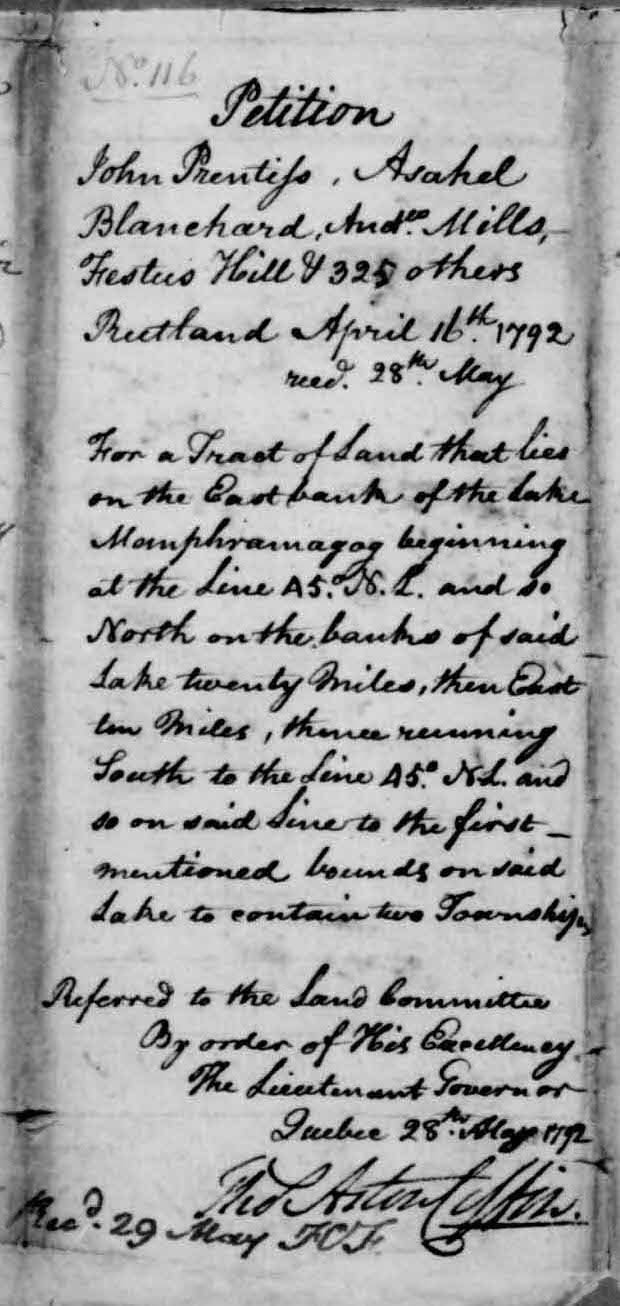
Library and Archives Canada, Petition of John Prentiss, detail showing government notations. See below for full citation.
The organizing meeting for this second group of would-be Stanstead (and Hatley) associates appears to have been held in Rutland, Vermont, on April 16th, 1792. As you’ll see (below), the ink and handwriting of the first signer, John Prentiss, appear identical with that of the petition statement itself (and many of the other signatures at the head of the petition!).
According to the Land Committee clerk’s handwritten notes (above), the petition was presented by and endorsed with the signatures of [presumed Leader] John Prentiss, [presumed Associates] Asahel Blanchard, Andw. [Andrew] Mills, Festus Hill and 325 others in Rutland, April 16th, 1792. It was received by the Lieutenant Governor’s office on May 28th and referred to the Land Committee the next day.
The petition, front side
Below is the front side to the original, complete, Associates petition for the two proposed townships, as found among the Land Petitions of Lower Canada, 1764-1841, RG 1 L3L, Vol. 160, archival page number 78473. As with the previous (Josiah Sawyer) petition, it appears that the microfilm camera operator needed two exposures to capture the full contents of the front side of this oversized page. I have used software to stitch the overlapping images back together, so that you can view the page as it looked in 1792:
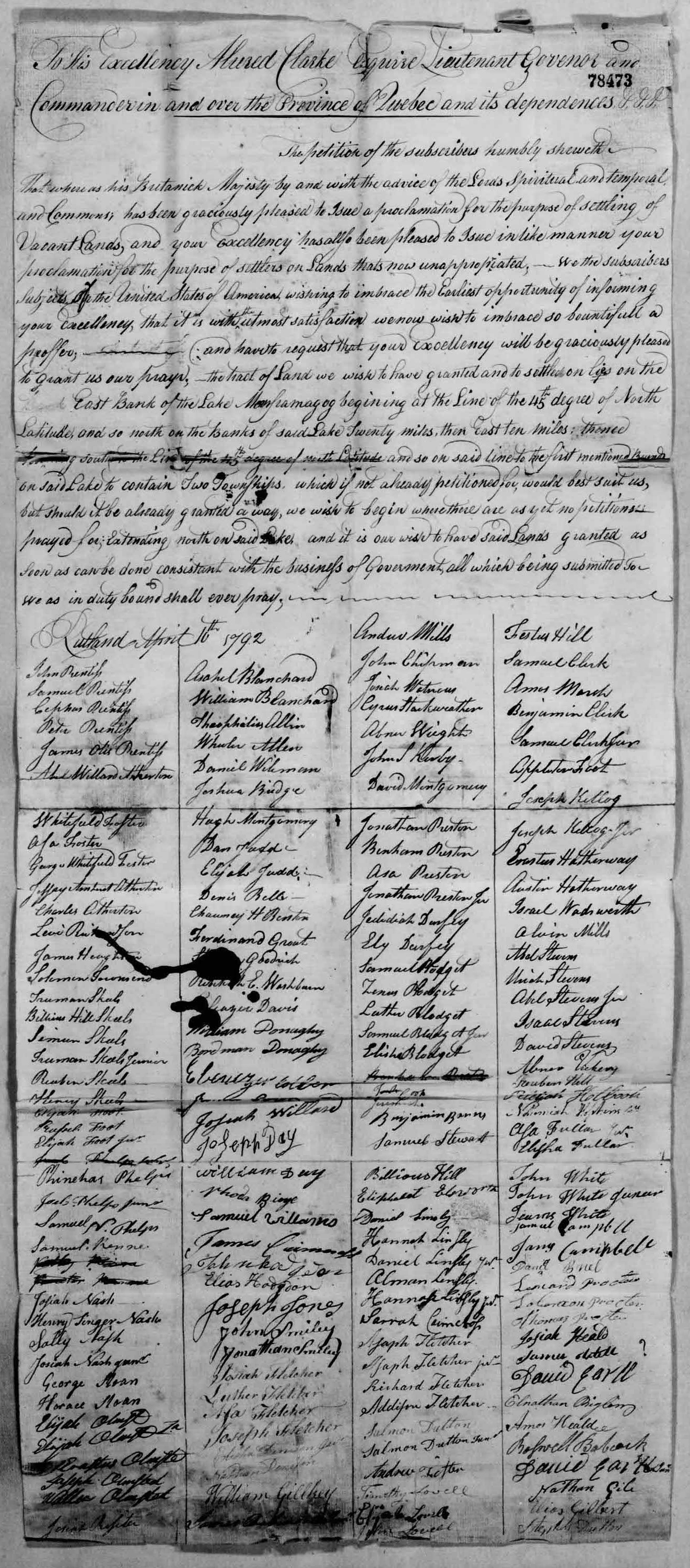
“Land Petitions of Lower Canada, 1794-1841,” Petition of Prentiss, John and Associates, 1792, [Stanstead and Hatley Townships], page 78473. Separate images of the upper and lower parts of page 78473 have been rejoined with photo editing software by Reed Perkins, 2023.
As always, if you click on an image you’ll open a new window with a much higher-resolution, zoomable version of the document.
A typical Eastern Townships petition “prayer”
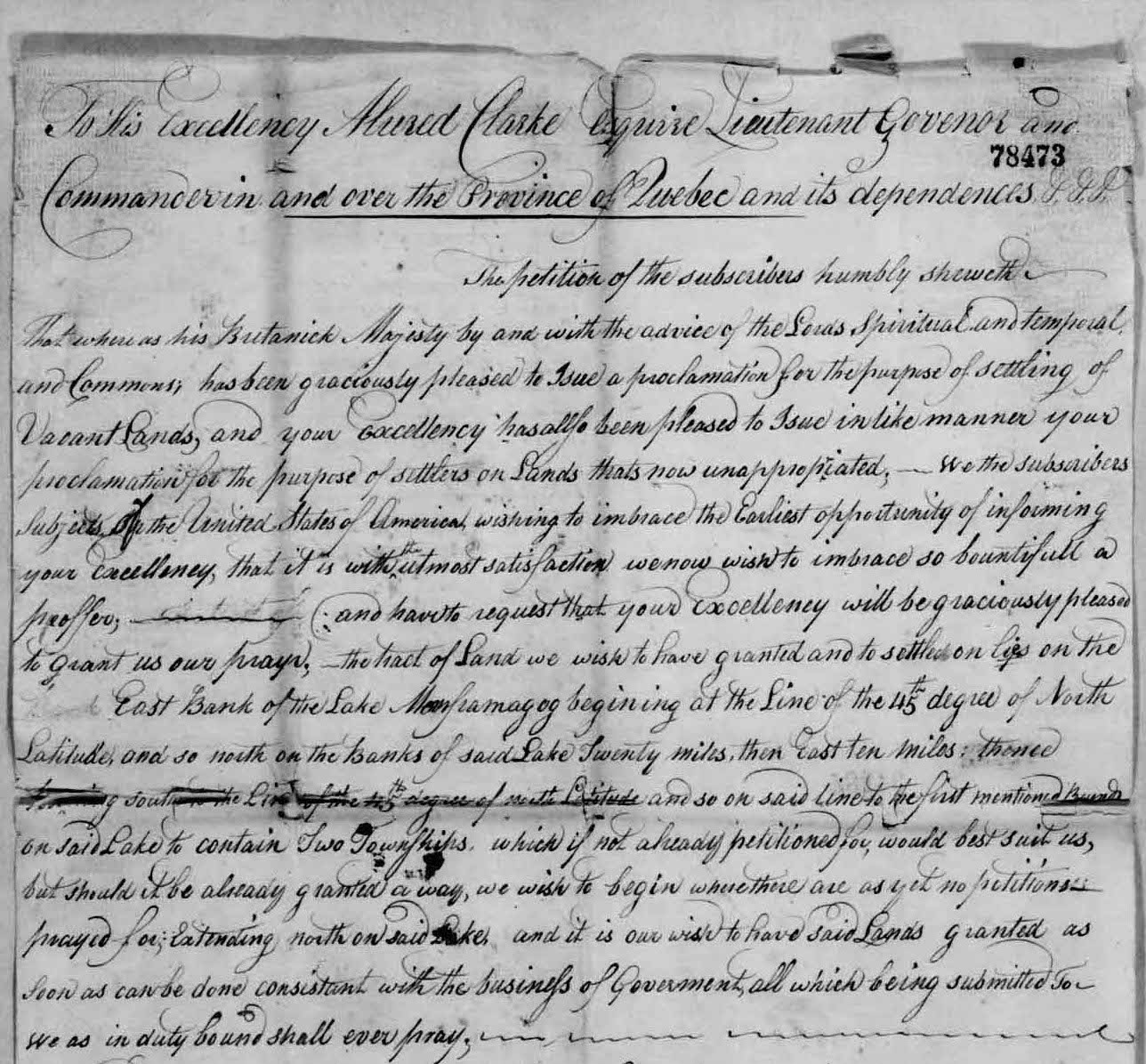
“Land Petitions of Lower Canada, 1794-1841,” Petition of Prentiss, John and Associates, 1792, [Stanstead and Hatley Townships], page 78473 (detail).
To His Excellency…
Our April 16th, 1792, petition begins with the standard, formulaic “prayer” to the Crown that a new township be surveyed and granted to the petitioners. These opening phrases are quite similar in all the various Lower Canada land petitions that I have seen. As this particular text is almost identical to—and much more legible than—the opening paragraph in the original Stanstead Associates petition (April 3rd, 1792), I’ll transcribe this one here, for reference and comparison:
To His Excellency Alured Clarke Esquire Lieutenant Governor and Commander in and over the Province of Quebec, and its dependences, &c., &c., &c.[1]
The petition of the subscribers humbly sheweth ~~~
That where His Britannick Majesty by and with the advice of the Lords Spiritual and temporal and Commons, has been graciously pleased to Isue a proclamation for the purpose of settling of Vacant Lands, and Your Excellency has allso been pleased to Isue in like manner your proclamation for the purpose of settlers on Lands thats now unappropriated. ~~ We the subscribers Subjects of the United States of America wishing to imbrace the Earliest opportunity of informing your Excellency, that it is with the utmost satisfaction we now wish to imbrace so bountifull a proffer; ~~~~ and have to request that your Excellency will be graciously pleased to grant us our prayer,
The petition text continues with a description of the geographic location of the desired land; the description on this document makes it clear that the petitioners desire the land on the eastern shore of Lake Memphremagog that would shortly become the two adjoining townships of Stanstead and Hatley:
~~ the tract of Land we wish to have granted and to settle on lies on the East Bank of the Lake Memframagog beginning at the Line of the 45th degree of North Latitude, and so north on the Banks of said Lake Twenty miles, then East ten miles; thence [illegible]-ing south to the Line of the 45th degree of north Latitude and so on said line to the first mentioned Bound on said Lake to contain Two Townships which if not already petitioned for, would best suit us, but should it be already granted a way, we wish to begin where there are as yet no petitions prayed for, Extending north on said Lake, and it is our wish to have said Lands granted as soon as can be done consistant with the business of Government, all which being submitted For we as in duty bound shall ever pray, ~~~~~
Signatures: 3 Clark men
The petition paragraph ends with the expected formal niceties and is followed, in the same hand and ink, by the place and date—Rutland April 16th 1792—and the first signature: John Prentiss. As far as I can tell, the only Clark names on this petition are located on this front side, near the top of the fourth column of signatures.
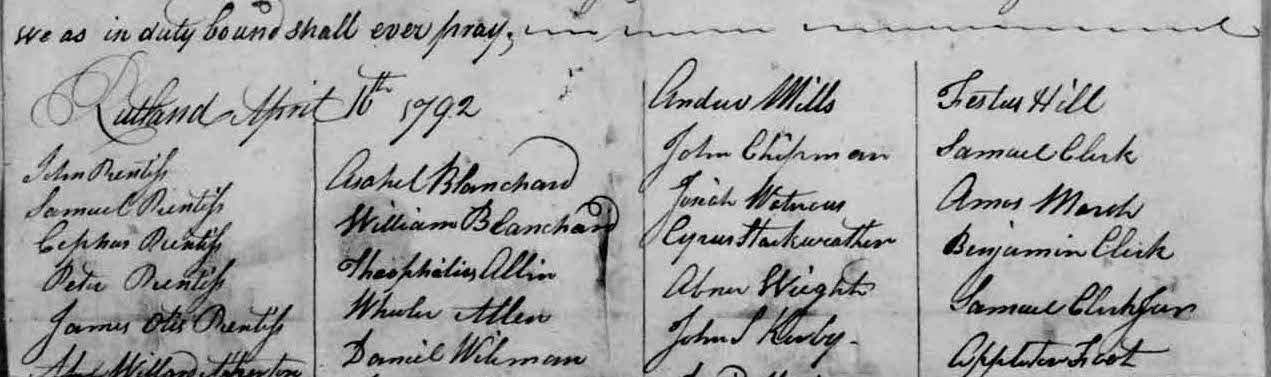
“Land Petitions of Lower Canada, 1794-1841,” Petition of Prentiss, John and Associates, 1792, [Stanstead and Hatley Townships], page 78473 (detail).
Transcribed, the signatures at the top of the fourth column read:
Festus Hill
Samuel Clark [perhaps the same Samuel Clark that signed the April 3rd petition?]
Amos Marsh
Benjamin Clark
Samuel Clark Jur [or Jnr, i.e., Junior]
The petition, back side (in two parts?)
The four columns of signatures continue on what appears to be the back of page 78473. Looking at the online images, it appears that the two parts of the oversized petition page 78473 were separated and then numbered and photographed separately, as pages 78474 and 78475. Here is the top portion of the big second page of signatures, numbered as page 78474:
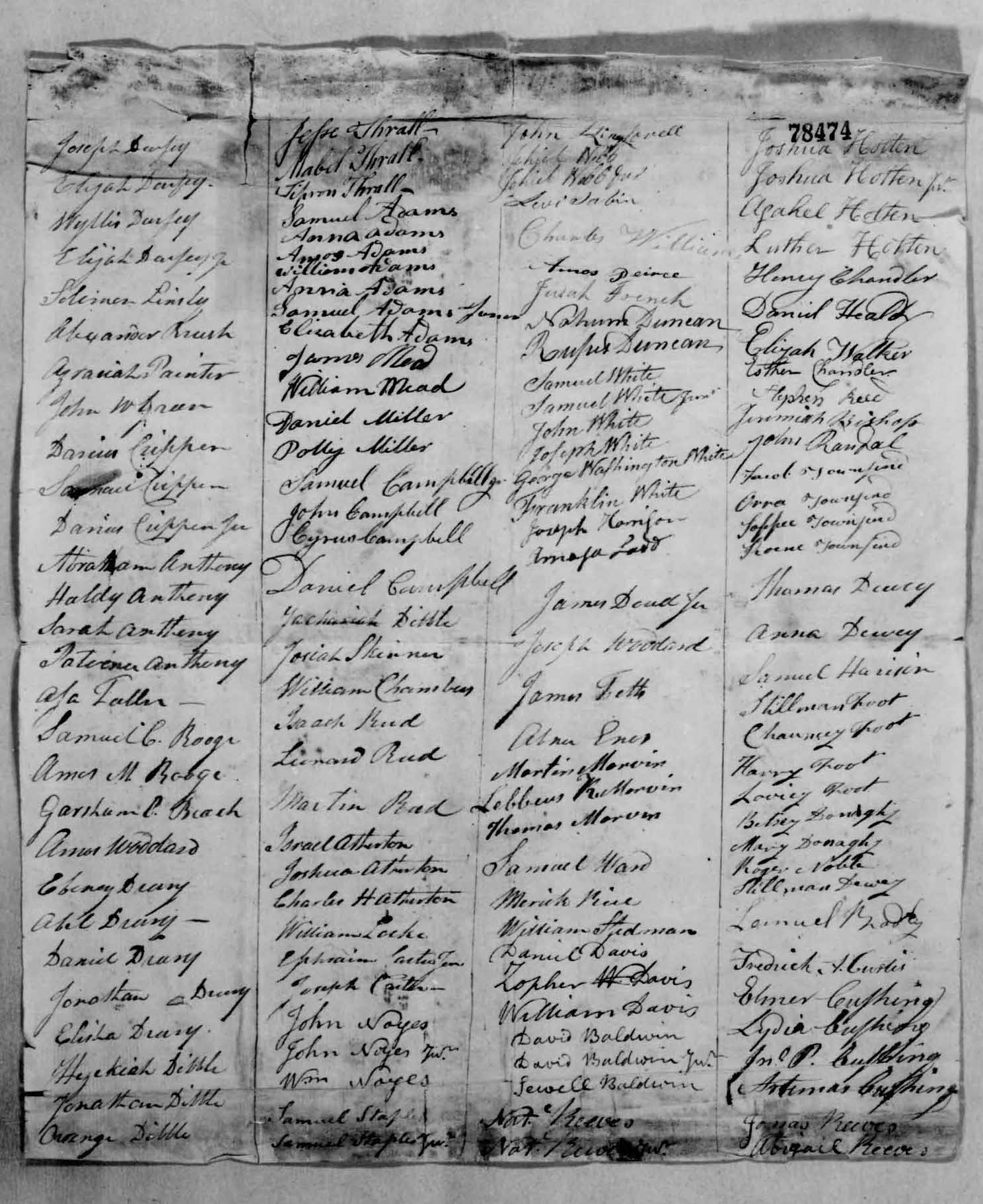
“Land Petitions of Lower Canada, 1794-1841,” Petition of Prentiss, John and Associates, 1792, [Stanstead and Hatley Townships], page 78474.
And here is what I believe to be the lower portion of the back of page 78473, numbered as page 78475:
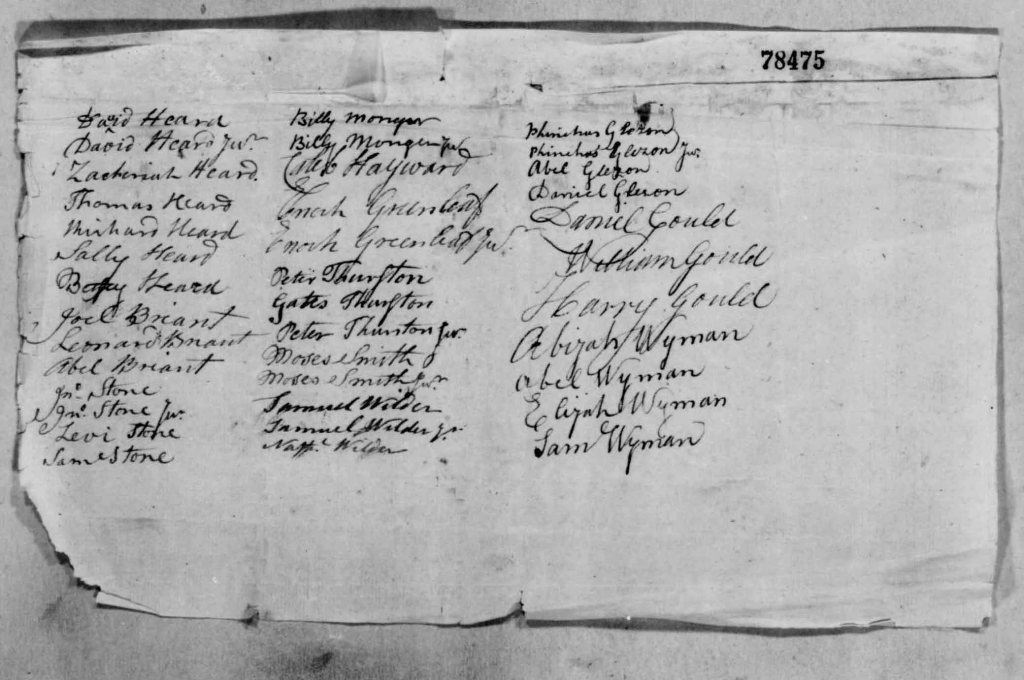
“Land Petitions of Lower Canada, 1794-1841,” Petition of Prentiss, John and Associates, 1792, [Stanstead and Hatley Townships], page 78475.
Odds & Ends
Except for the three men with the CLARK surname, noted above, very few of the surnames on this list figure prominently (or at all) in the early published histories of Stanstead. BLANCHARD, NOYES and WHITE occur infrequently and, of course, we don’t know if the Clark, Blanchard, Noyes or White associates that signed this petition were related to any of the settlers of the same name that actually emigrated to and pioneered in Stanstead.
Also, as a side note, the LAC staff have indexed Asahel Blanchard as Asabel. I’m not sure why they did this; his name seems to be clearly written as Asahel. (Asahel is also an actual, biblical name, unlike Asabel.) But if you want to find this man in the online Land Petitions of Lower Canada, 1764-1841, be sure to search for Blanchard, Asabel.
Rejected.
What happened to this second petition praying for a grant of land on the eastern shore of Lake Memphremagog?
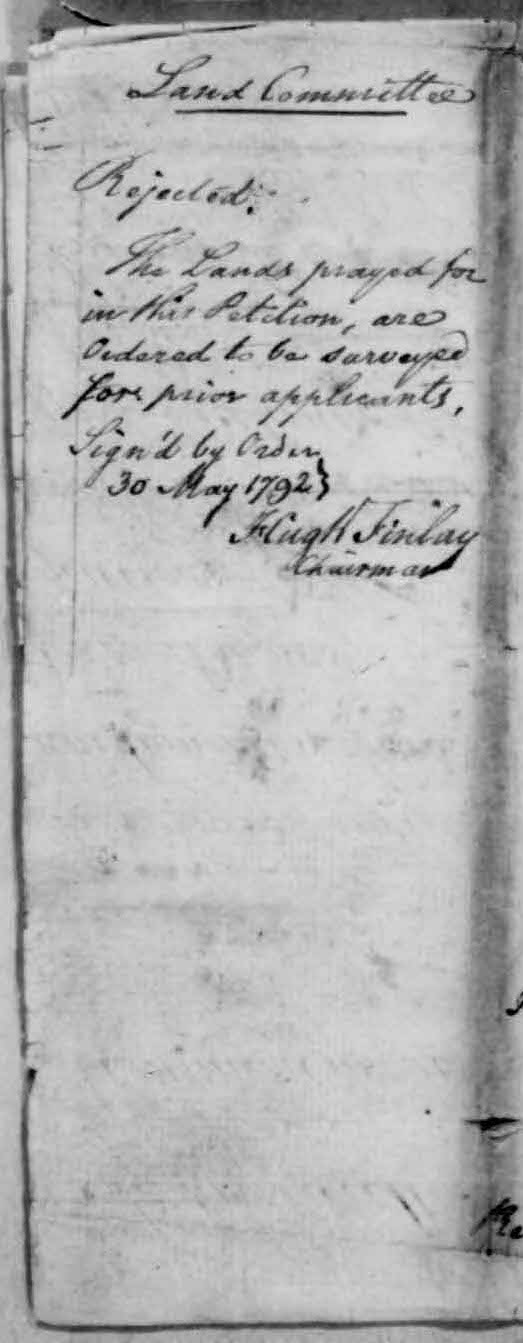
“Land Petitions of Lower Canada, 1794-1841,” Petition of Prentiss, John and Associates, 1792, [Stanstead and Hatley Townships], page 78476 (detail)
Land Committee
Rejected.
The Lands prayed for in the Petition, are Ordered to be surveyed for the prior applicants.
Sign’d by Order
30 May 1792
Hugh Finlay
Chairman
Sometime the wheels of bureaucracy grind slowly, but not in this case. The petition signed in Rutland, Vermont, on April 16, 1792, reached the office of the Lieutenant Governor in Québec City on May 28, was referred to the Land Committee on May 29th, and rejected on the 30th.
Prentiss’s petition failed because Josiah Sawyer’s petition of April 3rd, 1792—almost certainly on behalf of Eleazer Fitch and Issac Ogden—had already reached the Land Committee. By May 30th, that first petition had already been approved and the initial survey of the land that would become Stanstead Township, Lower Canada had been ordered. John Prentiss and his associates were too late.2
Just a reminder…
As we’ve learned, a large percentage of Lower Canada land petition signers had no intention of actually relocating to a new, “prayed for” township. They intended to collect a payment from the Leader(s) or Agent, transfer their rights to a 200 acre (or more) lot in the new township back to the Leader(s), and return to their established farms in New York, Vermont, New Hampshire or neighboring areas, somewhat richer after a short round trip to Rutland and back.
Are Jonathan M. Clark’s parents or other kin among the signers of this second petition? Maybe, but as with the first petition, this document does not prove that. If JMC’s kin were among the signers, did they actually relocate to Stanstead in the following years? Perhaps, but this petition does not include that information, either.
Before we can answer those questions, we need to know which Clark family or families actually migrated to Stanstead. Our next step will be to look at some early annotated Stanstead maps, and a few lists of would-be Lower Canada immigrants that went to the expense and trouble of traveling to the appropriate Lower Canada official and “take the oaths” of loyalty to King and (new) country, a mandatory step in the immigration and land granting processes. I’ve found some excellent related maps and documents in the files, and I’ll share some of them with you next week. See you then.
Bibliographic Citations3
Source List Entry:
Canada. “Land Petitions of Lower Canada, 1794-1841.” Database with images, Library and Archives Canada. Genealogy and Family History. https://www.bac-lac.gc.ca/eng/discover/land/land-petitions-lower-canada-1764-1841/Pages/land-petitions-lower-canada.aspx : 2023.
First (Full) Reference Note:
1. “Land Petitions of Lower Canada, 1794-1841,” database with images, Library and Archives Canada, Genealogy and Family History. (https://www.bac-lac.gc.ca/eng/discover/land/land-petitions-lower-canada-1764-1841/Pages/land-petitions-lower-canada.aspx : accessed 24 October 2023). Petition of Prentiss, John and Associates 1792, RG 1 L3L, Vol. 160, pages 78473-78476, item number 71200. Upper and lower parts of page 78473 (images 1-2) have been rejoined and restored to their original state with digital editing software, 2023.
Subsequent Note:
2. “Land Petitions of Lower Canada, 1794-1841,” Petition of Prentiss, John and Associates, 1792, [Stanstead and Hatley Townships].
_________________________
NOTES:
- Sir Alured Clarke was—almost certainly—not related to our Jonathan M. Clark. His biography at the online Dictionary of Canadian Biography is very interesting, and includes this useful summary of some of the issues that interest us:
Within Lower Canada, on the basis of general guidelines from London and perhaps the specific advice of local officials, Clarke issued a proclamation on 7 Feb. 1792 that laid down the terms for granting crown lands in the province. To attract settlers and reward loyalists, a maximum of 200 acres, to which the head of the administration might add up to 1,000 acres, was offered to each petitioner who would give assurances of cultivating the land, take an oath of loyalty, and pay the stipulated fees to officials. With such open-handed generosity, the land committee of the newly created Executive Council was soon deluged with claims, which took years to process, Clarke alone issuing warrants for the survey of 150 townships comprising some 7,000,000 acres. Large tracts of land would be monopolized by speculators and government officials through the system of township leaders and associates [see Samuel Gale] to the detriment of bona fide settlers and the province’s economic development. Another source of inconvenience and controversy was the reservation of one-seventh of each township for the support of a Protestant clergy and an additional one-seventh as crown lands from which the local executive might eventually derive a revenue free from the assembly’s control. More unwisely still for the future, Clarke’s original plan of setting up both crown and clergy reserves as a single block in each township was rejected in London in favour of a scheme that would scatter them through the townships in 200-acre lots according to a chequered pattern and thus intersperse them even more inconveniently among grants to individuals. - Speaking of Col. Fitch, I have noticed that his first name is spelled—or at least indexed—more than one way. Our Guest post! – Fitch & Ogden, the (contentious) founders of Stanstead prefers ELEAZER, the LAC index prefers (for the most part) ELEAZAR, and one LAC document is oddly indexed as ELEAGAR. I haven’t had time to check all of Col. Fitch’s mentions in these blog posts and make corrections, but it serves as a reminder to always use variant spellings when searching for individuals.
- As mentioned in our last post, bibliographic citations are not an exact science, and I am not a passionate—or expert—bibliographic citation maker. The goals, of course, are (1) to record the source of the particular record and (2) allow other researchers to access the same record and make their own conclusions from that evidence.
The online Land Petitions of Lower Canada, 1764-1841 collection includes digitized images of previously microfilmed images of a wide variety of original historical paper documents. Citing specific items in such databases is complicated, and I’ve done my best here, guided by the excellent Evidence Explained, third edition, by Elizabeth Shown Mills. But if you are a keen bibliographer and have some constructive advice for these citations, please comment publicly (below) or contact me privately. I’m open to suggestions.
 Clark House Historian
Pingback: Searching for JMC’s roots: land grants – the official process, 1792 | Clark House Historian