We believe that Jonathan M. Clark was born or raised, or both, in or near the Township of Stanstead, Lower Canada, in 1811 or 1812. Who his parents were, where they came from, and what happened to them, are important questions that we want to answer. I’ve been searching the Library and Archives of Canada (LAC) database of Land Petitions of Lower Canada, 1764-1841, and I have located what I believe are the earliest founding documents for Stanstead. Before we begin our examination of these documents, looking for signs of early settlers named Clark or Clarke (and their relatives and neighbors), I thought I should share a few notes about what we are looking for, and how we can find it again, in case anyone would like to check or build on the work we’re doing here.
Finding the documents
How do you find records of your early Eastern Townships pioneer? Begin by clicking over to the Library and Archives Canada (LAC) database called Land Petitions of Lower Canada, 1764-1841. The (old but still operating1) home page for that database looks like this:

Read the information on this page. It’s not long, but it’s very helpful. One of the essential points to note is the description of what is—and is not—indexed in this database:
This database provides access to more than 95,000 references to individuals in Executive Council Office of the Province of Lower Canada (RG 1 L3L). Microfilm reels C-2504 to C-2571 that contain volumes 29 to 210 have been digitized.
This database is estimated to be at least 85% accurate and complete. Names of petitioners and claimants were indexed, but those of surveyors and authors of many supporting documents were not.
A card index by name was prepared for volumes 1 to 10 and 29 to 209 (available on microfilm reels H-1155 to H-1172). Staff members created a database from this name index.
Records in volumes 10 to 28 (sub-series, Minute books and loose minutes) were not indexed. Certain records in volumes 10 to 28 relating to seigneurial tenure, exploration and surveying are of particular importance for legal or geographical research questions.
This information concludes with an epic bit of Canadian archivist’s understatement:
Some of the original documents are difficult to read and therefore some information in the database may be incorrect and/or incomplete
Ha! They’re not kidding. (We’ll get to this whole “difficult to read” business in a moment.)
How to search
Anyway, once you’re familiar with what’s in the database, click that big blue rectangular button labeled Search: Database. That will take you to this screen:
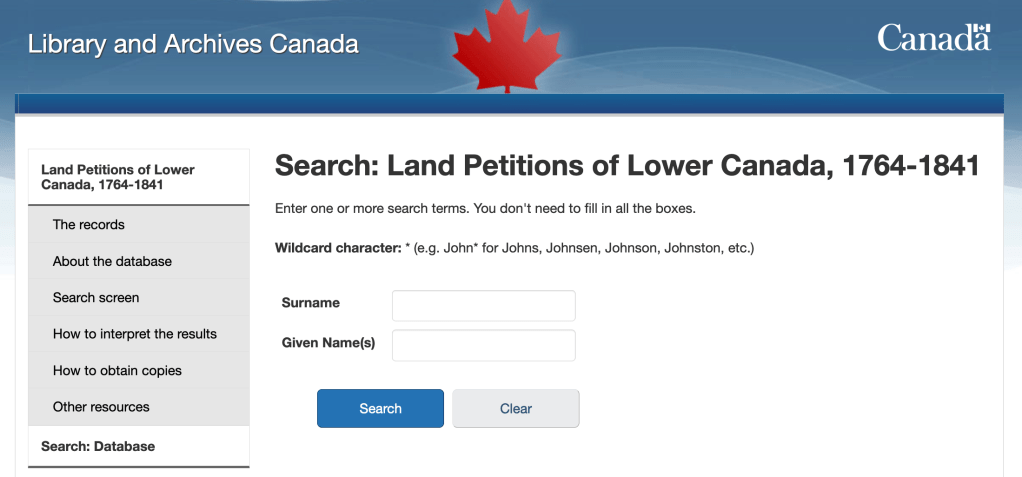
There are only two criteria for searching here: Surname and Given Name(s). You can use the asterisk (*) wildcard, for partial name searches, too. When searching given names, try just the first initial, as well as the full name. Misspellings—or archaic spellings—of proper names is not unusual, in both the original documents and sometimes during indexing. Be sure to try any and all variant spellings of first and last names.
Who to search for? I have two main strategies here. On the one hand, if you are trying to find a known settler’s name among these documents, try that name. You may find what you need, but you may have to read through many, many unrelated pages to find the (for example) “David Clark(e)” that settled in Melbourne Township, and is not to be confused with the other men named David Clark(e) that settled in other Lower Canada townships at other times.
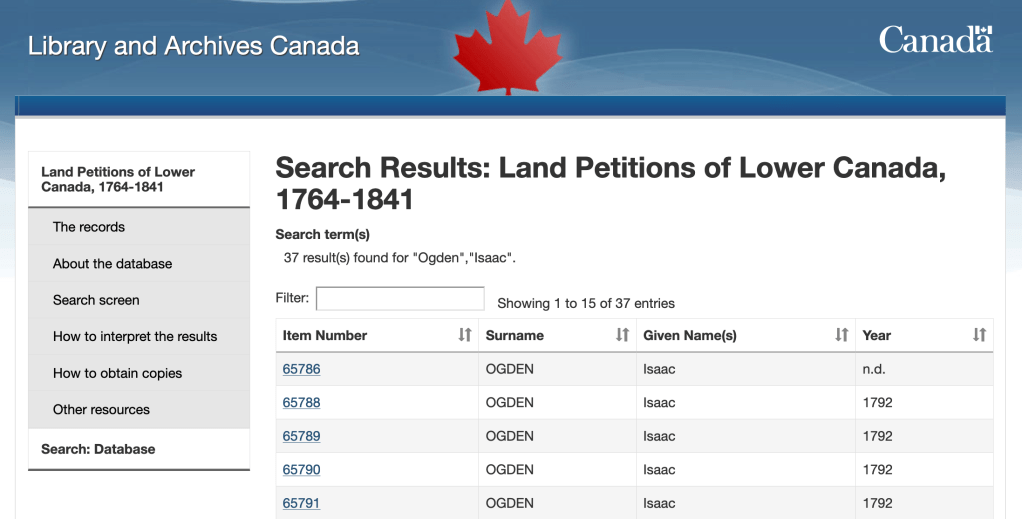
On the other hand, if you know the name of one of the “Leaders” or “Agents” that helped organize the township that you are interested in (and, especially, if that man has a somewhat distinctive name), search by the Leader or Agent’s name. For example, I knew that Stanstead was organized by Eleazar Fitch and Issac Ogden. I searched for each and got useful results, which I put in my spreadsheet. Here is the first page of results for my search for Issac Ogden:
Item Numbers vs. Page Numbers
This search resulted in 37 hits. The first 15 are on this page; not all shown in this screenshot. As you can see, the Search Results pages display and organize the results by Item Number, Surname, Given Name(s), and Year for each search result. The LAC Item Numbers are important, but hard to explain. They are unique identifiers that —for example—show that the name “Issac Ogden” was found and indexed within a specific collection of documents. It’s not the index or locator number for a particular document itself. It’s the locator number for Issac Ogden’s name on one or more specific documents that are (somewhere) within a file of many documents with many scanned pages, sometimes more than one hundred pages in one file. And somewhere in that multi-page file, on at least one of those pages, the name “Issac Ogden” appears and was indexed with an “Item Number” by the archivists.
The thing to note about these Item Numbers is that any one document (or, usually, any particular file containing multiple related documents) in the Land Petitions of Lower Canada collection, will often have many signatures or other names on each document, sometimes more than a hundred names in a file. And each of those names, in that particular file, will have its own Name + Item Number indentifer in the database.
At the same time, each side of each page of each document in a given file will be stamped with a unique page number, in sequential (but not necessarily chronological) order. This makes possible finding a specific document, or a specific page within a multi-paged collection of related documents. But individual documents can not be searched for by their individual page numbers. To get to a specific document (or collection of related documents stored within one archival file), you’ll need to know at least one Name + Item Number that is associated with that file, and then you’ll want to know which pages within that file are assigned to your document. Confused? Let’s continue with our example:
Piles of files
Take another look at our “Ogden, Issac” search results page, above. You’ll need to click on each item number to examine each digital file. But as the LAC’s introductory material noted, not all pages will have digital images. For example, the first link on our results list is Item Number 65786. Click on that and you’ll get this result:

Issac Ogden’s “Item Number 65786” is from Vol. 10 of the archival group RG 1 L3L, the records of the Executive Council Office of the Province of Lower Canada. As mentioned above, a “card index by name was prepared for volumes 1 to 10 and 29 to 209 (available on microfilm reels H-1155 to H-1172). Staff members created a database from this name index.” The image above is the online display of that text-only index. So we have the archival information, but not the scanned image(s) for this item. To view records like this you’ll need to view the microfilm.
Found it!
Our “Ogden, Issac” search returned 37 results. The first 33 of those were for exactly the name “Ogden, Isaac.” But the last three we indexed as:

And on that last entry, Item Number 65824, we hit the jackpot (although this may not be obvious at first glance). Let’s take a look at this page and see what it tells us about this file:
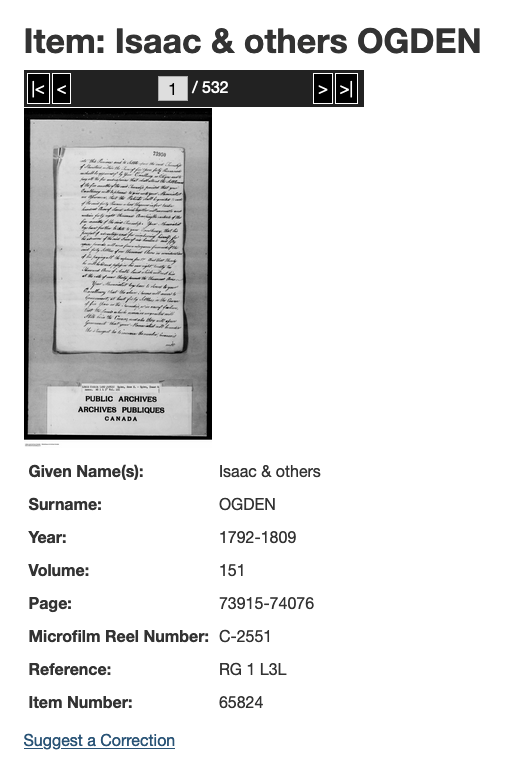
We already knew the Surname, Given Name(s), Year and Item Number from the previous Search Results screen. We know that all the documents in this database are from LAC archival Reference group RG 1 L3L, the records of the Executive Council Office of the Province of Lower Canada, in particular Volume 151 of those records.
There are two more, really important, things to learn from this screen. At the top, note that we are looking at the small, index image for the first digitized page out of 532 digitized pages in this file. Yikes! 532 pages? What’s up with that? And how does one navigate such a massive file?
It’s not quite as daunting as it seems. As mentioned above,
Some of the original documents are difficult to read and therefore some information in the database may be incorrect and/or incomplete
It appears that when these pages were originally microfilmed, the camera operator often took second and third passes through the original pages, perhaps with different camera settings, trying to obtain the most legible images possible. When that is the case, it looks like LAC has digitized all of the related and/or duplicate microfilm images of a given file, and placed them all online as, in this case, “one” file of 532 pages.
How many pages? In what order?
There’s one more bit of essential information on this Item page, the Page numbers. As mentioned earlier, the documents in a given file appear to have their pages numbered, in sequential (but not necessarily chronological) order. This file is comprised of pages numbered 73915-74076. A quick bit of subtraction, accounting for the first and last page in the series, shows that there are not 532 individual pages in this file, but rather only 162, repeated about 3 times or so.3
The page information also tells us on what page number the file should begin, in our case, page 73915. But if you click the thumbnail for image 1 of 532, you’ll see that—for some, unknown, reason—the display of this multi-page digitized file begins somewhere towards the middle of the file, on page number 73950, one of several pages of a longer document. Confusing, indeed.
To make sense of the file, you’ll want to find its numerical first page which, for this file, is page 73915. That page is located at image 47 of 532. Note that while using this database, if you click on the small display image you will open a larger, higher-resolution version of that image which will by much easier to read, download and save.2
Pages 73915-74076, and beyond…
The pages of this file, numbered 73915 to 74076 are, in fact, most of the essential original documents generated by and during the establishment of Stanstead Township in Lower Canada, including two “Diagrams” or maps of the initial official surveys of the township (more on those in a future post).Not included in these pages, however, are the original “Leaders & Associates” petitions for the Stanstead Township.
That petition is found in another file entirely, attributed to one Josiah Sawyer. Sawyer, whom other documents suggest lived in Missiquoi Bay, appears to have been the local agent for Fitch and Ogden. It looks like Sawyer was the “man on the scene” that actually organized the gathering of the would-be Associates in Rutland, Vermont, on April 3rd, 1792, at which time this initial petition for the prayed-for township (that would become Stanstead) was signed. The top two-thirds of the first page of the petition looks like this:

Click to open larger image in new window.
“Poor Copy,” indeed.4
There are, believe it or not, a lot of Clark names among the signatures on this petition including, presumably, many Vermonters. Were some of these kin to our Jonathan M. Clark? On the second page (not shown) we find the faint signature of an unidentified “Jonathan Clark.” Is he related to JMC? — father? uncle? grandfather? Like the handwriting on this document, that is not yet clear.
I’ll see you soon with the full details—and a more legible fair copy—of this petition, followed by many more historic documents filled, we hope, with clues for our Search for JMC’s Roots.
__________________________________
NOTES:
- In fact, you can access these documents from the LAC’s new but still under-construction web portal. And once you find a particular Lower Canada land document in the new portal, the new display window for these many-paged documents is much easier to page through. But in my experience—so far—in searching the specific database “Land Petitions of Lower Canada, 1764-1841,” the new search format is tricky, and returns a large number of “hits” for documents that are not relevant to my search. And I have spent years navigating the quirks of the old portal. So for now, I prefer to use the old portal to access and navigate this database. Your mileage may vary.
- This file’s first item is a somewhat cranky, two-page letter (pages 73915 & 72916), from Stanstead co-founder and leader Eleazar Fitch to, I think, Stanstead’s other co-founder and leader, Isaac Ogden (not certain, as one corner of the letter is missing). Written at St. Johns, Lower Canada, August 17th, 1792.
- Note; if you need to make a super-accurate survey of files like this, it’s worth your time to go through all of the images. It’s always possible that the camera operator, or the person that put the digital images online, made an error and either failed to place all the images online in the correct (if repeated) sequence. As always: “Trust, but verify.”
- To be fair, I think the microfilm camera operator did the best they could to try and get a legible image of a very tired and faded handwritten document from 1792.
 Clark House Historian
Pingback: Finding JMC’s roots: Word Search | Clark House Historian
Pingback: Monday: Map Day! Vermont, 1796 | Clark House Historian
Pingback: Searching for JMC’s roots: Stanstead’s original Associates’ petition, 1792 | Clark House Historian