UPDATED Nov. 9, 2023 to correct Mrs. Day’s first name. It’s Catherine (not Caroline) Matilda Day.
Continuing our search for Jonathan M. Clark’s supposed ancestry in Stanstead, Eastern Townships, Lower Canada—and before the deluge of original, mostly handwritten, documents from the Land Petitions of Lower Canada, 1764-1841 begins—we have another interesting and useful book to add to the first installment of our book list.
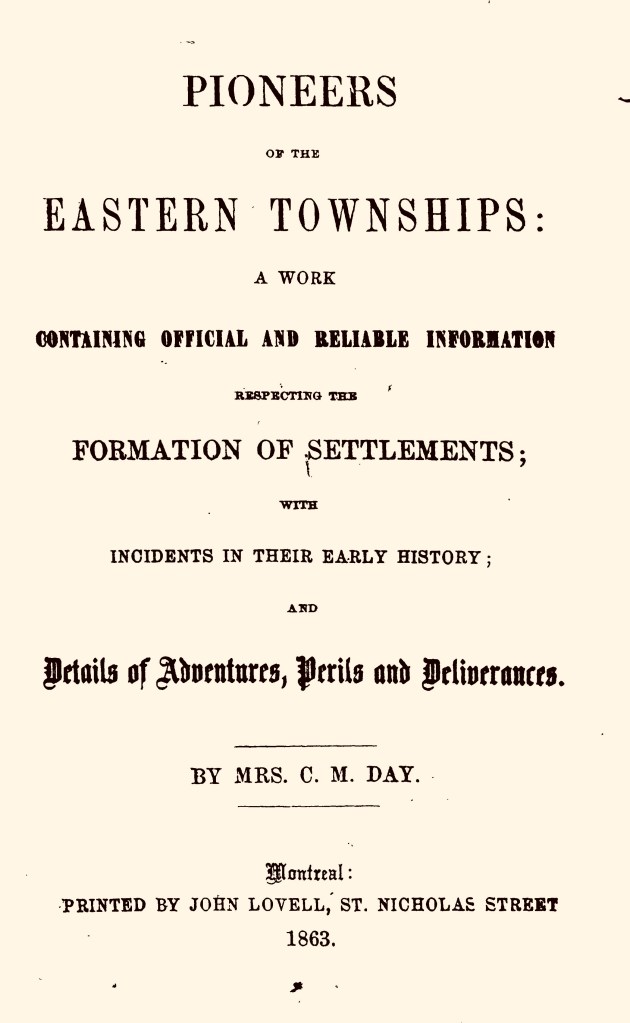
Day. 1863. Pioneers of the Eastern Townships1
Day, Mrs. C. M. [Catherine Matilda], Pioneers of the Eastern townships : a work containing official and reliable information respecting the formation of settlements, with incidents in their early history, and details of adventures, perils and deliverances, Montreal, 1863. Online via Canadiana, accessed September 24, 2023.
This early collection of Eastern Township history is not to be confused with the same author’s longer and more comprehensive History of the Eastern Townships Province of Quebec of 1869. Today’s 1863 book, only about 170 pages, is not intended to be a broad survey of early Eastern Township history like its 1869 successor, and it does not have any Stanstead- or Clark-specific information. But researchers seeking information on early Lower Canada history, land patent process, and settlement will find Pioneers of the Eastern townships to be very helpful and illuminating in two distinct ways.
Two aspects of Eastern Township settlement
Pioneers of the Eastern townships is really two—related—books in one. The first pages are centered around the migration of Issac Lawrence, “the younger,” from Connecticut to Vermont and then into the Eastern Townships, and a record of the bureaucratic steps taken to obtain a land grant from the Crown. The second and longer part of the book is an informative and interesting social history of daily life—and some unique experiences—in the early settlement of the Eastern Townships. I’ll have more to say about that, below.
The book’s preface and first chapter are a detailed explanation of the Lower Canada land acquisition process and a record of most of the required bureaucratic petitions and other correspondence that were submitted, and replies made, as Lawrence worked to obtain his grant of land in Stukely Township (located two townships north, and one west, of Stanstead). I think we can save much time and confusion if we look at some of that information today. If you familiarize yourself with the nature and language of the documents, as transcribed in Pioneers, and simply substitute “Stanstead” (or any other township name) for “Stukely,” you’ll develop a good sense of what the various documents in any Eastern Township land patent file say; this should make working with the manuscript documents easier for the modern reader.
Your handy guide to the land grant process
I’ve made my way through several hundred Lower Canada land grant documents already, and by trial and error I’ve figured out the typical sequence of events and accompanying government documents that were required to get a Lower Canada land patent, circa 1788-1830 or so. I could have saved myself a lot of time, and shortened the learning curve quite a bit, if I had read the opening sections of Pioneers of the Eastern townships first. For reference, here are some key passages from the preface and first chapter of Mrs. Day’s book, which use documents from the land petition files for the adjacent townships of Shefford and Stukely as exemplars (“merely because the writer had more ready access to them”).
First: the land needs to be surveyed
The first given of the documents [in the book’s initial example], is the ” Warrant of Survey for the township of Stukely,” then the Return to that Warrant by the Surveyor-General, to which is added the ” Certificate of the Surveyor-General of Woods.” Then follows a copy of the Charter of the township of Shefford,” and finally a document in reference to the arrangement between-Agent and Associate, which will fully explain itself.
Note: in my experience, the Land Petition files don’t often include the document detailing the (usually private) arrangement between the Agent (or Leader) and the Associates. These initial surveyor’s warrant files often do include a “Diagram,” or first official map of the newly-created township.
We now proceed to notice the preliminary steps to be taken in order to obtain the desired Grant.
First. It was necessary for the individual, who was to act as Agent for the Associates, to obtain a recommend as to his being a responsible person, when a petition was to be prepared in which the various, peculiar and urgent claims of the petitioner were brought forward, which reasons almost invariably related to grievances, embarrassments and losses suffered in consequence of the then late American rebellion; and redress was asked in the manner set forth in the petition. Then follows a description of the size and location of the Tract asked for by the petitioner and his Associates; all ending in the usual form: ” Which petition was referred by His Excellency to the Land Committee for consideration.”
The number of Associates required for a township ten miles square, was forty, all of whom, with the Agent, were to take the oath of allegiance before they were accepted, and their .names entered in the Letters Patent ; each Associate being obliged to make ” actual settlement.”
The Agent was to bear all the expenses incurred in the survey of the township: to open a road through, and erect, or cause to be erected, mills within the township; which conditions were to be fulfilled within a given term of time before the granting of the Letters Patent.
Mrs. Day’s representative townships of Shefford and Stukely were located to the north and west of Lake Memphremagog, territory that was often allotted to Loyalist settlers from the U.S. that had “grievances, embarrassments and losses suffered in consequence of the then late American rebellion.” For several decades, the Lower Canada government preferred to keep the townships east of Lake Memphremagog, including Stanstead, free from Loyalist settlement, so you won’t find many (or any?) such “memorials” regarding those sorts of Revolutionary War “grievances, embarrassments or losses,” in the files for Stanstead and neighboring townships on the east side of the lake.
Land Reserved for the Crown & Clergy
Five-sevenths of the township were to be given to· the Agent and Associates; of the other two-sevenths, one half was for the disposition of the Crown, the other half for Protestant Clergy; which lands were known as Crown and Clergy reserves.2
The power to grant Warrants of Survey and make conditions, rested with the Governor and Council, who, for the convenience of parties interested, appointed a board of Commissioners who were located at Missisquoi Bay, whose duty it was to administer the oath of allegiance to Agent and Associate, as well as to attend to the various details of the business that came within the defined limits of their deputed authority.
The Crown & Clergy reserves were often a source of confusion and dispute among the early settlers. Sometimes the necessary “internal survey” that officially marked and recorded these reserves was not completed until after settlers had arrived and begun to improve the land. The Crown & Clergy reserves caused serious title and ownership disputes for decades, and often generated pages of additional petitions and governmental replies. These documents are also in some of the land petition files and can contain useful genealogical information, which we will note as we proceed in our investigations.
The agreement between Leaders & Associates
We’ve looked into the unique Leaders & Associates system of Lower Canada land grants previously. If you haven’t read that post, please click the link and do so; it will save a lot of confusion as we go along. Meanwhile, here’s what Mrs. Day had to say about the Leaders (or “Agents”) & Associates from her 1863 viewpoint:
In few if any instances were the conditions fulfilled to the letter; but in cases of partial failure, compromises were effected owing to the extreme leniency of the Government, and as the contracts were in part fulfilled they were considered good thus far, and a proportional part of the land granted them, the remainder still remaining the property of Government.
The prosecution of this business was attended with serious delays and great expense, as intricate and vexatious questions were often raised to the no small annoyance of parties interested. The various items of expense involved in opening channels of communication with the cities, and the necessary surveyings, explorings, making roads, bridges, &c., were almost constant calls upon the time and means of the Agent; for which he was not too well repaid by the land which reverted to him, considering that it was in many eases far from being available for sale or cultivation. In this way fortunes were laid out without prospect of immediate, if of final, returns. A statement, with which the writer has met, giving these items of expense in the case of a single township, is a curiosity or itself, and effectually did away with any impression that these arrangements might have been a source of extensive profit to the Agent; the direct reverse being known and acknowledged to have been the case.
The author continues, with some thoughts on the corruption that too easily resulted from this system:
Whether this was the wisest method that could have been devised of apportioning land and effecting the settlement of the country, may well admit of serious doubt; the arrangements that were often entered into between agents and associates respecting the transfer of lands, admitting of so many and great abuses as seemed to open widely a door for the entrance of intrigue and corruption.
That something was lacking in the system we must believe; proof abundant being at hand even in our day, in the numerous cases of litigation which threaten serious losses to individuals. We hear of such that have been referred to Government for decision, where it is to be hoped they will find a satisfactory settlement.
A look at the records will show that “serious losses” did threaten the lives and land of many early settlers, whether they were intentional squatters in the township, or inadvertent settlers on Crown and Clergy reserved lands. We will run into some of those disputes as we search for Jonathan Clark’s ancestors in the Land Petitions of Lower Canada, 1764-1841.
Also, a detailed social history of early pioneer life
The larger part of Pioneers is a look at the social and domestic history of the early days of white settlement in the Eastern Townships, using the Issac Lawrence family of Stukely Township, Lower Canada, as a kind of case study. On page viii of the preface, the author explains3:
One principal object of the book, however, is to bring to a more lively remembrance the hardships and privations suffered by the early settlers of these townships. It is but a tribute of justice, we, their descendants, who have as it were entered into their labors and are enjoying its fruits, owe to those who bore “the burden and heat of the day,” in pioneering the way to our comfort and respectability. We cannot feel too grateful for the self-sacrificing efforts they made for their children, or too much admire the strength of character necessary to carry such a work to a successful completion: yet we do not—we never can know all of the labor and self-denial necessary to be done and borne in the formation of a home in the wilderness.
Of the different motives that may have influenced our forefathers in this work, and induced them to forego the comforts of home in a community of friends, to enter on the arduous labors and perilous adventures incident to the settlement of a country like this; whether they were prompted by a spirit of restless enterprise, ambition or hope of gain, it is not our business to judge.
We know that they did seek their habitations here; that in many instances tenderly reared and delicate women, with young and rising families of children, accompanied their husbands, fathers, and brothers, to these wild homes; that if not taking active part in the exciting perils and adventures of .their dear ones, their sympathies and anxieties were not only taxed to the utmost, but the work of their hands in those departments of domestic industry in which their services could be made available, was brought into constant requisition; all home privations were equally and cheerfully borne by them as they were alike active helpers or passive sufferers.
We, their children and grand-children, living in the daily enjoyment of what, though seemingly necessary to us, were luxuries to them, are quite too ready to forget the price at which our comforts were bought.
The lived experience of pioneer families
The experiences of the Issac Lawrence family and their neighbors in Lower Canada—as recalled in Pioneers of the Eastern townships—appear to be much like those of many pioneer immigrants to Wisconsin Territory. We know that Jonathan M. Clark and his neighbors John and Mary (Paul) Rix and their first seven (of an eventual 13) children, came from Stanstead4 to new farms and homes in the old Washington county towns of Mequon and Polk. Many other Mequon-area pioneers also came to southeast Wisconsin Territory from the north woods of Upper and Lower Canada, Vermont and New Hampshire. On the whole, their stories are not yet well documented.
The kinds of details of pioneer life chronicled in Mrs. Day’s book are often lacking from standard histories, but are very much worth the attention of all those interested in Clark House history. I will come back to Pioneers of the Eastern townships again, for a more detailed look, after the next pause in our search for Jonathan M. Clark’s ancestors in Lower Canada and northern Vermont.
But next time: Documents! beginning with the original Leaders & Associates petition for the Township of Stanstead. See you then.
___________________________
NOTES:
- I’m finding it increasingly useful to be mindful of the dates of our various written sources; it helps establish a chain of provenance and authority. With that in mind, I’m making a slight change to our bibliographic cataloging style. Before the full bibliographic entry in author-title-etc.-date (more-or-less MLA) style, I’m changing the brief title, in bold, to Chicago (author, date, etc.) style, as in today’s book record.
I’ve also gone back and made the change to the records for the books already noted in Searching for JMC’s roots in Eastern Township sources: books (part 1). - This is a very round-about way to state that one-seventh of each new township was to be reserved for the future use or disposition of the Crown, and one-seventh of each new township was to be reserved for the future use or disposition of the Protestant clergy.
- I’ve added a few paragraph breaks to this excerpt for ease of reading.
- To be precise, the Rix family definitely came to Wisconsin Territory from Stanstead, in the fall of 1844. JMC arrived in the Milwaukee-Mequon area no later than the fall of 1839, after three years U.S. Army service at Fort Howard (Green Bay), Wisconsin Territory, 1833-1836. JMC entered the U.S. at Whitehall, New York in 1831. Whether he came from Derby, Vermont or Stanstead, Lower Canada, is not yet clear.
 Clark House Historian
Pingback: Searching for JMC’s roots: land grants – the official process, 1792 | Clark House Historian