I’ve spent the last four or five days deep in the Library and Archives Canada (LAC) database of Land Petitions of Lower Canada, 1764-1841.
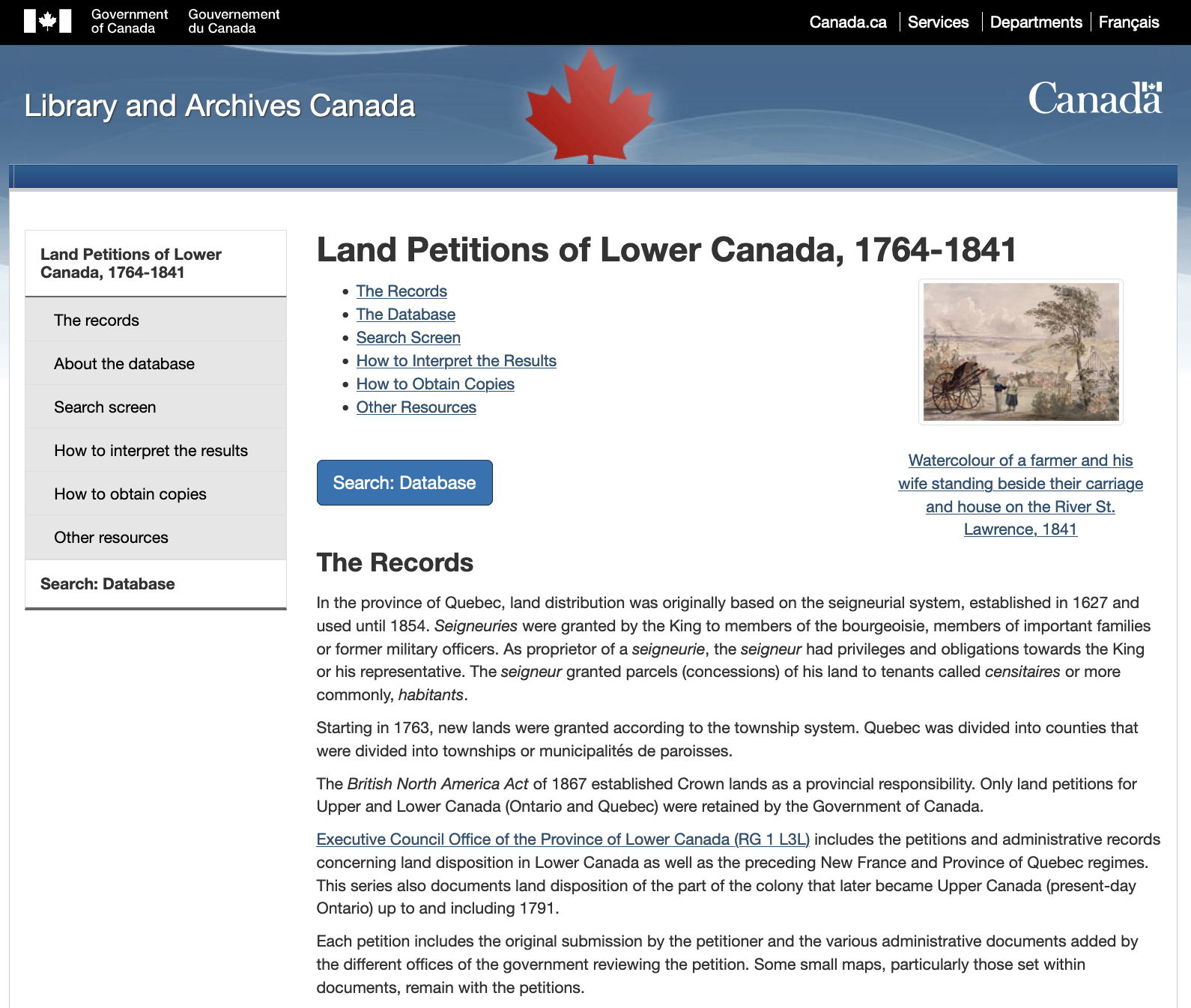
I’ve searched this database before—and found some interesting bits and pieces—but the enormous quantity of digitized page images (sometimes hundreds of images in a single file), the limited name-only search indexing, and the somewhat quirky image-browsing interface, made results very hit and miss. Which is too bad, because there are treasures of historical and genealogical information to be found in the files.
So—confronted by such a massive pile of documents and files–what’s a historian to do? Well, desperate times call for desperate measures, so…
I made a spreadsheet.
Yep. A spreadsheet.
Now don’t get me wrong. Spreadsheets are a wonderful tool of modern organization and analysis. But I’m really not a spreadsheet kind of guy.
So it couldn’t be helped. I dusted of my long-dormant copy of Excel and made a spreadsheet, incorporating all of LAC’s indexing criteria, followed by two additional columns for my own notes. When the files are organized this way it makes navigating the Lower Canada Land Petitions possible—and much more efficient—especially when trying to recognize the many duplicate entries of many of the petitions.
In case you’re wondering, here are screenshots of the first database entries, currently sorted in alphabetical order:


At the moment, I have 62 Lower Canada Land Petitions indexed. Of those, about 20 are of particular interest and will get the full Clark House Historian treatment. (Another one or two hundred of the LAC petition files were examined but not added to the spreadsheet, because they were either clearly not relevant to our search or—typically—lacked online digital images.) But at the moment…I’m beat. My eyes have had a full several days of reading and deciphering hundreds and hundreds of pages of 1790s-1830s handwritten documents. So I’m going to take a bit of a break and wait a day or two before I start writing up my discoveries.
Bonus organizing!
I’ve also been busy adding some extra features to the blog. A few need a little more work, but if you look at the sidebar (if you’re on a computer, it’s after the long ARCHIVES list; on a cell phone, look all the way below the current posts and the ARCHIVES roll), you’ll find a new feature below the MORE INFO section called SEARCHING FOR JMC – CANADIAN SOURCES. It looks like this:
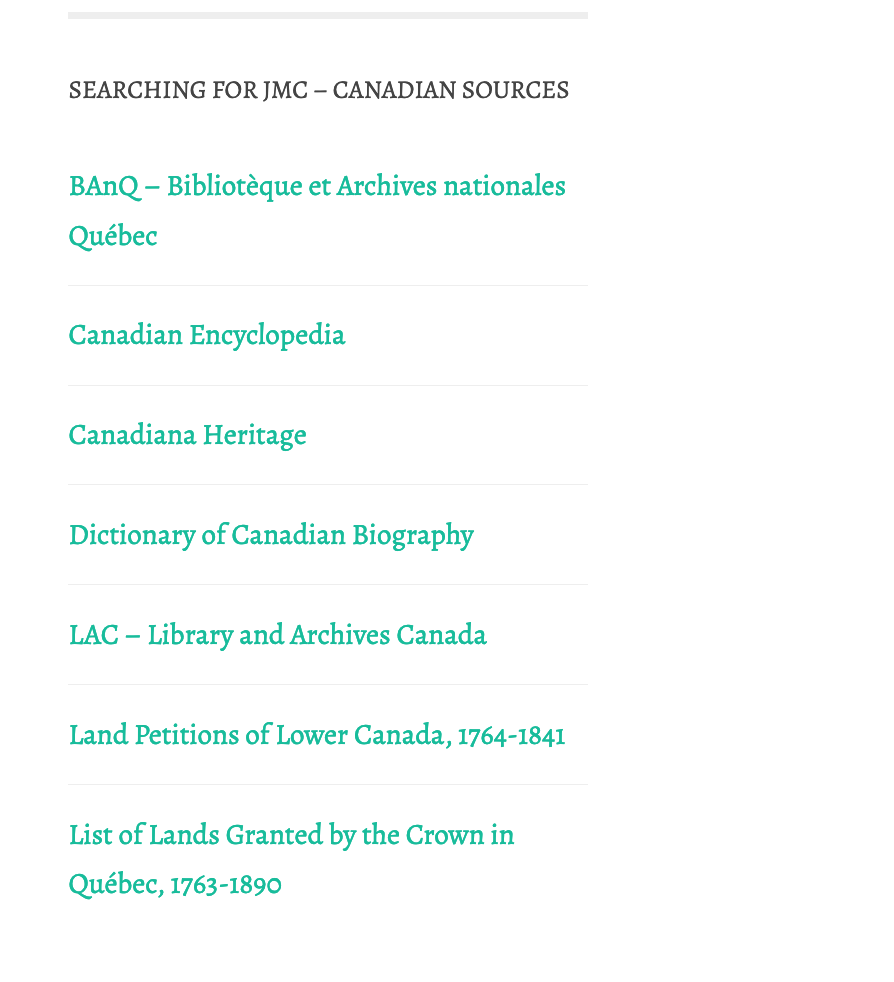
That’s right, you can Help the Historian! and dive into Canadian research on your own now!
Of course, the above image is just a picture of the links. Find the working links to the right, or below, and click your way into the world of Canadian history, archives and culture. Have fun, eh?
I’ll be back soon with some unique Stanstead- and Clark-related documents from the 1790s and 1800s from those LAC files.
 Clark House Historian
Since you are starting to use spreadsheets for your JMC research, you may want to check into using “Pivot Tables” – which allow you to summarize (in many different ways) the data in your spreadsheets. Not sure pivot tables are available on your version of excel.
LikeLike
Hello, Ed!
Thanks for the tip. My version of Excel can do pivot tables, but I’m not sure I’ll need to, considering the kind of information that I’m collecting and organizing.
For my purposes, I’m really using Excel as a searchable and sortable database of LAC cataloging information, and not as an analytical/statistical spreadsheet. This has a lot to do with my need to overcome some quirks and limitations of the LAC Lower Canada Land Petitions online search engine and its results display, combined with the number of digital pages in certain files.
The big problem is that the Land Petitions are only searchable by the names of people that appear on the petitions either as part of the petition language or as signatories to the petitions. Each time any name appears in one of these documents, that name is assigned a unique “Item No.” (col. H on spreadsheet) by the LAC catalogers. On the other hand, once you click through to an particular name/search result, you’ll be able to view much more cataloging and identifying information about the document on which the name is found. The most important document info is the LAC “Page(s)” number (col. E).
From my experience, it looks like the original LAC catalogers stamped a unique, sequential, page number on each page of each original (paper) petition file. Take a look at the “Page(s)” numbers in col. E and you’ll note that some of these petitions have more than 100 pages in one digital “document.” And the file for even a short petition (say 2 to 4 pages) can contain 100 or 200 signatures, or more. Just looking at the displayed LAC search engine results, it’s impossible to know the names of all the signatories on a particular document. For example: the fact that Ballard Clark (line 2), as “item no. 17641,” signed a document in 1830 and, similarly, Gilman Morrill (line 52), as “item 63285,” also signed a document in 1830, doesn’t tell us much. But once you look at the Page(s) numbers in col. E (in this case 33952-33953), you will discover that Ballard Clark and Gilman Morrill both signed, or are named, **somewhere** in the same 1830 petition file from the LAC’s Record Group RG 1 L3L, vol. 68, pages 33952-33953, archived originally on microfilm roll C-2519. (When I get down to business and write about this record, I will be able to cite specific pages from the file, by LAC page number, for future reference.)
To aid the “triage” of land petition files, I added notes in cols. I and J that “yes,” this petition will be of interest to our search for JMC and, further, the document can be briefly summarized as “Stanstead residents (many) 1830 petition.” Believe it or not, this spreadsheet collection of compiled, searchable, and lightly annotated cataloging data is a big improvement over just paging through the search results of LAC’s land petitions database.
So that’s the inside scoop on my return to spreadsheet (but really a database) making. Thanks again for reading and for the suggestion.
—Reed
LikeLike
Pingback: Searching for JMC’s roots: Navigating the “Land Petitions of Lower Canada, 1764-1841” | Clark House Historian