Today I’d like to share two rare and unusual official documents, and note how there are early 19th-century Bonniwell family genealogical clues hidden in each.
The Bonniwells and related families in Kent, 1667-1832
The image below is of St. Mary’s Church, Chatham, much as it looked at the time of Alfred T. Bonniwell’s christening there in 1826. It’s likely that the Bonniwells regularly attended services here during their years in Chatham. St. Mary’s has had a long and eventful history as a parish church, and has been reconstructed several times.1
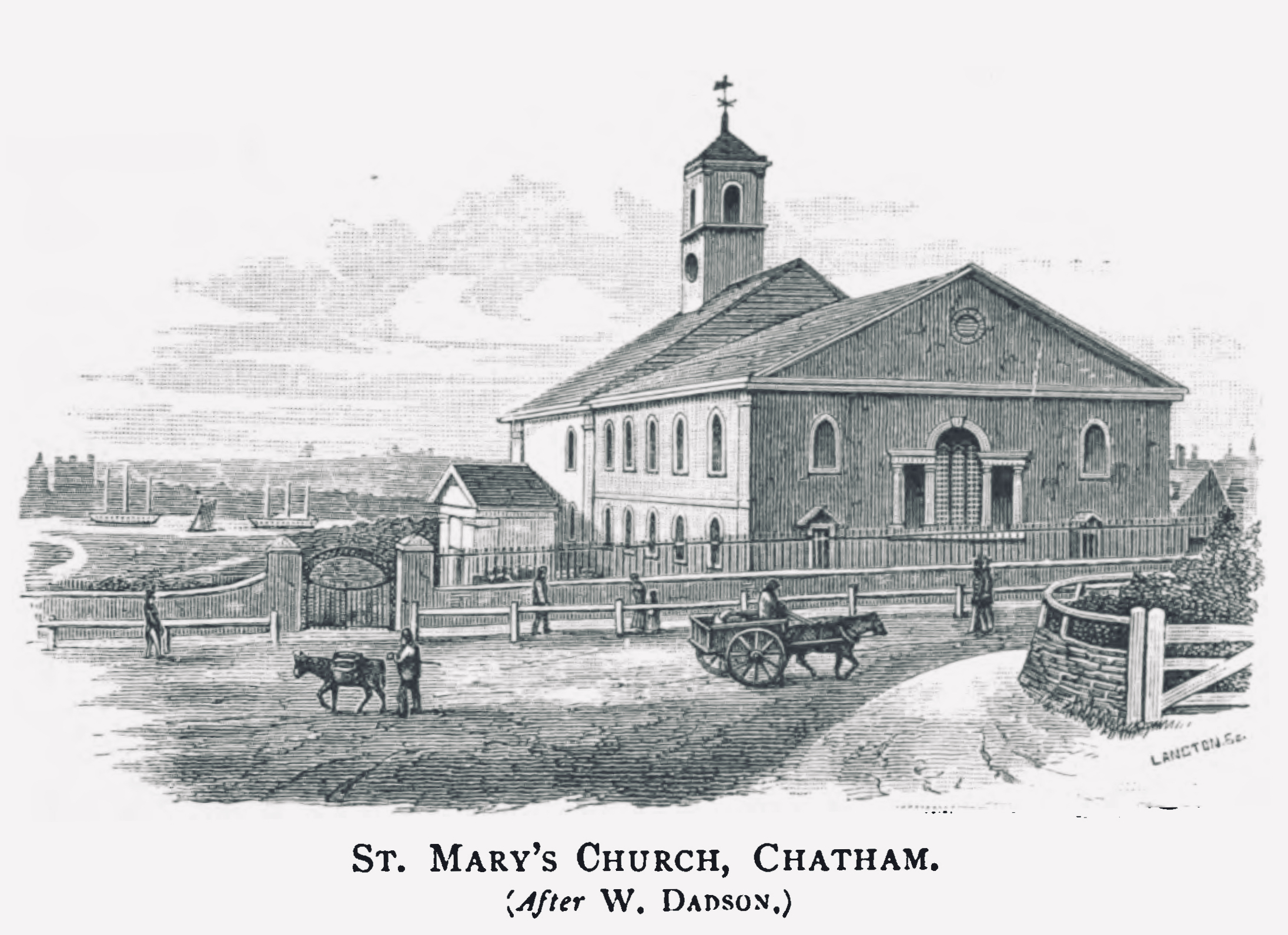
Engraving based on original art by W. Dadson, in Robert Langton’s The Childhood and Youth of Charles Dickens, Manchester, 1883, page 72. GoogleBooks, accessed 1 Aug. 2023.
A surprising number of our early Mequon immigrants had ancestors in southeast England’s venerable Kent county. Early Mequon settlers (and their spouses) from the Ashby, Bonniwell, Dunning, Eastree, Hills, Long, Moss, Munn, Smith and Whitehead families all had roots in Kent, many of them in or around the town of Chatham. For an introductory overview of this, see Monday: Map Day! – the Bonniwells in Kent, featuring a very cool map of the county from 1665, with added annotations that indicate many of the of the family’s various Kent residences, christenings, marriages, and burials over the subsequent decades.2
Family history before the census of 1841
The first modern, “all name,” census of England was enumerated in 1840 and published in 1841 and, as with every succeeding decennial census, the 1841 Census of England and Wales is full of useful information for historians and genealogists. But the Bonniwells left England for North America in 1832, almost a decade before the 1841 census was enumerated. How do we reconstruct and understand family relationships and local history, especially on the female branches of the family tree, before 1841? Today we’ll look at two obscure bureaucratic reports that may offer some useful clues.
Finding relevant records
Fortunately, the English are a record-keeping people, and we have many surviving pre-census ecclesiastical and civil records to search through. But anyone who does even a bit of family history research will tell you that finding records for, and understanding the relationships and stories of, the girls and women in a particular family is often maddeningly difficult. In many old census, legal, and other archival records, details of unmarried girls and women are often impossible to locate. The kin of married women are often hard to identify, as married women were typically referred to and recorded in documents in relation to their husbands and their husbands’ names.
For example, the matriarch of Mequon’s pioneer Bonniwell family was born Eleanor Hills. She married twice: first to William T. B. Bonniwell and, after William’s death, to Christopher Hyde. When Eleanor came to Wisconsin she left Capt. Hyde behind in New York and lived as the head of her own household. In most old documents she is known as Eleanor Bonniwell, Eleanor Hyde or, frequently, Mrs. Bonniwell, Mrs. Hyde, or “the widow Hyde.”
Fortunately, other family and church records inform that her maiden name was Hills. But we don’t know the names of her father or mother. How can we begin to make a list of possible pre-census Chatham area adults with the Hills surname that might be Eleanor’s kin? Oddly enough, two published committee reports from 1801 and 1821 may be a good starting place.
The Great Fires of Chatham, 1800 & 1820
William T. B. Bonniwell and his future bride, Eleanor Hills, were 18 and 15 years old in 1800 when the first of two Great Fires devastated Chatham. By the time of the second Great Fire—in March, 1820—William and Eleanor had been married for 18 years and were the parents of 7 children (6 living), and Eleanor would soon be expecting their eighth.3
Out of the ashes…relief and reports
To relieve the suffering of the 1800 and 1820 fire victims, subscription drives were organized. Committees were organized in Chatham and donors from near and far were encouraged to donate to the relief efforts. The committees then evaluated applications from the fire victims and distributed funds to them in varying amounts, based on need. The 1800 committee assessed need on the following criteria4:
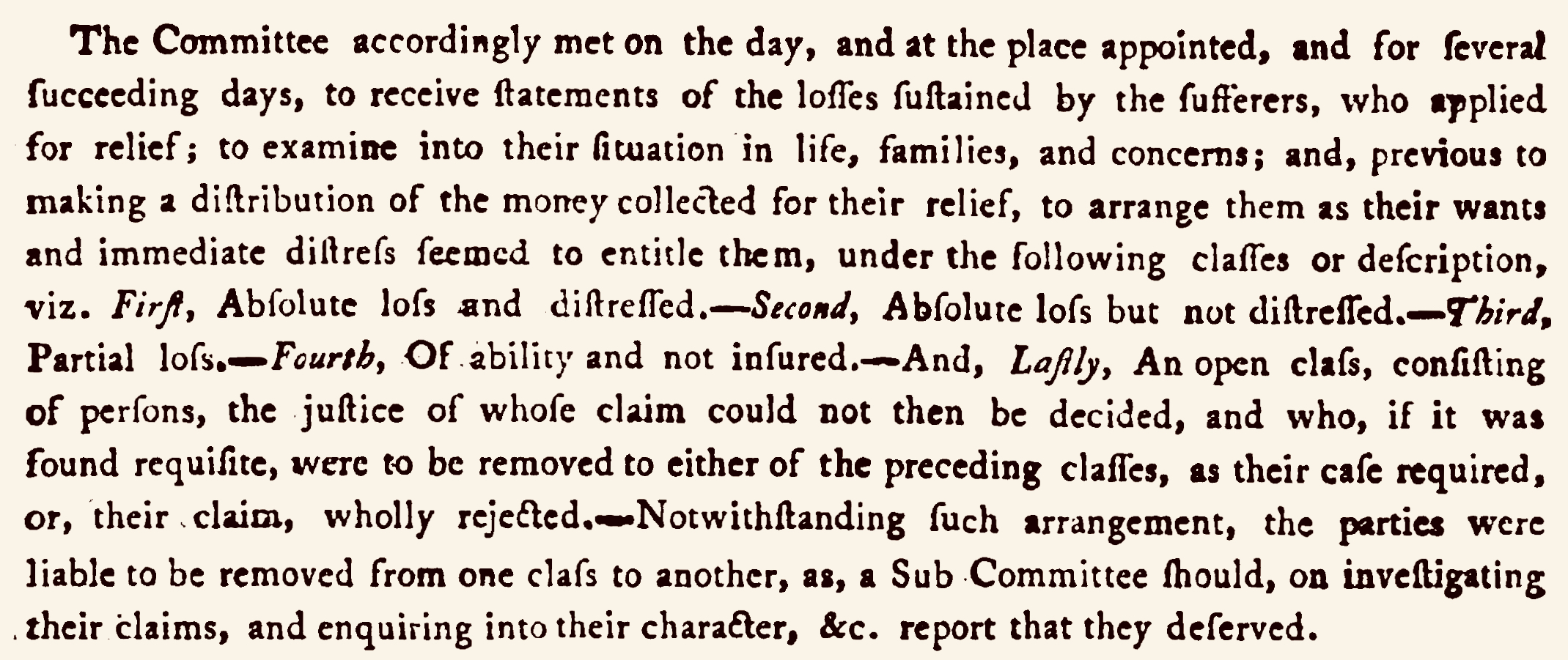
The 1820 relief committee followed similar procedures. Both relief committees published reports of their work. Each report examined the causes and extent of each fire, documented—in some detail—the losses sustained by Chatham residents and business owners, and recorded the pounds, shillings and pence (abbreviated £.s.d.) paid to each qualifying fire victim.
The Account of the Great Fire of 1800
I have been able to locate digitized versions of both reports and share them with you today.5 Click each report title page to access and save your own copies of the reports for the 1800 and 1820 fires:
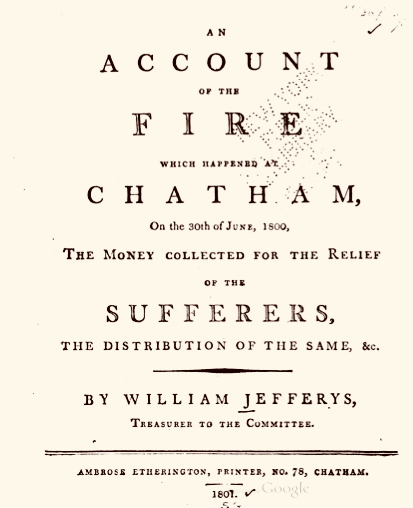
Click the image for a copy of my annotated PDF, or use this link to get the unedited scan from GoogleBooks
The Account of the Great Fire of 1820

Click the image for your own copy of my annotated PDF, or use this link to get the unedited scan from GoogleBooks.
Using these reports
If you’d like to use the reports most effectively, I highly recommend opening and then downloading/saving your own copies of each PDF. If you click on the two title page images (above) your browser will open my edited version of the each PDF. My edits are light; I’ve trimmed a few blank pages and tried to make sure that the two-page tables of information display properly. But this helpful feature only works in most browsers if you download and save the PDF(s) and then select the two-page view option in your PDF reader app (Acrobat, Acrobat Reader, Preview, and similar). On my screen, using Acrobat Pro, I go to the View Menu, pull down Page Display and select Two Page View, like so:

Click to open larger image in a new window.
If you’re using a different app to read the PDF, it will look a bit different, but should still offer you a “two page,” or “side by side,” page display option. And that comes in handy when you have two-page tables of information, like this…
Out of the reports…genealogy clues

Click to open larger image in a new window.
This two page table is from the account of the 1800 fire. It shows pages 66-67 from the section of the report that names each (head of household) “sufferer” of fire damage, and describes their occupation, family members, claimed losses, the amount of (cash) relief claimed and the amount of relief, if any, that they received from the committee. Funds are listed as British pounds, shillings and pence (£.s.d.). The last column in the table is reserved for any relevant observations.
In both PDFs I have highlighted, in yellow, any persons that share a surname with our Mequon immigrants from Chatham and elsewhere in Kent County, namely Ashby, Bonniwell, Dunning, Eastree, Hills, Long, Moss, Munn and Whitehead. (I have omitted the surname Smith as it is too common, and I didn’t have the energy to chase down all the Smiths in the two documents.)6
The man highlighted in this excerpt is one John Hills. Hills shares a surname with William T. B. Bonniwell’s future spouse, Eleanor Hills. Are John and Eleanor related? We don’t know. In 1800 Chatham, John Hills was a shopkeeper with a wife and one child at home. He was one of the Chatham merchants that lost a substantial amount of goods that had recently arrived at the town wharf aboard a hoy. (See our Bonniwell Background: a novel nautical note for more on this ship and its cargo.)
Hills claimed a loss of £46.5s.5p, a very considerable sum in 1800. But it looks like the relief committee did not award him any cash compensation. The Observation column notes he was “Of Ability [and not insured].” In the committee’s judgement, John Hills—uninsured, but not “distressed”—was apparently well off enough that the he was expected to deal with a loss of over £46 on his own.
Donors
The published Accounts of each fire and relief effort also include a comprehensive “List of Subscribers” to the fire relief funds. These lists are organized alphabetically by town, and within each town, alphabetically by donor. In each Account the donors from the town of Chatham are listed separately from the donors from “The Dockyards.” Here’s an example, pages 35 and 36 from the Account of the 1820 fire:

Click to open larger image in a new window.
The highlighted donor on page 35 is one Mr. Richard Whitehead, from the town of Chatham. He gave a handsome £3.3.0. to the relief fund. Is Mr. Whitehead any relation to the Alfred Whitehead, born in Chatham in 1812, that married Mary (Turck) Clark’s younger sister, Adamy Turck in Milwaukee in 1843? Not impossible, but we don’t know yet.
The other highlighted donor, page 36, is Mr. William Bonniwell, from the “Dock Yard,” who gave a more modest—but not negligible—2 shillings, 6 pence. I am confident that this donor is William T. B. Bonniwell (1782-1832), the husband of Eleanor (Hills) Bonniwell and father of Mequon’s Bonniwell settlers.
Speaking of the Hills family: the 1820 fire appears to have begun in or adjacent to the bakery of one William Hills. Was he kin to Eleanor? Father? Brother? Cousin? All are possible but, as with all the genealogy clues in the Accounts, more research is needed to prove a relationship.
Happy Hunting!
Genealogists and historians will find many clues on the hunt for Chatham—and Kent—history and ancestors in these Accounts. Of course, the two reports differ in details. But the formats of the Accounts are similar and easy to navigate. Both contain mentions of known members of the Bonniwell family, as well as many likely relatives whose relationship to the family is still unclear and not proven. There are lots of clues, needing lots of follow-up.
I’m tempted dig further into these documents and wander down the Chatham genealogy paths myself, but I know if I do, I’ll never get around to the two or three dozen Clark House history projects that I have already started to write about. So if you’re inclined, dive in to the Accounts and see what you can discover! And then let us know what you find. Happy Hunting!
_________________________
NOTES:
- For more history of the Bonniwells’ Chatham church, including St. Mary’s current status, follow this link to their page at Kent Churches.
Wondering how or why I found today’s illustration of St. Mary’s in a biography of the young Charles Dickens? It turns out that yes, some of the Bonniwell children (notably James Bonniwell, b. 1811) may indeed have been playmates of their neighbor, young Charles Dickens (b. 1812). I’ll have more on this when I can find time to write about it, in connection with a very interesting document that came into the Jonathan Clark House collection as part of the Bonniwell Bible donation in 2022. - Our previous post, Monday: Map Day! – the Bonniwells in Kent also maps some of the Bonniwell family residences and events that are recorded in inscriptions in the Bonniwell family Bible. These inscriptions are a unique source of Bonniwell family history during the 18th century, and they document a related, but not direct, line of ancestors of “our” Mequon Bonniwells. I’ll be following up on these folks at a later date, after I work through my backlog of other posts and topics that have been “in-the-works” for quite a while now.
- See our Bonniwell background: more Chatham links & docs for links to an excellent YouTube video and other information about Chatham’s two Great Fires.
- Classes of description of losses are excerpted here from page 7 of the report on the 1800 fire. See note 5 for detailed citations.
- For you bibliophiles, here are the full citations for the two official fire reports:
Jefferys, William. An Account of the Fire Which Happened at Chatham on the 30th June 1800 : The Money Collected for the Relief of the Sufferers the Distribution of the Same &c. Ambrose Etherington Printer No. 78 Chatham 1801. Via GoogleBooks, accessed August 18, 2023.
Jefferys, William. An Account of the Dreadful Fire at Chatham … March 1820 and the Proceedings of the Committee … to Distribute … Money … for the Relief of the Sufferers. Printed by Townson Chatham 1821. Via GoogleBooks, accessed August 18, 2023.
Note that the GoogleBooks scans of both reports lack images of the original Chatham plans (maps) that were originally included with each Account. - By the way, the yellow highlighting function on my PDF app has difficulty when highlighting non-linear text, such as the words and numbers displayed in the two-page tables in this report. So I did my best to highlight the relevant items and the results are kind of uneven in places. If you notice any difference in highlighter line widths or yellow color spillover onto words or numbers in adjacent lines or columns, please ignore it; it is just messy annotating and not a meaningful comment on the data.
 Clark House Historian