I’m still tidying up a longer post on the Great Chatham Fires of 1800 and 1820 and the genealogical clues that may be found in the post-fire documents published in 1801 and 1821. Meanwhile, I learned a new word and thought you might be interested, namely:
A Hoy
The report on the 1800 fire stated that a number of Chatham merchants lost a substantial amount of goods on a hoy. You’re probably familiar with the nautical greeting “Ahoy!”—the sailor’s equivalent of “Hello” or “Hey there!” But this hoy is a noun. What was a hoy? It turns out to be…
A boat

Groenewegen, Gerrit (1754-1826), A Hoy, drawing, c. 1790. Credits and copyright: see Note 1, below.
The workhorse of English rivers and coasts
A hoy, according to Wikipedia, was
[…] a small sloop-rigged coasting ship or a heavy barge used for freight, usually with a burthen of about 60 tons (bm) […] Principally, and more so latterly, the hoy was a passenger or cargo boat. For the English, a hoy was a ship working in the Thames Estuary and southern North Sea in the manner of the Thames sailing barge of the nineteenth and early twentieth centuries […] In the eighteenth and early nineteenth centuries, English hoys plied a trade between London and the north Kent coast that enabled middle class Londoners to escape the city for the more rural air of Margate, for example.
So in the Bonniwell’s day—when rivers such as the Thames and Medway were, so to speak, the “interstate highways” of the nation—the hoy served as a combination of semi-trailer cargo truck and Greyhound passenger bus. Hoys were an indispensable part of English commerce and river travel. Everyone in Chatham would have seen and, perhaps, sailed on one at some time. And to a maritime community such as Chatham, the loss of a cargo-laden hoy would be a serious matter for all concerned.
The 1800 fire destroyed a hoy & goods within
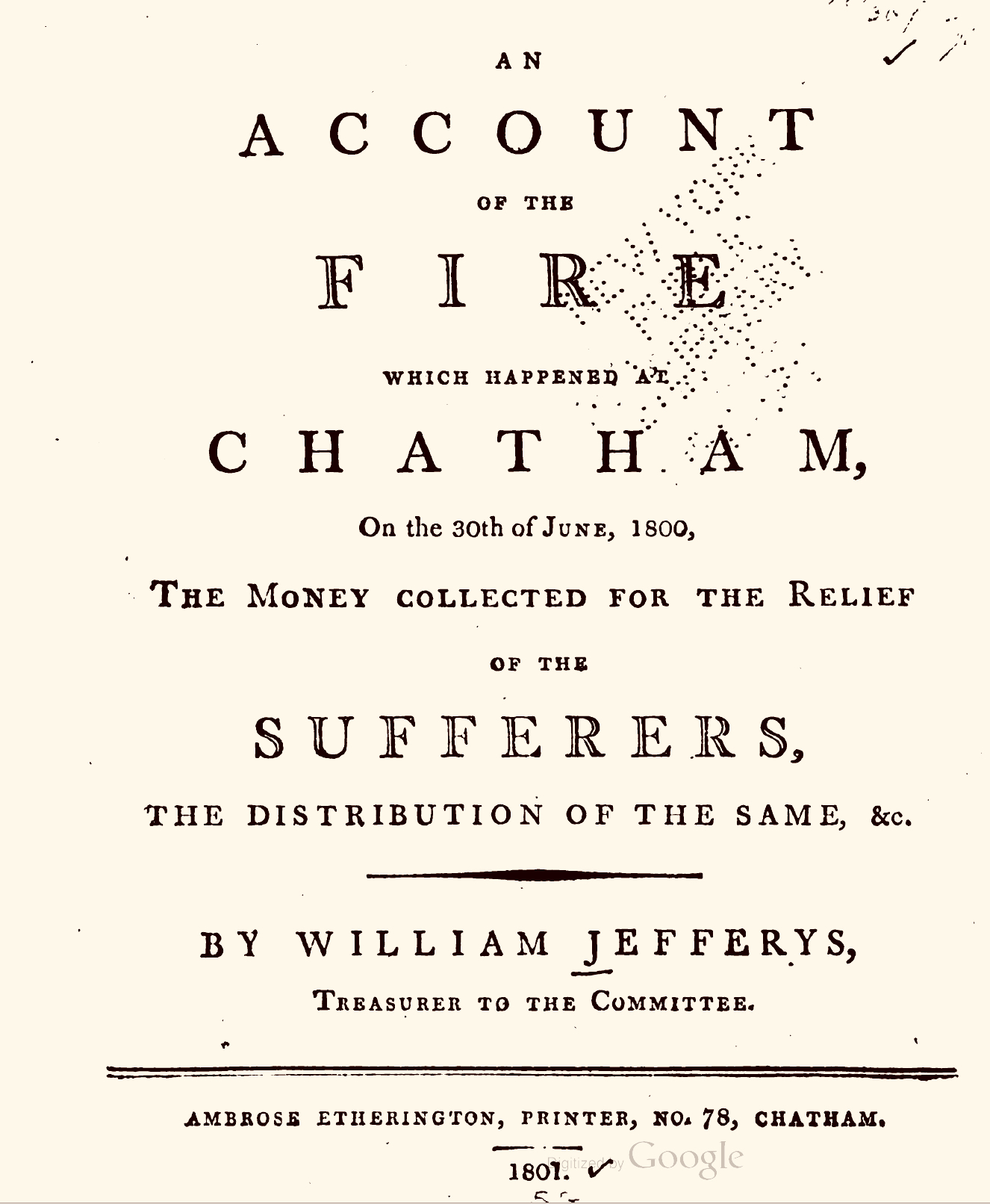
The 1801 post-fire report titled An account of the fire which happened at Chatham on the 30th June 1800 […], details the events and losses from the fire, and the funds raised and compensation distributed to the fire victims. One major component of the conflagration was the destruction of a wharf, warehouse and adjacent “Hoy deeply laden with Goods from London, belonging chiefly to the Tradesmen of Chatham, &c.” Interestingly, one of the eleven tradesmen (and women) awarded financial compensation by the relief committee was one John Hills, a shipwright with “Wife and four Children.”
The report shows that a sum of 17 shillings was awarded to the John Hills family in 1801 for their fire losses, “pledged in [John’s] Wife’s name.”2 Other owners of more, and more valuable, cargo lost on the hoy received larger payouts from the committee. John Hills was one of several Chatham residents with the surname Hills that received compensation for fire losses, and this interests us because we know so little of the Hills family and how their lives intersected with those of the William Bonniwell family.
Bonniwell family patriarch William T. B. Bonniwell married Miss Eleanor Hills near Chatham in 1802. Both William and Eleanor were born and lived in Chatham as adults. Thanks to George B. Bonniwell’s book, The Bonniwells: 1000 Years, we know a great deal about the Bonniwell family, both before and after William and Eleanor Bonniwell’s arrival in North America in 1832. But we know very little about the Bonniwell in-laws, including Eleanor’s Hills family. As we will see in an upcoming post, the Hills and Bonniwell families, and other related families were present and active in Chatham throughout the first decades of the 19th-century.3
More on the Great Fires coming up.
We’ll have more discussion of this document, and the similar post-1820 fire report, and how both provide clues to Bonniwell and related Kent genealogy and history. Meanwhile, if you’d like your own first edition of the 1801 An account of the fire which happened at Chatham on the 30th June 1800 […], there’s one for sale at AbeBooks, nicely rebound—with a crisp copy of the original plan (map) of the fire area—all in “near very good condition,” for a mere $1,244.29 (plus $15.90 shipping & handling).4
More on ships and shipping
From time to time, ships of all sorts featured in the lives of our Clark House family, friends and neighbors. So, naturally, ships and shipping have been the focus of many posts here on Clark House Historian. If you’re interested, here are links to a few of my favorites:
• How’d they get here? – Steamboats!
• How’d they get here? – Great Lakes ships, circa 1837
• Monday: Map Day! – How’d they get here?
• How’d they get here? – JMC to Ft.Howard, 1833.
• How’d they get here? – early Erie Canal images
These posts, and many more, may be found by searching through our “How’d the get here” and “Erie Canal” series. Click (all!) the links and enjoy the info and Illustrations.
I’ll be back soon with more Clark House history.
____________________________
NOTES:
- Today’s image, A Hoy, is a drawing, c. 1790, by maritime artist Gerrit Groenewegen (1754-1826), from the Royal Greenwich Museum collection, © National Maritime Museum, Greenwich, London. Image downloaded and published on this blog per their copyright and free download policy, here. Creative Commons Attribution, Non-commercial No Derivatives (CC BY-NC-ND) license terms apply.
- Jeffreys, William, An account of the fire which happened at Chatham on the 30th June 1800 […], Chatham, 1801, pages 80-81, 95. Via GoogleBooks, accessed July 25, 2023. Unfortunately, the attached Plan of Chatham that was originally bound with the book is missing from the GoogleBooks digital copy, but see note 4, below.
- In his essential book, The Bonniwells: 1000 Years (1999), author George B. Bonniwell focused his work on understanding and documenting the extensive, and complicated, Bonniwell family tree from the late 20th century back to its earliest known origins. Before finishing this post, I checked with George to see if he had any dormant stacks of unpublished material on the various non-Bonniwell Kentish ancestors of our Mequon pioneers, such as the family of Eleanor (Hills) Bonniwell.
George told me that while researching his book he did not have time to investigate these Kentish in-law families. So, history and genealogy lovers, here is another challenge waiting for you. Go to it, and see what you can find out about the Bonniwell and Turck family in-laws with roots in Kent and (in particular) with surnames Ashby, Hills, Moss, Munn, or Whitehead (as well as with surnames Dunning, Eastree, and Long). Let me know any connections you discover and we’ll announce them on the blog. - Disclaimer: Neither I, nor the Clark House, have a financial or other relationship with AbeBooks or with the independent bookseller that currently owns this Account of the 1800 fire, George Jeffery Books (UK). I have bought a used book or two via the AbeBooks website over the years, and found the process very satisfactory. If I had money to burn5, I’d probably add this little report on the 1800 fire to my personal library. But since I don’t have that kind of cash lying around—to put it mildly—I mention it here in case any of our readers might be interested.
- Pardon the pun. Like a moth to a flame, I couldn’t resist.
UPDATED: August 5, 2023, to correct a few minor typos
 Clark House Historian
Pingback: Bonniwell background: clues from the Great Fire reports | Clark House Historian