
While researching the life of one of Mequon’s first white settlers, Isham Day, I ran across the following breathless bit of regional puffery and promotion, penned by Milwaukee co-founder Byron Kilbourn. It’s from page 2 of the November 17, 1836, edition of the Milwaukee Advertiser:
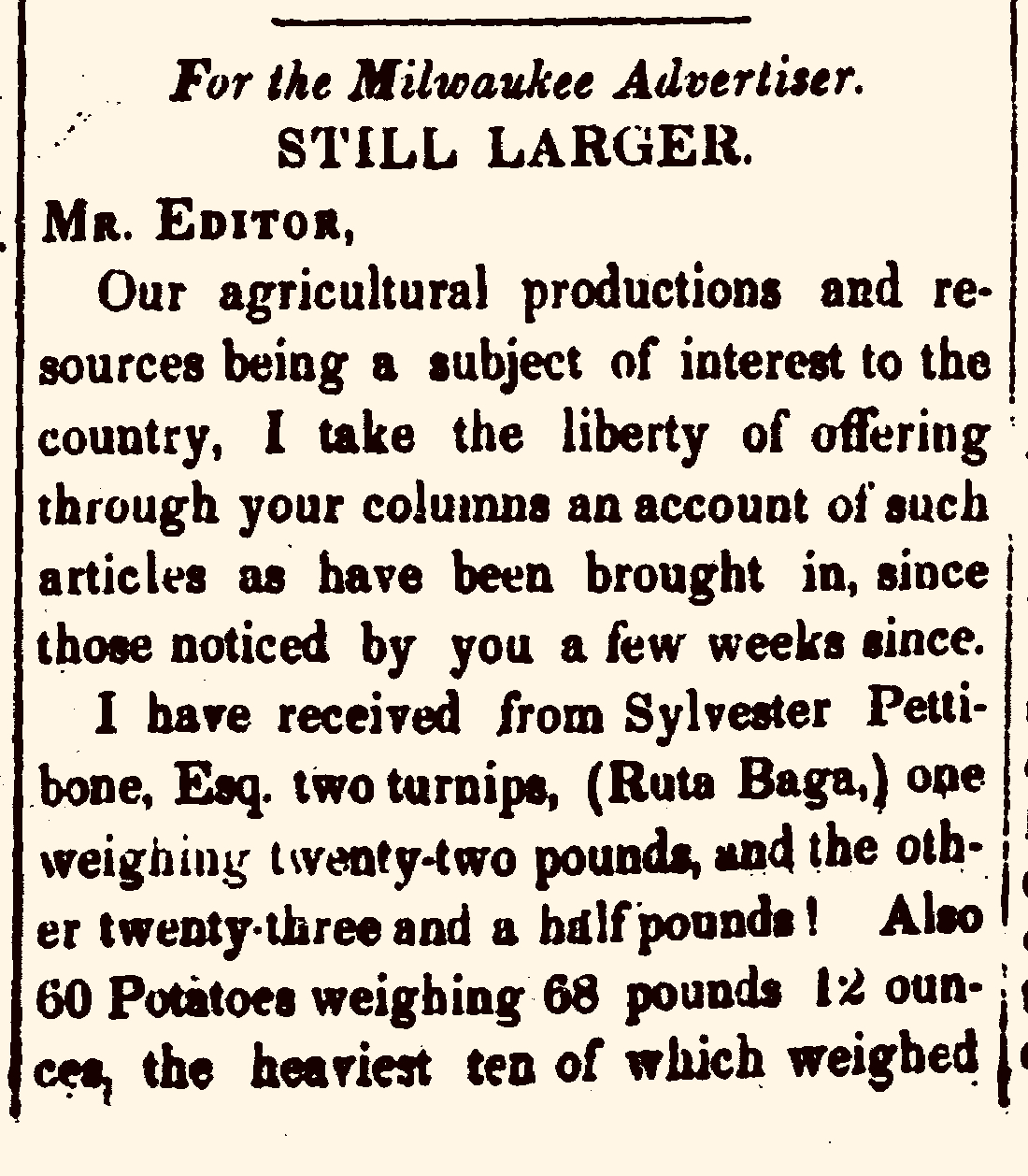

Lawyer Pettibone has, indeed, grown some astounding turnips (“Ruta Baga”), ‘taters, and carrots in the fertile soil of Milwaukee. Likewise Mr. Douglass with his enormous radishes and “common English” turnips. Have others done anything comparable? Indeed they have, and Mr. Kilbourn has the details…
And that’s not all!
This sort of “news item” was common whenever and wherever new lands were opening for settlement and land dealers and civic promoters, like Byron Kilbourn, sought to entice would-be pioneers to head west and buy land (from them) in the newly opened and incomparably fertile territories of the American “West.”
So this article is not particularly noteworthy (nor, perhaps, accurate), but it does have interest as an observation of pioneer Mequon settler Isham Day. Isham Day, it turns out, grew a magnificent crop of potatoes on his nearby land:

Can the farmers in “DuBuque” keep up with their colleagues in southeast corner of the territory? The glove has been thrown down!
That’s all for now. Back to more substantial matters next time.
_______________________
NOTES:
- Photo credit for the first image: Unknown artist, Vegetables in and Around a Basket, 1904. Library of Congress.
- “on Kinnickinnic” refers to the Kinnickinnic River, a tributary of the Milwaukee River that enters the larger river at Milwaukee harbor, south of downtown.
- “Sward ground” is an expanse of ground covered with (short) grass.
- The town called Prairie Village in 1836 was subsequently known as Prairieville and, eventually, the City of Waukesha, Waukesha county, Wisconsin Territory. In 1836, all of Waukesha county (along with all of old Washington county, including the future Ozaukee county) was part of Milwaukee county. For more, see the “City of Waukesha” entry in the online Encyclopedia of Milwaukee.
- Potatoes are native to the South American Andes. Originally cultivated by pre-Inca peoples of the area around Lake Titicaca, the potato was the main staple in the diet of the Inca. Potatoes were later exported to Europe by the Spanish conquistadores, and then brought to North America in the early-18th century. It’s not clear to me whether the first peoples of what is now Wisconsin grew potatoes in the early decades of the 1800s. Although Wisconsin’s native peoples grew and gathered a wide variety of plant foods, including various indigenous roots and tubers, I don’t believe potatoes were a common crop for the Ho-Chunk, Potawatomi, Menomonee or other Indian peoples of early 19th-century Wisconsin.
Isham Day arrived in Milwaukee in 1836. By June of that year he had planted his first potato crop along the Milwaukee River, perhaps near his still-existing house, the oldest house in Mequon. Isham Day grew his potatoes for sustenance. At the Jonathan Clark House Museum we grow potatoes as one of our educational activities. This year’s crop is already in the ground at the Clark House. So, when you think of it, this makes 2023 the 187th year of known potato cultivation in Mequon. - Byron Kilbourn published a follow up article, “MILWAUKEE AGAINST AMERICA,” in the Milwaukee Sentinel dated November 6, 1838, noting that Isham Day won an award “at the fair held December 25, 1836,” for “the ten largest potatoes, eleven pounds.” Quotations from Buck, James Smith. Pioneer history of Milwaukee : from the first American settlement in 1833 to 1841, with a topographical description as it appeared in a state of nature, illustrated with a map. Milwaukee: Milwaukee News Co., 1876-1886, p 82-83.
 Clark House Historian