Today we introduce a new category on Clark House Historian, one that I’m calling “Nope. Not our…”
What’s “Nope. Not our…” all about? Well, it’s about keeping track of some of the most important dead ends and disambiguation efforts that are—in fact—a huge “behind the scenes” part of the research that goes into this blog.

“Nope. Not our…” An all-too typical day in the Clark House Historian’s office.1
The fact is, I spend a lot of time chasing down “hot tips” for various unsolved Clark House history mysteries and, sadly, many of those promising clues turn out to be duds. From time to time I have written blog posts discussing specific erroneous or misleading bits of information, and then adding clarifying or corrected information and documents for the record.
But some ambiguous or promising Clark House Historian research paths are so complicated—and have taken so much time to research and document before being proven incorrect—that I need to create a more organized record of which research approaches were tried, and how each succeeded or failed. And since this blog is where I “show my work” as we uncover new chapters of Clark House history, I thought it was time for a CHH category dedicated to eliminating confusion and error in our search for a more complete and accurate history of the Clark House and its pioneering residents and neighbors.
And so we present our new category: “Nope. Not our…” And the honor of the first “Nope” post goes to:
Henry M. Clark in the Civil War
You may have noticed the discussion of Jonathan and Mary Clark’s only son Henry M. Clark in Monday’s post, Memorial Day, 2023. For almost a decade, I’ve been trying to solve the question of whether Henry actually served in the Civil War and, when he died in 1866, was it as a result of his service?
The answer, so far, remains…a diminishing chance of maybe. And, with the recent arrival of relevant new information that I requested from the National Archives, I thought it was time to document the various Wisconsin men named something-like-Henry Clark (or Clarke) that fought for the Union but who ultimately qualify for “Nope. Not our Henry Clark” status.
My first stop was the index of the invaluable Wisconsin Volunteers: War of the Rebellion, 1861-1865, arranged alphabetically, compiled under the direction of the Adjutants General during the years 1895-1899. Published by the State, Madison, 1914. Index page 176 lists the Wisconsin soldiers with the surname Clark and a first name beginning with “H.”

Is one of these our Henry?
Knowing that all lists are fallible, including lists compiled from wartime records, I researched each of these men to see if they might be our Henry M. Clark. I began with the excellent online searchable Civil War indexes at the Wisconsin Historical Society’s website, beginning with:
This index not only lists the men’s names and ranks, but—most importantly—also identifies the regiment(s) and company/companies in which they served. This is essential information for tracking Civil War soldiers’ records at the state and federal level. My next step was to search for each man at the online:
- Roster of Wisconsin volunteers, War of the Rebellion, 1861-1865
Volume 1: begins with the Cavalry, Light and Heavy Artillery and ends with the 15th Regiment, and
Volume 2: starts at the 16th Regiment
For example, the first man on my list (above) of “Clark, H…” soldiers, is one Harry D. Clark, private, Co. K, 2nd Wis. Cavalry. This is intriguing, as we know at least two other Mequon lads served in the 2nd Wis. Cavalry, Watson Peter Woodworth and Evander Bonniwell. And “Harry” is a common nickname for men named Henry. Could this be our Henry? Volume 1, page 80 of the Roster has additional info:

At the time he enlisted, Private Harry D. Clark stated he lived in Darien, [Walworth Co., Wisconsin]. Darien is in far south Wisconsin, near the Illinois state line, west of Kenosha county. Harry D. Clark’s date of enlistment was November 25, 1861. And after his three-year term of service expired, Harry D. Clark stayed in the service; he transferred to the Veteran Reserve Corps on December 13, 1864. None of these facts align with what we know about the residence, draft registration (in 1863), and possible Union service of Jonathan and Mary Clark’s son Henry M. Clark.
I applied the same sorting process to all the Clark soldiers in the index, from Clark, Harry D. through Clark, Hervy G. and made this annotated version of page 176 of the index (note the residence info added in the left margin):
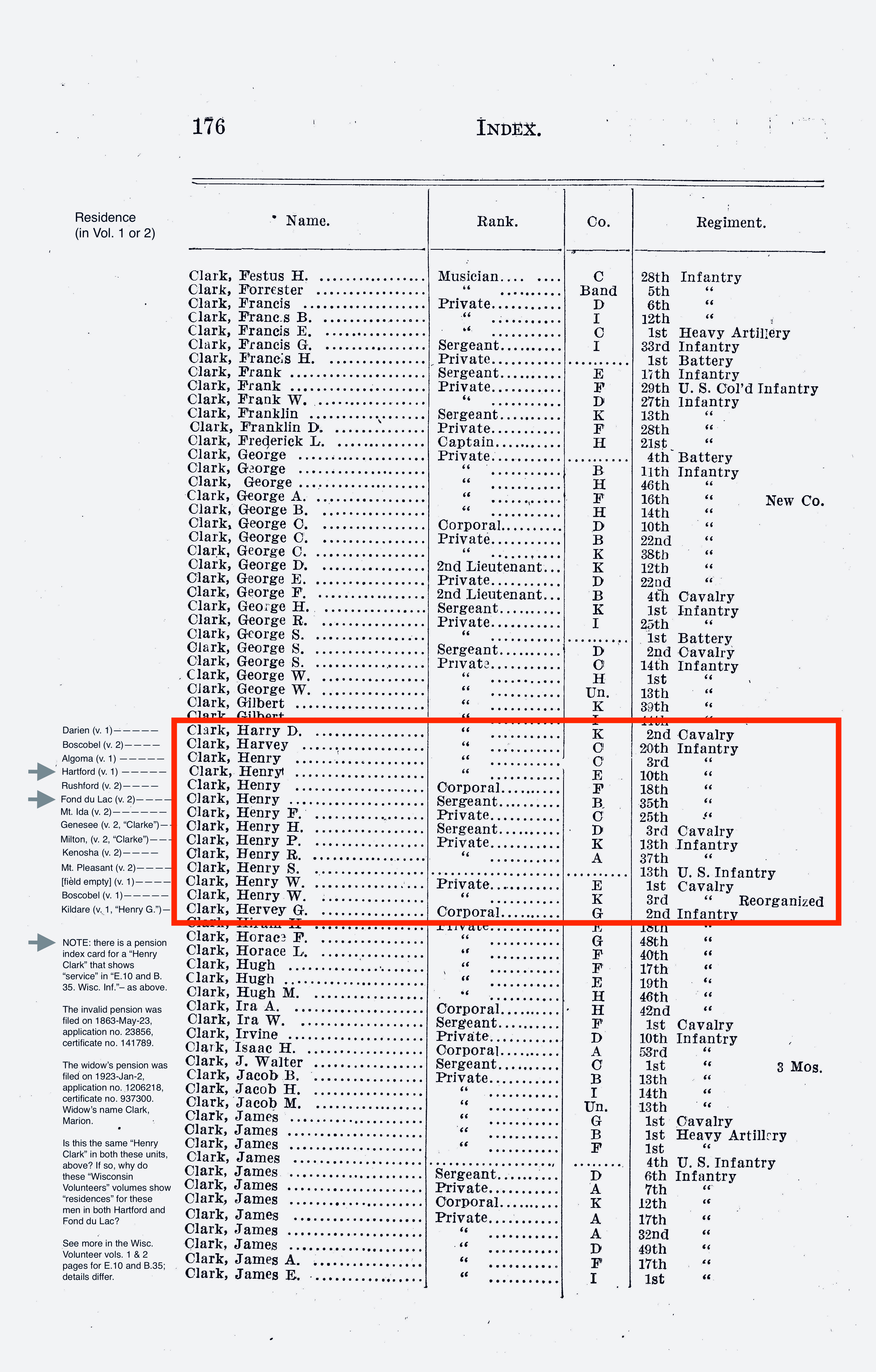
With this additional information I made an initial assessment of these Wisconsin soldiers named Clark. I considered these factors:
- Surname: Clark (or Clarke)2
- First name (and initial): I looked at “Henry” and anything remotely similar.3
- Rank: We have no information about Henry M.Clark’s rank; I would assume that Mary (Turck) Clark and the rest of his family would have been eager to record any rank/promotion above private soldier. Since they did not, the Clark soldiers listed here with ranks of corporal or sergeant are less likely to be our Henry.
- According to the info in Vols. 1 and 2, did they survive the war?
At first glance, based on these criteria, none of these men appear to be “our” Henry Clark.But indexes, like all historical documents always have a potential for error. So I made further checks.
Next steps: the Red and Blue Books
The Wisconsin state Adjutant General was in charge of the original records that were indexed and published as the Roster of Wisconsin volunteers, War of the Rebellion, 1861-1865. That Roster serves as the index to an essential collection of Wisconsin Civil War documents, the Regimental and Descriptive Rolls of Wisconsin soldiers who served in the Civil War, more commonly referred to as the Red & Blue Books or Compiled Service Records.
The Red and Blue Books are key resources for identifying individual Wisconsin Civil War soldiers. And once you’ve identified a particular soldier, you can then order the full Red and Blue Books information for that soldier through the Wisconsin Veteran’s Museum. For details, see their online Wisconsin in the Civil War database lookups.
And as mentioned earlier, the Roster of Wisconsin Volunteers, War of the Rebellion, 1861-1865 is also available online at the Wisconsin Historical Society website. And this WHS link also includes full explanations of the origins of those documents and instructions on how to order copies of a soldier’s Red and Blue Books information from the WHS. Alternatively, you can also browse digitized images of the microfilms of the original Red and Blue Books in this FamilySearch database:
- Wisconsin Adjutant General’s Office. Military Records, 1861–1865. (FS Library films 1311667-98.) These include such information as the soldier’s name, rank, birthplace, age, and occupation. They are arranged by regiment, then company
That was my next step.4
Beyond the rosters
I located Red and/or Blue Book entries for many of these men. The Red and Blue Books allowed me to confirm, and occasionally correct, the information found in the Index and its accompanying two volumes of Rosters. I also waded through the online images for the assorted “unassigned” soldiers and various non-standard companies and larger units that were recorded in the Red and Blue Books. I checked the digitized microfilm for Henry Clark on each item on this index for the “Miscellaneous” final portion of the final roll of the Red and Blue Books microfilm series5:

Starting with the information from the Red and Blue Books, I looked for additional information for each of our 13 (or 14) “Clark, H…” soldiers. In particular, I looked for the immediately disqualifying evidence that the man either died during his term of service or was alive after Henry Clark’s death date of April 21, 1866. I checked one or more of the following sources for each of these men until I found such disqualifying evidence:
- National Park Service Civil War Soldiers & Sailors database
- State and federal census records, circa 1860-1900 or so
- 1890 federal Veterans Census records
- [U.S.] Alphabetical card index to the compiled service records of volunteer Union soldiers belonging to units from the State of Wisconsin, NARA M559
- [U.S.] General index to pension files, 1861-1934 : NARA T0288
- other indexes to Civil War military service at FamilySearch, Ancestry, and Fold3
- FindAGrave.com
In each case, I found one or more records that ruled out all 13 (or 14) “Clark” men in the index of Wisconsin Volunteers. But I also found one other Henry Clark, a man not recorded in the published Roster.
The Henry without a company
During a close search of the online images of the Alphabetical card index to the compiled service records of volunteer Union soldiers belonging to units from the State of Wisconsin, NARA M559, I discovered this CMSR general index card:
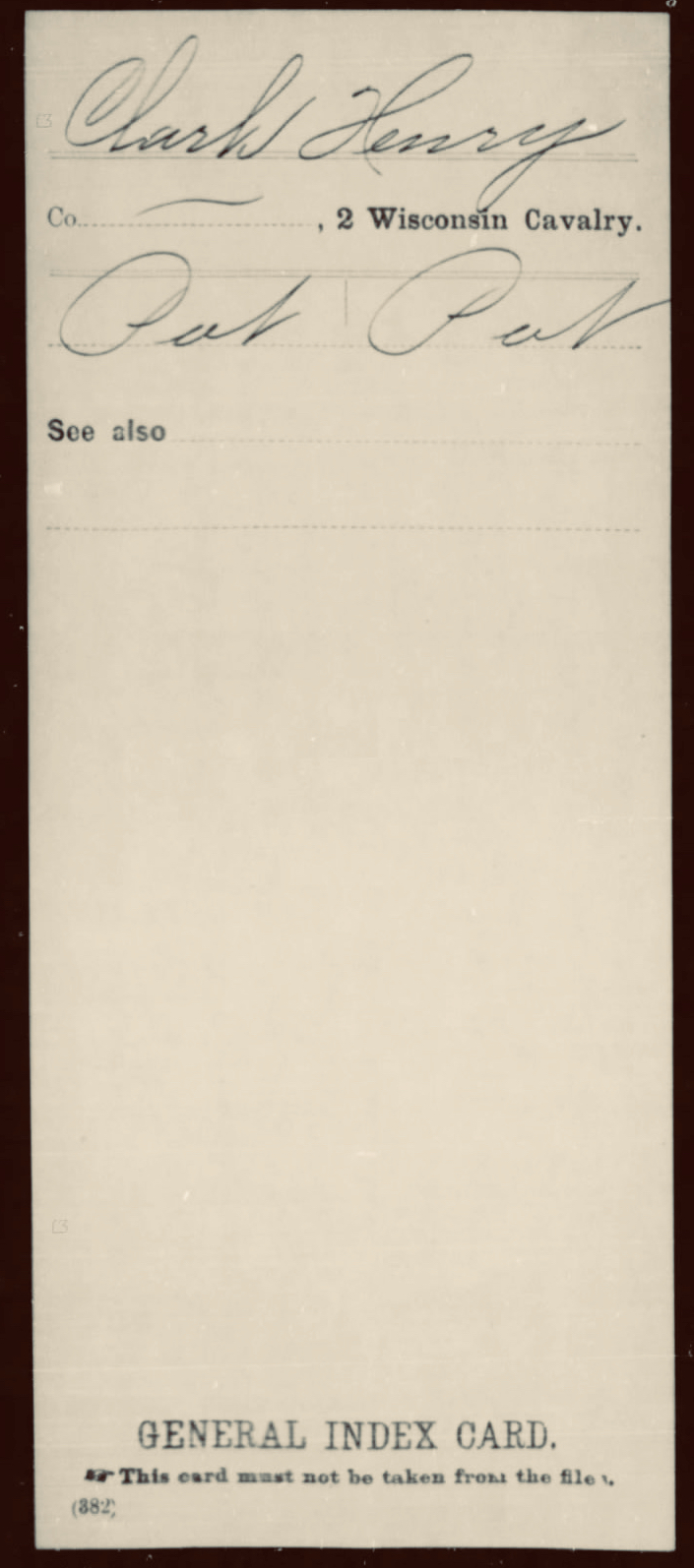
This was interesting: a soldier with a regiment, but no company assignment. And the regiment is one in which other Mequon men were known to have served.
Lacking any other information on unassigned men named “Henry Clark” in the Wisconsin Index, Rosters and Red & Blue Books, I went ahead and ordered a copy of this man’s full CMSR packet from the National Archives.6 Maybe, just maybe, this might be our Henry M. Clark.
After a bit of a wait, and a $30 fee, I received digital copies of this Henry Clark’s CMSR jacket (which is almost identical to the above General Index Card), and the complete contents of that jacket, namely, this single card:

Curiously, this card does assign this Henry Clark to a company: Co. C, 2nd Wis. Cavalry. Why this company info was never transcribed onto his CMSR jacket or general index card (or the Red and Blue Books) is a mystery. It may be related to the notation in the Remarks section of the CMSR: “Not borne on muster rolls of reg[imen]t.”
More importantly, this Henry Clark was—alas—born in the wrong place, at the wrong time, and lived in the wrong Wisconsin county to be our guy. This man, I regret to report, is another “Nope. Not our…” Henry Clark in the Civil War.
Will we ever know?
I feel confident in saying that no man named “Henry Clark”—or something close to it—that was recorded as serving in a Wisconsin unit during the Civil War was our Henry M. Clark, the only son of Jonathan M. and Mary (Turck) Clark. Will we ever know if our Henry Clark served? Here is my checklist of possibilities and future records to search:
- Henry was the only son of a widowed mother. As such, he might have asked to be excused from serving.
- Henry (or his mother) may have paid to have a substitute serve in his place.
- Henry may have failed his enlistment physical exam.
The state archives at the WHS include several record groups that might confirm (or dismiss) any of the above hypotheses. These include7:
- Series 1137. Wisconsin. Adjutant General’s Office. Civil War Draft Records, 1862-1865. This series includes lists of draft-eligible men, as well as men that were exempt from the draft and the reason for exemption, and the names of some substitutes. This would be my next stop on the research trail. Other record series that might be of use include:
- Series 248. Wisconsin. Secretary of State. Volunteer Aid (Civil War), 1861-1865. If Henry served, he might have had his pay sent home to his mother, or his family may have applied for relief funds.
- Other record series of some interest may include Secretary of State series 1853 & 227 and State Treasurer series 618, 511.
If those possibilities don’t pan out, then we have to consider a few less-optimistic outcomes:
- Henry served, but enlisted under another name and/or in another state, or in a federal army unit. This puts our search into “needle in a haystack” territory.
- Henry actually served as a soldier “with the bridge builders” as claimed years after the fact. During the Civil War, the Union Army did not have many engineering (or “Pioneer”) units. From what I know, many of these were connected to federal or New York regiments or larger formations. NARA may well be the place to search for those records (with professional assistance).
- Some of these Pioneer units appear to have hired civilians to assist as additional ax men and laborers as the army built bridges, cut roads and destroyed and/or repaired railroads. Henry may have served in one of these units as a civilian. I have no idea whether decent records and rosters were kept of these “civilian contractors,” and if they were, do they still exist?
- And it’s always possible that Henry did not serve at all, and did not leave a paper trail documenting that fact. It’s hard to prove a negative. Absent some as yet unknown documentation, we’d never be certain.
Postscript: what about the Navy?
As far as I know, the Union states did not raise naval units. That was a federal concern. The U.S. Navy of the Civil War era did not have a draft, and their enlistment terminology differed from that of the army. Instead of “enlistment offices,” the Navy had the Naval Rendezvous. The closest such Rendezvous to Henry Clark was at Chicago.
The Naval Rendezvous enlistment records are available online at Ancestry8, and an initial search shows that there were 22 Henry Clarks that enlisted in the Navy between 1863-1865. Only two of them enlisted at Chicago, Here is the enlistment information for one of those men:

This 1864 Henry Clark was originally recorded as “Clark, Terry.”9 Some other hand then penciled in “Henry” above “Terry.” This Henry Clark enlisted on April 13, 1864, for a term of 2 years general service as a seaman. He was born in Maine and is 31 years old and a Mariner by trade. He had hazel eyes, dark brown hair, a “Reddy” complexion, and stood 5′ 10-1/4 inches tall. He was “Entitled to three months pay as advance [enlistment] bounty.”
And here is the info for the other:

This man is Henry C. Clark. He enlisted on August 20, 1864, for a one year term of service as an ordinary seaman on general service. He resided in Wisconsin’s 5th congressional district in Winnebago county. He was born in Connecticut about 1824 and was a butcher by profession. He had hazel eyes, dark brown hair, a dark complexion and stood 5 feet, 8-1/4 inches tall. He had a scar on his left thigh.
All of which is to say, that in spite of being named “Henry Clark,” both of these men clearly belong to the increasingly large fraternity of Nope. Not our…Henry Clark in the Civil War.
That’s all for now. As you can see, we’ve run down a lot of once-promising leads and come up empty-handed. But that, too, is a big part of doing history. I hope you enjoyed the process.
One more Civil War post coming up next time, and then on to other things. See you soon.
___________________________
NOTES:
- In 2021 I spent quite a bit of time trying to nail down “What we do — and don’t — know about the Clarks’ only son,” Henry M. Clark, including whether or not he served in the Union army. The short answer to that question is: (1) Maybe, (2) It’s complicated, and (3) there is still a lot we don’t know. For the full story, here are links to those posts:
• Part 1: Meet the Children: Henry M. Clark
• Part 2: Henry Clark and the Civil War draft
• Part 3: Henry Clark – Civil War draftee
• Part 4: Henry Clark’s last days
• Part 5: Henry Clark’s final resting place
• and a related tidbit: Avoiding the draft, 1862 style
UPDATED, August 20, 2023, to include this inadvertently omitted photo credit: Unknown photographer, Translating a love letter from a Boston girl – “Now, does that mean yes or no?,” stereo photograph, publish Underwood & Underwood, New York, etc., c. 1903. Library of Congress. - Page 179 of the Index lists 15 men with the surname Clarke. None have a first name beginning with the letter H. If Henry enlisted under a surname other than Clark we may never find his records.
- And I checked “Clark, Jonathan” just in case Henry enlisted under his late father’s name. There was one “Clark, Jonathan” in the index: Jonathan D. Clark, a private in Co. C, Wis. 7th Infantry. He was from Sheboyg’n Falls, enlisted on October 14, 1864, and mustered out on July 3, 1865. It’s not impossible that he could be Henry M. Clark using an alias, however…
Sheboygan Falls is about 40 miles north of the Jonathan Clark House and farm, and about 55 miles from the Clark family’s then-current home in central Milwaukee. My initial thoughts are that this man’s name, enlistment date, and distant hometown conflict with what we know about Henry M. Clark and his possible Civil War service, so I have not looked further into this. - For full info on the Wisconsin Red and Blue Books, check out this FAQ page at the WHS. The Red and Blue volumes were compiled at different times and contain similar, but not identical, information. If you are researching a Wisconsin Civil War soldier, you should definitely view his entries in both books.
- This is the typescript index to FamilySearch film no. 008547923, last section, “Miscellaneous,” of the Wisconsin Regimental and Descriptive Rolls (final roll), covering 52nd and 53rd Infantry – 1st Sharpshooters, Company G (Berdan’s) Unassigned and miscellaneous. I did not find our Henry M. Clark in any of these units, including the 1st Regiment, U.S.V.V. (U.S. Veteran Volunteer) Engineers.
- By the way, once you know a few things about the service man or woman and his or her unit, it’s now easy to order CMSR and other military records from NARA. For a complete copy of a Civil War CMSR all it takes is the online NARA Form 86 and a credit card for the $30 fee. Do be patient; NARA is still running behind after closing during the worst of COVID. It took me almost 8 weeks from order date until receiving my requested information. More info here, and I highly recommend creating your own NARA “eServices” account and ordering through the online portal.
And, as usual, I have cropped, straightened and added a bit of color to all of today’s images, to make them more visually distinctive and easier to read. NARA document copies are almost always black & white images. - The descriptions of the various useful archival record series are borrowed and/or paraphrased from Barker, Brett, Exploring Civil War Wisconsin: A survival guide for researchers, Wisconsin Historical Society Press, 2003.
- Ancestry.com. U.S., Naval Enlistment Rendezvous, 1855-1891 [database on-line]. Provo, UT, USA: Ancestry.com Operations, Inc., 2014.Original data: United States, Naval Enlistment Rendezvous, 1855-1891. Salt Lake City, Utah: FamilySearch, 2013.
- On a mostly-unrelated note: the name “Clark, Terry” brings to mind Clark Terry (1920-2015), one of the legendary jazz musicians of the second half of the 20th century. For over half a century he played trumpet and flugelhorn with all the jazz greats. He was a key member of the Duke Ellington band for years, and the first Black staff musician on a national TV network, as a core member of Johnny Carson’s “Tonight Show” band.
Do yourself a favor and check out this sample of his work: Clark Terry, Oscar Peterson, Ray Brown and Ed Thigpen, live in Finland, 1965. “Cool” does not begin to describe these men and their music. Enjoy!
UPDATED: May 31, 2023, to correct a few minor typos and syntax errors and to add a clarifying sentence at the end of the discussion of the “Henry with no company” CMSR. Last update 2:03 p.m.
 Clark House Historian